On this page
An invisible mark on everything AI makes.
AI-generated content labelling becomes the rule for all generative AI on the EU market on 2 December 2026. Systems that create images, audio, video or text and were placed on the market from 2 August 2026 already had to mark their output in a machine-readable way. The Digital Omnibus on AI gave the tools that were already out there four extra months. That grace period ends on 2 December, and it covers exactly the generators most marketing teams have used for years.
The mark is the provider's job. If your company is in Berlin, Rotterdam, London or Austin and your product generates content for people in the EU, that provider can be you. If you only use such tools, your part is the visible label on deepfakes and on unreviewed AI text about matters of public interest. Below: where that line runs, and what the new ban of the same day covers.
The tool
A model generates it
Image, audio, video or text from a generative system, on your prompt.
The provider
Invisible mark
Machine-readable, in the file or the content. For tools on the market before 2 August 2026, required from 2 December.
You
Edit and publish
Cropping or adding a caption does not make you the provider. The mark should survive your edit.
You, if it looks real
Visible label
A deepfake of people, places or events gets a disclosure, for example the EU icon.
The platform
Recognises the origin
Detectors and platforms read the mark, even when nobody sees a label.
The mark is the tool provider's job. The visible label is the publisher's job, and only for deepfakes and certain texts.
When a builder of AI features becomes the provider
The AI Act calls the company that develops a system and places it on the market under its own name the provider, wherever it is established. A Dutch SaaS that adds "write my product description" to its app, or a US design tool sold to EU teams, is a provider of a generative system. Building on someone else's large language model does not change that: the feature is yours, so the mark is yours to arrange. The simplest route is a model whose output already carries a mark, plus a check that your own pipeline does not strip it.
Was your feature live before 2 August 2026? Then 2 December is your deadline. Did you launch it later? Then the duty applied from day one. Breaches of the transparency rules carry fines of up to EUR 15 million or 3 percent of worldwide turnover; for SMEs the lower of the two counts. Our EU AI Act checker walks you through each feature.
Which content needs a visible label
Users of AI tools label two kinds of content themselves: deepfakes, meaning image, audio or video that resembles real people, objects, places or events and would falsely appear authentic, and AI text that informs the public on matters of public interest. Seven cases from marketing work:
| What you publish | Visible label? | Why |
|---|---|---|
| A photorealistic AI model wearing your German shop's new jacket | Yes | Resembles a real person and looks authentic |
| A drawn mascot or an obviously illustrated scene | No | Nobody takes it for real |
| A blog post on your service, drafted with AI and edited by your team | No | Not public-interest text, and a person took editorial responsibility |
| An automated AI summary of new regulations that nobody reviews | Yes | Public-interest text without human review |
| A voice on your support line cloned from an employee | Yes | Audio resembling a real person |
| A satirical clip featuring a well-known politician | Limited | Evidently satirical or artistic work needs a disclosure that does not spoil it |
| An AI image you posted in June 2026 | Not required | No retroactive labelling, though it is encouraged |
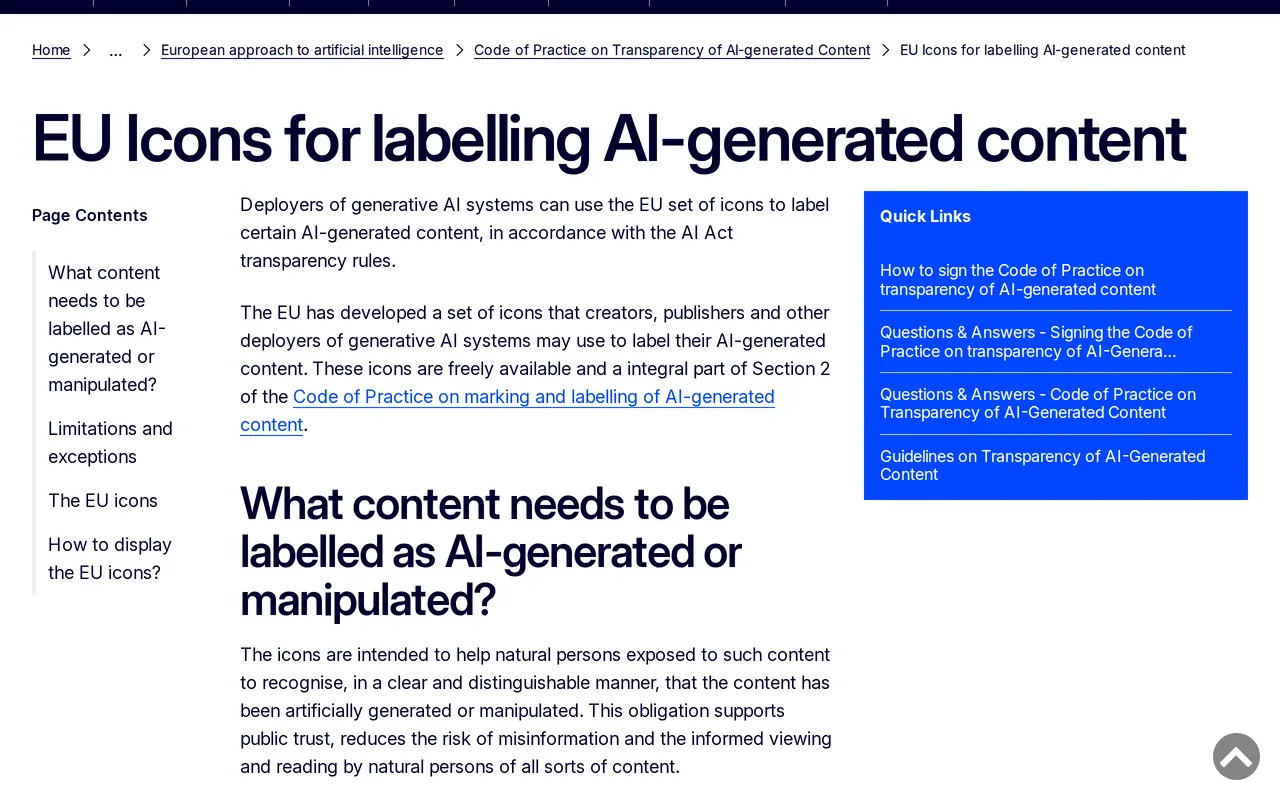
The Commission designed three optional EU icons for the label: a basic one, one for fully AI-generated content and one for authentic material partly modified with AI. Whatever you use must be visible the first time someone sees the content and survive resharing and downloads. The chatbot rules that apply since August are in the EU AI Act transparency obligations.
What publishers and marketers ask
Do I have to watermark my AI images myself?
No. The machine-readable mark belongs to the provider of the tool. You add a visible label only when the image is a deepfake: realistic, and resembling real people, places or events.
A French publisher uses AI to draft news summaries. Does every article need a label?
Only those that nobody reviews. When an editor checks the text and the publisher holds editorial responsibility, the disclosure duty falls away.
Does the mark survive when I crop or compress an image?
That depends on the technique. A mark in the file metadata can disappear on export, a mark woven into the pixels survives more. Never remove it on purpose.
Who enforces this?
The market surveillance authority of each member state. The EU AI Office handles systems built on a general-purpose model by the same provider and systems inside very large online platforms.
The big model providers have signed
The Commission had independent experts write a code of practice on how to mark and label. By the end of July 2026 about 190 organisations had signed it. On the provider side they include Anthropic, Black Forest Labs, Google, Meta, Microsoft, Mistral and OpenAI; on the publisher side Getty Images and Lufthansa among others. The Commission and the AI Board assessed the code as an adequate way to show compliance.
For a team that uses mainstream tools, the mark is largely handled. The risk sits with smaller or self-hosted generators: ask whether they mark from 2 December. Which tools suit which job is covered in AI tools for business, and how to put them to work in AI for marketing.
What the new ban reaches
From 2 December the AI Act prohibits systems that generate intimate or sexually explicit images of an identifiable person without explicit consent, and systems that generate child sexual abuse material. An ordinary image generator stays legal when it has adequate safeguards against that use; one built for it, or one that produces it reliably without safeguards, does not. Using any tool for that purpose is itself a breach. Prohibited practices carry fines of up to EUR 35 million or 7 percent of worldwide turnover.
Getting your content pipeline ready
- List every tool that generates images, audio or text for you, including features inside your design and email software.
- Ask the smaller providers whether they mark output from 2 December.
- Agree with your team when you label, using the table above.
- Name who reviews AI text on public topics before it goes out.
- Put it in a short policy; read do I need an AI policy and the EU AI Act for business.
Real footage still convinces buyers more than any generated image; AI works best for variants, translations and first drafts, as in our social media management. What else the omnibus moved is in the EU AI Act high-risk delay.