AI in legal practice
AI for lawyers, with confidentiality built in
AI for lawyers and law firms that reads and orders case files, in an environment where nothing leaves.
Law firms lose their hours to reading, not to advocacy
AI for lawyers takes over the reading that is not legal work: going through a bundle of forty documents, putting the facts on a timeline, finding the deadline in a judgment, drafting a first letter from your own precedents.
It decides nothing. Every line points to the document and page it came from, so you check it in seconds. And every case or statute it cites, you verify, as bar regulators across Europe now ask.
Nor does it run in a public chatbot. Confidentiality shapes the build: a closed environment per firm, access per matter, a model that stores nothing and does not learn from your files, and a log of who asked what.
Below: what European and national bar rules say, what AI does per process, a worked example in hours and euros, and how a project runs.
Professional secrecy and AI: what bars and regulators ask
Bar regulators did not ban AI. They set conditions, and those conditions decide how an AI system for a law firm has to be built. Belgium's bars wrote theirs down in detail, so we use them as the worked example alongside the European and English rules.
| Rule | What it says | What it means for the build |
|---|---|---|
| CCBE guide on generative AI, 2 October 2025 | Lawyers should not enter personal, confidential or client data unless safeguards are in place, such as zero data retention, a processing agreement, local or closed systems and processing in the EU or EEA where appropriate | No retention by the model provider, a processing agreement, hosting in the EU |
| Flemish and French-speaking Belgian bars, AI guidelines of 20 January 2025 | AI is neither forbidden nor required. Material under professional secrecy never goes into an AI tool unless the lawyer is absolutely sure of a closed environment, such as within the firm's own perimeter with no information shared outside | A dedicated environment per firm, not a shared chatbot |
| Same guidelines | The lawyer checks that cited legislation, doctrine and case law exist, pseudonymises personal data and reads the tool's terms | Every citation with a link to its source; names replaced before they reach the model where possible |
| SRA warning notice on misuse of AI, England and Wales, 17 August 2026 | Solicitors stay accountable for their work and output, must check citations, and putting client data into public AI tools is likely to breach confidentiality | The same build: closed, cited, reviewed |
| EU AI Act, Article 4, since 2 February 2025 | Firms using AI take measures to support the AI literacy of their staff; supervision starts 2 August 2026 | Short training and an AI policy for the firm |
| EU AI Act, Article 50, since 2 August 2026 | A chatbot tells people they are talking to AI | An intake assistant that introduces itself as AI |
The SRA says it received 42 reports of possible AI misuse between July 2025 and July 2026. A system that puts the source next to every line makes checking a citation a matter of seconds. The chatbot rule itself is explained in EU AI Act transparency obligations. Whether your firm needs a written AI policy is answered in do I need an AI policy?
And the high-risk rules of the AI Act? Annex III lists the administration of justice, but that entry covers AI used by or on behalf of a judicial authority. An assistant that reads and summarises for your own firm is, in our reading, something else. What your use case does carry, you can see with the EU AI Act checker; the delay of the high-risk rules to 2 December 2027 is explained in EU AI Act high-risk delay. Which software a firm runs next to AI, and where a client portal fits, is on legal practice management software.
Case documents that put themselves on a timeline
What came in
- doc 1Email from the client
- doc 2Building contract
- doc 3Two invoices
- doc 4Registered letter
- doc 5Photos of the site
What the lawyer reads
3 FebContract signed, handover planned for June
from doc 2, clause 4
12 JunFirst invoice, paid
from doc 3
28 AugDefects reported with photos
from doc 5
15 SepSecond invoice, unpaid
from doc 3
2 OctFormal notice by registered letter
from doc 4
Example with a made-up case file. The lawyer reads, edits and decides.
What AI does in a firm, process by process
This is what AI does reliably in a law firm today, and where the lawyer keeps deciding.
| Process | Today | With AI in your firm | What you gain |
|---|---|---|---|
| Opening a matter | Reading a bundle of documents to learn what it is about | A summary per document, the parties, the amounts and what is missing | You start at the core, not at page one |
| Ordering the facts | Building a chronology by hand | A timeline with date, fact and the document it comes from | A statement of facts you check in minutes |
| Deadlines | Reading a judgment or service and copying the date to the diary | The service date recognised, the deadline proposed, the lawyer confirms | No deadline lost between two emails |
| Intake | A first meeting where the client tells the story from the start | An intake on your site asks about the facts and prepares a summary | A first meeting about the solution |
| Firm knowledge | Searching colleagues' folders for a precedent or opinion | Plain-language search across your own precedents, opinions and pleadings | The firm's work becomes reusable |
| First drafts | A letter or formal notice from a blank page | A draft from your own template and the facts of the matter | The lawyer rewrites instead of types |
| Foreign-language documents | Reading or sending out a French, German or Dutch letter for translation | A summary in English, with the original sentence alongside | Faster understanding, source at hand |
Deadlines differ per country, so a system has to know yours. Belgium shows how specific it gets:
| Belgian procedure | Deadline | Runs from |
|---|---|---|
| Opposition to a default judgment, Judicial Code art. 1048 | One month | Service of the judgment |
| Appeal, art. 1051 | One month | Service or notification of the judgment |
| Appeal to the Court of Cassation, art. 1073 | Three months | Service, unless the law sets a shorter term |
| Undisputed business debt (IOS), bailiff's demand, art. 1394/21 | Payment within one month | The demand; only between businesses registered in the KBO or an equivalent EU register |
An assistant that answers from your firm's own documents is built the way we build a custom ChatGPT for your business. An intake on your site works like an AI chatbot, with your firm's questions. A portal where clients upload documents and follow their matter is covered in client portal; bringing more enquiries to that intake starts with SEO for law firms and a website for law firms.
Intake that prepares the first meeting
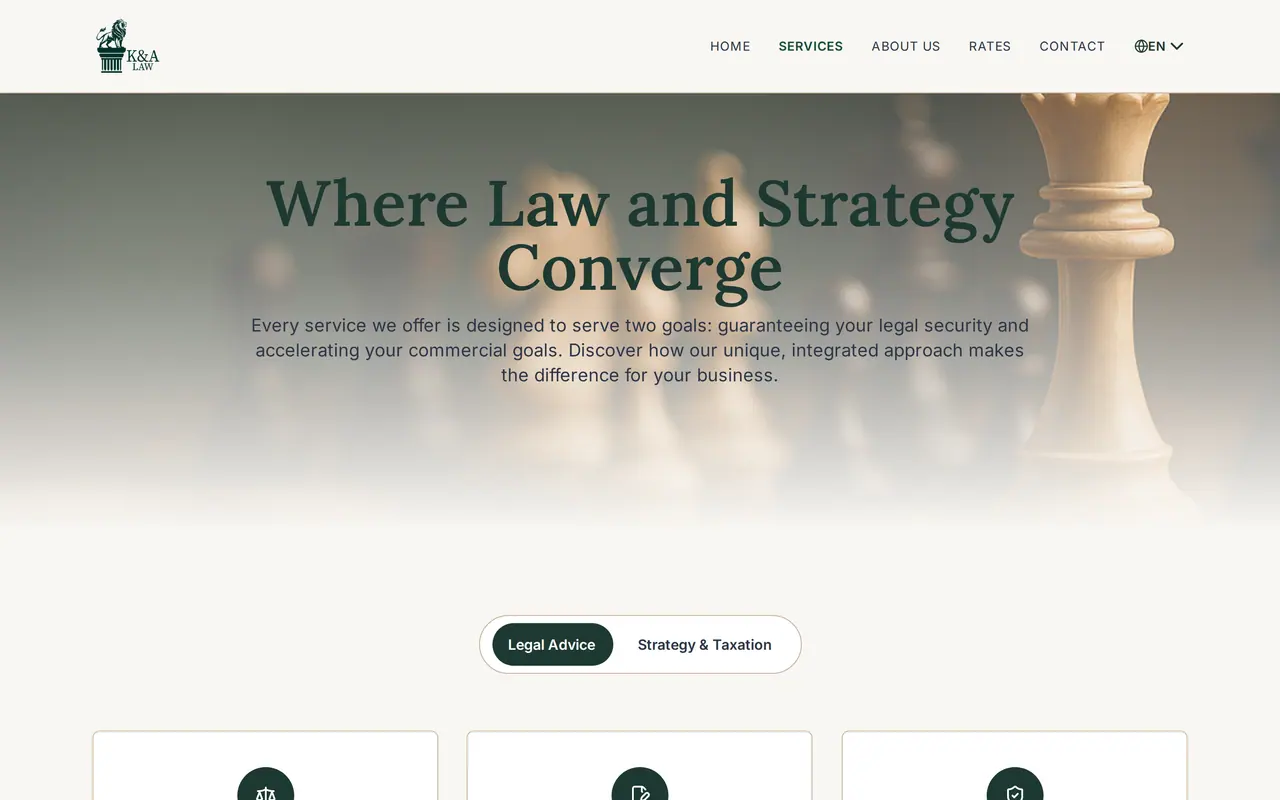
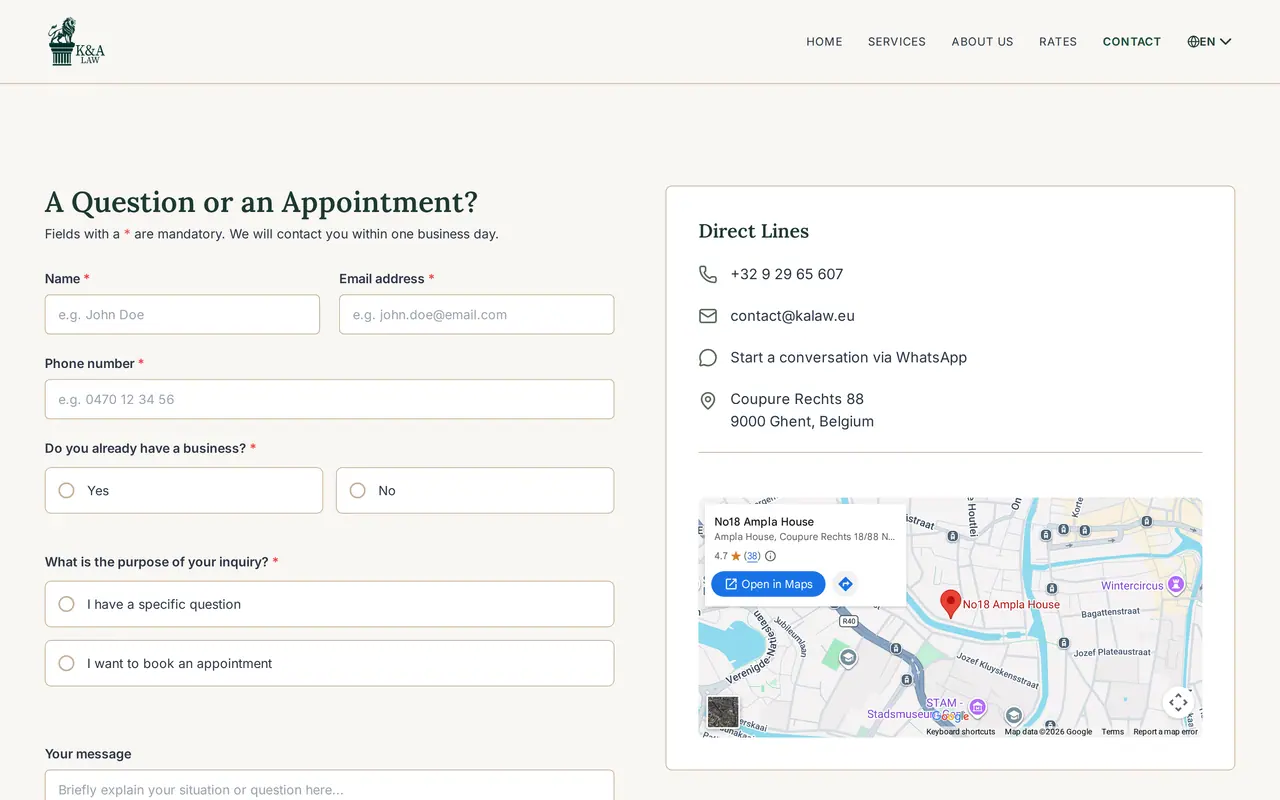
For K&A Law, a legal and strategic partner for business owners in Ghent, we built a site in Dutch, English, French and Turkish with twelve sector dossiers, a fees page and a contact form that asks whether you already run a business and what you are after.
An AI intake goes one step further: it asks about the facts, recognises the sector and the stage of the question, and prepares a summary for the first meeting. The lawyer starts with a file instead of a blank page. Whoever talks to the intake knows it is an AI assistant.
- Questions per sector and per stage
- A summary for the first meeting
- An assistant that says it is AI
Eight lawyers, 300 matters: what it returns
Take a firm with eight lawyers and three support staff, 300 new matters a year, 600 enquiries through the site and phone, 400 judgments and services to follow up and 1,000 letters. The figures are assumptions; run them again with your own firm.
| Task per year | Without AI | With AI, a lawyer checks |
|---|---|---|
| Reading and ordering matters, 300 | 4 hours each: 1,200 hours | 1.5 hours: 450 hours |
| Intake and preparing the first meeting, 600 enquiries | 30 minutes: 300 hours | 10 minutes: 100 hours |
| Deadlines from judgments and services, 400 | 15 minutes: 100 hours | 6 minutes: 40 hours |
| First draft of a letter, 1,000 | 30 minutes: 500 hours | 15 minutes: 250 hours |
| Total | 2,100 hours | 840 hours |
That is 1,260 hours a year, close to one full-time person. At an assumed average cost of 70 euros an hour it is worth 88,200 euros. Put differently: hours your lawyers can spend on work clients recognise as advice.
And the AI itself? A 200-page bundle is about 120,000 input tokens; a summary with timeline about 5,000 output tokens. With Claude Sonnet 5.5, at 2 dollars per million input tokens and 10 dollars per million output tokens, that is about 0.29 dollars per matter, or 87 dollars for 300 matters. With the heaviest model, Claude Opus 5.5 at 4 and 20 dollars, double that. Run your own numbers in the AI cost calculator, or compare models in ChatGPT vs Claude.
So what may it cost? An investment of 40,000 to 80,000 euros in an assistant around your matters pays back within a year in this example. A firm of two or three lawyers starts with one use, the matters or the intake, and spends accordingly less.
Public chatbot or an assistant inside your firm
- Privileged material
- Public ChatGPT for lawyersShould not go in, say the CCBE, the SRA and the Belgian bars
- An assistant inside your firmStays in a closed environment of the firm
- What the model knows
- Public ChatGPT for lawyersThe law in general, and sometimes case law that does not exist
- An assistant inside your firmYour matters, precedents and opinions, with the source in every answer
- Training and storage
- Public ChatGPT for lawyersDepends on the terms and the subscription
- An assistant inside your firmNo training on your data, no retention by the provider
- Access
- Public ChatGPT for lawyersEveryone sees what they paste
- An assistant inside your firmAccess per matter and per person
- Audit trail
- Public ChatGPT for lawyersNo firm-level log
- An assistant inside your firmA log of who asked what and what the AI answered
A public chatbot helps with a general question. An assistant inside your firm helps with your matters, without confidential material leaving the firm.
Firm assistant project: four phases to the first matters
- Call and process review, two weeksOver video calls in English we follow a few closed matters and measure where the hours go: reading, ordering, deadlines, letters. You get a proposal with what comes first and what it returns.
- Closed environment and first version, four to six weeksA dedicated environment in the EU, access per matter and a first use, tested on closed matters whose outcome you know.
- Trial with one team, four weeksOne practice group works with it on live matters. What the AI misses, we fix; what it does well, we measure.
- Roll-out, training and upkeepThe whole firm, with short training for the AI literacy the AI Act asks for and an AI policy. Then we extend use by use.
An honest starting point for your firm
An AI assistant for a law firm is not in our portfolio yet; what we built sits close. For K&A Law we built the site in four languages, with twelve sector dossiers and a contact form that prepares the intake. For AMOSI, our own AI software that went live in July 2026, we built document reading that keeps the source of every fact. And the Business Centrum management platform holds sensitive data with encryption, two-factor authentication and abuse tests.
What we do for your firm:
- We start with closed matters, not a demo. You see what AI makes of your own documents, and where it hesitates.
- Confidentiality sits in the technology: a closed environment per firm in the EU, no training on your data, access per matter.
- Every citation can be checked, with the document, the page or the source alongside.
- Calls and documents in English, one hour ahead of London, with prices in euros.
The full offer is on AI for business. Show us a closed matter: book a call.
What lawyers abroad ask us about AI
Can lawyers use AI on client matters?
Yes, with conditions. The CCBE asks for safeguards such as no retention by the provider, a processing agreement and closed systems before client data goes in. The Belgian bars allow privileged material only in an environment the lawyer is absolutely sure is closed. In England and Wales the SRA warns that client data in public AI tools is likely a breach of confidentiality.
Do I have to tell my client I use AI?
The Belgian bar guidelines impose no duty to tell the client. Check your own regulator. When the client talks to a chatbot or intake directly, they must know it is AI; the EU AI Act requires that since 2 August 2026.
Is our assistant high risk under the EU AI Act?
In our reading, no. Annex III covers AI that assists a judicial authority in researching and interpreting facts and law. An assistant that reads and summarises for your own firm is something else. The AI literacy duty of Article 4 does apply to everyone in the firm who uses AI.
Can you work with a firm outside Belgium?
Yes. We work remotely in English, read your bar's rules with you, and build for the languages your documents arrive in. The environment runs in the EU, under the GDPR.
Does this work with our practice management system?
Where the system offers an integration, we read from it. Otherwise we work on a folder of documents you fill yourself, inside the same closed environment.
Where is our data kept?
In a dedicated environment in the EU, separated per firm and per matter, with a model that stores nothing and does not train on your documents.
AI for business
How VBS helps you with this
We build AI into your own work: it drafts emails, reads documents and answers questions, and you stay the one who decides.
- First a task that costs time, then a working prototype
- On your own documents and your own data
- An AI policy your team understands
How we approach it is on our page about AI for business.
Less reading, more advising?
Show us a closed matter. We will show what AI makes of it, and what it is worth to your firm per year.
Rather get in touch right away?