AI agent development
AI agent development for work that is never the same twice
AI agent development by a team in Ghent: agents that work in your tools and stop where you decide.

Office work an agent can take over
AI agent development is the step after a chatbot. A chatbot answers what you ask. An agent gets a task and keeps working: it reads an email, looks the customer up in your CRM, pulls the file and drafts a reply. Or it collects your figures every Monday at seven and mails you the report.
In most small and mid-sized companies that work lands on the most expensive people. The owner reads the shared inbox at night, the project lead searches three systems to see who ordered what, and nobody chases the quotes that have been open for two weeks.
What the agent may do alone, it does. Whatever costs money or touches a customer, it puts in front of you. You get back the hours that now go into reading, searching and chasing.
What an agent takes over, process by process
An agent is software with a language model that gets a goal and chooses its own steps to reach it, using the tools you give it access to. A fixed workflow does the same steps every time; an agent adjusts to what it finds on the way. Here is what that means inside a business.
| Process | Today | With an AI agent | What you gain |
|---|---|---|---|
| Shared inbox | Someone reads every mail, looks up the order and types a reply | The agent recognises the question, finds the order or file and drafts a reply | Your team reviews and clicks send instead of searching |
| New enquiry from your site | The form lands in an inbox and waits a day | The agent researches the company, creates a record in your CRM and drafts a first reply | A same-day answer with the right details attached |
| Open quotes | Nobody tracks who has not replied | After ten days a follow-up per customer is ready, in your tone | Fewer quotes that die quietly |
| Weekly report | Someone pastes numbers from four systems into a spreadsheet | The agent collects the figures, compares them with last week and writes what stands out | A report every Monday, holidays included |
| Invoices and documents | Retyping into the accounts | The agent reads the fields and flags the doubtful ones | Less typing, and a person sees the exceptions |
Not every row needs a full agent. A weekly report is really a workflow with one AI step: the numbers come from your systems, the model only writes the commentary. Drafting quotes from a site note is its own page: AI quote generator. An agent that prepares your marketing is worked out in AI for marketing, other uses of AI in a business on AI for business, and an agent inside a larger platform is custom software.
Where it breaks today
Small companies rarely lack tools, they lack connections. The inbox does not know what is in the CRM, and only the owner knows everything. An agent works on those seams: it reads in one system and acts in another.
A working week of an agent, with you in it
- Mon07:00Last week's figures collected, report in your inbox
- Tue10:12New enquiry: company looked up, record in your CRM10:13 · waits for youFirst reply drafted
- Wed14:30Mail from a regular client recognised, file pulled up14:31 · waits for youReply ready for approval
- Thu09:00Three open quotes without a reply found09:01 · waits for youFollow-up mail per client drafted
- Fri16:00Weekly summary: what ran, what is still open
An example of what we can build. Everything with a blue border only goes out once you approve it.
Agent costs in hours and euros: a worked example
Take an installation company with twelve people, a shared inbox with forty emails a day, fifteen new enquiries a week and an owner who chases quotes himself. These are assumed figures. Run them again with your own week.
| Task per week | Today | With an agent |
|---|---|---|
| Reading, looking up and answering email | 10 hours | 4 hours reviewing and approving |
| Chasing open quotes | 3 hours | 0.5 hours |
| Researching enquiries and entering them in the CRM | 2.5 hours | 0.5 hours |
| Building the weekly report | 2 hours | 0.25 hours |
| Total | 17.5 hours | 5.25 hours |
That is 12.25 hours a week. Over 46 working weeks it adds up to 563.5 hours. At an assumed cost of 40 euros an hour, that is 22,540 euros a year.
Against that stands the model cost. Say the agent calls the model four times per email, each time with about 3,000 tokens in (the mail, the file, your instructions) and 400 tokens out. With Claude Sonnet 5.5, at 2 dollars per million input tokens and 10 dollars per million output tokens, that is 4 US cents per email. For 880 emails a month it comes to 35.20 dollars, about 31 euros, or some 375 euros a year. With the faster Claude Haiku 5.5, at 0.10 and 0.50 dollars, it drops to 1.76 dollars a month. With the heaviest model, Claude Opus 5.5 at 4 and 20 dollars, it is 70.40 dollars. Run your own volume through the AI cost calculator, and see which model fits which task in ChatGPT vs Claude.
Build the same flow in a tool and a subscription comes on top. Zapier Professional costs 19.99 dollars a month on annual billing for 750 tasks, counting every step after the trigger. n8n Starter costs 20 euros a month on annual billing for 2,500 executions.
What does that mean for your budget? An agent that frees 563 hours a year and costs a few hundred euros in model fees pays back an investment of about 22,000 euros in a year, and one of 44,000 euros in two. Whether building beats buying for your case is laid out in build vs buy software.
Approval queues we already built
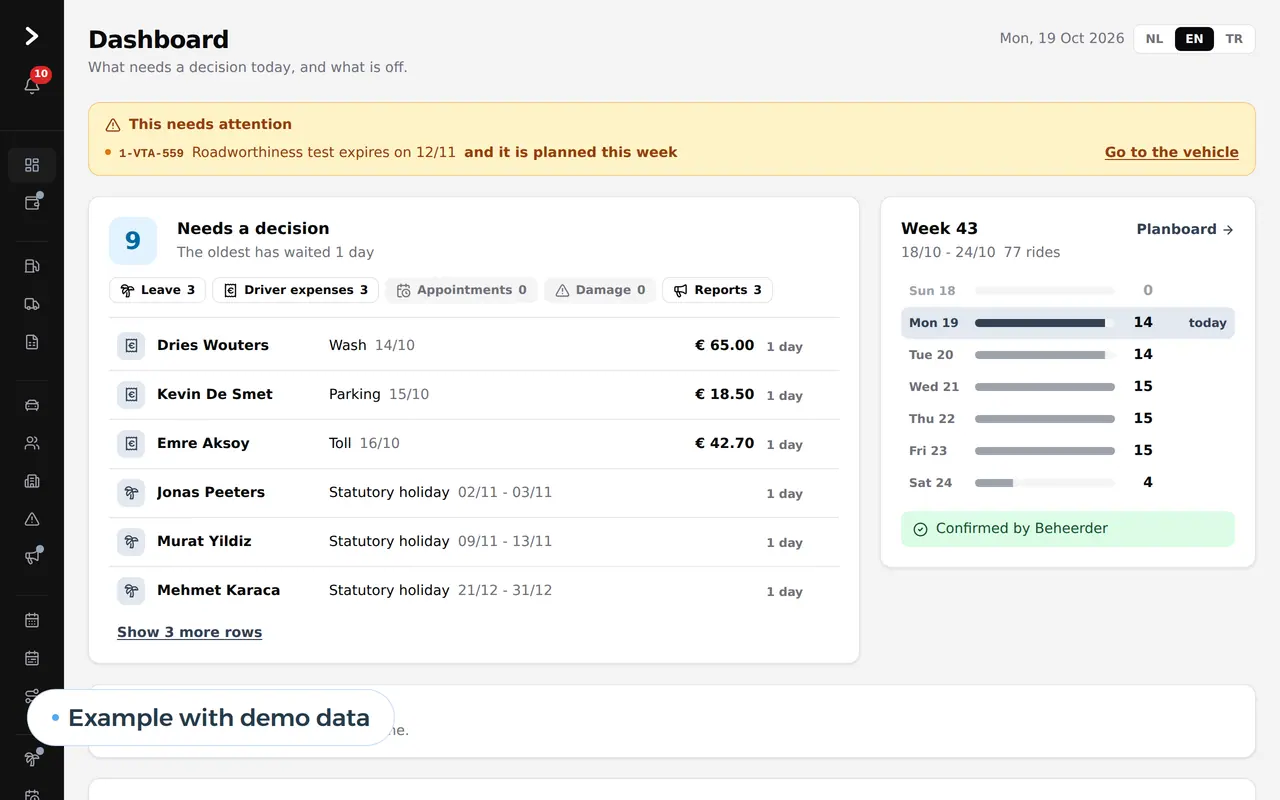
What needs a decision today, oldest first. An agent's drafts would wait here too. 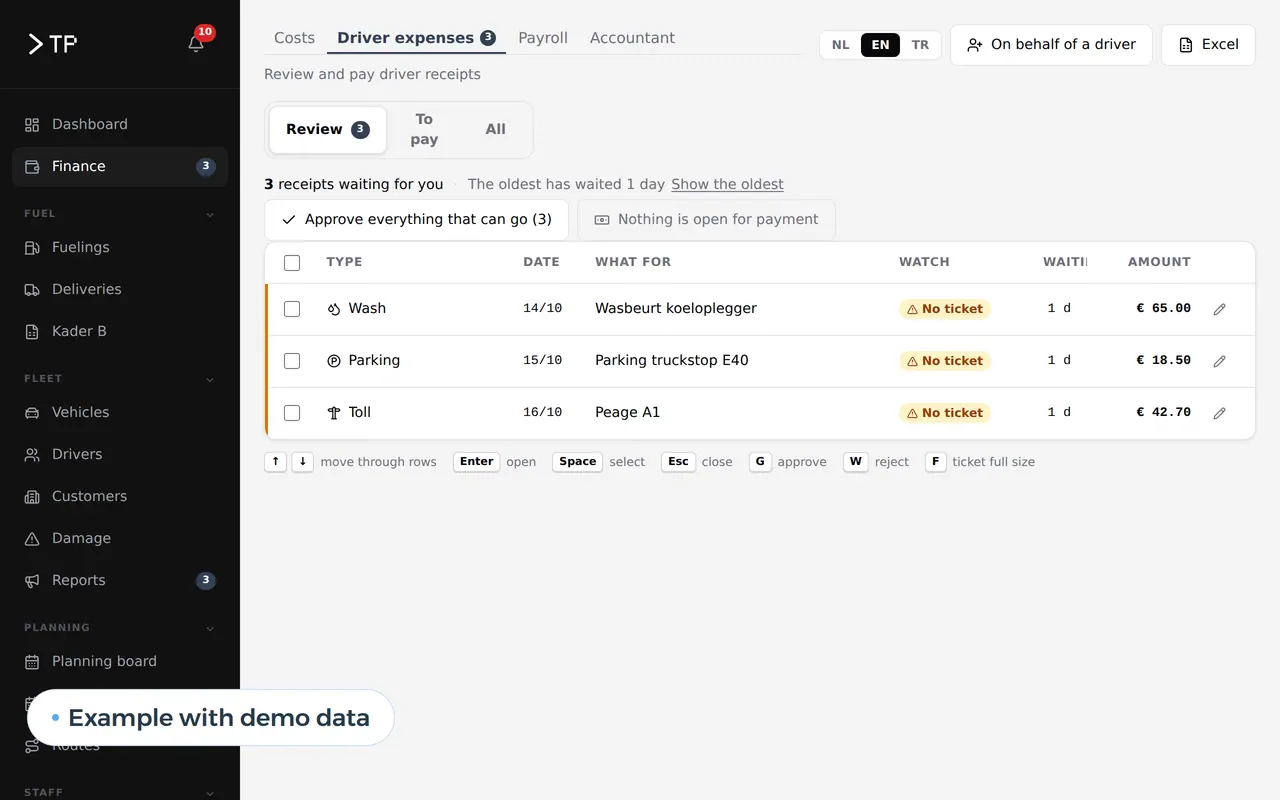
Receipts wait for a yes or no, with one button to approve what can go. 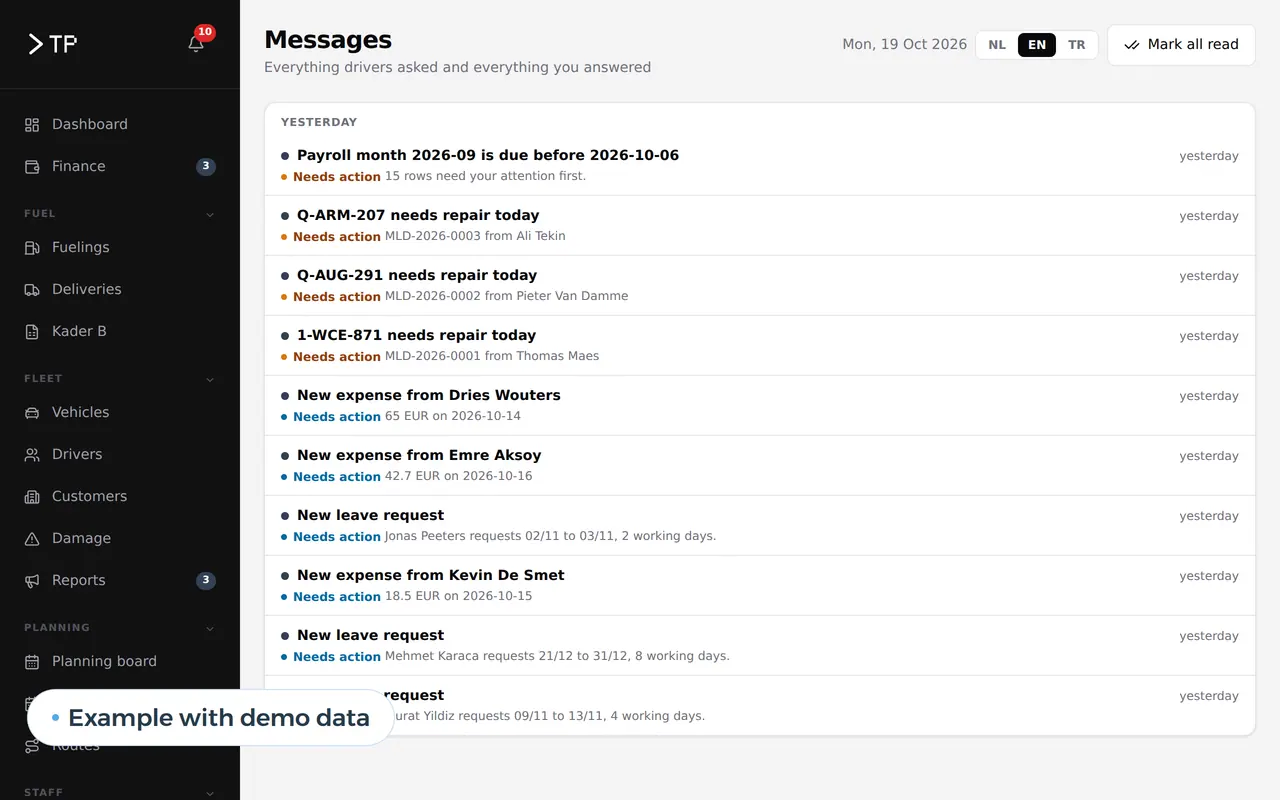
Everything that still needs an answer, in one list.
Workflow tool or custom agent: what your task needs
Zapier, Make and n8n all have AI steps now. Sometimes that is enough. This is how to choose.
- Start
- Zapier, Make or n8n with an AI stepA flow runs in an afternoon, if your tools have a connector
- Custom AI agentA first version in a few weeks, on a test environment
- Strong at
- Zapier, Make or n8n with an AI stepFixed steps with an AI step in between: summarise, sort, draft
- Custom AI agentWork where every case differs and the agent has to look things up and weigh them
- Your own software
- Zapier, Make or n8n with an AI stepOnly if the tool has a connector for it
- Custom AI agentWe write the connection ourselves, also to an old system or a spreadsheet
- Monthly cost
- Zapier, Make or n8n with an AI stepA subscription per task or execution that grows with volume, plus model fees
- Custom AI agentHosting and model fees, no meter per step
- Control
- Zapier, Make or n8n with an AI stepA run history inside the tool
- Custom AI agentIts own log per step, tests on your real examples, permissions per system
- Data
- Zapier, Make or n8n with an AI stepIn the tool's cloud; n8n can be self-hosted
- Custom AI agentOn a server in Europe that you own, with the code
Choose a workflow tool when the steps are fixed and volume is low. Choose a custom agent when it has to work inside your own software, handles customer data or a mistake is expensive.
Guardrails under the EU AI Act and GDPR
An agent is only as good as its limits. It gets the permissions it needs and no more, it never sends, pays or deletes without approval, and it writes every step to a log. On top of that come two European laws. The EU AI Act (Regulation 2024/1689), amended by the AI Omnibus in force since 27 July 2026, also applies to companies outside the EU when the output of their AI system is used in the EU. GDPR applies as soon as the agent touches personal data.
| Situation | What applies | Since |
|---|---|---|
| Your team works with the agent | AI literacy (Article 4): people who use it know what it can do and where it fails. Since the Omnibus the law sets no fixed level | 2 February 2025 |
| The agent talks to customers itself, with nobody reading along | People must know they are dealing with AI (Article 50) | 2 August 2026 |
| The agent creates images, audio or video that look real | A notice that it was made with AI (Article 50) | 2 August 2026 |
| The agent ranks job applicants or decides on credit | High risk (Annex III), with heavy duties | 2 December 2027 |
| The agent reads customer or staff data | GDPR: a processing agreement per service (Article 28), no decision with legal effect without a human (Article 22) | 25 May 2018 |
For most business agents this comes down to three agreements: who approves, which data never goes to the model, and what the agent says about itself in a conversation. The EU AI Act checker tells you in ten questions which risk class your use falls into. Whether you need a written policy is answered in do I need an AI policy. What changed for chatbots in August is in EU AI Act transparency obligations, and the new timeline for high-risk systems in the EU AI Act high-risk delay.
Pitfalls we see often
- Too much at onceAn agent that has to handle mail, quotes and planning does all three badly. Start with the task that costs the most hours and carries the least risk.
- Permissions that are too wideAn agent allowed to delete your whole inbox will one day do so. Reading and drafting is almost always enough.
- The model as the source of truthA price, a date or a stock level comes from your system, never from the model's memory.
Working with a team in Belgium
We are based in Ghent and work in English, by video call and shared screens. Belgium runs on Central European Time, so a full working day overlaps with the Netherlands, Germany and the Nordics and the morning overlaps with the UK. Prices are in euro. We host in an AWS region in Europe, so your data stays under EU rules, and you own the code and the data.
Agent projects in four phases, with your team involved
- Picking one task (week 1)A call and an afternoon watching the work. We pick the task with the most hours and the least risk, and collect fifty real examples with the right answer.
- Limits on paper (weeks 1 and 2)What the agent may do alone, what it puts to you, what never. Which systems it reads and where it writes. That is settled before a line of code.
- A first version that reads along (weeks 3 to 6)On a test environment, connected to your inbox, CRM or own software. It drafts everything, you approve everything, and we measure how often you change something.
- Live, then let go where it can (from week 6)What is always right may then run on its own. Every release switches over in seconds with a backup and a way back, and the log shows what the agent did and why.
Where we build agents, and what we already built
For AMOSI, our own marketing software that went live in July 2026, we built blocks in which a model does work on its own: a website scan that collects the facts about a company, reading what a company uploads, an overview of competitors and the sector. That is where we learned where a model may choose and where a person has to sign.
For DA Logistics, a Belgian haulier, we built a platform the office and about thirty drivers use every day, with five queues for the office and a mail layer that sends its own reminders: 185 emails in thirty days. That is automation without AI, and it shows where an agent lands most easily: in software where the tasks and the data are already in place.
What we do for you:
- A call about your real work: your inbox, your CRM and your week. Afterwards you know which task comes first and what it is worth.
- Limits on paper: what the agent may do, what it asks, and what never.
- A first version in a few weeks, measured against your own examples.
- Maintenance: models and prices change, and we tell you when a cheaper model does the same job.
The full offer is on AI automation. Book a call and we will look at whether a workflow is enough or an agent makes sense.
What buyers abroad ask before they commission an agent
- Can you build agents for a company outside Belgium?
- Yes. The agent runs on a server in Europe, wherever your team sits, and we invoice in euro.
- What does an AI agent cost per month to run?
- The language model costs a fraction of a euro per task; in the worked example above it stays under 35 euros a month. Hosting and maintenance come on top. The build depends on the task and the connections; you get a price after the first call.
- What if the agent makes a mistake?
- That is why a person approves everything in the first weeks, and anything that touches a customer or money stays in the approval queue. Every step is in a log, so you see what it did and why. Prices and dates come from your systems, not from the model.
- Does the EU AI Act apply to us if we are in the UK or the US?
- It applies when the output of the AI system is used in the EU, also for companies based elsewhere. For most business agents the duties are AI literacy for your team and, if the agent talks to people on its own, telling them it is AI.
- Will our customer data leave Europe?
- That is your choice. We build on a server in Europe, send the model only the data a task needs, and sign a processing agreement with every service that handles personal data, as GDPR requires.
AI automation
How VBS helps you with this
We make emails, quotes, documents and follow-up run by themselves, built into the way you already work.
- One flow per task, from form to confirmation
- A person approves what matters
- Runs on AWS, with a log and an alert when something fails
How we approach it is on our page about AI automation.
Which task should go first?
Show us your inbox, your CRM and your week. We will tell you where an agent saves hours and where a plain workflow is enough.
Rather get in touch right away?