Software for accounting practices
Software for accounting firms, built around your ledger

Software for accounting firms: client files, tasks with deadlines and a client portal, alongside the accounting package you already use.
Practices run on one package and a dozen spreadsheets
Software for accounting firms usually means the accounting package, and it does the bookkeeping well. The work around it lives elsewhere: a shared inbox, a spreadsheet of deadlines, a calendar per person and the memory of whoever has handled the client for years.
Which client still owes documents for the quarter? Who follows up that return now your colleague is off sick? Was last month's extra payslip ever billed? In most firms the answer takes a walk around the office.
A practice platform puts that work in one place: a file per client with contacts, documents, tasks and an audit log, a client portal where clients upload, ask and book meetings, roles per colleague, and a list of work outside the fixed fee, ready to bill. Your accounting package stays. We build what is missing around it and connect the two. We are a team in Ghent, Belgium, and we work with firms across Europe in English.
The rules a practice platform has to respect
Belgium's professional body for accountants and tax advisers, the ITAA, surveys 1,500 members every year. In its 2025 barometer 72 percent call e-invoicing an administrative burden and 59 percent plan to invest more in secure data management. Firms in the Netherlands, Germany or the UK will recognise it.
These are the rules a practice platform deals with every day. The EU rules apply wherever your clients are in the EU; the Belgian ones show how deep we go into a country's calendar, and we map yours the same way.
| Rule | What it asks of your firm | What the platform does |
|---|---|---|
| GDPR, processing agreement | Any service that handles client data for you is a processor and needs an agreement | We sign one, and data stays on servers in the EU |
| GDPR, data breaches | A breach is reported to the authority within 72 hours | Roles, an audit log of who opened what, so you know what was exposed |
| Anti-money laundering | You identify each client and its beneficial owners before you start; in Belgium those records are kept ten years after the relationship ends | An onboarding with required fields and documents, and a retention rule per file |
| Retention of books and invoices, Belgium | Seven years again, no longer ten | An archive per client and year, with the date a document may go |
| VAT returns, Belgium | Monthly by the 20th of the next month, quarterly by the 25th | The right calendar per client, and a task that starts weeks ahead |
| E-invoicing, Belgium | Structured B2B e-invoices via Peppol since 1 January 2026, fines of 1,500, 3,000 and then 5,000 euros for lacking the means | Per client, whether they can send and receive, and a list of who is not ready |
| E-invoicing, EU | Under the VAT in the Digital Age package, intra-EU B2B sales move to e-invoices and digital reporting from 1 July 2030 | The same client view, ready for whichever deadline your country sets |
The Belgian rules are explained in plain English in e-invoicing in Belgium and is Peppol mandatory in Belgium? Whether a Belgian company can already receive e-invoices takes seconds with the Peppol check, and what Belgium adds in 2028 is in e-reporting in 2028.
A document, a question and a meeting, from portal to done
- In through the portalDocument
Korenaar Bakery uploads the invoice for a new oven
Task with a deadlineBook the asset, propose the depreciation
Lien, client manager
Back to the clientProcessed on 6 November, visible in the portal
- In through the portalQuestion
Peeters Garage asks whether the new van can go on the company
Task with a deadlineDraft the answer, a partner approves
Ruben, tax adviser
Back to the clientAnswer with the documents attached, kept in the file
- In through the portalAppointment
Studio Noor Hair books Tuesday 17 November at 10:30
Task with a deadlinePrepare the year-end figures
Sofie, managing partner
Back to the clientConfirmation and agenda in the client's inbox
Every step is in the audit log: who opened it, who finished it, and when.
Example with made-up clients, staff and dates. Your firm sets its own tasks, deadlines and roles.
What the platform takes over, step by step
It takes over what falls between email, spreadsheets and calendars today.
| Process | Today | With a practice platform | What you gain |
|---|---|---|---|
| A new client | Details in an email, ID documents in a folder, an engagement letter in Word | Onboarding in the portal: details, beneficial owners, documents and the engagement letter in one place | A complete file before you start, ready for an inspection |
| Receiving documents | Email, WhatsApp, a box at reception | The client uploads per period in their portal and sees what is still missing | No document stuck in someone's inbox |
| Tasks and deadlines | A spreadsheet per person, a Monday meeting | Tasks per client with an owner and a deadline from that client's calendar | One view of what falls due this week, and with whom |
| Client questions | Calling and emailing whoever knows the file | Questions arrive in the file, become a task, and the answer is kept | A colleague can take over without asking around |
| Meetings | Emails back and forth about a time | The client picks a free slot, the meeting lands in your calendar | No phone calls to schedule |
| Work outside the fixed fee | On a sticky note, or forgotten | Logged per client and per month, with an export for billing | Work you did gets billed |
| Access and audit trail | Everyone sees everything on the shared drive | Roles per colleague, two-factor sign-in, an audit log of every change | Confidentiality and GDPR built into the software, not only into a procedure |
Time tracking per file and a dashboard of your practice per colleague and client fit on the same base; we build both as web applications. If you want the platform to read and pre-code documents too, see AI for accountants and invoice automation; working with a team in Belgium from abroad is covered in nearshore software development.
Client-file screens as we built them for a haulier
Screens from the transport platform we built for DA Logistics, in English with demo data. For a firm, drivers become clients.
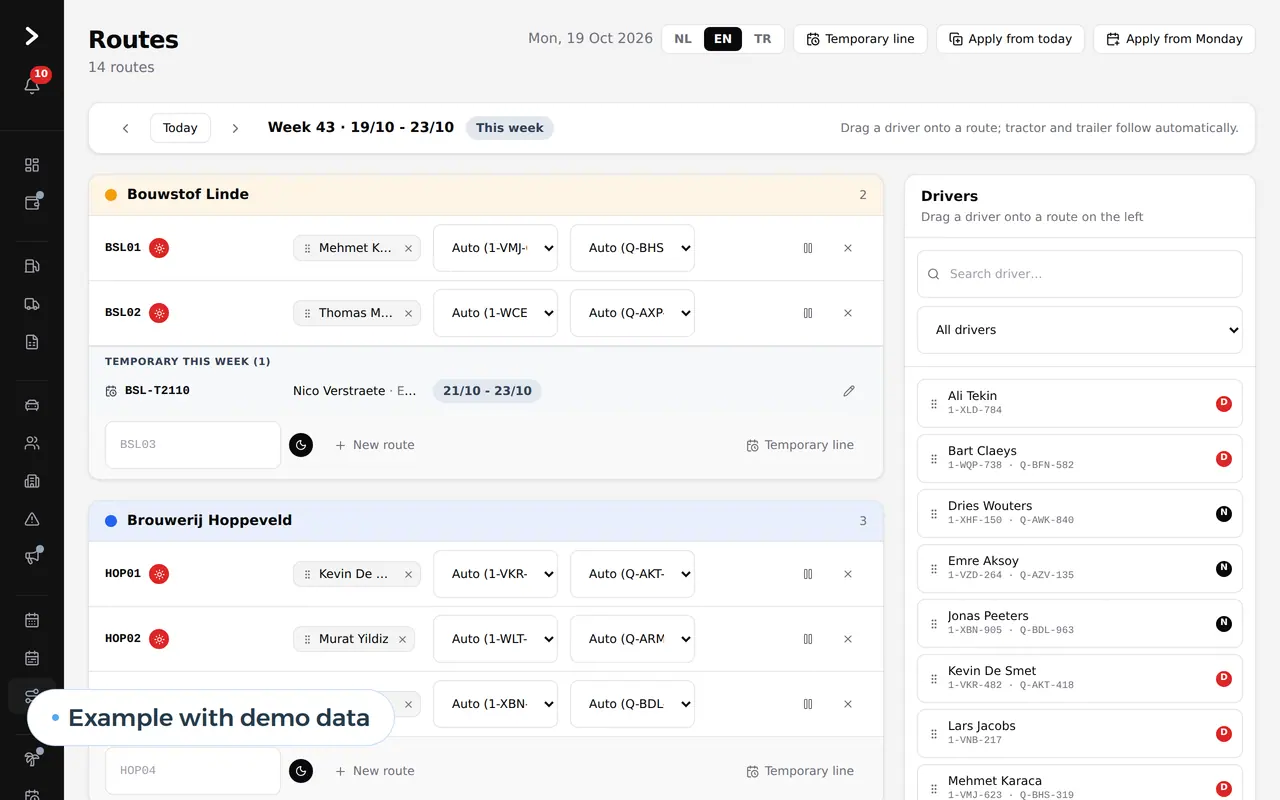
Every client in one list
Every customer and route in one list, with filters and status.
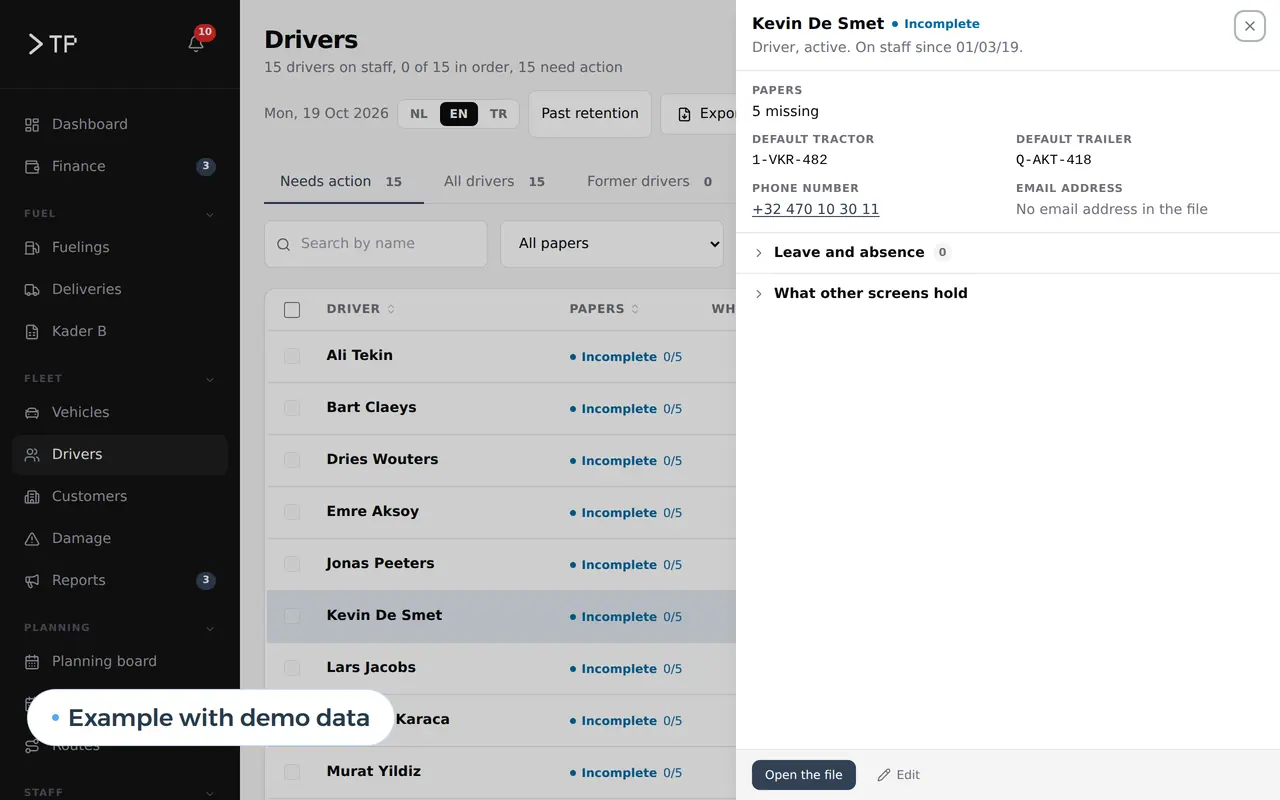
One file, a tab per subject
Details, papers, history and status of one person, without digging through folders.
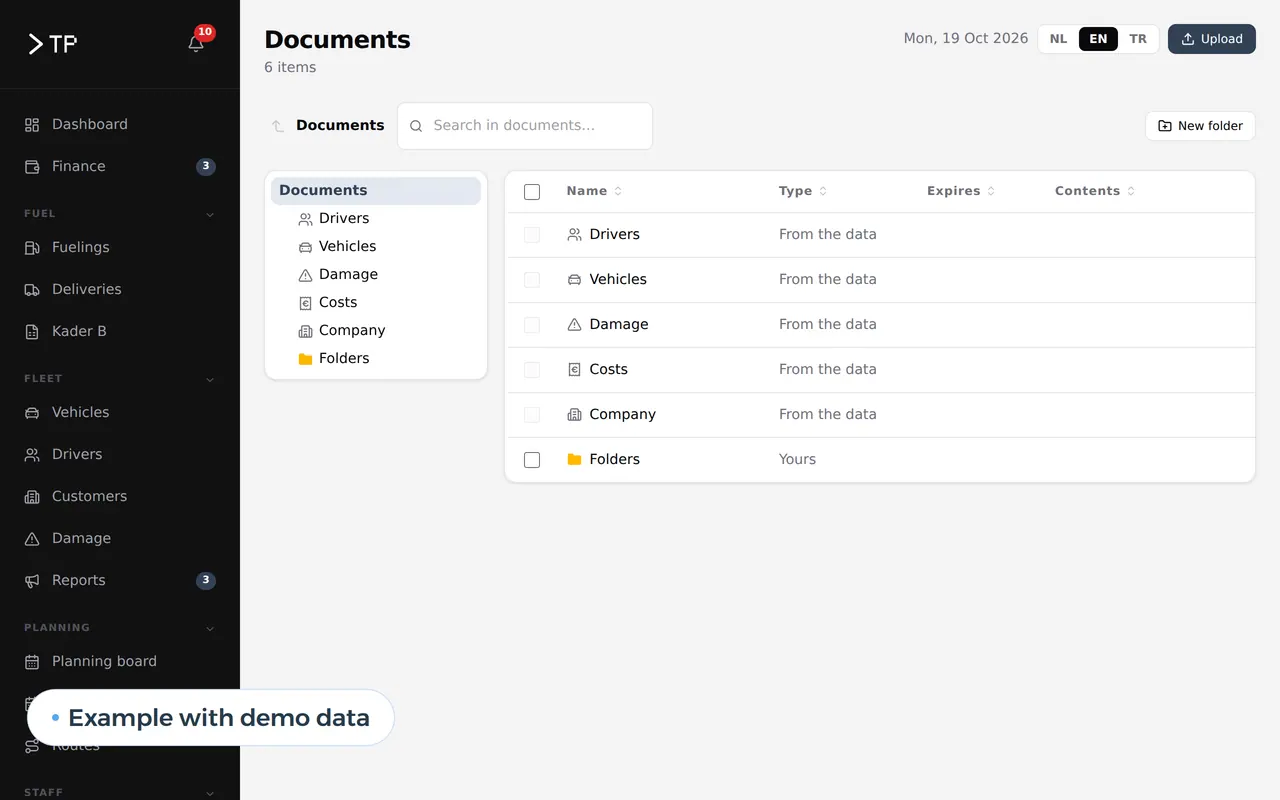
Roles per colleague
Documents per subject, with who may see what.
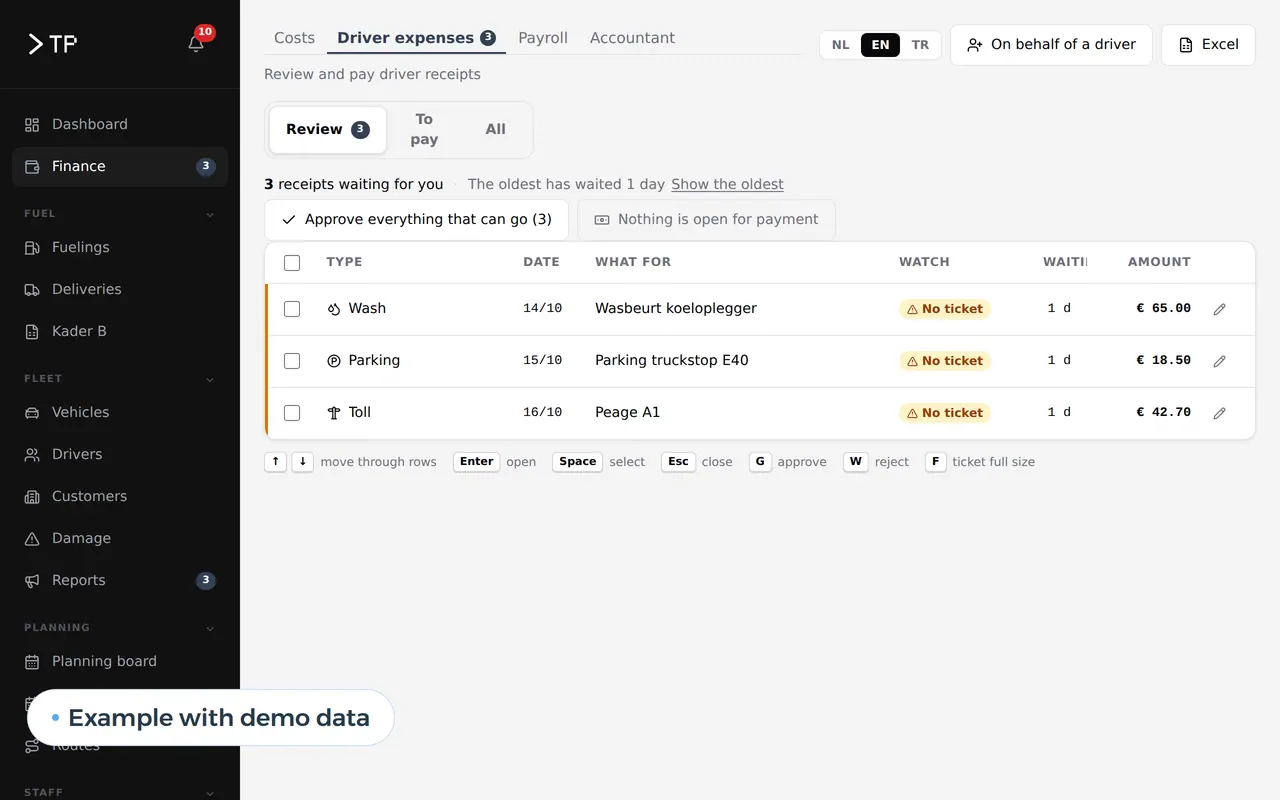
Work outside the fixed fee
Extra work logged per person and month, with an export for billing.
Meetings your clients book themselves
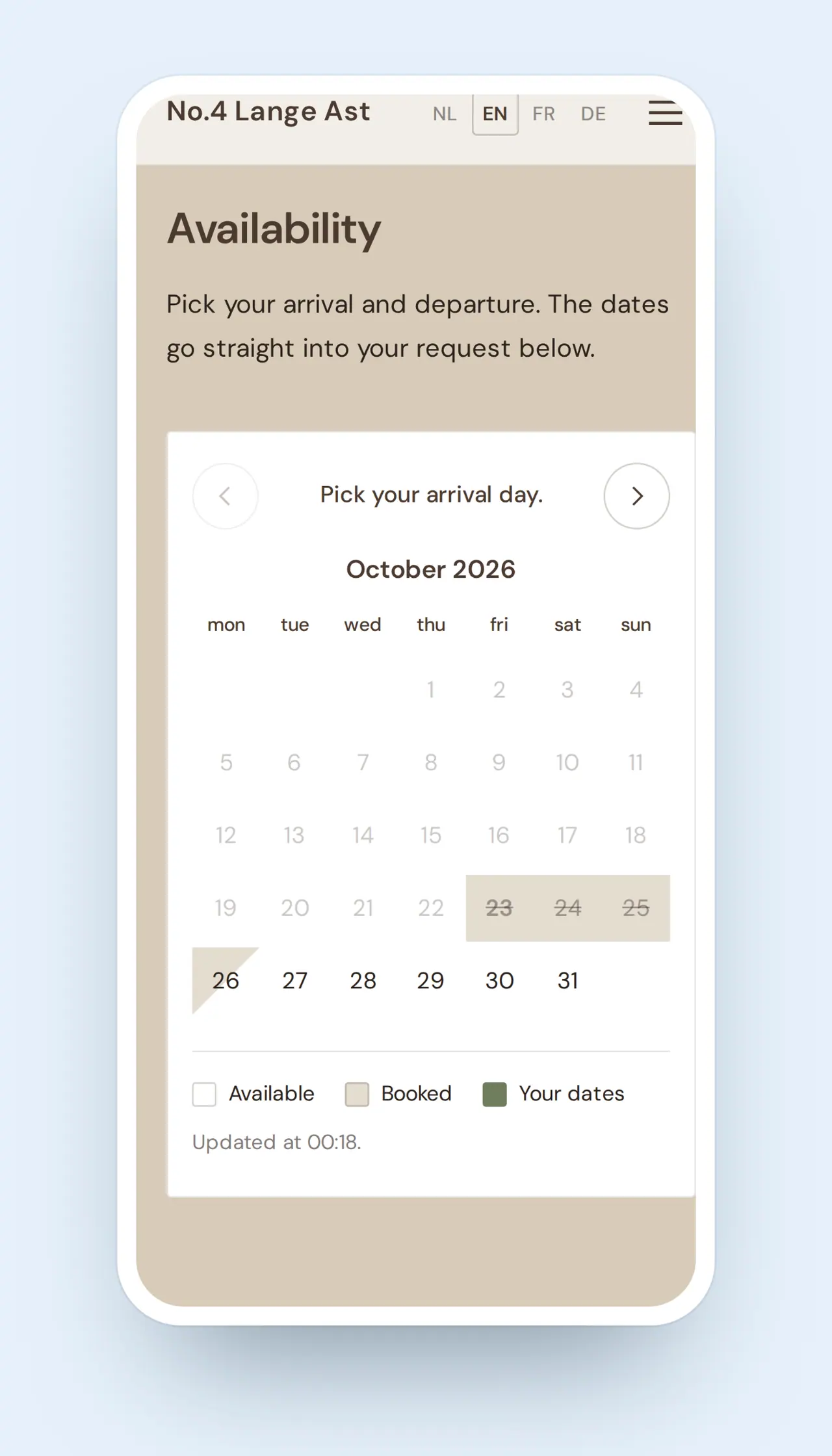
For FK Boekhouding, a certified accounting firm in Ghent, we built a site in four languages with a portal where clients book their own meetings. The client picks a day, then a free half-hour slot, and leaves a message.
In a practice platform that meeting becomes a task at once: prepare the figures for the conversation, for the colleague who handles the file, due the day before.
- Free slots from your own calendar
- A confirmation in the client's inbox
- In Dutch, French, English or Turkish
Eight staff and 250 client files, worked out
Take a firm with eight staff and 250 client files. The figures are assumptions; run them again with your own practice.
| Per month | Without a platform | With a practice platform |
|---|---|---|
| Requesting and chasing missing documents, 250 files at 6 minutes | 25 hours | 6 hours |
| Clients asking how far their file is, 150 questions at 5 minutes | 12.5 hours | 3 hours |
| Scheduling meetings by email and phone, 60 meetings at 10 minutes | 10 hours | 1 hour |
| Keeping tasks and deadlines in spreadsheets and meetings | 8 hours | 2 hours |
| Total | 55.5 hours | 12 hours |
That saves 43.5 hours a month, or 522 hours a year. At an assumed staff cost of 50 euros an hour it is worth 26,100 euros a year.
Then there is what slips through today. Say your firm does 50 jobs a month outside the fixed fee, at 40 euros on average, and forgets to bill one in four. That is 500 euros a month, or 6,000 euros a year. Together: 32,100 euros a year.
So in this example an investment that pays back within a year may cost up to about 32,000 euros, or up to 64,000 euros over two years. For comparison, a practice management package such as Karbon costs 5,664 to 8,544 dollars a year for eight users, every year again.
Off-the-shelf practice software or a platform of your own
For a firm that works the way a package was designed, a package is a good start. This is what they charge, from their own pricing pages.
| Package | What it does | Price, excl. VAT |
|---|---|---|
| Karbon Team | Tasks, workflows, shared inbox, client portal, time and billing | 59 dollars per user per month billed yearly, 79 dollars monthly |
| Karbon Business | Everything in Team, plus task automation | 89 dollars per user per month billed yearly, 99 dollars monthly |
| Exact Online accounting, Belgium | The bookkeeping itself, with Peppol and an app to scan receipts | Essentials 49 euros a month with one user, Plus 99 euros with two, Premium from 299 euros |
Pick a package if your firm can adapt to it, and you need no link to your own ledger, your website or your country's filing calendar.
Pick a platform of your own if your way of working is your edge: your own onboarding, your country's filing calendar per client, a client portal for accountants in your clients' languages and branding, or a link to the ledger you already run. Or if you pay per seat for colleagues who open the system now and then. A custom platform is yours, with no licence per person.
The trade-offs are laid out in build vs buy software and CRM vs ERP. To write down what you need before you talk to anyone, use the software requirements template.

Client spreadsheets, imported with a report
Almost every firm starts from a spreadsheet. For Business Centrum, a payroll bureau in Ghent, we loaded their real spreadsheet in the trial: 309 employers and 971 employees, with a report of what was missing or inconsistent.
Your platform starts the same way: with your own clients in it. A blank column or a duplicate company number shows up before go-live, not a year later.
Practice platform project: the road to your first client files
- Call and process mapping, weeks 1 and 2By video with a partner and two file managers, we map how a client file runs today, from a new client to year-end. You get a plan of what we build first.
- First version, weeks 3 to 8Client files, tasks with deadlines and roles, with your own client list loaded. Every week you see what is new, on a test environment.
- Trial with one team, two to four weeksOne team works in it with real files. Whatever chafes, we adjust before the rest of the firm moves in.
- Client portal and go-liveClients get a link in their email and sign in without a password. Our platform releases switch over in 2 to 6 seconds, with a backup and a way back.
- Maintenance and growthNew rules, a link to your ledger, another language: we keep building in small steps while your firm keeps working.
Client-file work we already built, for a payroll bureau
No accounting firm runs on a platform of ours yet; the client-file work around it we did build. For Business Centrum, a payroll bureau in Ghent, we built the platform that replaces their spreadsheet: employers, employees, tasks, documents, billable extras, an audit log and a portal where their clients sign in with a link in their email. For FK Boekhouding, a certified firm in Ghent, we built a four-language site with an appointment portal.
What we do for your firm:
- A process review: we follow one client file from start to finish and show where the hours leak.
- A first version with your own clients, imported from your spreadsheet.
- A client portal in your branding and your clients' languages, as on client portal development.
- Your data in the EU, encrypted, with roles and an audit log, under a GDPR processing agreement.
The broader offer is on custom software development. Tell us how a client file runs in your firm: book a call.
What accounting practices ask us
Does this replace our accounting package?
No. Your package stays for the books and the returns. We build the work around it: client files, tasks, portal, meetings and billable extras, and we connect to your package wherever it offers an integration or an export.
Where is our clients' data stored?
On servers in the EU. Each client sees only their own file, each colleague only what their role allows, sensitive data is encrypted and every change is logged. We sign a GDPR processing agreement.
Can you work with a firm outside Belgium?
Yes. Calls and documents are in English and we invoice in euros. Tax rules differ per country, so we build around your package and your local filing calendar, not Belgium's.
Can we bring our client list from spreadsheets?
Yes. We import it and show in a report what is missing or duplicated, as we did for Business Centrum. You start with your own clients in it.
How do our clients sign in to the portal?
With a link in their email, no password to remember, as in the Business Centrum client portal. They see only their own file: their documents, their questions and what is still needed from them.
Client portal
How VBS helps you with this
We build a portal where your clients sign in, see their file and handle what they can themselves: fewer emails, less retyping.
- Sign-in with a link by email, no password
- Documents, appointments and status per client
- Linked to your own back office
How we approach it is on our page about Client portal.
Your client files in one place, your deadlines in view?
Tell us how a client file runs in your firm, from a new client to year-end. We will show you what we would build around your accounting package.
Rather get in touch right away?