AI in HR
AI for HR that keeps staff files up to date
AI for HR that tracks certificates, expiry dates and staff questions, so nothing lapses unseen.

AI in HR for companies without an HR department
AI for HR is for the owner who keeps the staff files himself, and for the payroll bureau that does it for hundreds of employers.
The system tracks when a certificate, a work permit, a driving licence or a medical check expires, writes the reminder in the employee's language and reads the new document when it arrives. A spreadsheet import is checked before an error slips into payroll. A question about leave or a payslip gets a draft answer from the employee's own file.
What AI does not do: decide about people. Ranking candidates, scoring performance or assigning work based on behaviour is a high-risk use in the EU with heavy obligations. We build AI that carries the paperwork, so you have time for the people. Our team is in Ghent, Belgium, and works in English with companies across Europe.
An HR document that expires, and what happens before it does
Driver's medical certificate
Example with made-up data
60 days
Employee
A friendly reminder in his own language, with what to bring
30 days
Employee and manager
A second message, with a proposed appointment
7 days
HR
The file at the top of your list, with who has not replied
Expired
Planning
No longer scheduled until the new document is in
The staircase itself is a fixed rule. AI writes the message in the right tone and language, and reads the new certificate when it arrives.
Which HR task, who decides and what risk
Not every AI use in HR weighs the same. The EU AI Act sorts them by risk. This is the map we go through with every client.
| HR task | What AI does | Who decides | Risk under the AI Act |
|---|---|---|---|
| Expiry dates of certificates and permits | Watches the date, writes the reminder, reads the new certificate | HR approves the document | Low |
| Staff questions about leave or payslips | A draft answer from the employee's file and the work rules | HR sends it | Low, with a duty to say it is AI if a chatbot answers |
| Spreadsheet imports for payroll | Reads the import, flags what is wrong or missing | The file manager corrects | Low |
| Job ads and onboarding emails | Writes in your tone, in several languages | You review | Low |
| Filtering CVs or ranking candidates | Possible, but it co-decides who gets a chance | Whoever deploys it carries the duties | High, Annex III, from 2 December 2027 |
| Rating performance or assigning tasks by behaviour | Possible, but it judges people | Same | High, Annex III, from 2 December 2027 |
| Reading employees' emotions | Camera or voice that estimates mood | Nobody | Banned since 2 February 2025, except for medical or safety reasons |
The first four rows save the most time and are the easiest to keep compliant. That is where we start. Which class your idea falls into takes two minutes with the EU AI Act compliance checker. Rosters and leave are covered separately on custom scheduling software. Hours worked per day belong in custom time tracking software. Questions about the staff handbook or the leave rules are answered by an assistant on your own documents, as in a custom ChatGPT for your business; how to roll AI out further is in implementing AI in your business.
AI for payroll bureaus and employers
Examples of what we can build, on platforms we already made.
Job ads and onboarding in your tone
A job ad, a welcome email, an explanation of the leave policy: ready to review, in English, Dutch, French or Turkish.
Imports that check themselves
A spreadsheet of employees is read and checked, with a report of what is wrong before it reaches payroll.
Watching expiry dates
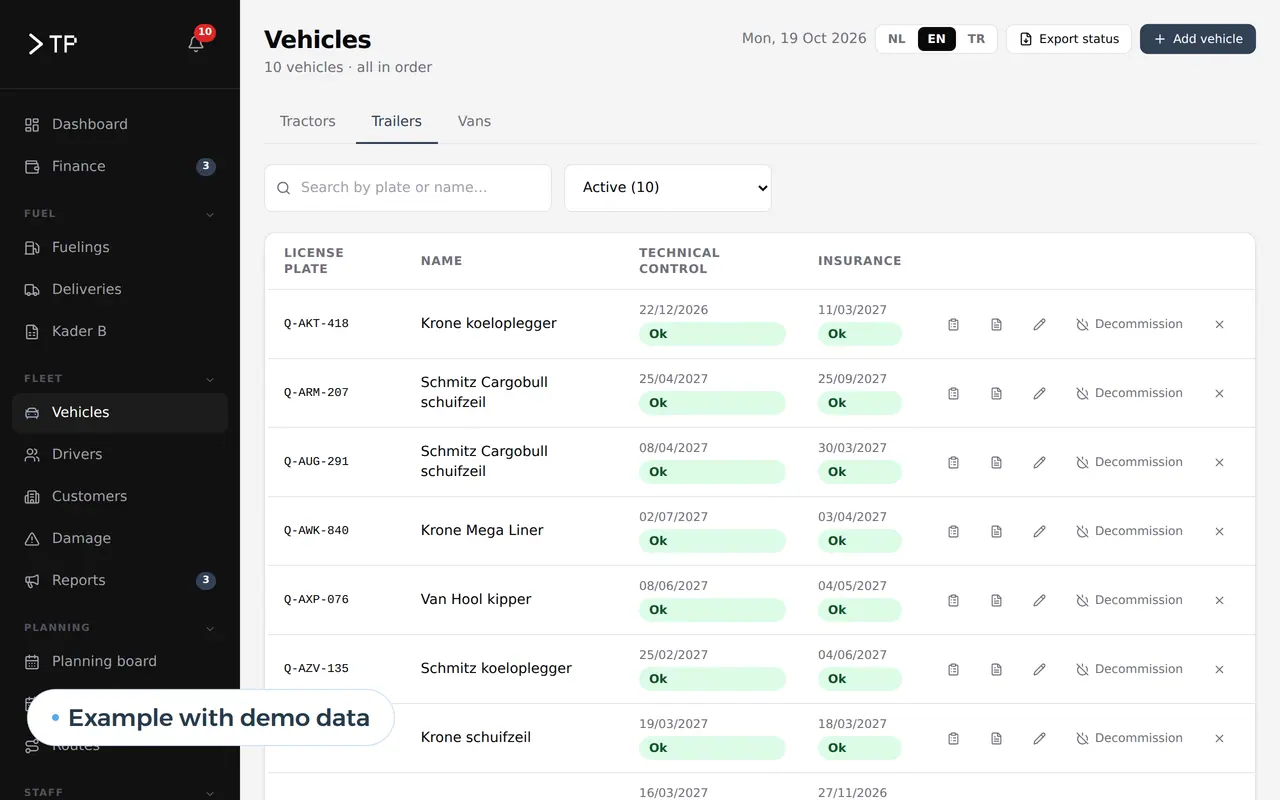
Like the reminder staircase at DA Logistics: papers per driver, with the right email at the right moment.
HR and AI in law: the dates and the duties
An employer that uses AI meets several layers of rules. The EU layer is the same in every member state; national labour law adds its own.
| Rule | Since or from | What it asks of an employer |
|---|---|---|
| AI literacy, AI Act Art. 4 | 2 February 2025 | Staff who use AI know what it can and cannot do. No certificate needed, but explanation and agreements |
| Ban on emotion recognition at work | 2 February 2025 | No systems that estimate employees' state of mind |
| Transparency, AI Act Art. 50 | 2 August 2026 | A chatbot that answers employees or candidates says it is AI |
| High risk in employment, Annex III | 2 December 2027, after the delay in the AI Omnibus | Human oversight, logs, and informing workers and their representatives before you deploy |
| GDPR, Art. 22 | Since 2018 | No decision with legal effect based solely on automated processing, without a human involved |
| Works councils | National law | In Germany the works council co-decides on technical systems that can monitor staff; in the Netherlands the works council must consent to staff monitoring systems; in Belgium collective agreement no. 39 requires information and consultation on new technology |
In the UK the EU AI Act does not apply as such, but UK GDPR keeps the same limits on automated decisions, and UK employers with EU staff or clients meet the EU rules through them. Whether you need an internal AI policy is answered on do I need an AI policy?, and whether a privacy policy must mention it on do I need a privacy policy? A client portal gives employers or employees their own entrance, and questions from customers rather than staff belong with AI customer service.
HR pitfalls with AI we see often
Pasting a CV or a sick note into the free version of a chatbot: staff data leaves your company without a processing agreement. Using a job board that ranks candidates itself: you are the one deploying a high-risk system, even though you did not build it. Forwarding an AI answer on employment law without a source: a language model sounds certain even when it is wrong, so every answer must point to the rule it relies on. And picking a system that learns from your past decisions: if you mostly hired one profile before, it will propose that profile again. That is why we build AI that shows its sources, runs inside your own environment and does not rank people.
AI in staff administration: a worked example
Take a company with 120 employees and one HR manager, or a file manager at a payroll bureau with a similar portfolio. The figures are assumptions; run them again with your own team.
| HR task per month | Without AI | With AI, a person approves |
|---|---|---|
| Staff questions, 60 at 10 minutes | 10 hours | 3 hours |
| Tracking expiry dates and writing reminders | 4 hours | 0.5 hours |
| Checking payroll imports | 6 hours | 1 hour |
| Job ads and onboarding emails, 4 a month | 6 hours | 2 hours |
| Total | 26 hours | 6.5 hours |
That is 19.5 hours a month, or 234 hours a year, worth 11,700 euros at an assumed 50 euros an hour. For a payroll bureau with hundreds of employers it multiplies: the platform we built for Business Centrum loaded the bureau's real spreadsheet with 309 employers and 971 employees in its trial. When moving off a spreadsheet pays, see replace Excel with software.
The AI itself costs next to nothing. Answering one question from a file takes a model about 3,000 input tokens and 300 output tokens. With Claude Sonnet 5.5, 60 questions a month cost about 54 dollar cents. The cost is in connecting to your files and in shielding who sees what. Run your own numbers in the ChatGPT API cost calculator.
HR processes with AI, in four steps
- Where it goes wrong todayAn expired certificate, an import error, a question asked ten times. We start with what costs the most, and note the risk class next to it.
- Your files in one placeIf everything still lives in spreadsheets and folders, we first move it into a platform that keeps track, with rights per user and encrypted sensitive numbers.
- AI where reading and writing are neededReading certificates, writing messages, checking imports. Fixed rules for the rest, because an expiry date is not an estimate.
- You keep the overviewA list of what needs attention, a log of what was sent, and an explanation for your team so everyone knows what the AI does.
HR files we already put into a system: Business Centrum platform and DA Logistics.
Two platforms that already hold staff files
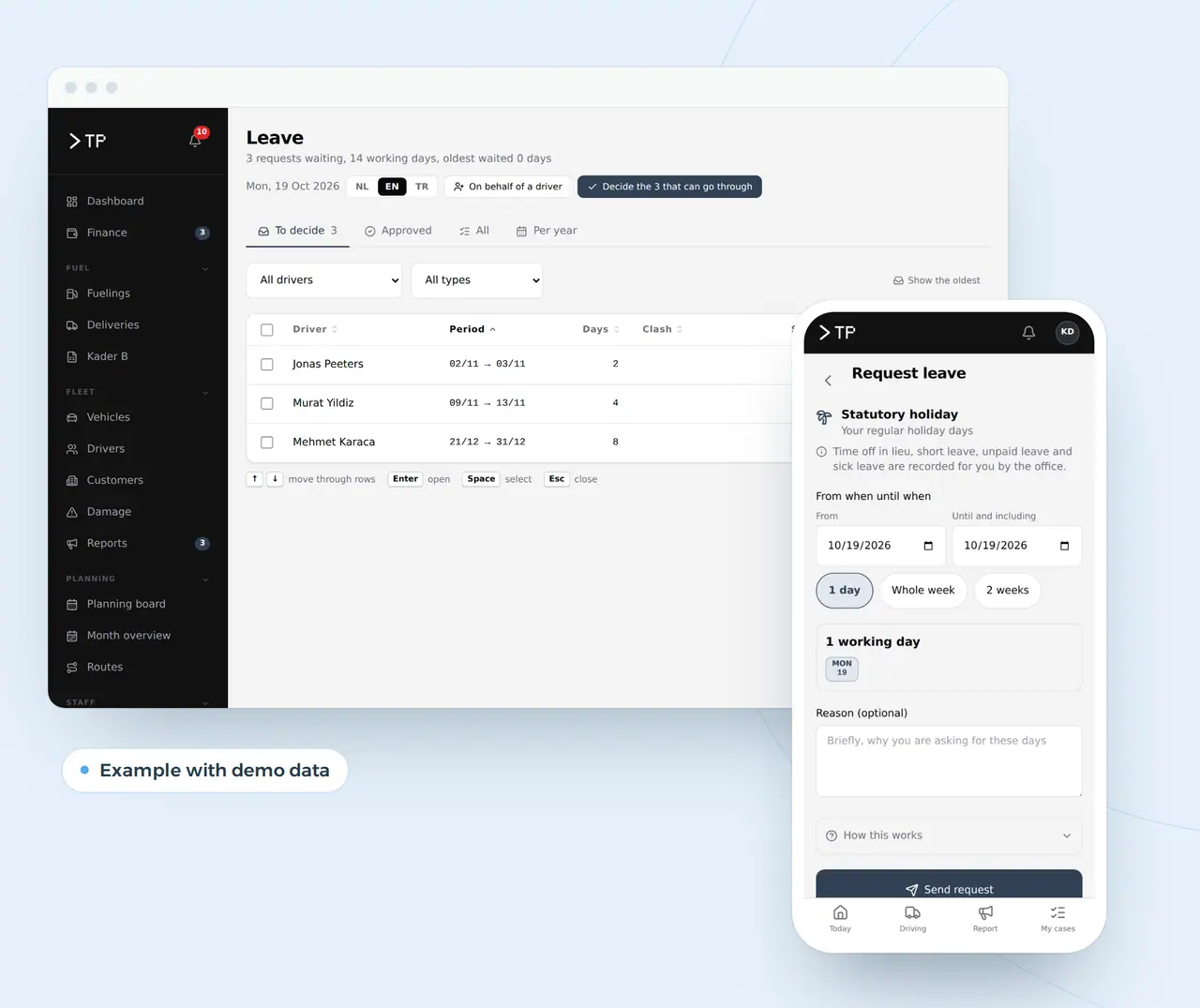
For Business Centrum, a payroll bureau in Ghent, we built a management platform that replaces their spreadsheet: employers, employees, work permits, meal vouchers, payroll, tasks and a client portal. Sensitive numbers are encrypted, two-factor authentication is ready for whoever turns it on, and the import reports what does not add up. For DA Logistics, a Belgian haulier, we built staff files with a reminder staircase and an app in which drivers request leave themselves, in Dutch, English or Turkish. There is no AI in those two platforms yet; it is the layer we now build on top.
What we do for you:
- We start with the low-risk tasks that cost the most hours: files, certificates, questions, imports.
- We put the rules next to it: which risk class, what you tell your team, what goes into your AI policy.
- Data stays shielded, on servers in the EU, with rights per user and no training on your data.
- A person decides about people, always.
The broader offer is on AI for business, and why a team in Belgium can be the right call on nearshore software development. Tell us which HR task costs you the most time: book a call.
Staff data, AI and the questions we get
May AI process staff data?
Yes, within the GDPR: only what is needed, in a shielded environment, with rights per user and a processing agreement with every service. We encrypt sensitive numbers, as in the Business Centrum platform.
Does AI decide on hiring?
Not with us. AI writes and organises; decisions about people stay with people. Whoever lets AI rank candidates falls under the strictest AI Act rules from 2 December 2027.
Does it work with our payroll provider?
We read exports and deliver data in the format they ask for. If you are a payroll bureau yourself, we build on your own platform.
Do we have to inform our employees?
For a low-risk use, an explanation in your AI policy is enough. For a high-risk system you must inform workers and their representatives in advance, and in Germany or the Netherlands the works council has a say over monitoring systems.
Which languages does it work in?
The languages of your staff. The DA Logistics driver app runs in Dutch, English and Turkish; AI writes messages and reminders in the reader's language.
Do you calculate payroll?
No. A salary or a notice period must be exactly right and belongs with your payroll provider. AI reads, organises and writes; the calculation stays a fixed rule.
AI for business
How VBS helps you with this
We build AI into your own work: it drafts emails, reads documents and answers questions, and you stay the one who decides.
- First a task that costs time, then a working prototype
- On your own documents and your own data
- An AI policy your team understands
How we approach it is on our page about AI for business.
Less paperwork, more time for your people?
Tell us which HR task costs you the most time. We will show you what AI may and can do there.
Rather get in touch right away?