
AI in accountancy
AI for accountants that sorts the paperwork first
AI for accountants and bookkeepers: your clients' paperwork read, sorted and chased before you start.
Accounting firms lose their hours before the bookkeeping starts
AI for accountants does not start at the tax return. It starts with everything before it: documents arriving in five formats, clients who forget, questions asked three times.
An AI layer reads your clients' invoices, receipts and certificates, files them under the right client and period, proposes a coding and asks for what is missing. A client question in your portal or inbox gets a draft answer from the file. Your colleague approves, edits and sends.
Your team does the work it trained for: checking, advising, planning. Clients notice a firm that answers faster, without you hiring in a market where that hardly works. We build this from Ghent, Belgium, for firms across Europe, in English.
Accountancy in 2026: what makes the work heavier
Belgium's professional body for accountants and tax advisers, the ITAA, surveys 1,500 of its members every year. Its 2025 barometer shows where the pressure sits, and the picture will be familiar to firms in the Netherlands, Germany or the UK.
| What accountants report | Share |
|---|---|
| My firm will be ready for e-invoicing by 2026 | 87% |
| My clients will be ready for e-invoicing by 2026 | 55% |
| E-invoicing named as an administrative burden | 72% |
| AI is moving the profession towards more specialised advice | 71% |
| I will invest more in secure data management | 59% |
E-invoicing is spreading across Europe. Belgium made structured B2B e-invoices via Peppol mandatory on 1 January 2026, with fines of 1,500, 3,000 and 5,000 euros for repeat breaches; the rules are explained in plain English on e-invoicing in Belgium. Germany has required every business to receive e-invoices since 1 January 2025, with issuing phased in from 2027. Under the EU's VAT in the Digital Age package, adopted in March 2025, e-invoicing becomes the rule for intra-EU B2B sales from 1 July 2030.
E-invoices solve part of the retyping: they arrive structured. But receipts, foreign invoices, certificates, contracts, payslips and client questions stay unstructured. That is where AI earns its keep.
A client's pile of paperwork, sorted by AI and approved by you
Client: Korenaar Bakery
Q3, 6 new documents
- E-invoice from the flour supplierPeppolPurchases of raw materials, VAT 6%
- DIY store receiptPhoto in the appMaintenance, VAT 21%
- Invoice from a German oven supplierEmailFixed asset, intra-EU: reverse chargeTo a person
- Payment on 12 September, 480 eurosBank statementNo matching invoice foundAsk the client
- Van insurance certificatePortalInsurance, no VAT
- Lease for the new workshopEmailSummary: starts 1 October, 1,850 euros a monthTo a person
- 3Pre-coded: ready for approval
- 1Ask the client: reminder drafted for the client
- 2To a person: with a colleague, reason attached
Example with a made-up client and documents. Your firm decides the coding and the chart of accounts.
Where AI takes over the work in the firm
This is what AI does reliably in a firm today, and where people keep deciding.
| Process | Today | With AI in your firm | What you gain |
|---|---|---|---|
| Receiving documents | Email, portal, WhatsApp, a shoebox | One list, read and filed per client and period | No document stuck in an inbox |
| Pre-coding | Retyping every receipt and foreign invoice | Supplier, date, amount, VAT rate and a proposed account, with a confidence per field | Your colleague checks instead of types |
| Missing documents | Writing to each client and remembering | The system sees what is missing for the quarter and drafts the reminder in the client's language | A complete period before the deadline |
| Client questions | Looking up every answer in the file | A draft answer from the file, with the documents it relies on | Faster answers, same quality |
| Anomalies | Found at closing, or not | A duplicate invoice or an odd amount is flagged on arrival | Fewer corrections afterwards |
| Summaries | Reading a contract or a letter from the tax office | A summary with deadlines and amounts, source attached | You read what matters first |
How invoices are read field by field is on invoice automation. If you want an assistant that answers from your firm's own documents, such as internal procedures and checklists, see custom ChatGPT for your business. For a full firm platform with client files, tasks and a portal, see software for accounting firms and client portal development.
AI in bookkeeping, examples for your firm

Read and sort documents
Clients' invoices, receipts and certificates are read and filed per client and period, with a proposed coding.
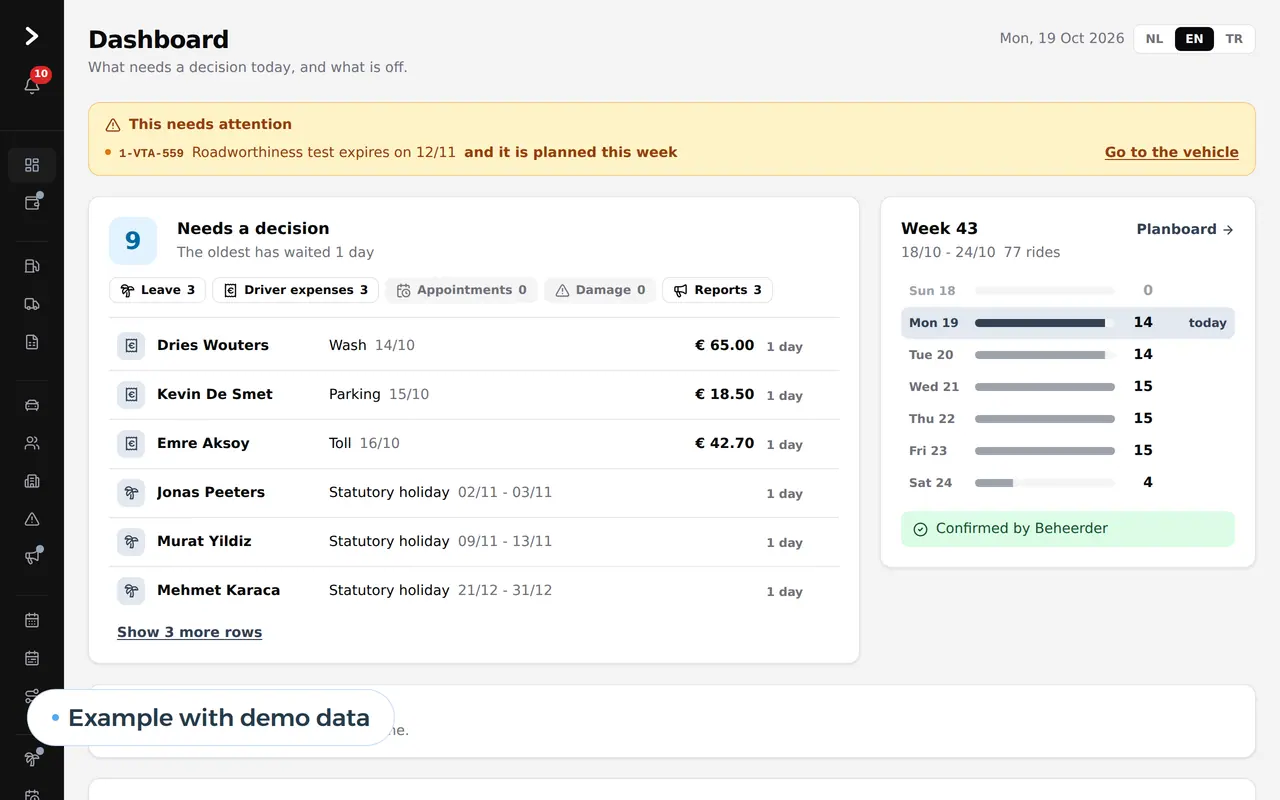
A file per client
Clients, tasks and what needs a decision in one place, like the dashboard of the transport platform we built.
Reminders nobody has to write
Per client an email listing exactly what is missing for the period, in their language, well before the filing date.
ChatGPT for accountants or an assistant inside your firm
- Client data
- Standalone AI toolsPasted into someone else's tool, often without a processing agreement
- Built into your firmStays in your own environment in the EU, separated per client
- Documents
- Standalone AI toolsUploaded one by one
- Built into your firmArrive via portal, email or app and are read automatically
- Follow-up
- Standalone AI toolsYou remember what is missing
- Built into your firmThe system tracks what is missing and drafts the email
- Your accounting package
- Standalone AI toolsNothing, you retype the result
- Built into your firmAn export or integration in the format your package imports
- Audit trail
- Standalone AI toolsNo record of what the AI did
- Built into your firmEvery suggestion with its source and who approved it
A general AI helps with a text. An assistant inside your firm helps with your clients, and keeps a record of what it did.
Six people, 120 client files: the sum
Take a firm with six staff and 120 small-business clients. The figures are assumptions; run them again with your own firm.
| Task per month | Without AI | With AI, a person approves |
|---|---|---|
| Sorting and pre-coding 3,000 unstructured documents, 1.5 minutes each | 75 hours | 15 hours of checking |
| Chasing missing documents from 120 clients | 10 hours | 2 hours |
| Looking up and answering client questions, 320 a month at 6 minutes | 32 hours | 12 hours |
| Total | 117 hours | 29 hours |
That is 88 hours a month, or 1,056 hours a year: more than half a full-time hire you do not have to find. At an assumed cost of 55 euros an hour it is worth 58,080 euros a year.
And the AI itself? Reading one document takes a model about 2,500 input tokens and 400 output tokens. With Claude Sonnet 5.5, at 2 dollars per million input tokens and 10 dollars per million output tokens, 3,000 documents a month cost about 27 dollars. With a fast model such as Claude Haiku 5.5 it is under 2 dollars. Run your own numbers in the ChatGPT API cost calculator, and compare models in ChatGPT vs Claude.
An investment of 30,000 to 50,000 euros in an AI layer around your client files pays back within a year in this example.
A client portal where AI reads first
For FK Boekhouding, an accounting firm in Ghent, we built a site in four languages with a client portal that books appointments. For Business Centrum, a payroll bureau, a management platform with a portal where employers enter their staff hours and send reports themselves.
That is where AI fits best: whatever the client uploads or asks is read at once and prepared for your file manager, in the file where it belongs.
- Appointments and questions through the portal
- Documents filed with the right client straight away
- A draft answer from the file

Professional secrecy, GDPR and the EU AI Act in your firm
An accountant works with the most sensitive data a client has. AI does not change that; it only sharpens the question of who sees what. These are the rules, and the questions to put to any AI supplier. They apply across the EU; UK firms serving EU clients meet the GDPR and AI Act duties through those clients.
| Rule or question | For your firm |
|---|---|
| AI literacy, AI Act Art. 4, since 2 February 2025 | Staff who use AI know its limits. A short training and an internal AI policy usually do |
| Transparency, AI Act Art. 50, since 2 August 2026 | If a chatbot answers your clients, they must know it is AI |
| GDPR and a processing agreement | An AI service that handles client data is a processor. Without an agreement it is not allowed |
| Where does the data live? | Choose an environment in the EU and a model that does not train on your data |
| Professional secrecy | Every file separated per client, with a log of who opened what |
| Who approves? | An AI suggestion is never a booking. A person approves, and that is recorded |
The European federation of accountants, EFAA, puts security first when choosing an AI tool in its guide on AI in accounting. Which duties your use case carries takes two minutes with the EU AI Act compliance checker; whether you need a policy is answered on do I need an AI policy?

An accounting firm starts with AI in three steps
- One quarter as a trialWe take a quarter of documents from a handful of clients and show what the system extracts, field by field, and where it hesitates. After four to six weeks you know how many hours it saves.
- Connect to your package and portalThe extracted data flows into the accounting package your firm already uses. Clients upload through a portal, email or app.
- Roll out team by teamDocuments first, then reminders, then client questions. We measure every step, so you know what it brings.
What FK Boekhouding and Business Centrum taught us
For FK Boekhouding, a certified accounting firm in Ghent, we built the four-language site and the portal where clients book an appointment; there is no AI in it yet. The Business Centrum platform replaces a payroll bureau's spreadsheet with client files, documents, tasks and an import that reports what does not add up. And for AMOSI, our own software that went live in July 2026, we built a layer that reads company documents and keeps the source of every fact: the core of what your firm does with client paperwork.
What we do for your firm:
- We start with a quarter of your clients' paperwork, not a demo. You see what AI extracts from your own documents.
- Your package stays: we build alongside it and connect to it.
- Every suggestion can be traced, with its source and who approved it.
- Data stays in the EU, separated per client, never used for training.
The broader offer is on AI for business, and why a team in Belgium can be the right call is on nearshore software development. Show us a quarter of one client's paperwork: book a call.
What accountants ask us about AI
Will AI replace our bookkeepers?
It takes over sorting, retyping and chasing. Advice, review and responsibility stay with you. Seven in ten accountants in the ITAA barometer expect AI to push the profession towards more specialised advice.
Does it work with our accounting software?
We connect to the package you use, or deliver an export in the format it imports. You do not have to switch.
Is AI still useful now that e-invoices arrive structured?
Yes. E-invoicing structures domestic B2B invoices, but receipts, foreign invoices, certificates, contracts and client questions stay unstructured. And an e-invoice still has to land in the right file and account.
How do you protect our clients' data?
Data stays in an EU environment, separated per client, under a processing agreement, and the language model does not learn from it.
Is this worth it for a small firm?
Yes. A firm of three or five people often gains relatively more, because nobody there only sorts paperwork. We start with one use case and extend once it works.
Can you work with a firm outside Belgium?
Yes. We work in English by video call; accounting rules differ per country, so we build around your package and your local filing calendar rather than Belgium's.
AI for business
How VBS helps you with this
We build AI into your own work: it drafts emails, reads documents and answers questions, and you stay the one who decides.
- First a task that costs time, then a working prototype
- On your own documents and your own data
- An AI policy your team understands
How we approach it is on our page about AI for business.
Less chasing, more advising?
Show us a quarter of one client's paperwork. We will show you what AI extracts, and what it is worth to your firm each year.
Rather get in touch right away?