On this page
A competitor analysis template for online channels takes an hour: note where competitors rank in Google, test their sites, count their reviews, look up their ads, check what they post and ask an AI assistant whom it recommends. Then score yourself and four competitors from 0 to 3 on each of those six channels. The Excel file adds it up and shows where you trail and where you win cheaply. You download it without leaving an email address.
The worked example is built for a company that sells across borders: a fictional web studio that competes with agencies in Belgium, the Netherlands and the UK. Most templates assume one market. Online, your competitors in Amsterdam and Manchester show up for the same buyer as the agency down the road.
Picking competitors per market
Pick four: two that your clients also ask for quotes, and two that rank above you for your main search term. If you sell in several countries, take them per market, because the same service has different leaders in each. A search for web design in Ghent, in Rotterdam and in Leeds returns three different first pages, and the words people type differ too.
| Market | Search in | Language of the term | Watch for |
|---|---|---|---|
| Belgium | google.be | Dutch and French, often English for B2B | Flemish and Walloon competitors are rarely the same |
| Netherlands | google.nl | Dutch, Netherlands spelling | Dutch terms differ from Flemish ones |
| United Kingdom | google.co.uk | British English | Local agencies with many reviews |
Search in a private window, so your own history does not count, and set the region in Google's settings. What people actually type is the subject of keyword research; the search intent behind a term tells you whether that visitor wants to buy or to learn. If you serve several countries from one site, the language versions need hreflang so Google shows the right one; a website in French and Dutch shows how that works in Belgium.
One hour, six measurements
- Search terms, 15 minutesYour three main services in each market's own Google, in a private window. Note positions and the words in competitors' titles.
- Website, 10 minutesPageSpeed Insights on mobile for each home page, and the system each site is built on.
- Reviews, 5 minutesCount, rating and the date of the latest review on Google.
- Ads, 10 minutesMeta Ad Library and the Google Ads Transparency Center, filtered on the right country.
- Social and AI, 20 minutesPosts in the last 30 days, then three buying questions to ChatGPT, Gemini or Copilot.
What to look up, and where
Two details make the difference. For search terms, look at the title tag of whoever ranks above you: which words come first, and which services get a page of their own? The SERP preview shows how your title compares. For ads, the Meta Ad Library has shown every ad that ran in the EU since the Digital Services Act, with its run dates, for a year after its last impression. An ad that has run for months is probably paying off for that advertiser. Filter on the right country for each market.
The example: one studio, three markets
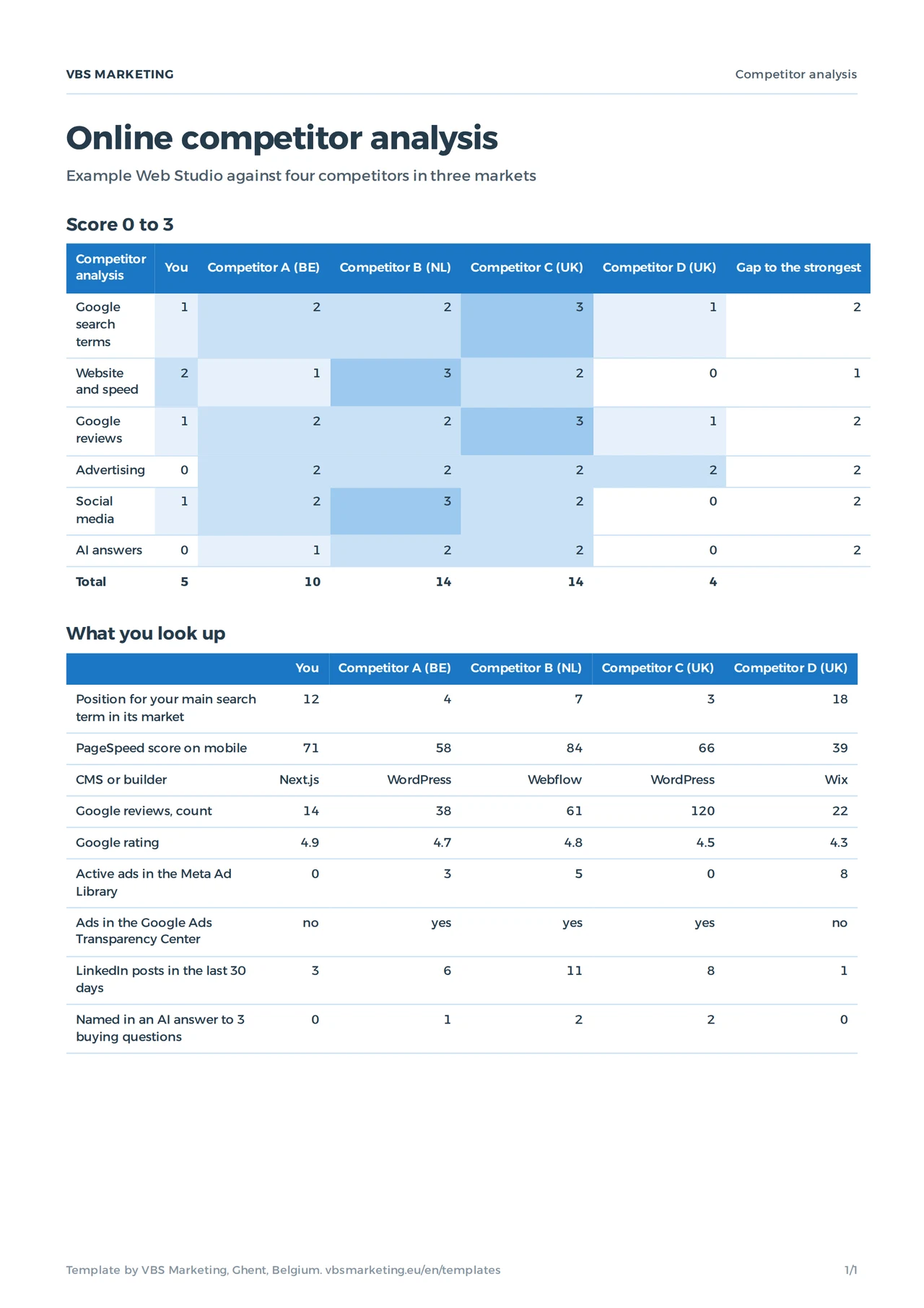
The filled-in sheet is a fictional web studio that sells in Belgium, the Netherlands and the UK. This is what its hour turned up.
- Search termsPosition 12 for its main service in its home market. The Belgian competitor ranks 4th in Belgium, the Dutch one 7th in the Netherlands, the strongest British one 3rd in the UK.
- WebsitePageSpeed gives the studio 71 on mobile, the Dutch competitor 84, one British competitor 39.
- Reviews14 reviews at 4.9, against 61 for the Dutch competitor and 120 for the strongest British one.
- AdsNothing running in the Meta Ad Library; the Dutch competitor has 5 active ads, one British competitor 8.
- LinkedInThree posts in 30 days, against 11 for the Dutch competitor.
- AI answersNot named once in three buying questions; the Dutch and the strongest British competitor twice each.
The lesson for a company selling across borders: the leader differs per market, and a competitor you never meet in a pitch can still own the first page in the country you want to grow in.
Scoring: 0 to 3 per channel
The matrix is only useful if you score strictly and the same way for everyone, yourself included.
| Score | Meaning | Example for Google reviews |
|---|---|---|
| 0 | Absent | No profile or no reviews |
| 1 | Present but weak | Fewer than 20 reviews or a rating below 4 |
| 2 | Good | 20 to 80 reviews, rating above 4.3, recent |
| 3 | Strong, the benchmark in your market | More reviews than the rest, new ones every week |
In the example, the fictional web studio scores 5 out of 18. The Dutch and the British competitor each reach 14: strong on search, reviews and LinkedIn, and named by AI assistants. The studio's own site is fast, 71 on mobile, but it has few reviews, no ads and is not named in a single AI answer. Its gap is 1 to 2 points on every channel, which means no single fix, but also no channel where it is hopeless.
Total score out of 18: six channels, 0 to 3 each
- You, Example Web Studio5 of 18
- Competitor A, BE10 of 18
- Competitor B, NL14 of 18
- Competitor C, UK14 of 18
- Competitor D, UK4 of 18
The two strongest players are in the Netherlands and the UK; the gap is 1 to 2 points on every channel.
Which channel to tackle first
A matrix without a plan is just a nice sheet. Take your gap per channel and the cost of closing it, and start where the ratio is best.
- Choose reviews ifyou trail and have happy clients who were never asked. It costs nothing and works fastest locally; see how to get more Google reviews and how to set up a Google Business Profile.
- Choose search terms ifcompetitors have a page for services where you have none. That takes months; how long SEO takes is honest about how many.
- Choose ads ifyou need enquiries fast and your site already converts. Which platform fits is in Meta Ads or Google Ads.
- Choose AI answers ifcompetitors are named and you are not. How assistants pick companies is in how to get found in ChatGPT, and whether their crawlers may read your site shows in the AI crawler checker.
Put the outcome in your marketing plan with a date per step, and run the same sheet again in three months. The difference between the two matrices is your result.