Inventory management
Custom inventory management software, right to the litre
Custom inventory management software: every delivery, every withdrawal and every correction, with a balance that always reconciles.
Stock in a spreadsheet is only right on counting day
Stock in a spreadsheet is right on the day you count it, and a little less right every day after.
Deliveries get entered when someone has time, withdrawals are forgotten, and what the online store sells lives in another system. At the annual count the gap is large and nobody knows where it started. Meanwhile you over-order what sits still and reorder too late what runs out.
Custom inventory management software books every movement the moment it happens: a delivery with its invoice, a withdrawal by whom and when, a correction with a reason and a name. The balance on screen is the balance in your warehouse, and you see per delivery what is left and what it cost. We build it from Ghent, Belgium, for businesses across Europe.
FIFO inventory: every withdrawal from the oldest delivery
Three deliveries, one stock
Example with demo data
Fully used
Fully used
Partly used
27,400 L withdrawn, oldest delivery first
6,200 L still in stock, from the latest delivery
- Oldest firstEvery refuel or withdrawal takes litres from the oldest delivery that still has some. So you know per delivery what is left.
- A correction leaves a trailIf the tank reading differs from the books, the system books the gap with date, reason and name.
- The report builds itselfA monthly overview that reconciles: delivered, withdrawn, balance. For your accountant or for customs.
Four ways to value stock, and the rules
Tracking stock is one thing, valuing it another. Most accounting frameworks allow a few methods for interchangeable goods such as diesel, screws or flour; your accountant picks one and applies it consistently.
| Method | How it calculates | Where it fits |
|---|---|---|
| FIFO, first in first out | What came in first goes out first; what remains is valued at the latest prices | Perishable or date-sensitive goods, fuel, anything with batch numbers |
| Weighted average cost | Each withdrawal at the average purchase price of what is in stock | Bulk goods and items with many small deliveries |
| LIFO, last in first out | What came in last goes out first | Allowed under Belgian rules, not under IFRS; rare in small businesses |
| Specific identification | Each item at its own purchase price | Unique goods: machines, vehicles, art |
Belgian law also requires at least one full inventory a year, and most EU countries have a similar rule. If you hold excise goods, such as professional diesel under Belgium's excise refund scheme, customs also want to see that delivered, used and in stock reconcile, with an explanation for every gap.
Software that keeps every movement per delivery can calculate each method and show the inventory at any time. To check the margin per item, use the margin calculator.
Stock down to the litre, customs included
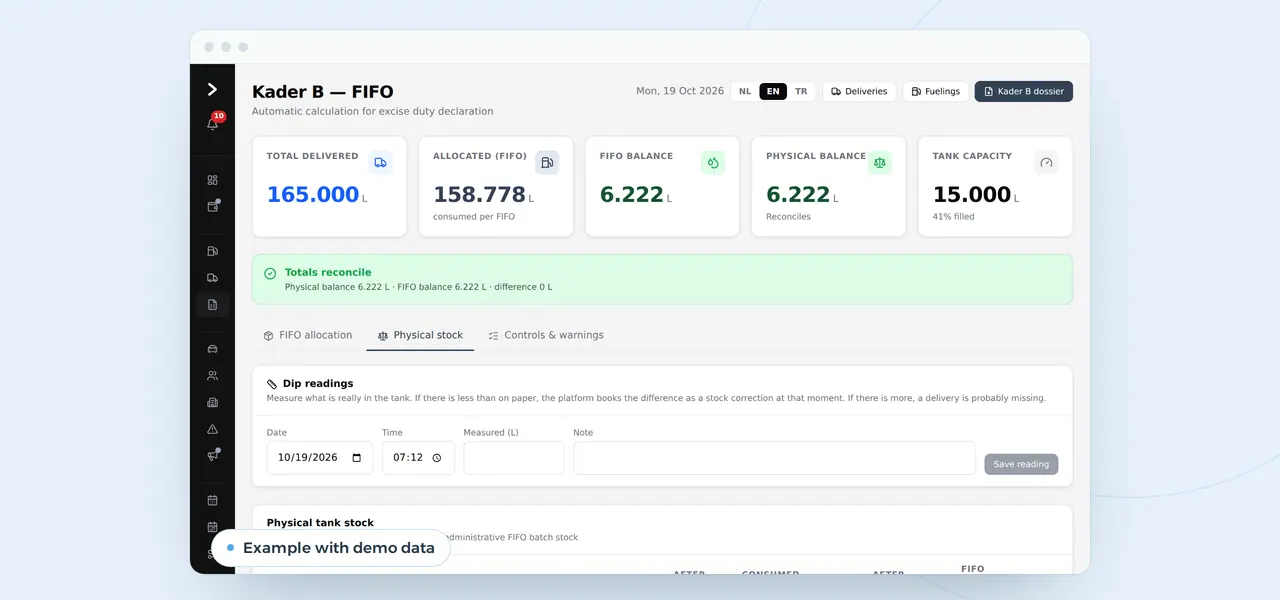
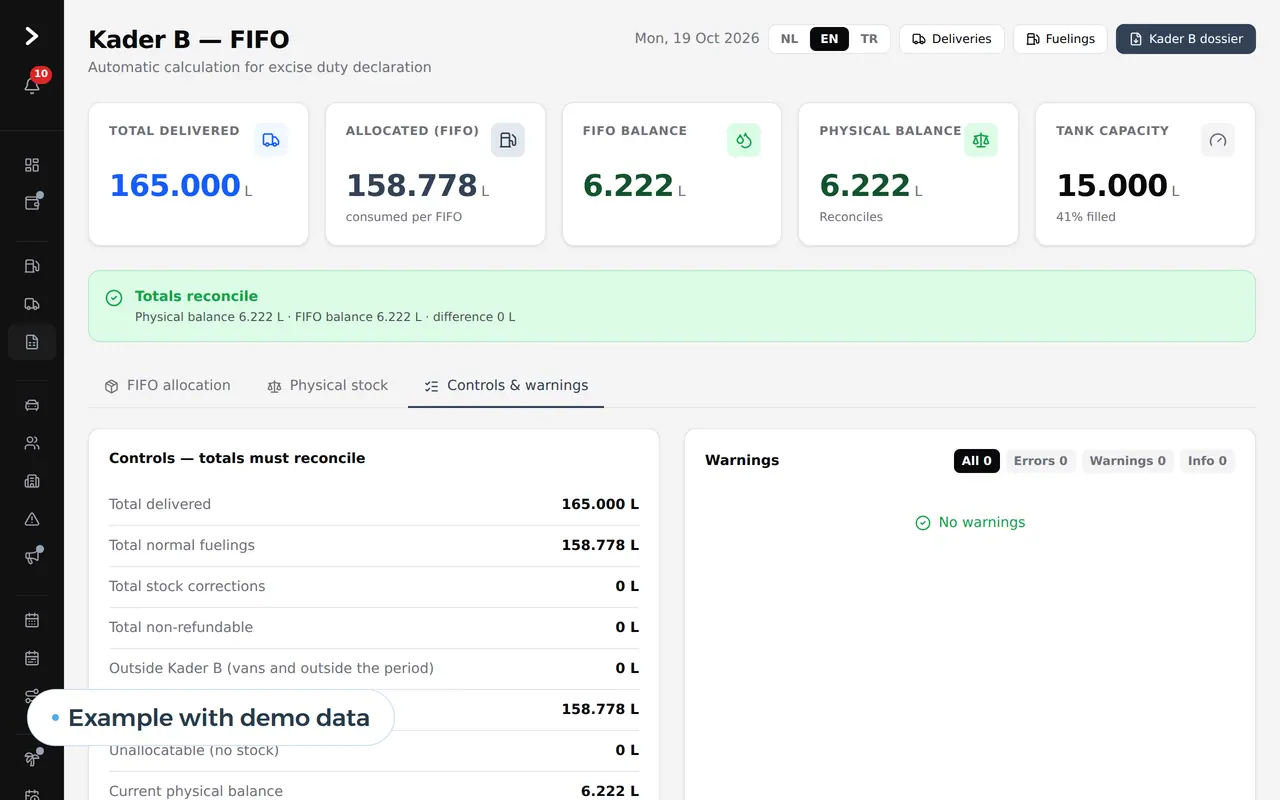
For DA Logistics, a Belgian haulier, we built inventory management for professional diesel under the Belgian excise refund scheme. Every delivery, every refuel and every tank reading is in the system. Delivered, allocated and physical balance must reconcile, and the screen says so when they do. A correction leaves a trail with reason, date and name, and the discrepancy report for customs builds itself.
At Zuco Logistics stock works differently: a depot with purchases on invoice, FIFO on purchases and an export for customs. Two companies, two ways of handling stock, one core.
- Deliveries with invoice and date
- Withdrawals per person, vehicle or order
- Readings and corrections with reason and name
- A monthly report that reconciles
What changes in your warehouse, step by step
This is what changes per step once your stock lives in a system of your own.
| Process | Today | With your own system | What you gain |
|---|---|---|---|
| Receiving goods | A note in a folder, entered later | Booked on arrival, with the invoice and purchase price per delivery | The balance is right the same day |
| Withdrawals | Forgotten or on paper | Per person, vehicle, site or order, also with a phone camera | You know where every item went |
| Online store and shop | Two stocks drifting apart | One stock, sales come off at once | No more selling what is gone |
| Reordering | When someone notices it is out | A minimum per item and an order list that fills itself | Fewer shortages, less cash on shelves |
| Counting | Once a year, a gap without explanation | Cycle counts per zone, with the movements that explain a gap | A smaller gap, and a reason |
| Valuation | Your accountant reconstructs it | FIFO or average cost per item, at any moment | A faster year-end |
Delivery notes and supplier invoices need no retyping: AI can read them and queue them for review, see invoice automation. Material a technician takes along comes off stock through the work order app. If it becomes a system for your whole company, read custom ERP development. Selling mostly online? Start with webshop development; a screen with stock and sales per day is custom dashboard development, installers with material in the van read software for installers, and why a team in Belgium is on nearshore software development.
Inventory and warehouse management we can build
Examples of what we could build, next to what already runs.
Stock linked to your online store
What sells online comes off stock at once. When something runs out, it is no longer for sale.
Warehouse management per location
Racks, zones or vans as locations, with transfers between them and who put what where.
Reorder before it runs out
A minimum per item and an order list that fills itself, ready to send to your supplier.
Material per site or job
What a technician takes comes off stock and lands on the work order and the invoice.
A discrepancy report
Where paper and count differ, with the movements that explain the difference.
1,200 items and 400,000 euros of stock: the sum
Take a wholesaler or installer with 1,200 items, a stock value of 400,000 euros and eight people working with the stock. The figures are assumptions; run them again with your own warehouse.
| Item per year | Spreadsheet and an annual count | Your own system |
|---|---|---|
| Updating stock, 6 hours a week | 276 hours | 69 hours |
| Annual count, 4 people for 2 days | 64 hours | 32 hours, spread over the year |
| Count difference, assumed 2% of value | 8,000 euros | 4,000 euros |
| Cash on shelves, 10% less stock through minimum rules, at 8% cost a year | 0 euros | 3,200 euros saved |
The hours differ by 239, worth 9,560 euros at an assumed 40 euros an hour. With the smaller gap and the freed cash, this example yields about 16,800 euros a year.
And a package? This is what they ask:
| Package | Price | For eight users |
|---|---|---|
| Odoo Custom | 35.90 euros per user per month in the first year, then 44.90 | 3,446 euros, then 4,310 euros a year |
| Exact Online for wholesale, Plus | 449 euros a month, one user and the bookkeeping included | 5,388 euros a year plus extra users |
| Custom | The build, 25,000 to 35,000 euros in this example, then hosting and maintenance | The build once, then a few hundred euros a month |
A package is the right call when your stock is ordinary. Custom pays off when you have rules a package does not know: settling per delivery, excise, batch numbers, material that disappears on a site, or one stock spread over store, shop and vans. A system worth 16,800 euros a year pays back an investment of 25,000 to 35,000 euros in about two years. What Odoo really costs is on Odoo pricing; the alternatives on Odoo alternatives, and the general case in build vs buy software.
Nine weeks to the first count in the new system
- Week 1Your items and your movementsWe load your items, quantities and locations from a spreadsheet or your current system and map every movement your stock knows, over a video call.
- Weeks 2 to 6A first version on your real stockDeliveries, withdrawals, corrections and the balance per item and location, on a test environment. Your warehouse works in it next to the spreadsheet.
- Weeks 7 to 9Connect and scanYour online store, your accounting and scanning with a phone camera. A first count in the new system.
- After thatReordering and reportsMinimum rules, an order list and a monthly report that reconciles. Every release goes live in seconds, with a backup and a way back.
- litres: the new diesel tank, in balance from 1 October 2026
- 23,500
- refuels in the DA Logistics platform on 3 August 2026
- 1,182
Stock that customs look at
Our strongest proof is stock that customs look at. At DA Logistics, a Belgian haulier, the platform tracks diesel stock with FIFO per delivery, a correction log and a discrepancy report, and the stock sits with the refuels, the fleet and the drivers. At Zuco Logistics the same core got its own stock model: a depot with purchases on invoice.
What we do for your stock:
- We map your movements first: where goods arrive, where they go and who books what.
- We build only what a package cannot, and connect to what you have: your online store, your accounting.
- Your warehouse scans with a phone, no separate scanners.
- You own the system: code, data and a server in the EU.
We build inventory management as a web application. Tell us what you track and where it goes wrong today: book a call.
What warehouse managers ask us
Can we import our current stock?
Yes. We load your items, quantities and locations from a spreadsheet or your current system, with a report of what does not add up.
Does it work with our online store?
If your store allows an integration, we sync sales and stock both ways. Shopify, WooCommerce and most systems can; what Shopify costs over three years is in Shopify cost.
Can we scan?
Yes. A barcode or QR code scans with a phone camera, no separate scanner needed.
Can it run FIFO and average cost side by side?
Yes. Because every movement is kept per delivery, the system calculates each method. Your accountant picks which one goes into the accounts.
Do we still need to count?
Yes. The law asks for at least one inventory a year, and counting is the only way to see theft, breakage and mistakes. But you count per zone, spread over the year, and every gap has a trail.
Can it run in our language and currency?
Yes. Interface language, units and currency are settings. Our platforms already run in Dutch, English and Turkish.
Web application
How VBS helps you with this
We build software in the browser for your whole team, on every computer and phone, around the way you work.
- Roles and permissions per person
- Links to your accounting and your email
- Releases without downtime, with backup and rollback
How we approach it is on our page about Web application.
Stock that reconciles without counting?
Tell us what you track and where it goes wrong today. We will show you how it works in a system of your own.
Rather get in touch right away?