Trades
AI for plumbers and electricians: from voice note to job report
The engineer talks, AI writes the report and the parts list, the office invoices the same day.
The hours after the job
AI for plumbers and electricians writes job reports from voice notes, drafts quotes from photos and answers calls after hours. The work stays with the engineer; what AI takes over is the writing afterwards and the puzzling before.
A heating, plumbing or electrical business loses hours to text every day. Engineers write up job sheets in the evening, the office retypes them for the invoice, the owner writes quotes at the weekend after a site visit. And the phone keeps ringing after five, when nobody picks up.
This page covers three flows where a trades business wins hours, plus an assistant for calls after hours, with what each costs a month and the human check that stays. Up front: we have no trades business as a client; the proof comes from a platform with a staff app we built for a haulier.
A voice note becomes a job report
Voice note
Boiler service at the Patels in Leeds, burner cleaned, heat exchanger gasket replaced, pressure was 0.8 bar, topped up to 1.5. Next visit check the expansion vessel. An hour and a quarter.
- TranscribeSpeech to text, accents and trade terms included
- StructurePull work, parts, readings and time out of the text into the report template
- CheckThe engineer reads it and signs on the phone
Job report
The Patel family, Leeds
- Work
- Gas condensing boiler service, burner cleaned
- Parts
- 1 heat exchanger gasket
- Readings
- Pressure 0.8 bar, topped up to 1.5 bar
- Time
- 1 h 15 min
- Next visit
- Check the expansion vessel
Example with a made-up customer and job.
Three flows that win back hours
| Flow | What AI does | Check | Cost a month, roughly |
|---|---|---|---|
| Voice note to job report | Transcribes the recording, pulls out work, parts, readings and time, fills your job card template | The engineer reads and signs on the phone | Transcription at 0.006 dollars per minute; 20 engineers, 4 one-minute notes a day, 22 days: about 11 dollars |
| Photos to quote | Drafts a quote with parts and hours from site visit photos and notes, using your own price list | The owner or estimator edits and sends | A few dollars of model cost; the value sits in your price list |
| Maintenance that schedules itself | Contracts coming due, grouped by area and engineer, a proposed slot sent to the customer | The planner confirms | A one-off build, little after |
| Calls after hours | A voice assistant that takes the call, notes the fault and offers a slot | An urgent fault goes straight to whoever is on call | About 0.05 dollars a minute for the voice model, plus the language model |
Model prices are the vendors' own, in dollars. A report from a voice note is done only when the engineer has checked it: a model can mishear a reading. So the recording stays attached to the report, and anyone in doubt can listen back. Quotes from photos are covered in depth on AI quote generator.
The paperwork AI can prepare, and what it cannot sign
Trades work comes with certificates and records that a person must sign. AI can draft them from the job; it cannot sign them.
| Record | What AI can prepare | What stays with the engineer |
|---|---|---|
| Job report and invoice lines | Work, parts, time and readings from the voice note | Checking every reading and signing |
| Service record for a gas appliance | The fields from the job card, the next service date | The checks themselves, and the signature of a registered engineer |
| Electrical installation certificate | The circuit list and test results typed up from notes | The tests and the signature of a competent person |
| Quote | Parts list and hours from photos and your price list | The price and the decision to send |
Which certificates apply depends on your country and scheme, such as Gas Safe registration or a competent person scheme in the UK; check with your scheme. The point is simple: AI removes the typing, not the responsibility. Hours per job belong in a time tracking app, and parts in the van in inventory management software.
Where our job-sheet and planning work fits a plumbing firm
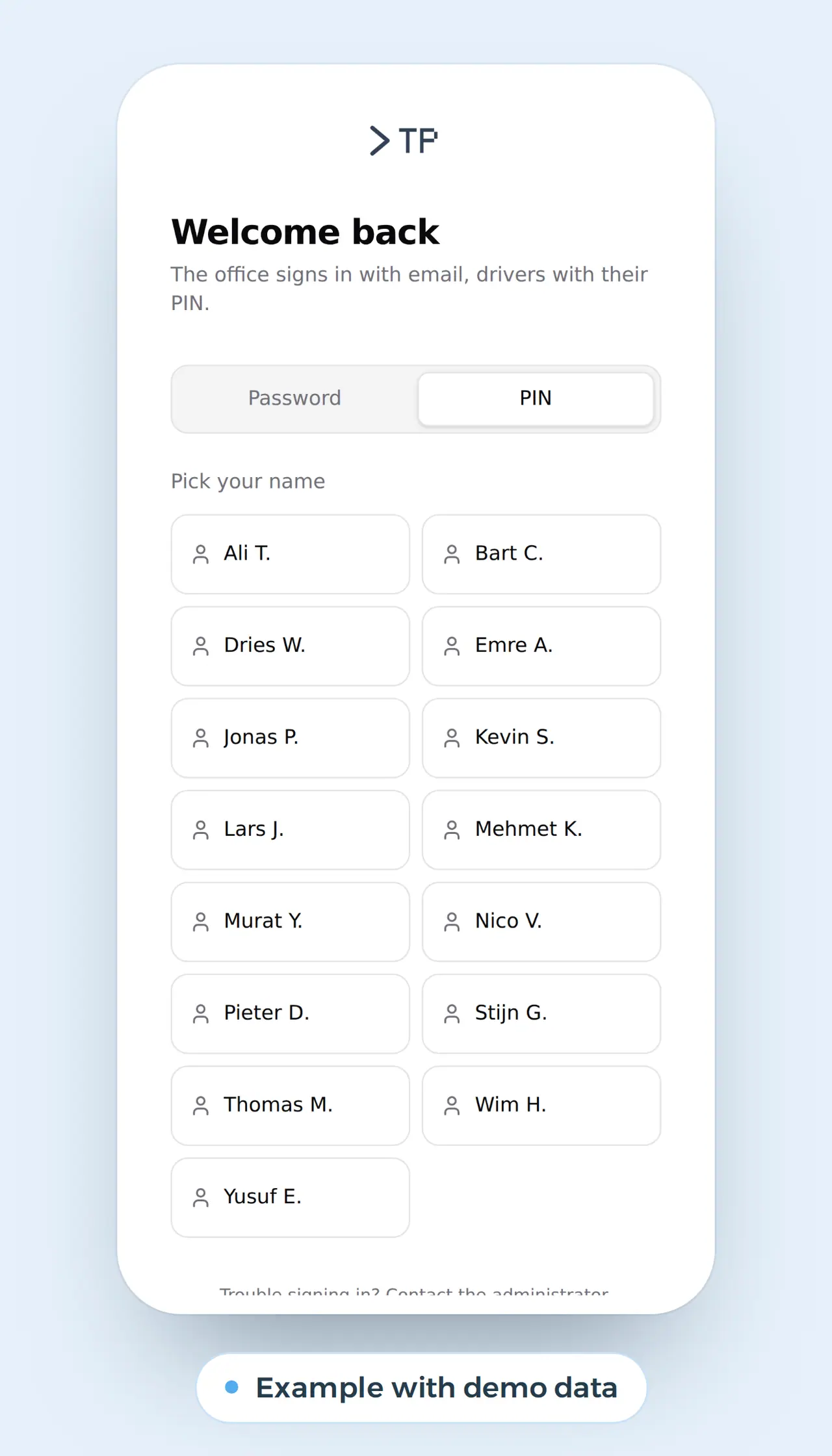
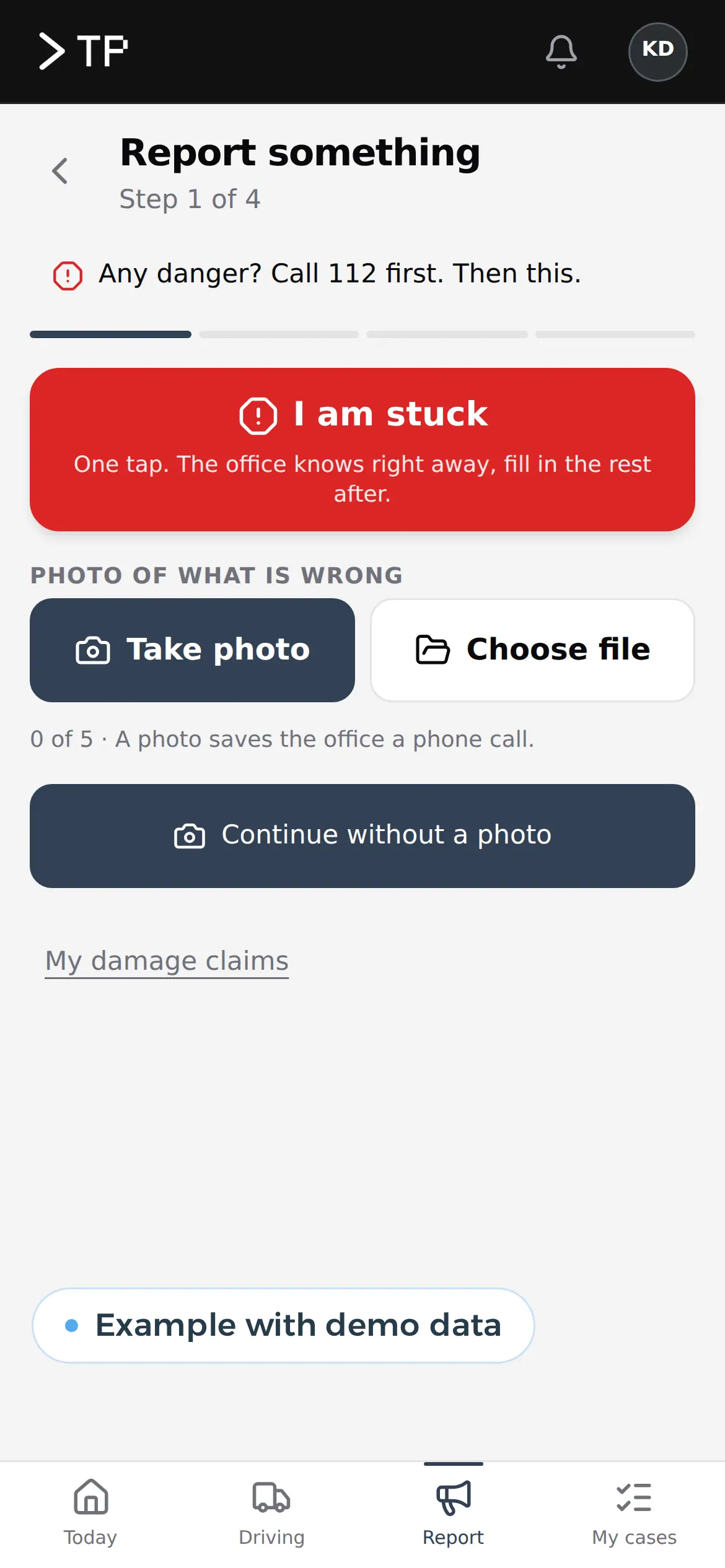
For DA Logistics, a haulier, we built an app in which about thirty drivers request leave, upload receipts and report damage or problems with their truck, in Dutch, English or Turkish. They sign in with a name tile and four digits, with no password to remember.
In the office those reports arrive in queues, and a mail layer sends fourteen kinds of messages. For a trades business the drivers become engineers and the trucks become installations: the same flow from the field to the office, where a voice note is the next step.
How a job runs from call to next service through such a system is on software for installers.
Where AI fits in your software
AI works best inside the software your engineers already use. A report that appears in a separate app has to be retyped again. The order we recommend:
- Digital job cards first. An app where the engineer fills in the job, takes photos and gets the customer's signature. What it needs is on work order app.
- Then the voice note. A button on that same job card: talk instead of type, and the report fills the fields.
- Then quotes and planning, from the same data: the customer's installations, contracts and your parts list.
- Then the phone after hours, with an assistant that knows which customers have a contract and which faults are urgent. How such an assistant answers and hands over is on AI customer service.
Many installers also work on building sites; how AI helps there is on AI for construction. An assistant that books the slot itself, rather than only noting it, is an AI agent.
Where to start, by size of business
The right first step depends less on the technology than on how many people write reports today.
| Business | Start with | Add next |
|---|---|---|
| One to three engineers | A phone assistant after hours, so no call goes unanswered while you are on a job | Quotes from photos, from your own price list |
| Four to fifteen engineers | Digital job cards with a voice note button, linked to invoicing | Maintenance contracts that propose their own slots |
| More than fifteen engineers | Job cards and planning in one system, with reports from voice notes | An assistant that sorts incoming calls and emails by urgency |
Whatever the size, the order stays the same: first make sure the data lands in one place, then let AI fill it. A voice note that ends up in yet another inbox saves nothing. And keep the engineer as the last check: a report goes out under their name, so they read it before they sign.
A worked example for twelve engineers
The model cost for those notes stays under 10 dollars a month. The real cost is the build: the job card app, the link to your invoicing and the template of your report. We quote a fixed price per project after a first call. Check model costs for your own volume with the AI cost calculator; how a business brings in AI step by step is on AI for business and implement AI in business. Supplier invoices can be read and booked the same way, see invoice automation; what an assistant may do on its own is explained in AI agents explained, and what a phone or chat assistant costs in full in AI chatbot cost.
AI for business
How VBS helps you with this
We build AI into your own work: it drafts emails, reads documents and answers questions, and you stay the one who decides.
- First a task that costs time, then a working prototype
- On your own documents and your own data
- An AI policy your team understands
How we approach it is on our page about AI for business.
Job reports that write themselves?
Tell us how your job sheets run today, how many engineers you have and what you invoice with. After a call you get a proposal and a fixed price.
Rather get in touch right away?