Custom ERP software
Custom ERP development: your whole company in one system
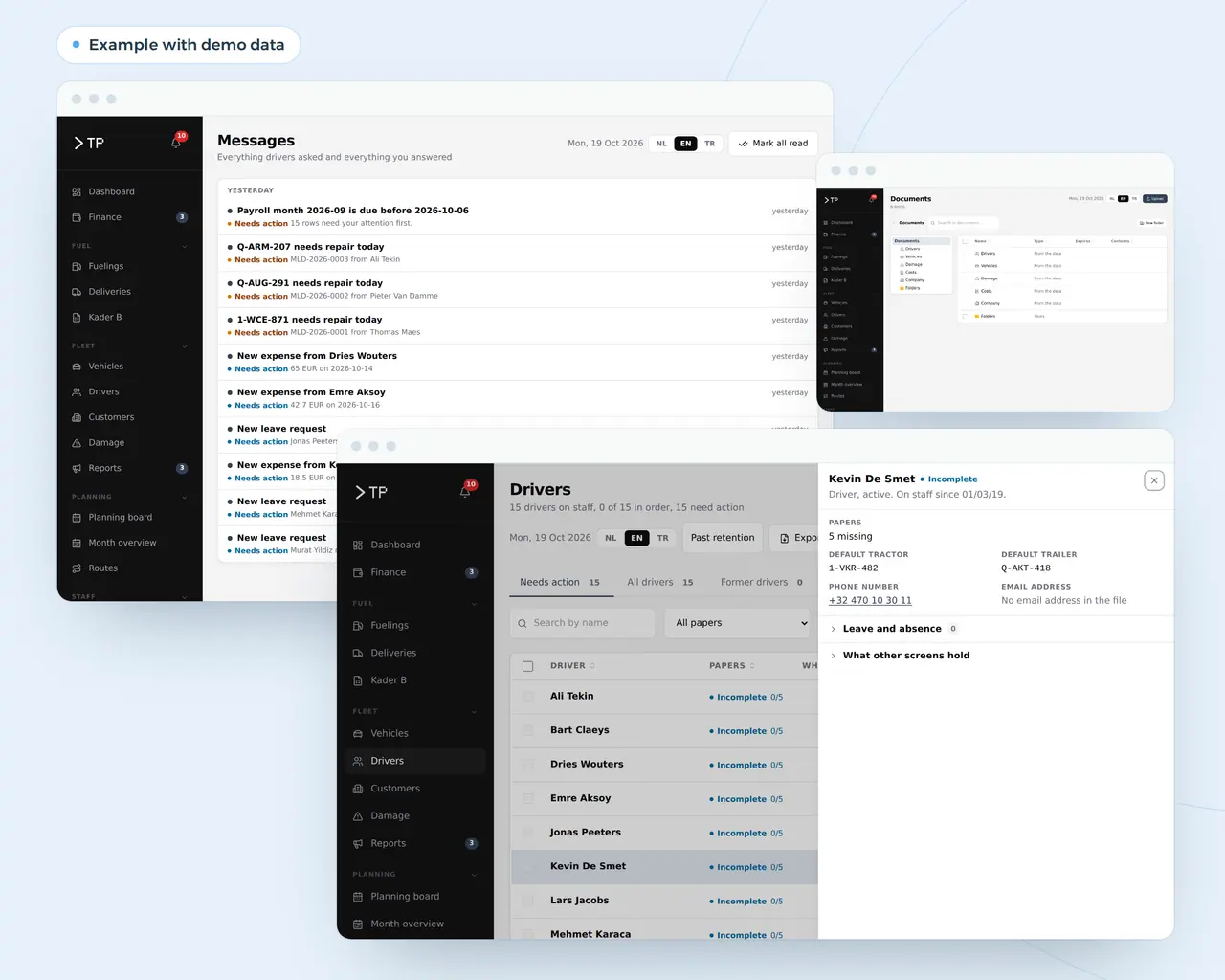
Custom ERP for your company: planning, stock, staff and costs in one database, built module by module.
Five packages that each know one part of your business
An ERP system promises everything in one place. In a small or mid-sized company it often becomes one big package you bend your work around, or five small ones that do not talk to each other.
Planning sits in one, stock in another, staff with the payroll provider and costs in a spreadsheet. Whoever wants to know what a customer, a site or a vehicle really costs lines up four exports. Every time a fact must live in two systems, somebody types it twice.
Custom ERP software starts small and grows with your company. Every module writes into the same database: what an employee enters on a phone is in planning, payroll and costs at once. You do not build everything in one go; you start where you lose the most time.
One database in the middle, the modules around it
- FuelDeliveries, refuels, FIFO stock
- FleetVehicles, inspection, insurance
- PlanningLanes per week, day and night
- CustomersShippers, lanes, agreements
- StaffFiles, papers, leave
- Payroll and costsExpenses, receipts, payroll month
- DocumentsPer driver, vehicle or customer
- Email and alertsWhoever needs to act, sees it
This is how the DA Logistics platform grew: it started with fuel, and every module added later read and wrote into the same database. Today fuel, fleet, planning, staff and payroll live in one system, with no second package next to it.
What each module tracks and reads from the rest
An ERP earns its keep when retyping between systems disappears. This is what each module does, and what it brings because it writes into the same database.
| Module | What it tracks | What it reads from the rest | What you gain |
|---|---|---|---|
| Customers and quotes | Contacts, enquiries, quotes, agreements | What is planned, delivered and invoiced for that customer | A customer file that is right, even when your colleague is on leave |
| Planning | Jobs, trips or sites per day and per crew | Who is available, which vehicle or equipment is free | No double bookings, no forgotten job |
| Stock and purchasing | Deliveries, withdrawals, minimum stock | What planning needs in the coming weeks | Ordering on time, less cash on shelves |
| Staff | Files, certificates, leave | Planning, so nobody is scheduled without a valid certificate | Expiry dates nobody misses |
| Hours and costs | Hours worked, expenses, receipts | Per job, customer or vehicle | Job costing without a spreadsheet |
| Invoicing | Invoices and credit notes, as e-invoices | Hours, material and agreements from the rest | Invoices from the work, not from memory |
| Reporting | A dashboard and a monthly report | Everything above | What a customer or project really earns |
Not every company needs every module, nor in this order. Starting with customers? Read custom CRM development; with stock, custom inventory management software; with numbers, custom dashboard development. The difference between a CRM and an ERP is set out in CRM vs ERP and in the glossary entries for ERP and CRM. Invoices from your own work, over Peppol, are on Peppol invoicing software. What a packaged ERP with implementation costs over three years is worked out in ERP cost per month.
An ERP package or custom ERP software
Odoo, Exact, Dynamics or an industry package work well if your company works the way the package does. This is where they differ.
- Start
- ERP packageFast, with standard modules
- Custom ERPWith one module that wins back time at once
- Your way of working
- ERP packageAdapt to the package, or customise inside it
- Custom ERPThe system follows your way of working
- Cost over time
- ERP packageLicences per user and per module, every year
- Custom ERPBuild per module and hosting, no licence per user
- Industry rules
- ERP packageWhat the vendor provides
- Custom ERPWhat your industry asks, such as an excise refund scheme for diesel
- Who changes it
- ERP packageA vendor partner, at their hourly rate
- Custom ERPUs, in the same code, which is yours
Sometimes an accounting package with a few custom modules next to it is the best answer. We look at that in the first call.
Five years of licences against five years of your own system
Take a company with 15 users. These are the public list prices, excluding VAT, next to what a system of your own costs over the same five years.
| Option | What you pay | 15 users over five years |
|---|---|---|
| Odoo Standard | 19.90 euros per user per month in the first year, then 24.90 | 21,510 euros |
| Odoo Custom, needed for Studio and the API | 35.90 euros in the first year, then 44.90 | 38,790 euros |
| Dynamics 365 Business Central Essentials | 69.30 euros per user per month | 62,370 euros |
| Dynamics 365 Business Central Premium | 95.30 euros per user per month | 85,770 euros |
| Custom, one module | 25,000 to 50,000 euros to build, plus hosting and maintenance at an assumed 300 euros a month | 43,000 to 68,000 euros |
| Custom, three modules | 75,000 to 150,000 euros to build, plus the same hosting and maintenance | 93,000 to 168,000 euros |
The package prices are the eurozone list prices; a package also needs implementing, through an Odoo Success Pack or a partner at their hourly rate. What Odoo really costs a company of 5, 15 or 40 people is in Odoo pricing, and the wider choice in Odoo alternatives.
On licences alone, a package nearly always wins. Your own system wins on what it removes. A worked example with assumed figures: four people each retype data from one system into another for three hours a week. That is 12 hours a week, or 552 hours over 46 working weeks, worth 24,840 euros a year at an assumed 45 euros an hour, or 124,200 euros over five years. A first module that removes that retyping pays back in one to two years. If a package removes it just as well, the package is the better buy.
Where it tips:
- Choose a package ifyou work the way the package does, need few integrations and your industry has no rules of its own.
- Choose custom ifyou would have to bend the package hard, your industry has rules it does not know (such as an excise refund scheme for diesel), or your number of users grows fast.
- Choose both ifyour accounts sit well in a package and the rest of your work does not: a package for the books, your own modules for the rest.
How to weigh it is in build vs buy software; to brief any supplier, use the software requirements specification template. If you want to offer the system to other companies later, it becomes a SaaS platform.
What EU invoicing and privacy rules ask of your system
An ERP touches your invoices, your staff and your customers. These are the rules that weigh on it today, and what they ask of your system.
| Rule | Since or from | What your ERP must handle |
|---|---|---|
| E-invoicing over Peppol between Belgian businesses | 1 January 2026 | Sending and receiving structured invoices through a certified provider |
| E-invoicing in Germany | Receiving since 1 January 2025, issuing phased in from 2027 | Structured invoices for German customers |
| EU VAT in the Digital Age | Intra-EU B2B e-invoicing from 1 July 2030 | One structured invoice flow for every market |
| GDPR | Since 2018 | Rights per user, staff and customer data shielded, a log of who saw what |
| Tax relief for e-invoicing software | Differs by country; in Belgium a 20 percent deduction since 2025 | Ask your accountant whether the invoicing module of your own system qualifies |
Whether your Belgian customers can receive over Peppol shows in the Peppol check.
Module by module, without stopping the office
- July 2026The platform liveThe new version of the DA Logistics platform goes live, with fuel under the Belgian excise refund scheme, on its own domains.
- August 2026The drivers on boardLeave, expenses, appointments and reports in an app in three languages.
- September 2026A second companyZuco Logistics runs on the same core, with its own fuel model.
- October 2026A bigger tankThe switch from a 9,000 to a 23,500-litre tank runs straight into the stock module.
A driver's report, seen in the office at once
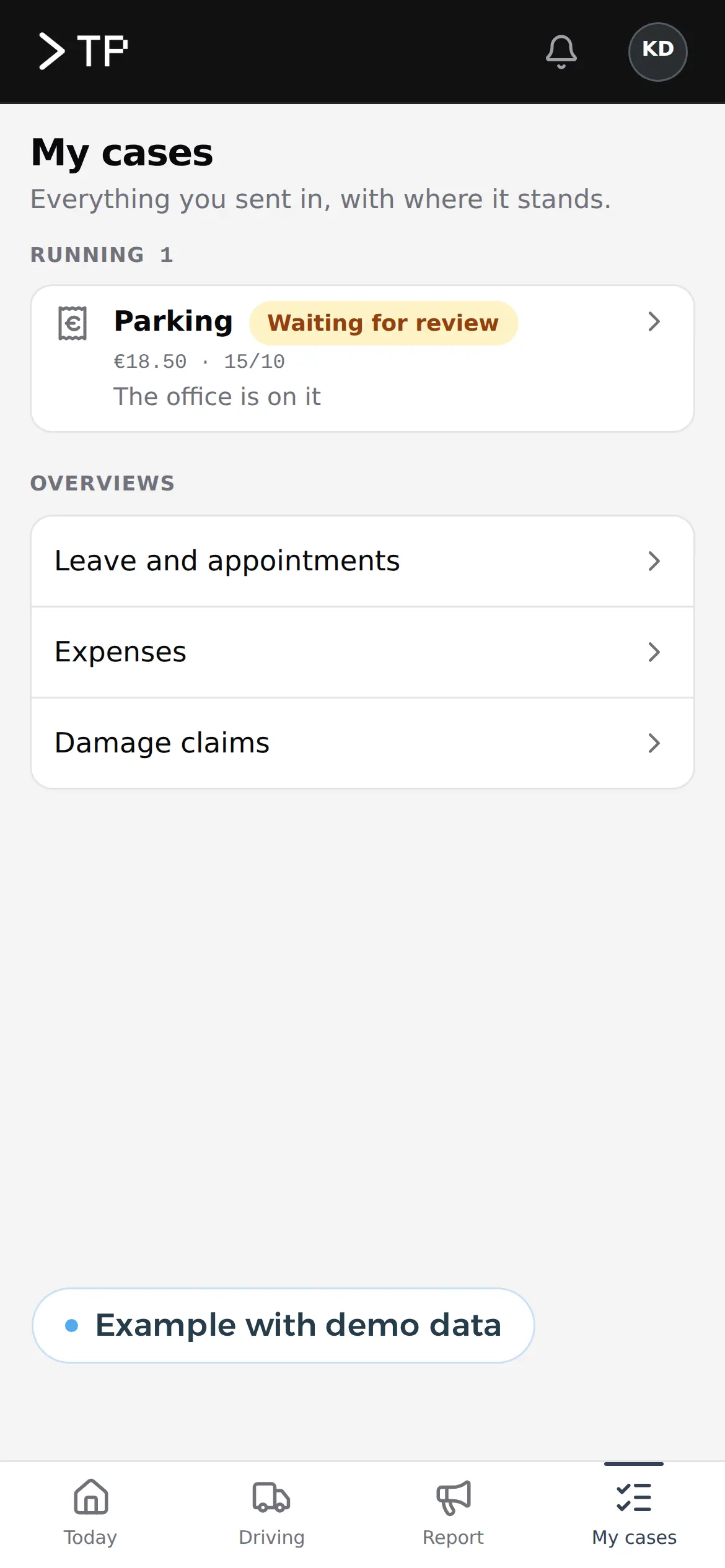
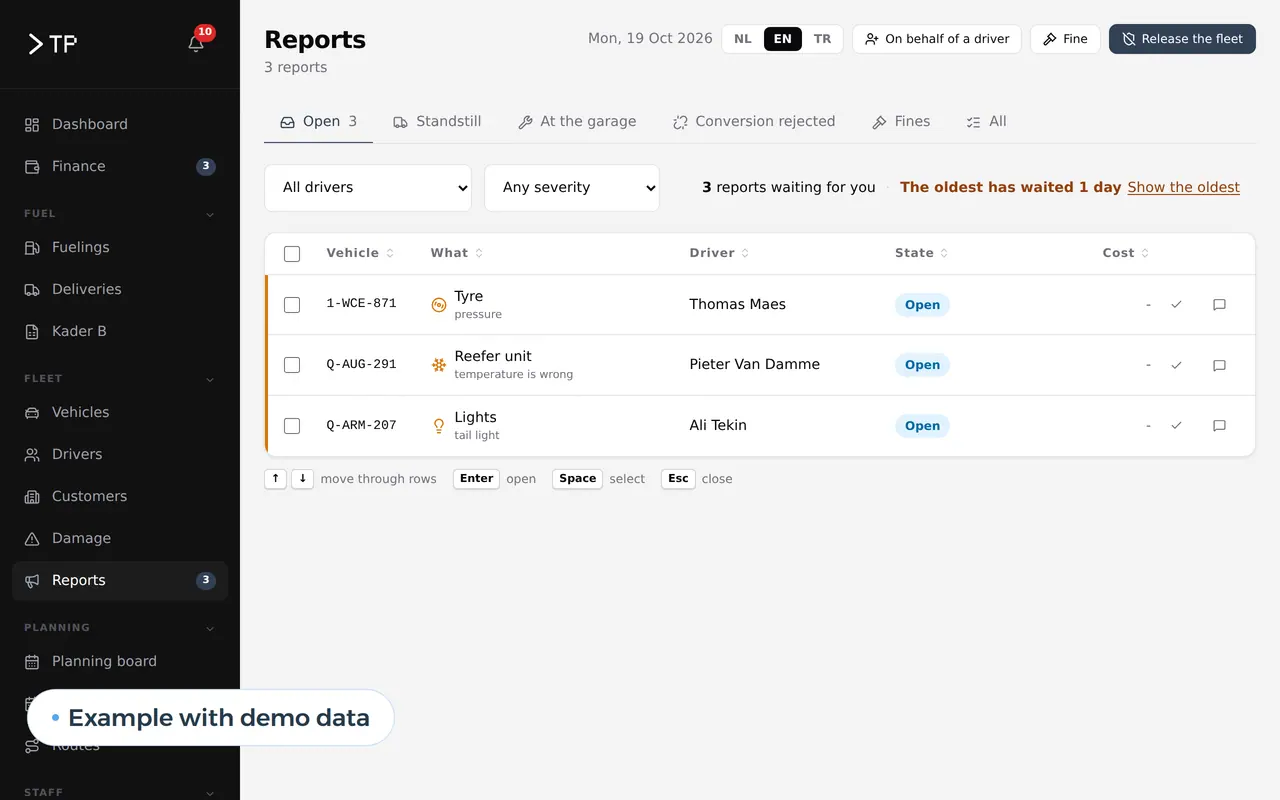
- automated tests guard every release of the DA Logistics platform
- 1,396
- refuels stood in the system on 3 August 2026, each tied to a driver, a vehicle and a delivery
- 1,182
How we built the DA Logistics platform module by module
At DA Logistics, a Belgian haulier, it started with fuel. Then came planning, fleet management, staff with leave and expenses, payroll, costs and an app for the drivers, each in the same database. The office runs on it every day, and since September Zuco Logistics has run on the same core. For Business Centrum we built a management platform that replaces their spreadsheet, tested on 309 employers and 971 employees from their own file.
That is how we build yours, as custom software:
- We start with the module that costs you the most time, not with a hundred-page specification.
- Your accounting package stays: invoices, costs and payroll go out in the format your accountant uses.
- Your data comes along: we import your spreadsheets and old systems, with a report of what does not add up.
- You own the code and the data, on a server in the EU.
The team sits in Ghent and writes specifications, screens and handover notes in English; how working with a team in another EU country runs is on nearshore software development.
Tell us which part of your company costs you the most time. Book a call and we will show you the first module.
What companies ask before they start
Is a custom ERP not too big for a small company?
Not if you build module by module. You start with a part that costs you time today and extend once it runs. DA Logistics started with fuel.
What about Odoo?
Odoo is a good choice if you work the way Odoo does. If you must customise it heavily or have industry rules it does not know, custom is often simpler. It can also be both: a package for the accounts, custom for the rest.
Does our accounting package stay?
Yes. We pass on invoices, costs and payroll in the format your accountant uses, or through an integration if your package has one.
How long until the first module runs?
Usually a few weeks to a few months, depending on the module and the data that comes along. You see a version on your own data along the way.
What if you stop?
The code and the data are yours, on a server in your name or in an account you can take over. Another developer can carry on in the same code.
What does custom ERP development cost?
A first module usually costs 25,000 to 50,000 euros, depending on what it has to do, the integrations and the data that comes along; after that you pay hosting and maintenance, no licence per user. After a call you get a price for that first module.
Custom software
How VBS helps you with this
We build the platform your business runs on every day: your spreadsheets, emails and paperwork in one system that does what you do.
- Your workflow mapped first, then a fixed price
- Screens for the office, the client and the road
- Hosting, backups and security managed by us on AWS
How we approach it is on our page about Custom software.
Where would your ERP start?
Tell us which part of your company costs you the most time. We will show you the first module.
Rather get in touch right away?