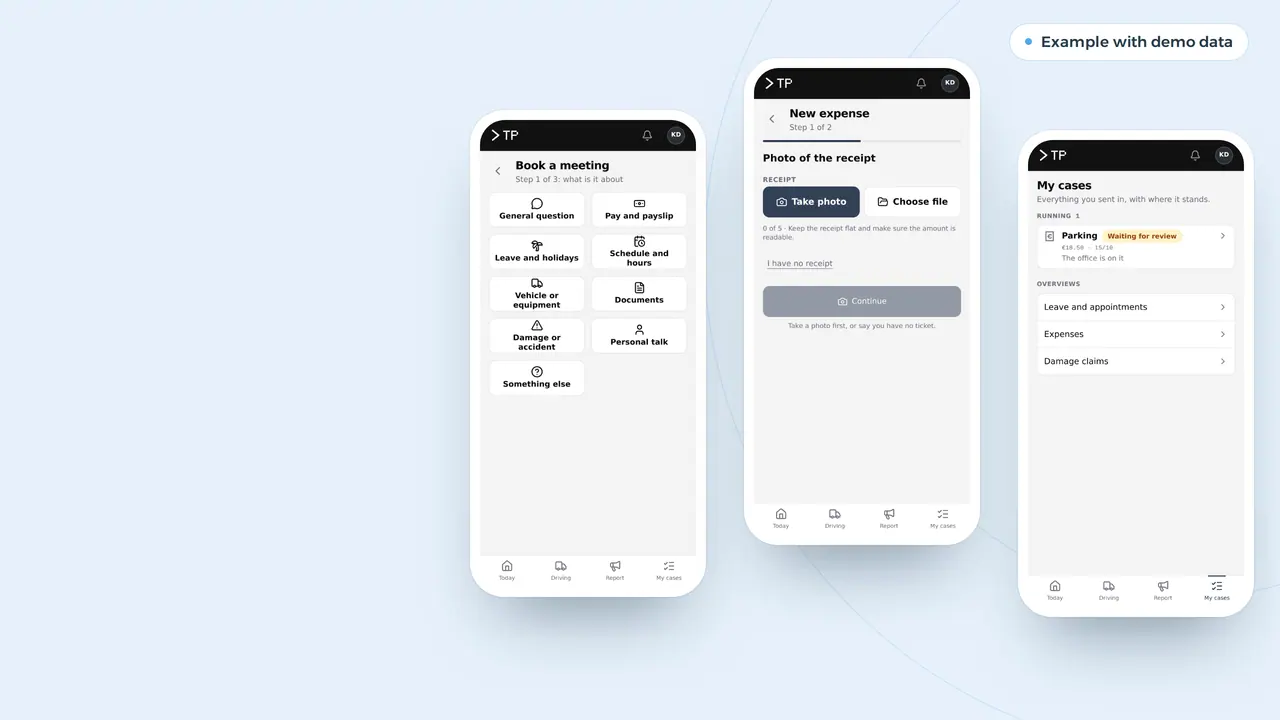
Software for installers
Software for installers and their contracts
Software for installers, built around your firm: from the first call to the invoice and the next service visit.
Installation firms running on five lists
Software for installers has to carry the whole firm, not just the work order. A heating, plumbing or electrical business often runs in five places at once.
Calls come in by phone, by email and on WhatsApp to the owner's mobile. The schedule lives on a whiteboard or a shared calendar. Maintenance contracts sit in a spreadsheet one person keeps, certificates in a folder per customer, and invoices in the accounting package.
A system of your own puts those five lists in one place. A call becomes a job with a customer and an installation. The planner sees who is free and holds the right certification. The technician fills in the work order on the phone, the customer signs, the office invoices. And every maintenance contract books its own next visit, so no customer is forgotten and you do not miss that revenue. We build it from Ghent, Belgium, in English, for installers across Europe.
The deadlines an installer watches for his customers
An installer does not just sell work; he watches deadlines for his customers. Inspection cycles, certified technicians and reporting duties exist in every European country, with national details. As an example of how deep we go, these are the rules in Flanders and Belgium that most often belong in an installer's software.
| Situation | What the rule asks | What it means for your system |
|---|---|---|
| Boiler servicing in Flanders | Yearly for heating oil, every two years for gas, by a certified technician | Each contract books the next visit by fuel |
| Certificates after a service | A combustion and a cleaning certificate | The certificate comes out of the work order |
| Reporting each service | Every inspection and service registered online within a month | A list of what still needs reporting, with its deadline |
| New central heating installation | Inspection before first use, with report and certificate | The job only closes once the inspection is in |
| Technician certification | Refresher training every 5 years, or the certification lapses | An expiry date per technician, respected by the schedule |
| Electrical installation in a home | Inspection at first use, then every 25 years; 18 months to put it right after a sale | Last inspection per installation, follow-up after a sale |
| Electrical installation in a business | Every 5 years; yearly for high voltage and explosion-risk areas | A contract per customer with the right cycle |
| Subcontracting in construction | Declaration of works from 5,000 euros with a subcontractor, else 30,000; withholding when debts exist | A check on every invoice |
| Renovating a home | 6 percent VAT instead of 21 for homes older than 10 years, private use, end user | The work order asks, the invoice sets the rate |
Working elsewhere? We set your own country's rules up as cycles and checks per installation. What the technician fills in on site, and why, is covered in detail on work order app. If you work on contractors' sites, read software for construction companies as well. How voice notes become job reports inside this system is on AI for plumbers and electricians.
A service visit in two lanes: office and technician
Mon 6 Oct, 08:14
Call
The customer calls: the boiler is noisy and its service is due.
Office
Mon 6 Oct, 08:40
Scheduled
Tom has a gap on Tuesday and the right certification. The customer gets a confirmation.
Office
Tue 7 Oct, 10:05
Work order and photos
Service and a new gasket, parts from the list, photos before and after.
On site
Tue 7 Oct, 11:20
Signature
The customer signs on the screen. The certificate goes out by email.
On site
Tue 7 Oct, 14:00
Invoice
Hours and parts are already on it. The report to the regional authority is ready.
Office
The file of this boiler
Gas condensing boiler
The Claes family, Wetteren
Installed in 2019, serviced every two years
- Call with the error code attached
- Visit on Tuesday at 10:00
- Work order, 4 photos, 1 h 15 min
- Signed work order and certificate
- Invoice and service report
- Reminder for September 2028
Example with a made-up customer, technician and dates, of what we can build for an installer.
One system for every step of a service job
This is what changes per step when your firm runs on a system of its own instead of five lists.
| Process | Today | With your own system | What you gain |
|---|---|---|---|
| A customer calls | A phone call, a sticky note, a message on the owner's mobile | A job with customer, installation and error code; also through a form or a customer portal | No call gets lost |
| Scheduling | Who is free, and is he certified? Ask around | The board shows who is free and certified, with travel time | A schedule that works first time |
| On site | Paper sheet, parts from memory | Work order on the phone, parts from the list, photos and signature | Complete work orders, every time |
| Parts | A van nobody counts | Usage per work order, an alert when stock runs low | Fewer trips to the wholesaler |
| Maintenance contracts | A spreadsheet and a memory | Each contract books its visit; the customer gets a reminder and picks a slot | No forgotten visits, a full schedule in the quiet season |
| Certificates and reports | A folder per customer, reporting later | The certificate from the work order, the report in a list with its deadline | Reported on time, everything findable |
| Invoicing | Retyped on Friday | Hours and parts already on it, to your package or as an e-invoice | Paid a week sooner |
| A customer calls with a question | Find out who was there last | The installation's file with every job, photo and certificate | An answer while the customer is on the line |
The customer side is essentially custom CRM development with installations added; bring in stock and purchasing and it moves towards custom ERP development. The difference is explained in CRM vs ERP. Your technicians' hours per job are on custom time tracking software; the warehouse and the vans on inventory management software. If customers should request a visit and download their certificates themselves, read client portal. AI can come later: a quote from the photos of a site visit (AI quote generator) or sorting customer emails and drafting a reply (AI customer service). Why a team in Belgium can build it for you is on nearshore software development.
Installers see their day on one screen
Screens from the platform we built for a haulier. For an installer, trucks become installations and drivers become technicians.
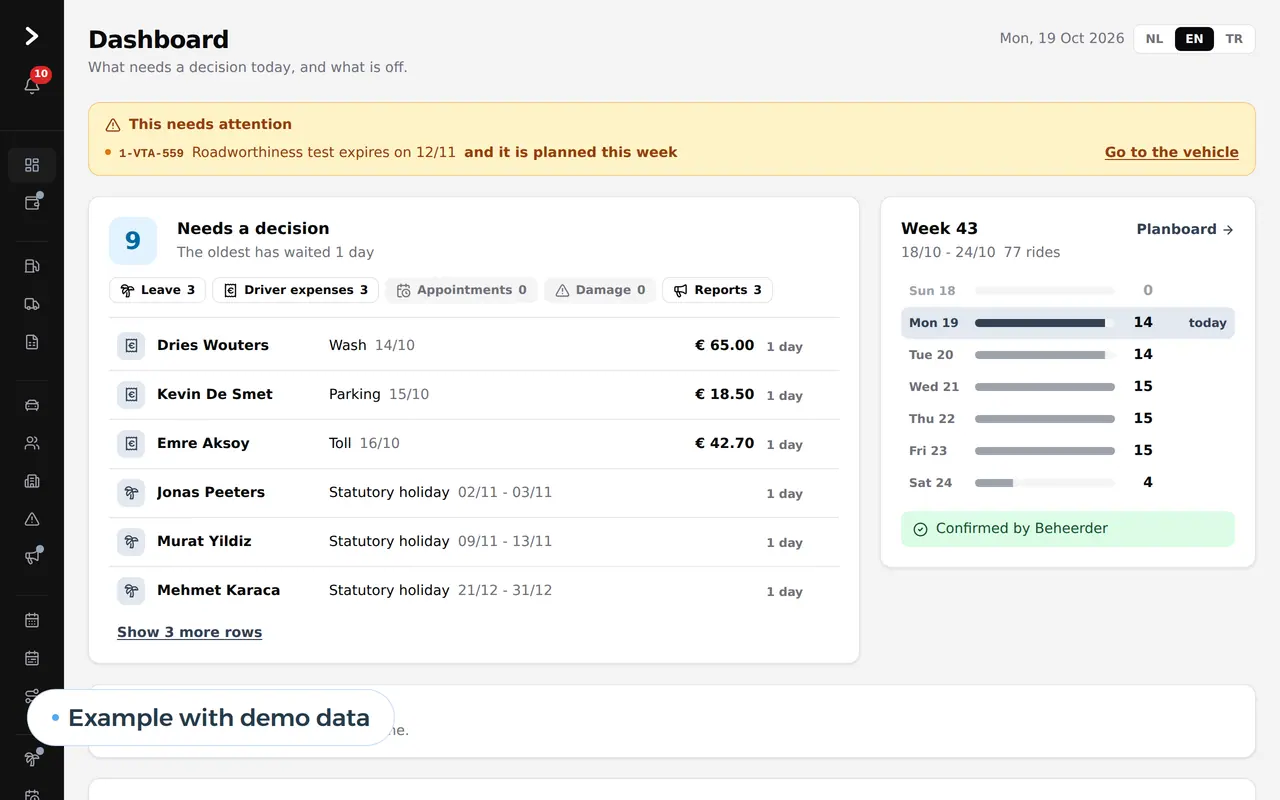
What needs attention today
At the top, what expires and what waits for a decision. For an installer: urgent calls, services falling due and work orders not yet invoiced. Example with demo data.
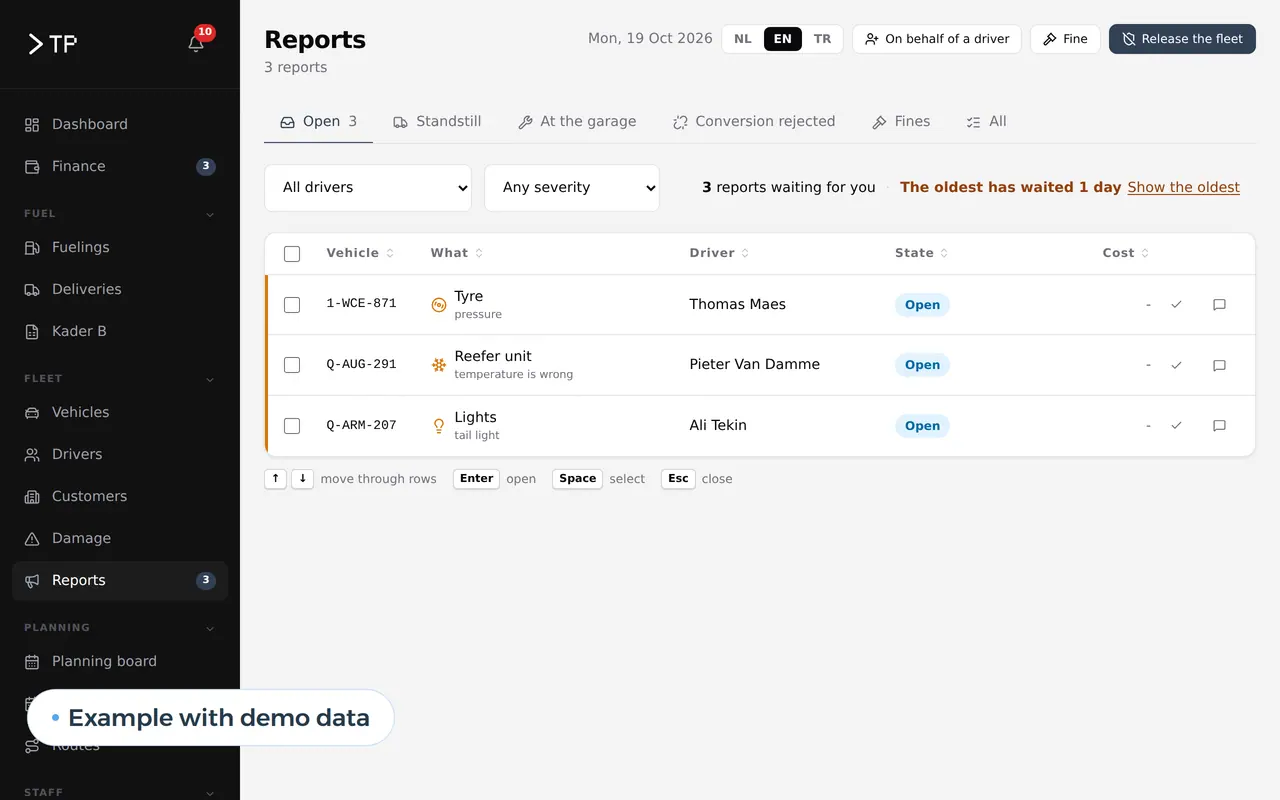
Reports in a queue
What comes in, who reported it and its status. Breakdowns arrive the same way. Example with demo data.
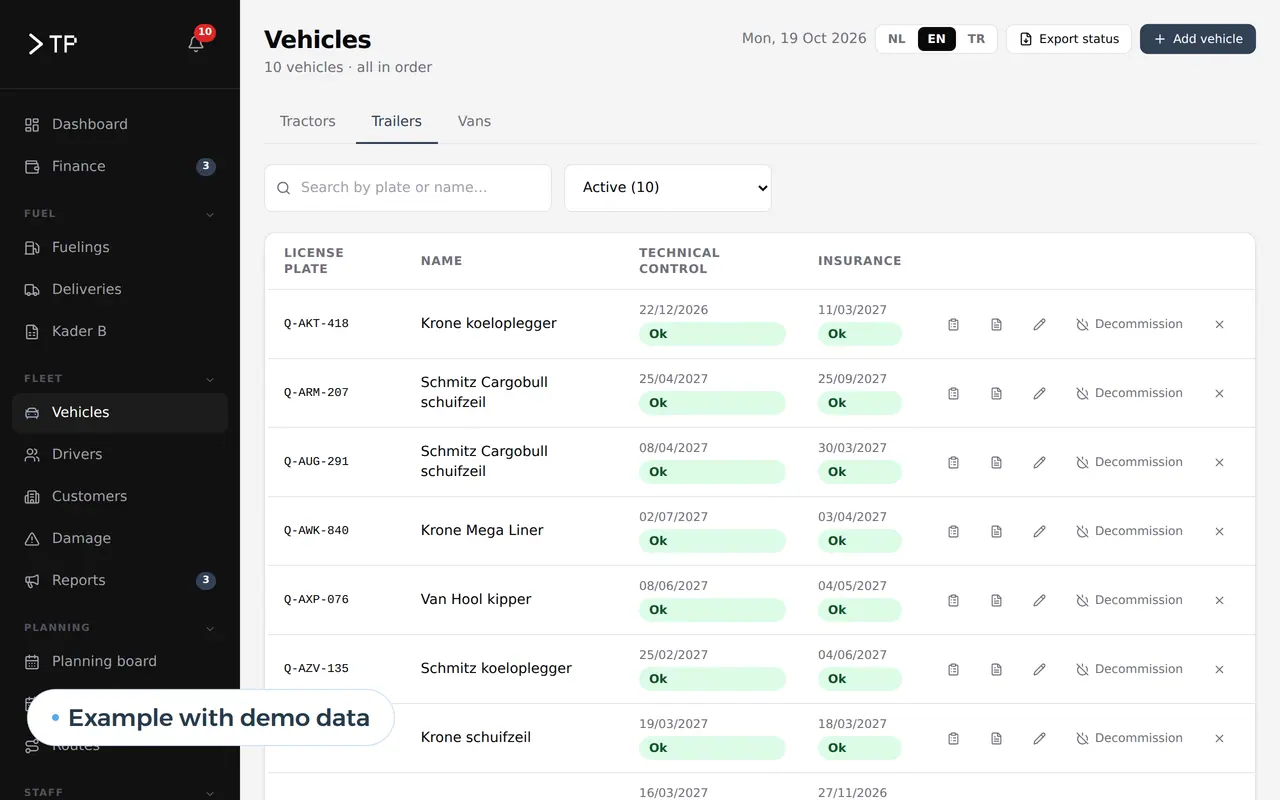
A row per installation with its dates
Per vehicle the inspection and insurance with their dates. Per installation those become the last service and the next inspection. Example with demo data.
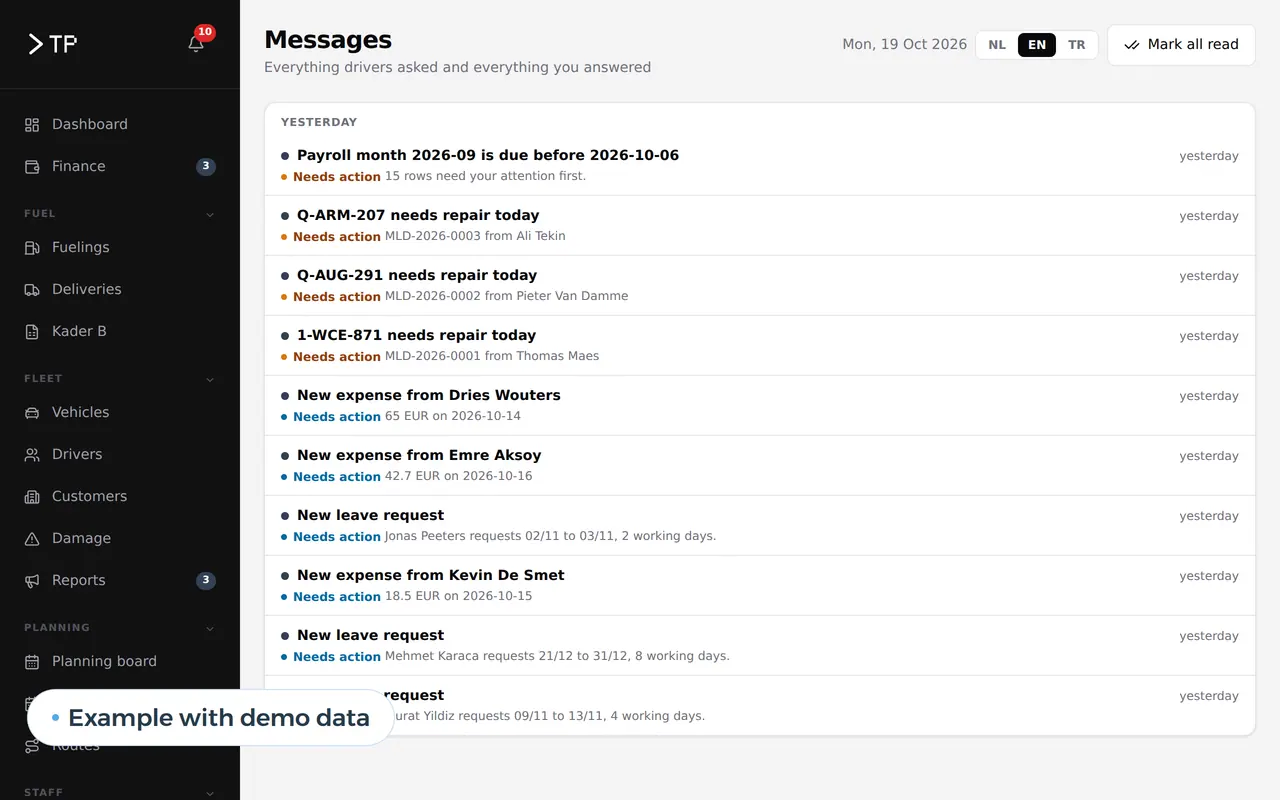
Messages waiting for action
What staff ask and what still needs an answer. Example with demo data.
Twelve technicians and 1,200 contracts: the sum
Take an installation firm with twelve technicians, 1,200 maintenance contracts and two people in the office. This is a worked example with assumed figures: 46 working weeks, an office cost of 45 euros an hour. Run it again for your own firm.
| Task per week | Five lists | A system of your own |
|---|---|---|
| Logging and passing on calls, 60 a week | 4 hours | 1 hour |
| Scheduling and rescheduling | 6 hours | 2 hours |
| Booking maintenance visits, 30 a week | 3 hours | 0.5 hours |
| Processing work orders and invoicing, 180 a week | 18 hours | 3 hours |
| Filing certificates and entering reports, 25 a week | 2.5 hours | 0.5 hours |
| Total | 33.5 hours | 7 hours |
That is 26.5 hours a week, or 1,219 hours over 46 weeks. At 45 euros an hour: 1,219 x 45 = 54,855 euros a year. Add the visits that never get booked. Say 4 percent of 1,200 contracts go a year without follow-up, 48 visits, at an assumed margin of 90 euros per visit: 4,320 euros. Together 54,855 + 4,320 = 59,175 euros a year.
What does a package cost? Per month and excluding VAT, for twelve technicians and two office users:
| Package | Price | For 14 users per year |
|---|---|---|
| Robaws Go (sites for Belgium, the Netherlands, Germany, the UK and Ireland) | 59 euros a month with one user, 49 euros per extra user, billed yearly; scheduling, work orders, equipment and time tracking. Pro (119 euros, 89 per extra user) adds job costing and subcontractors | 59 + 13 x 49 = 696 euros a month, 8,352 euros |
| Teamleader Focus GROW with the Planning and Work orders add-ons | 33 euros per user per month billed yearly, 50 percent off from the sixth user; Planning 35 and Work orders 20 euros per account per month | 5 x 33 + 9 x 16.50 + 35 + 20 = 368.50 euros a month, 4,422 euros |
| Odoo Standard | 19.90 euros per user per month in the first year, then 24.90; all apps, including Field Service, Planning and Sign | 3,343 euros, then 4,183 euros |
| Software built for you | Built per module, then hosting and maintenance, whatever your number of technicians | A price after a call |
Honestly: those are fair prices. Robaws is made for construction and installation, Odoo gives a lot for little. Choose a package if your firm works the way the package thinks. Build if your own work is what sets you apart: contracts with your own cycles and prices, certificates and reports that prepare themselves, a portal where customers see their installations, or a link to a platform you already have. A system that saves 59,175 euros a year earns back an investment of about 59,000 euros in one year, and 118,000 euros in two. More on the packages: Odoo alternatives and Teamleader alternatives. The decision itself: build vs buy software.
Ten weeks: customers, work order, scheduling and invoice
- Week 1Your firm on one pageHow does a call come in, who plans, what does the technician fill in, how is it invoiced and where are the contracts? We map the path and choose where to start, on site or on a video call.
- Week 2 to 6Customers, installations and the work orderWe import your customers, installations and contracts from spreadsheets or your package. The first technicians use the app on real jobs.
- Week 7 to 10Scheduling, contracts and invoicingThe planning board, maintenance reminders and the link to your accounting. The lists close.
- After thatOne module at a timeA customer portal, stock per van or reports that leave on their own, when you want them.
An installation is what a truck is to DA Logistics
The platform of DA Logistics, a Belgian haulier, has queues for the office, files with expiry dates and an app in three languages for about thirty drivers. What a truck is to a haulier, an installation is to you: a thing with a history, dates that expire and people who work on it. For Business Centrum we built a management platform with a client portal and a spreadsheet import, the starting point of almost every installer. We have no installer as a client yet; the building blocks do run.
What we do for your firm:
- We start with what costs you most time now, often the work order or the maintenance contracts.
- Your team works with us from the first version: the planner, a technician and whoever invoices.
- Your accounting package stays: customers, items and invoices go back and forth in the format it expects.
- You own it: code, data and a server in the EU, with daily backups.
This is how we build custom software. Tell us how you schedule and invoice today: book a call.
What installers ask us
Can customers request a visit themselves?
Yes, through a form on your website or a customer portal. The request arrives with the address, the installation and, if they like, a photo of the error code, and lands straight in the planner's list.
Can the software file the service reports for us?
The report stays the responsibility of your certified technician. The system prepares the data and shows what still needs reporting and by when. In Flanders there is a government API for software; whether we connect it for you is something we decide together.
Does it follow our country's rules?
Yes. Inspection cycles, certificates and VAT rates are settings per installation and per customer. We set them up with you for the countries you work in.
Does it work for electricians and plumbers too?
Yes. The cycles differ: a business's electrical installation every 5 years in Belgium, a gas boiler in Flanders every two years. The system counts with the cycle that belongs to each installation.
What does software for installers cost?
It depends on your technicians, your types of contract and the integrations. After a call you get a price in euros for the first version, without a licence per user. Put your wishes on paper first with the software requirements template.
Custom software
How VBS helps you with this
We build the platform your business runs on every day: your spreadsheets, emails and paperwork in one system that does what you do.
- Your workflow mapped first, then a fixed price
- Screens for the office, the client and the road
- Hosting, backups and security managed by us on AWS
How we approach it is on our page about Custom software.
Your calls, contracts and certificates in one place?
Tell us how you schedule and invoice today. We will show you where we would start and what it saves you per year.
Rather get in touch right away?