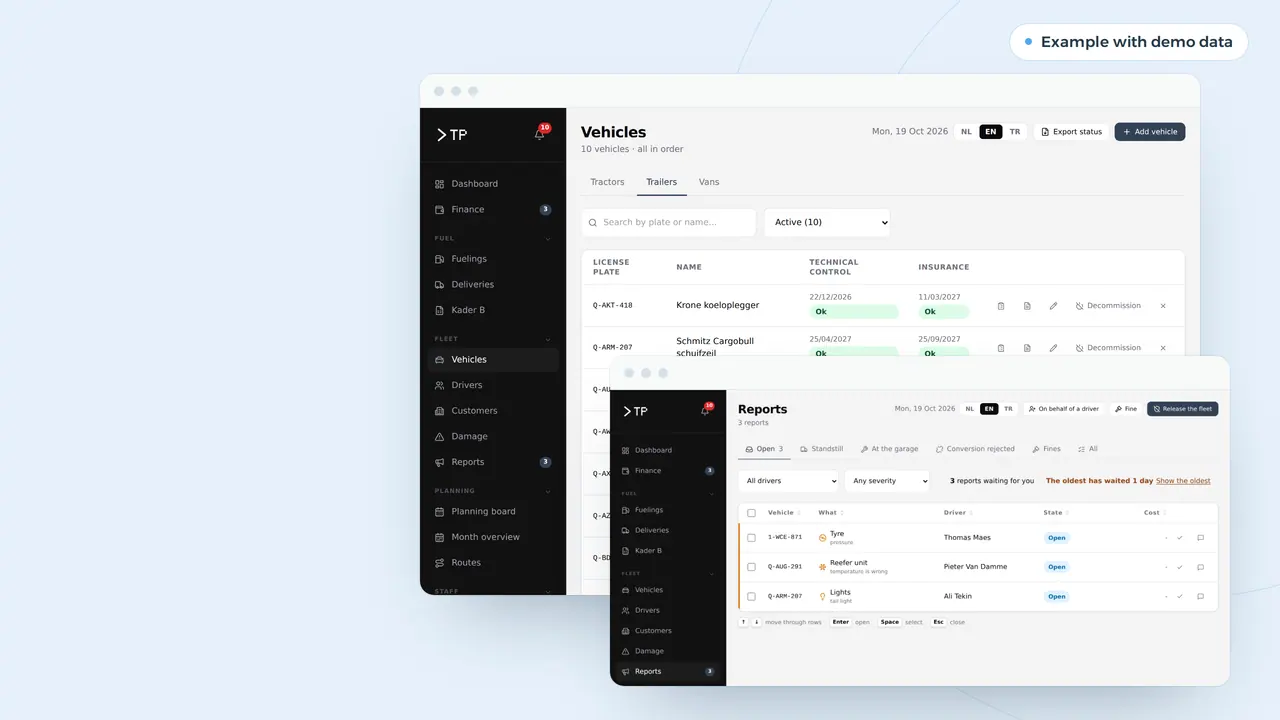
Fleet management
Fleet management software for hauliers
Fleet management software built for you: a file per vehicle, every expiry date watched, every driver report in the office.
Thirty vehicles, two hundred expiry dates a year
Running a fleet from a spreadsheet works until the day a tractor unit is on the road with an expired inspection. Mileage, servicing, roadworthiness tests, insurance, tachograph, tolls: each vehicle carries a handful of dates, and a fleet of thirty soon adds up to two hundred a year.
A driver who reports a problem with his truck sends a message that stays on one phone. Anyone who wants to know what a truck cost this year searches three folders and two inboxes.
Custom fleet management software puts every vehicle in one file with its papers, its costs and its history. It watches the dates, warns the right person in time and takes a vehicle that cannot be used off the planning board. We build it in Ghent, on the core that already runs the fleet of DA Logistics, a Belgian haulier.
The closer the date, the louder the reminder
- 60 daysAppears in the list of what expires soon.
- 30 daysEmail to the fleet manager, with a link to the vehicle.
- 14 daysAt the top of the dashboard until an appointment is booked.
- InspectionTractor 1-VTA-559
An example of what we can build, with a made-up number plate. The DA Logistics platform already watches the papers in every staff file this way, and puts an inspection that expires soon at the top of the dashboard.
The deadlines every vehicle file holds in the EU
These are the dates a haulier tracks per vehicle. Most come from EU law and apply in every member state; national rules add their own. Every missed date costs a fine, a vehicle off the road or an argument with the insurer.
| What | For which vehicles | Interval |
|---|---|---|
| Roadworthiness test | Trucks over 3.5 tonnes and trailers over 3.5 tonnes | Every year (Directive 2014/45/EU) |
| Roadworthiness test | Vans | Varies by country; Flanders moves them from yearly to every two years between 2026 and 2028 |
| Periodic tachograph inspection | Every vehicle with a tachograph | At least every two years (Regulation (EU) 165/2014) |
| Tachograph data download | Vehicle unit and driver card | At least every 90 days for the vehicle unit and 28 days for the driver card under EU rules; Belgium asks for two months and 21 days |
| Smart tachograph version 2 | International haulage; since 1 July 2026 also vans of 2.5 to 3.5 tonnes | Once, but missing it means driving in breach |
| Insurance and green card | Every vehicle | Yearly, with damage files per vehicle |
| Distance-based road tolls | Trucks over 3.5 tonnes in most of the EU | Per kilometre; in Flanders since 1 July 2026 with a CO2 surcharge, 0.245 to 0.285 euros per km for a Euro VI over 32 tonnes |
| Servicing | Every vehicle | By mileage or period, as the manufacturer sets |
Keeping those dates in a spreadsheet takes constant attention. Putting them in a system means seeing them in time. How the planning board uses them is on transport management software. A garage or dealer that wants the same vehicle files behind its website will find the front on car dealer website design.
What the DA Logistics platform already tracks
Screens from the platform we built for DA Logistics, with demo data.
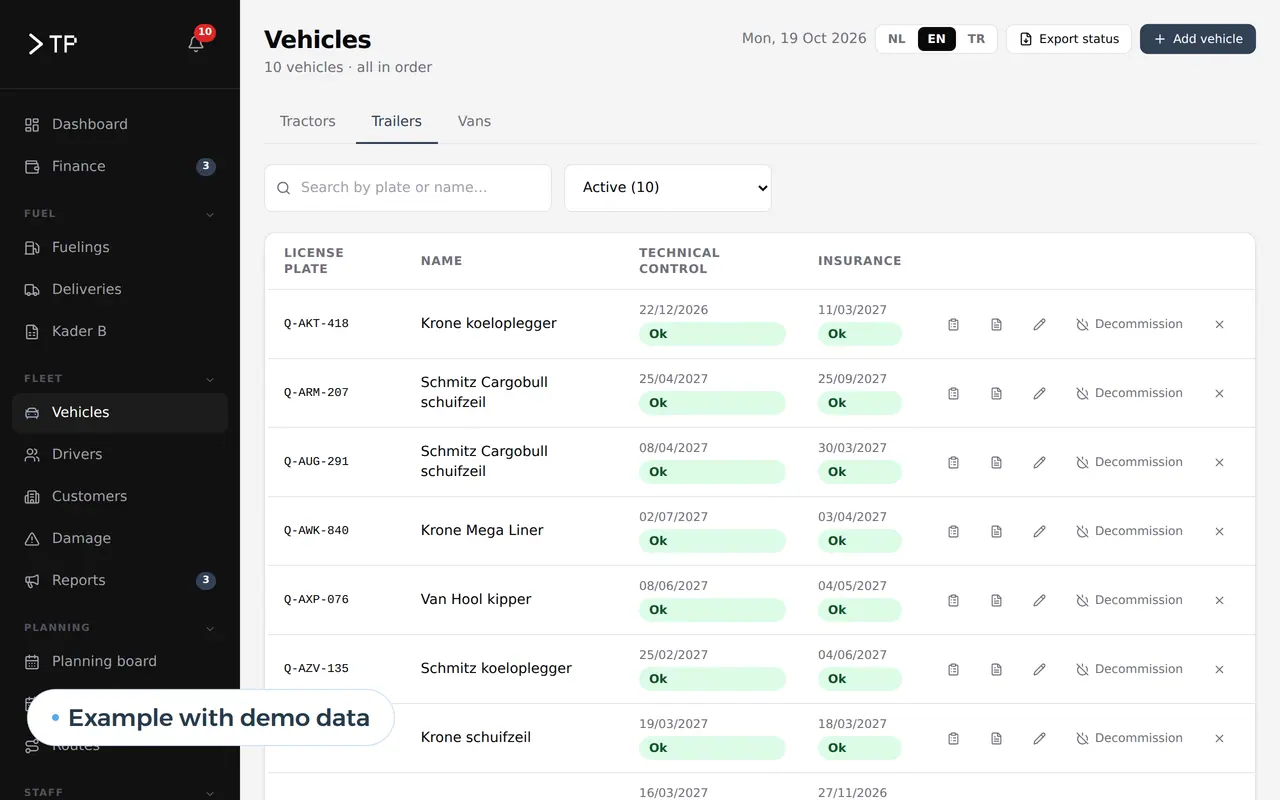
A file for every vehicle
Tractors, trailers and vans with their inspection, insurance, servicing and tachograph, and what expires soon.
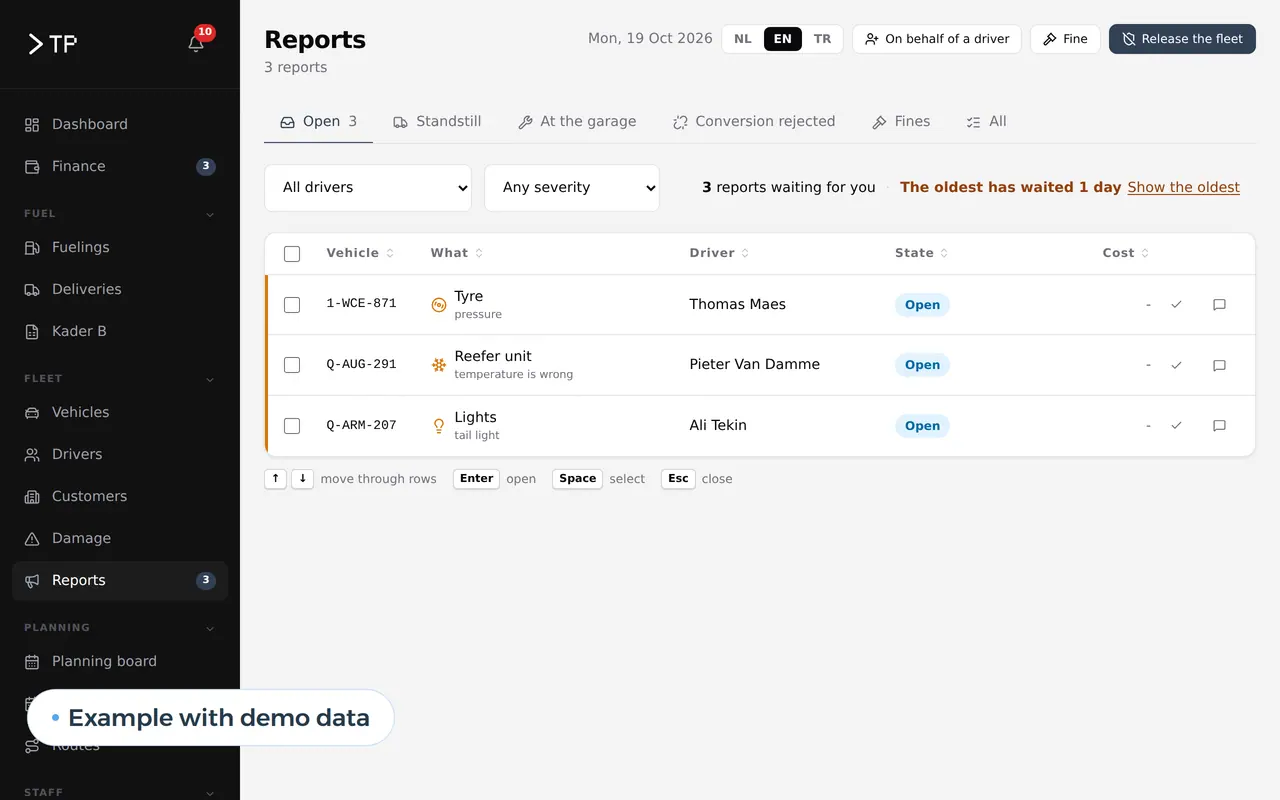
Reports from drivers
A tyre, the reefer unit or the lights: the driver reports it in the app with a photo, and the office sees it in a queue that gets followed up.
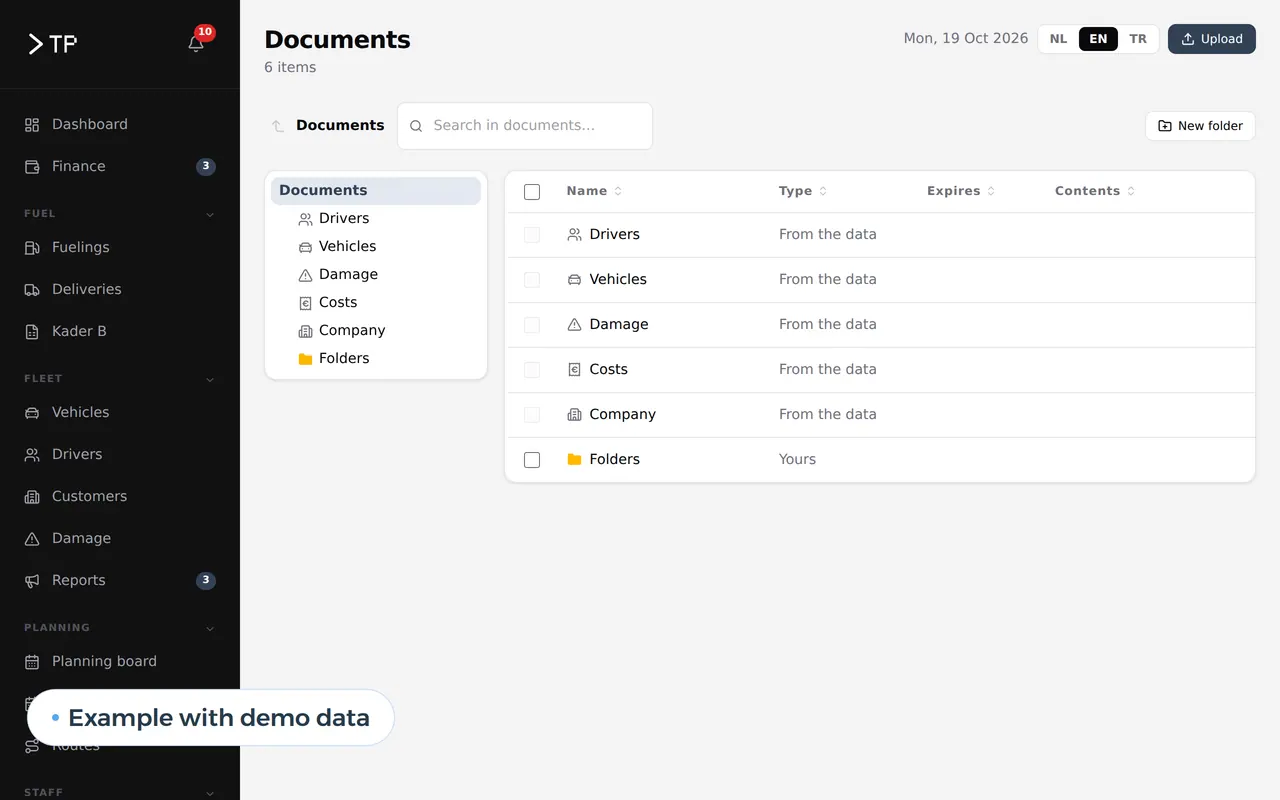
Papers in one place
Policy, inspection certificate and damage file sit with the vehicle, not in a shared folder nobody can find.
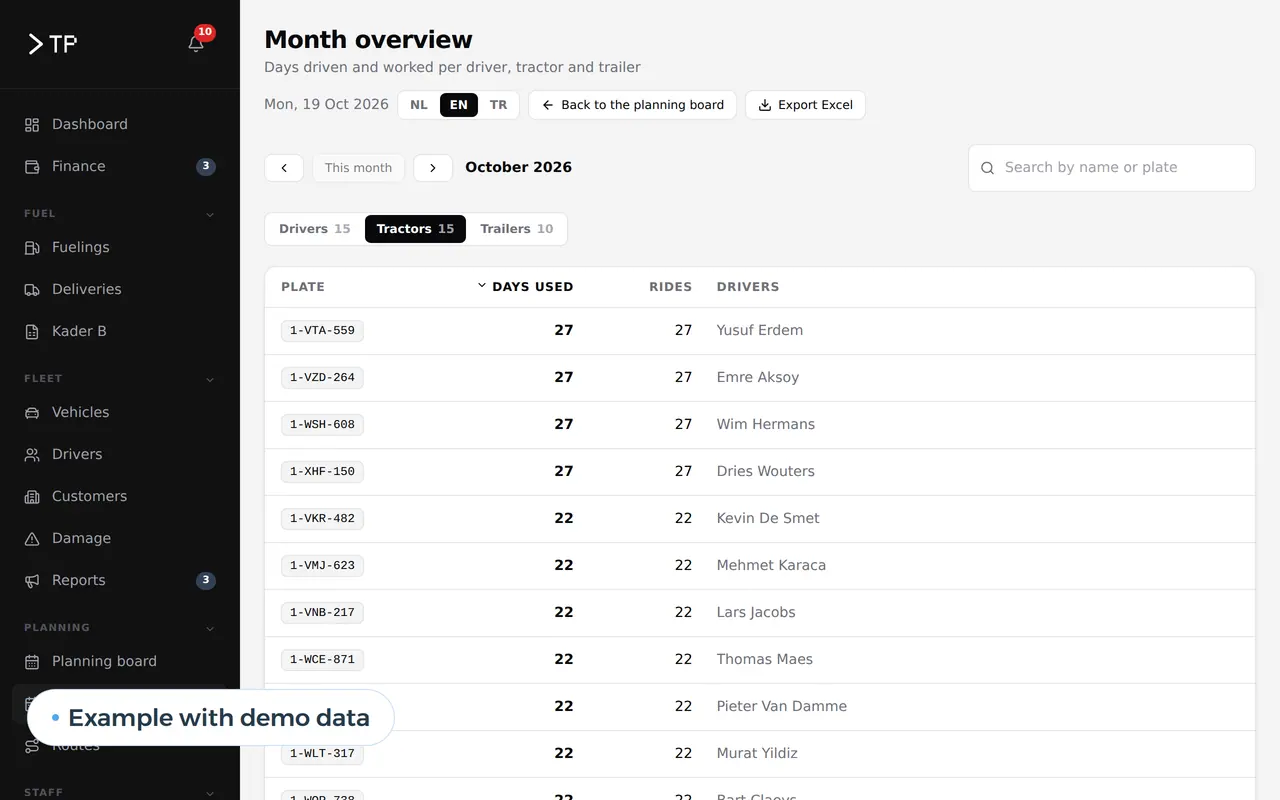
A monthly fleet report
Days in use, trips and drivers per tractor or trailer, to see which vehicle earns its keep.
What changes, task by task
A fleet system is more than a list of number plates. This is what changes per task.
| Task | Today | With a system of your own | What you gain |
|---|---|---|---|
| Expiry dates | A spreadsheet column somebody has to open | A staircase of reminders at 60, 30, 14 and 7 days, sent to whoever fixes it | No expired inspection on the road |
| Availability | The planner does not always know | A vehicle that cannot be used cannot go on the board | No trip that falls through at the last minute |
| Damage and defects | Photos and messages on a phone | A step-by-step report in the app, with a photo, in the driver's language | Faster repairs, a complete file for the insurer |
| Papers | Shared folders, emails | Policy, certificate and damage file with the vehicle | Everything in one click, also at a roadside check |
| Cost per vehicle | Gathering invoices | Refuels, servicing and use per number plate | Knowing which truck pays and which to replace |
| Fuel | Fuel card statements side by side | Every refuel per driver and plate, down to the litre | Anomalies stand out |
Refuels per plate belong with fuel management, so we usually build fleet management as one module of a transport software platform, together with planning, fuel and staff. Garage and tyre invoices can be read instead of retyped with invoice automation; stock per delivery, down to the litre, is on custom inventory management software. Reports and receipts come from a driver app, the kind of build covered under app development; the same drivers' hours fit in custom time tracking software. Later, AI can flag unusual fuel use per vehicle or summarise a damage report for the insurer: see AI in road transport.
Choose a telematics package if you mainly want to see where your trucks are, and planning, fuel and staff each run well in their own software.
Choose custom if your fleet, planning board, refuels and drivers touch each other: a truck in the workshop must not appear on the board, a refuel belongs to a plate and a driver, and a damage report has to land in the right vehicle file. All of that in one system is a custom ERP.
Hours and tolls lost by a fleet of thirty trucks
Take a fleet of 30 trucks and 20 trailers. The figures are assumptions; run them again with your own fleet.
| Task per week | Spreadsheet and email | A system of your own |
|---|---|---|
| Checking and chasing expiry dates | 3 hours | 0.5 hours |
| Collecting and forwarding driver reports | 2 hours | 0.5 hours |
| Finding papers for a check or a claim | 1.5 hours | 0.25 hours |
| Gathering costs per vehicle | 1.5 hours | 0.25 hours |
| Total | 8 hours | 1.5 hours |
That is 6.5 hours a week, or 299 hours over 46 working weeks. At an assumed cost of 45 euros an hour, the time alone is worth 13,455 euros a year.
The bigger gain is what you can see. A truck above 32 tonnes that drives 100,000 km a year in Flanders pays 28,500 euros in road toll at 0.285 euros per km. If a fifth of your fleet runs five percent empty or duplicate kilometres that only show when you measure per vehicle, that is 8,550 euros a year in toll for six trucks, before diesel and wages.
Those kilometres only show on a screen that lists, per vehicle, what needs attention today: a custom dashboard. A system that shows both the hours and those kilometres pays back an investment of 20,000 euros in about a year. Custom software is not priced per vehicle: one more truck adds no licence. Weighing it against a package? Our build vs buy comparison works through the numbers, and the software requirements specification template helps you brief any supplier.
Spreadsheet and email, or a system of your own
- Expiry dates
- Spreadsheet and emailSomeone has to remember
- A fleet system of your ownReminders in time, louder as the date nears
- Driver reports
- Spreadsheet and emailMessages on a phone
- A fleet system of your ownA queue in the office, with photo and status
- Use and cost per vehicle
- Spreadsheet and emailPieced together from invoices
- A fleet system of your ownPer vehicle and per month on screen
- Planning
- Spreadsheet and emailA separate file
- A fleet system of your ownA vehicle that is off the road cannot be planned
- Who did what
- Spreadsheet and emailCannot be traced
- A fleet system of your ownEvery change with name and date
A fleet package with telematics can work too, and we are happy to connect one. Custom pays off when your fleet is tied up with your planning, your fuel and your people, as it is for a haulier.
Eight weeks from a list to an app
- Week 1Your fleet and your datesWe load your list of vehicles, plates and dates and agree which deadlines the system watches and who gets which reminder, over a video call.
- Weeks 2 to 5A first version with your own fleetVehicle files, the reminder staircase and documents per vehicle, on a test environment with your real fleet. Your fleet manager works in it next to the spreadsheet.
- Weeks 6 to 8The app for your driversDamage and defects reported step by step, with a photo, in the driver's language. The office sees the report at once.
- After thatConnect and growYour planning board, fuel card or telematics, your accounting. Every release goes live in seconds, with a backup and a way back.
- refuels per driver and number plate in the DA Logistics platform on 3 August 2026
- 1,182
- minutes from domain to live: how fast Zuco Logistics went live on the same core
- 57
DA Logistics: 34 vehicles in one system
The platform we built for DA Logistics tracks 34 vehicles with their inspection, insurance, servicing and tachograph dates. About thirty drivers report damage, defects and receipts in the app, in Dutch, English or Turkish, and the office runs on it every day. Since 14 September Zuco Logistics has run on the same core, with its own profile and its own server.
For your fleet:
- We start from your list, however messy. What sits in your spreadsheet today is in the system on day one.
- We build what you track: ADR certificates, reefer units, cranes or tail lifts get their own dates.
- We connect what you already have: telematics, fuel cards or accounting, wherever an export or integration exists.
- You own it: the code, the data and a server in an EU region.
Our team in Ghent is an hour ahead of the UK and on the same clock as most of the EU, and every call and document is in English. How that works with a team abroad is explained on nearshore software development.
Tell us how big your fleet is and what you track today. Book a call and we will show you how it looks in a system of your own.
What fleet managers ask us
- Can we import our vehicles from a spreadsheet?
- Yes. We load your list of vehicles, plates and dates. You start with a full fleet, and whatever is inconsistent in the spreadsheet shows up straight away.
- Does it handle tractors and trailers separately?
- Yes. Tractors, trailers and vans each have their own list and papers, and are paired per trip on the planning board.
- Can a driver report damage with photos?
- Yes, in the app on his phone, in four steps, in his own language. The office sees the report straight away with the photos and the number plate.
- Does it connect to our telematics or fuel card?
- Where your provider offers an export or an integration, we read mileage and refuels from it. Where it does not, the driver can enter them in the app.
- Our fleet runs outside Belgium. Does that matter?
- No. The EU rules on inspections and tachographs are largely the same everywhere; national dates and tolls are settings, not rebuilds. We set them up for the countries you operate in.
- What does custom fleet management software cost?
- It depends on your fleet size, what you track and whether it has to work with planning and fuel. After a call you get a price in euros for the first version, with no licence per vehicle.
Transport software
How VBS helps you with this
We build planning, trips, fuel and fleet on one platform, with an app for your drivers.
- A weekly planning board that shows conflicts
- Fuel under the Belgian Kader B scheme to the litre
- The driver app in their own language
How we approach it is on our page about Transport software.
No more expired inspections on the road?
Tell us how big your fleet is and what you track today. We will show you how it looks in a system of your own.
Rather get in touch right away?