On this page
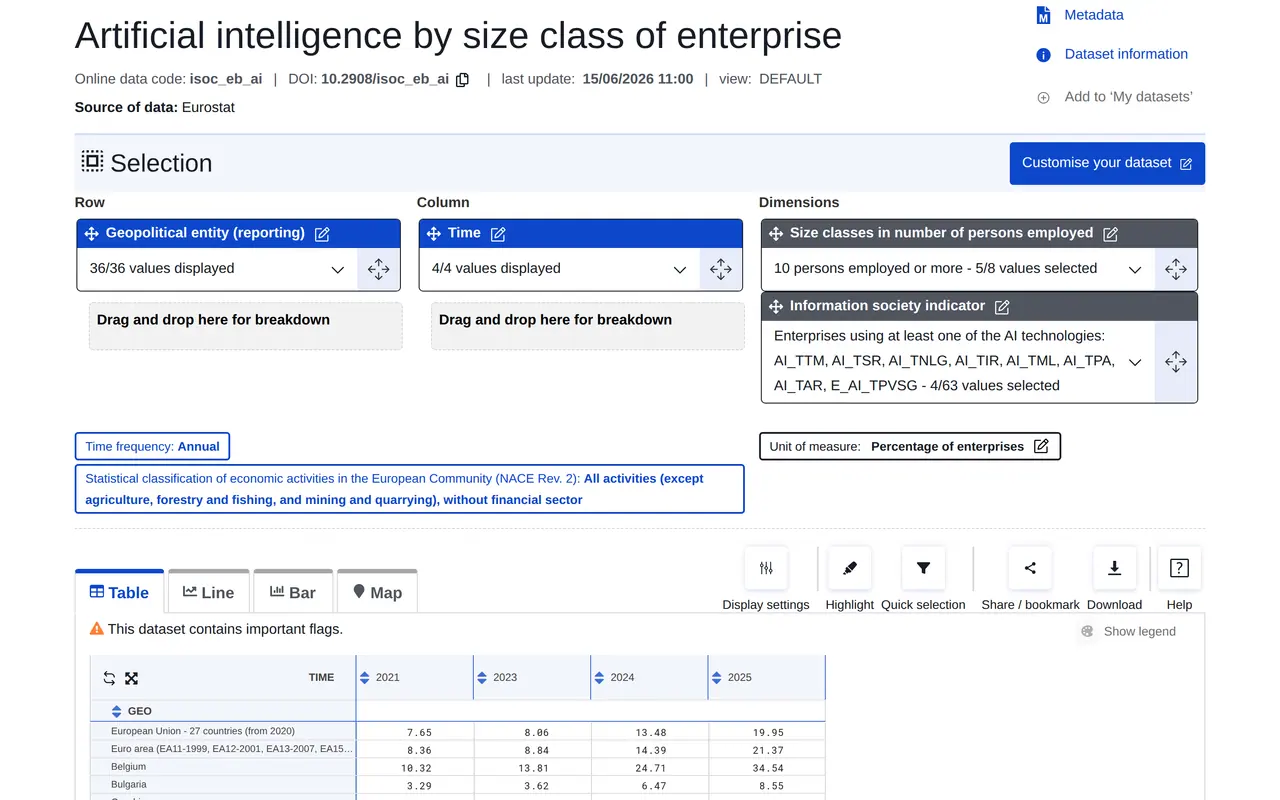
In 2025, 34.5 percent of Belgian enterprises with ten or more employees used at least one artificial intelligence technology, according to Eurostat. The EU average was 20.0 percent. That puts Belgium fourth of the 27 member states, behind Denmark (42.0), Finland (37.8) and Sweden (35.0), and just ahead of Luxembourg and the Netherlands.
For a buyer or investor comparing European markets, the Belgian number matters for two reasons. It rose fast: from 13.8 percent in 2023 to 34.5 percent two years later. And it holds for small firms too, not only for the large ones that pull most national averages up. This page sets out the official data by country, company size, technology and purpose, and adds what we measured ourselves on the websites of Belgian small businesses. How to start with AI in your own company is in our guide to implementing AI in a business.
AI adoption by country in 2025
Eurostat counts an enterprise once it uses at least one of eight technologies: text mining, speech recognition, generating text or code, generating images or sound, image recognition, machine learning for data analysis, AI that automates workflows or supports decisions, and AI that moves machines. The ranking below covers all 27 member states.
Share of enterprises using AI, per EU country
- 1Denmark42.0%
- 2Finland37.8%
- 3Sweden35.0%
- 4Belgium34.5%
- 5Luxembourg33.6%
- 6Netherlands33.2%
- 7Austria30.0%
- 8Germany26.0%
- 9Estonia23.4%
- 10Slovenia21.6%
- 11Malta21.5%
- 12Lithuania21.3%
- 13Spain20.3%
- EU average20.0%
- 14Ireland19.6%
- 15France18.2%
- 16Slovakia18.0%
- 17Czechia17.6%
- 18Italy16.4%
- 19Croatia15.2%
- 20Latvia12.2%
- 21Portugal11.5%
- 22Hungary10.4%
- 23Cyprus9.3%
- 24Greece8.9%
- 25Bulgaria8.6%
- 26Poland8.4%
- 27Romania5.2%
Enterprises with ten or more employees, excluding finance, 2025. Source: Eurostat.
Belgium ranks fourth of 27, after Denmark, Finland and Sweden.
The spread is wide: from 42.0 percent in Denmark to 5.2 percent in Romania. Northern Europe and the Benelux lead; Southern and Eastern Europe trail, with Italy at 16.4 and Poland at 8.4 percent. Belgium, the Netherlands and Luxembourg sit within 1.3 points of each other, which makes the Benelux one of the most AI-ready regions in the EU.
| Country | 2023 | 2024 | 2025 |
|---|---|---|---|
| Belgium | 13.8% | 24.7% | 34.5% |
| Netherlands | 14.1% | 23.1% | 33.2% |
| Luxembourg | 14.5% | 23.7% | 33.6% |
| Germany | 11.6% | 19.8% | 26.0% |
| France | 5.9% | 9.9% | 18.2% |
| EU average | 8.1% | 13.5% | 20.0% |
Belgium passed the Netherlands in 2024 and kept the lead in 2025. Eurostat flags a break in the Dutch series for 2025, so treat year-on-year comparisons for the Netherlands with care.
AI adoption by company size
National averages are pulled up by large companies, which adopt first. The Belgian lead holds at every size, and it is widest in the middle: firms with 50 to 249 employees use AI at 54.5 percent, against 30.4 percent across the EU.
| Company size | Belgium | Netherlands | France | Germany | EU |
|---|---|---|---|---|---|
| 10 to 49 employees | 28.8% | 28.8% | 15.0% | 23.1% | 17.0% |
| 50 to 249 employees | 54.5% | 46.6% | 30.8% | 35.6% | 30.4% |
| 250 or more | 76.4% | 67.6% | 58.0% | 57.0% | 55.0% |
The larger the firm, the more AI; Belgium leads at every size
BelgiumEU average
- 10 to 49 employees28.8%17.0%
- 50 to 249 employees54.5%30.4%
- 250 or more76.4%55.0%
- All (10 or more)34.5%20.0%
Share of enterprises using at least one AI technology. Source: Eurostat, 2025.
Firms with fewer than ten people are outside the survey. In Belgium that is most companies: of 1.2 million VAT-registered businesses, the large majority are sole traders and micro firms. No official adoption figure exists for them, which is one reason we measured their websites ourselves (further down).
Which AI technologies companies use
Text mining is the most common use in Belgium and in the EU. Generative AI for images, video and sound, asked for the first time in 2025, came in second straight away. On every technology Belgium sits at roughly twice the EU level.
| Technology (2025) | Belgium | EU |
|---|---|---|
| Text mining (analysing written language) | 23.0% | 11.8% |
| Generating images, video or sound | 17.3% | 9.6% |
| Generating text, speech or code | 15.9% | 8.8% |
| Speech recognition | 12.3% | 7.2% |
| Machine learning for data analysis | 11.2% | 5.1% |
| Automating workflows or supporting decisions | 10.8% | 5.4% |
| Image recognition | 6.5% | 3.8% |
| Autonomous movement of machines | 3.0% | 1.4% |
| Two or more of these | 22.9% | 13.0% |
Which tools sit behind these categories, and what they cost per seat, is in our guide to AI tools for business and the comparison ChatGPT or Copilot.
What companies use AI for
Belgian AI users apply it most to business administration (39.6 percent of them) and to accounting and finance (31.2 percent). Marketing and sales come lower, at 26.4 percent, against 34.7 percent across the EU and 37.2 percent in the Netherlands. That is the clearest Belgian gap in the data: high adoption, but less of it pointed at customers.
Belgian firms use AI mostly behind the scenes, less for marketing
BelgiumEU average
- Administration and management39.6%31.0%
- Accounting and finance31.2%23.1%
- Marketing and sales26.4%34.7%
- ICT security24.9%19.8%
- Research and innovation22.1%19.1%
- Production17.1%20.8%
- Logistics6.1%6.1%
Share of the enterprises that use AI. Source: Eurostat, 2025.
For marketing and sales, Belgium sits 8.3 points below the EU.
For a company selling into Belgium, that gap is an opening: competitors use AI for their back office more than for their marketing. What AI does in marketing work, sector by sector, is on AI for marketing. Since 2 August 2026, a chatbot that talks to customers in the EU has to say it is AI; see our note on the EU AI Act transparency obligations.
Why companies do not use AI
Of Belgian firms, 9.8 percent considered AI but did not use it. Eurostat asked them why. Lack of expertise tops the list at 74.5 percent, above the EU figure of 70.3 percent. Then come unclear legal consequences (57.9 percent) and data protection concerns (50.9 percent). Data quality follows (46.2 percent); cost ranks only sixth (35.5 percent).
Knowledge and rules hold firms back, money much less
BelgiumEU average
- Lack of expertise74.5%70.3%
- Unclear legal consequences57.9%53.6%
- Data protection concerns50.9%52.7%
- Data not available or poor46.2%43.5%
- Incompatible with existing systems38.3%41.6%
- Costs seem too high35.5%38.4%
- Ethical considerations27.0%24.6%
- Not useful for the business14.6%17.8%
Share of enterprises that considered AI but do not use it; several reasons possible. Source: Eurostat, 2025.
The two biggest barriers are knowledge and rules, not money. What the EU AI Act asks of a small business is in our guide to the EU AI Act for business, and whether you need a written policy in do I need an AI policy. To estimate what AI tools cost for your team per month, use the AI cost calculator.
How many people use generative AI
In 2025 Eurostat asked individuals about generative AI for the first time. In Belgium, 42.0 percent of people aged 16 to 74 used a tool such as ChatGPT, Gemini or Copilot in the three months before the survey, against 32.7 percent in the EU. Belgium ranks tenth of 27, level with Sweden. Among 16 to 24 year olds it is 74.4 percent.
| Generative AI in 2025 (ages 16 to 74) | Belgium | Netherlands | France | Germany | EU |
|---|---|---|---|---|---|
| Used in the last three months | 42.0% | 44.7% | 37.5% | 32.3% | 32.7% |
| For private use | 33.5% | 28.1% | 27.7% | 27.2% | 25.5% |
| For work | 20.8% | 26.6% | 18.4% | 15.8% | 15.4% |
| For education | 10.3% | 13.1% | 11.0% | 6.0% | 9.3% |
By age the gap is wide: 74.4 percent of 16 to 24 year olds used generative AI, against 11.7 percent of 65 to 74 year olds. Belgium is above the EU average in every age group.
One in five Belgians (20.8 percent) used generative AI for work. For a business, the other side counts: more of your buyers now ask an AI assistant instead of a search engine. Whether your company shows up in that answer depends on what the assistant can read about you; see how to get found in ChatGPT.
Three in four young adults use generative AI
BelgiumEU average
- 16 to 2474.4%63.8%
- 25 to 3460.0%50.7%
- 35 to 4447.8%39.0%
- 45 to 5440.6%28.4%
- 55 to 6421.7%16.5%
- 65 to 7411.7%6.5%
Share of people who used a generative AI tool in the last three months. Source: Eurostat, 2025.
Belgium is above the EU average in every age group.
What small business websites show
The survey stops at ten employees. To see AI from the customer's side at smaller firms, we checked the home pages of 427 Belgian small business websites in October 2026.
| What we looked for on the home page | Share of sites |
|---|---|
| A chat window (live chat or chatbot) | 2.6% |
| A chatbot from an AI service (such as Chatbase or Voiceflow) | 0% |
| An llms.txt file for AI assistants | 17.8% |
| AI crawlers blocked in robots.txt | 0.6% |
| A button or link to WhatsApp | 4.4% |
Not one site in the sample ran a chatbot from an AI service, and a chat window of any kind appeared on 2.6 percent of sites. The llms.txt found on 17.8 percent is almost always set by the platform: Wix adds one on 34 of its 35 sites and Shopify on all 14, while only 11 of 169 WordPress sites have one. Small businesses do not block AI either: of the 477 sites that responded, three block GPTBot in robots.txt and none block the search crawlers of ChatGPT, Claude or Perplexity. Our AI crawler checker shows the same for your own site in a minute. Eurostat puts the share of Belgian firms with ten or more employees that offer a chat service at 10.4 percent; among the smaller firms we measured it is 2.6 percent.
The full measurement, with speed, search basics and cookies per site, is in the state of Belgian business websites in 2026.
What this means if you are entering the Belgian market
- Choose Belgium as a test marketif you sell AI tools or services to small and mid-sized firms: adoption is high, the market is bilingual and compact, and mid-sized firms adopt at nearly twice the EU rate.
- Choose marketing as your angleif you sell to firms that already use AI. Belgian companies trail the EU on AI for sales and marketing, so that is where demand is least served.
- Choose training over licencesif your buyers hesitate. Three in four Belgian firms that considered AI and stopped name a lack of expertise.
If you want AI built into a fixed task for your Belgian or European operation, see AI for business, or book a call.
Method and limits
The enterprise figures come from the 2025 EU survey on ICT usage and e-commerce in enterprises, run in Belgium by Statbel: firms with ten or more employees, excluding agriculture, mining and finance. The individual figures come from the 2025 EU household survey, ages 16 to 74. Eurostat publishes the 2026 survey in December 2026, and we will update this page then. What 2027 brings for AI rules is in AI trends 2027.
Our own website sample comes from OpenStreetMap and is not official statistics: it shows what is visible on a home page, not what a firm does with AI behind the scenes.
AI adoption in Belgium in five questions
What is the AI adoption rate in the EU?
20.0 percent of EU enterprises with ten or more employees used at least one AI technology in 2025, up from 8.1 percent in 2023, according to Eurostat.
Which EU country has the highest AI adoption?
Denmark, at 42.0 percent of enterprises in 2025, followed by Finland (37.8), Sweden (35.0) and Belgium (34.5).
How many Belgian companies use AI?
34.5 percent of firms with ten or more employees in 2025. Among firms with 250 or more employees it is 76.4 percent; among firms with 10 to 49 it is 28.8 percent.
How many people in Belgium use ChatGPT or similar tools?
42.0 percent of Belgians aged 16 to 74 used generative AI in 2025, against 32.7 percent in the EU.
Can I use these figures?
Yes, citing Eurostat as the source for the survey data and VBS for the website measurement. Both datasets are linked as CSV at the top of this page.