SEO for law firms
SEO for law firms: found on the question your client types
Clients search for an answer late at night, in their own language, long before they call a firm.
A client looks for an answer, not a lawyer
SEO for law firms works differently from SEO for a shop. Almost nobody types "corporate law firm". People type their problem: may I dismiss an employee on parental leave, what if my client does not pay, how do I set up a company in Belgium? The firm with the clearest answer is the one that gets the call afterwards.
For a firm in Europe that answer has to fit two frames: EU law, which protects your right to inform the public, and your bar's code, which sets the limits. Below: what both say, which pages a findable firm needs, what a client through Google costs, and how AI answers change the picture.
What EU law and your bar allow
Inside the EU, a total ban on advertising by lawyers is no longer possible. Article 24 of the Services Directive obliged every member state to remove all total prohibitions on commercial communications by the regulated professions. The same article lets each profession keep rules that protect its independence, dignity, integrity and professional secrecy, as long as those rules are non-discriminatory, justified by the public interest and proportionate. In practice that means your bar decides how you may present yourself, and the answer differs from Brussels to Berlin to Dublin.
The code of the Flemish bar, the Orde van Vlaamse Balies, shows what such rules look like when written down. Its section on publicity starts by allowing it, then sets six limits: nothing misleading; no tailored offer for a specific matter without an invitation, and no deliberate poaching of another lawyer's client in an ongoing case; a claim of special expertise only when your knowledge or experience can back it; results of past matters only without the client's name unless the client agrees; fees, if you publish them, stated clearly and completely, never as a bare minimum price, and binding once published; and judicial or political offices kept to your CV.
The software behind the site, and a portal for clients, is on legal practice management software.
May this go on your firm's website?
- FinePractice area pages, answers to client questions, search adsEU member states had to remove every total ban on commercial communication by the regulated professions, lawyers included.Services Directive 2006/123/EC, art. 24(1)
- Respecting your bar's own rulesThose rules may protect independence, dignity, integrity and professional secrecy, as long as they are non-discriminatory, justified and proportionate.Services Directive, art. 24(2)
- Not fineMisleading claims, such as a success rate without contextMisleading publicity is forbidden. The Flemish code puts it in a single line.Flemish bar code, art. 83
- FineNaming the outcome of past mattersIn Flanders: nature, size and result may be mentioned, without the client's name unless they agree, and only where secrecy and data protection allow.Flemish bar code, art. 86
- Fees that are clear and complete, if you publish themIn Flanders a firm may not quote only a base or minimum price, and is bound by the fees it publishes.Flemish bar code, art. 87
Bars differ per country and sometimes per city. Read the rows as a map of the usual limits, and check your own bar's code before you publish.
The pages of a law firm site that gets found
| Kind of page | Found on | What is on it |
|---|---|---|
| Practice area | employment lawyer, debt collection lawyer, plus a city | what you do in that area, for whom, how a matter runs and how your fee is built |
| Question | the question as a client types it | the answer in the first sentence, the exceptions, when a lawyer makes the difference |
| Jurisdiction | doing business in Belgium, setting up a company in the EU | the rules of the country you practise in, written for someone who comes from elsewhere |
| Template | formal notice, termination letter | the template with an explanation, and when not to write it yourself |
| Language | the same questions in French, Dutch, German or Turkish | its own copy per language, written from that language's searches |
| Lawyer | a lawyer's name | who they are, their practice areas, languages and training |
An international client rarely knows the local term for their problem. They type it in their own words and their own language: "how to fire an employee in Belgium", "Kündigung Mitarbeiter Belgien". A firm with a jurisdiction page in each of those languages often stands alone in those results. How such a site is built is on multilingual website development; how the copy is written, on SEO copywriting; and where your current site loses those searches, an SEO audit shows.
Cross-border work, in five searches
- Moving a business hereCompany forms, registration, the first hire. A jurisdiction page per question, in the founder's language.
- Hiring and dismissalNotice periods and procedures differ widely between countries. Foreign employers search for exactly that difference.
- Unpaid invoices abroadThe European order for payment and local collection rules, explained for a creditor in another country.
- Contracts and liabilityWhich law applies, which court decides. Short answers with the exceptions spelled out.
- The same question, other languagesA French or German speaker types other words. Each language gets its own terms and its own pages.
What a client through Google costs
| Channel | What you pay | What it brings |
|---|---|---|
| SEO | work on pages, no price per click | pages that bring clients for years on their own questions |
| Google Ads | legal and financial terms in Belgium mostly 3 to 8 euros a click; in the US 9.87 dollars a click and 131.63 dollars a lead on average | visible at once, as long as you pay |
| Google Business Profile | free | your firm on the map for "lawyer" plus your city |
| your time | your name with business owners and referrers |
So we build the answers first, and run ads only where a practice area must grow fast or while the pages climb. Work back from your own target with the Google Ads budget calculator; what drives the price is in how much Google Ads costs, and the choice between the two in SEO or Google Ads.
AI answers: the new front door of a firm
More clients now ask ChatGPT, Gemini or Perplexity before they search Google: what can I do when a client does not pay, do I need a lawyer for this? Those assistants quote sites that answer clearly and that they are allowed to read. A firm with short, correct answers per question, its practice areas spelled out and its lawyers named, gets cited; a firm with only a home page does not. Check whether AI crawlers may read your site with the AI crawler checker, read the difference in SEO vs GEO, and see how we work on it in generative engine optimization.
Confidentiality, reviews and AI tools
Your site holds information, never a file. A contact form asks for the kind of question and how to reach the client, not documents. A reply to an online review that refers to the matter breaches secrecy; keep it general and offer a conversation. If you ask for reviews, ask every client at the close of a matter in the same way: Google forbids selective asking and any reward, see get more Google reviews. If you draft copy with AI, client data never goes in, and a lawyer checks every legal statement; whether your firm needs a written policy is answered in do I need an AI policy.
How long it takes
A new question page can appear in Google within days and climb over weeks; practice area pages in a competitive city take months. Real numbers are in how long until my website shows on Google. You get your own figures from Search Console every month, so you see the trend rather than a promise.
SEO
How VBS makes a firm findable
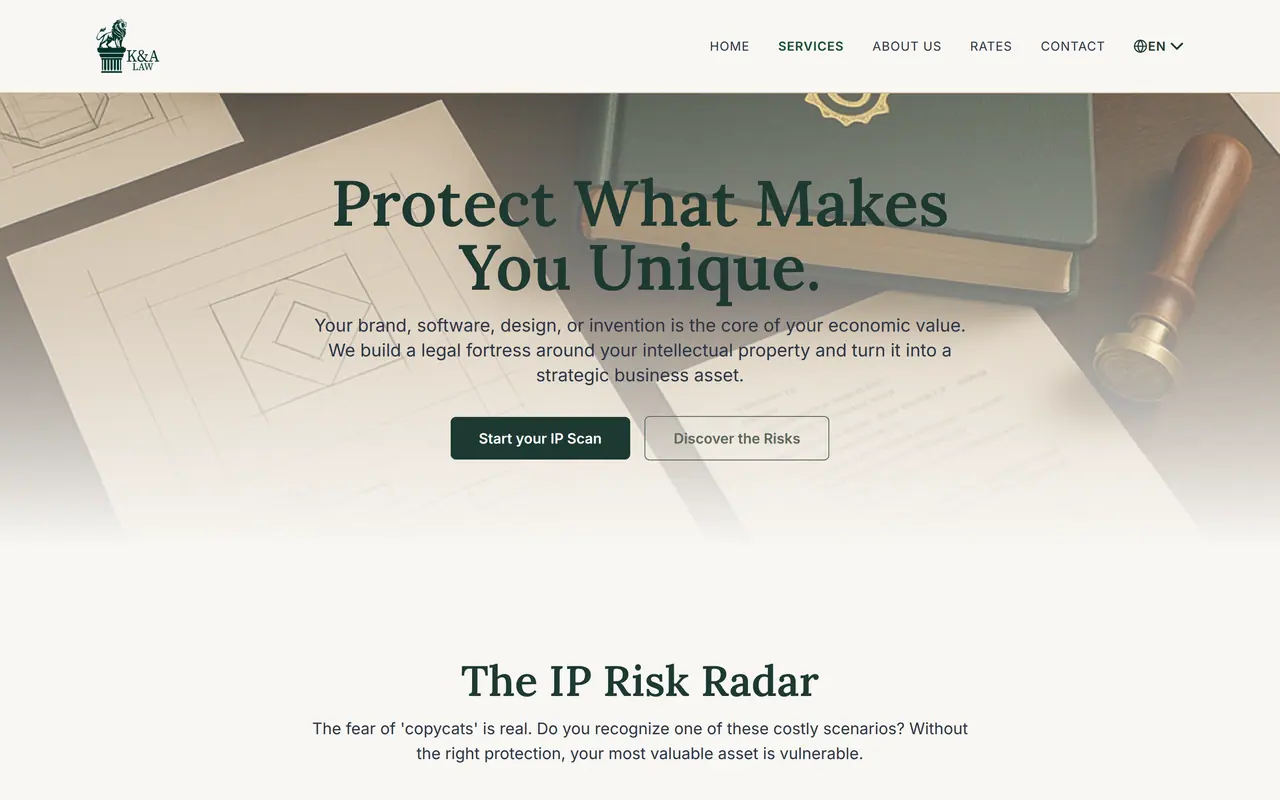
We map the search terms of your practice areas, jurisdictions and languages, read your current site against your bar's code, and write the pages your clients look for. You approve every page legally before it goes live. For K&A Law we built a site in four languages with twelve sector files and ten service pages. With the same method of search terms with proof, Business Centrum went from 13 to 1,593 non-brand search terms on page one. The approach is on SEO, the site itself on website for law firms. Book a call.
Which questions do your clients type?
Tell us your practice areas, countries and languages. We say which search terms exist and which page comes first.
Rather get in touch right away?