AI in logistics
AI in road transport, built on your own trips
1,182
AI in road transport only works on good data. We already built that data layer for real hauliers.
AI in logistics starts with refuels, trips and reports
AI in transport sounds like self-driving trucks and warehouse robots. For a haulier with twenty or thirty drivers the money sits closer to home: in the refuels, the trips, the receipts and the reports that already come in every day.
Once that data sits in one place, AI can look along. Which tractor uses more than it normally does? Which damage report has to reach the insurer today? Which receipt belongs to which trip? A language model or a simple statistical model answers those in seconds, if the data is right.
That is also the catch. At most hauliers the data lives in a fuel card statement, a spreadsheet, a WhatsApp group and a shoebox of receipts. So we start with the platform that collects it, and only add AI where it earns something you can measure. We are a team in Ghent, Belgium, building this for transport companies across Europe, in English.
A truck that drifts away from its own average
Alert for the office
Tractor C has used a sixth more than its own average since week 7.
Another driver, a leak, a fuel card used elsewhere? The system points, the office looks.
Six processes where AI reads along, and who decides
Not every promise about AI in logistics is ready for a small or mid-sized carrier. This is what works today, on data you already have, and who decides.
| Process | What AI does | What people do | What it brings |
|---|---|---|---|
| Fuel | Compares every tractor with its own litres per 100 km and flags the one that drifts | The office checks why: another driver, a leak, a fuel card used elsewhere | Litres and euros you do not see today |
| Damage and defects | Summarises a report from the app with its photos: what, where, which truck, how urgent | The office decides on repair and insurance | A complete file without chasing calls |
| Receipts and fuel slips | Reads a photo and turns it into an expense with amount, date, VAT and plate | Someone approves or corrects | No retyping, less searching at month end |
| Freight documents | Reads CMRs and delivery notes and links them to the trip | The planner checks what differs | Faster invoicing of what was actually driven |
| Messages to drivers | Translates a message from the office into each driver's language | The office writes and sends | No misunderstanding about a changed run |
| Planning | Suggests a free driver or a swap when there is a conflict | The planner decides | A faster answer, the planner keeps the last word |
The planning board in our transport platform solves conflicts with clear rules today, not AI. That is deliberate: a rule can be explained to a driver, a shipper and an inspector. How that board works is on transport management software. Reading receipts and supplier invoices is covered separately on invoice automation. Need the software under the AI first? See transport software and fleet management software. Tasks that run themselves, such as a weekly fuel report, are on AI agent development; the broader offer is on AI for business, and why work with a team in Belgium at all on nearshore software development.
Transport data that already exists, per driver and per day
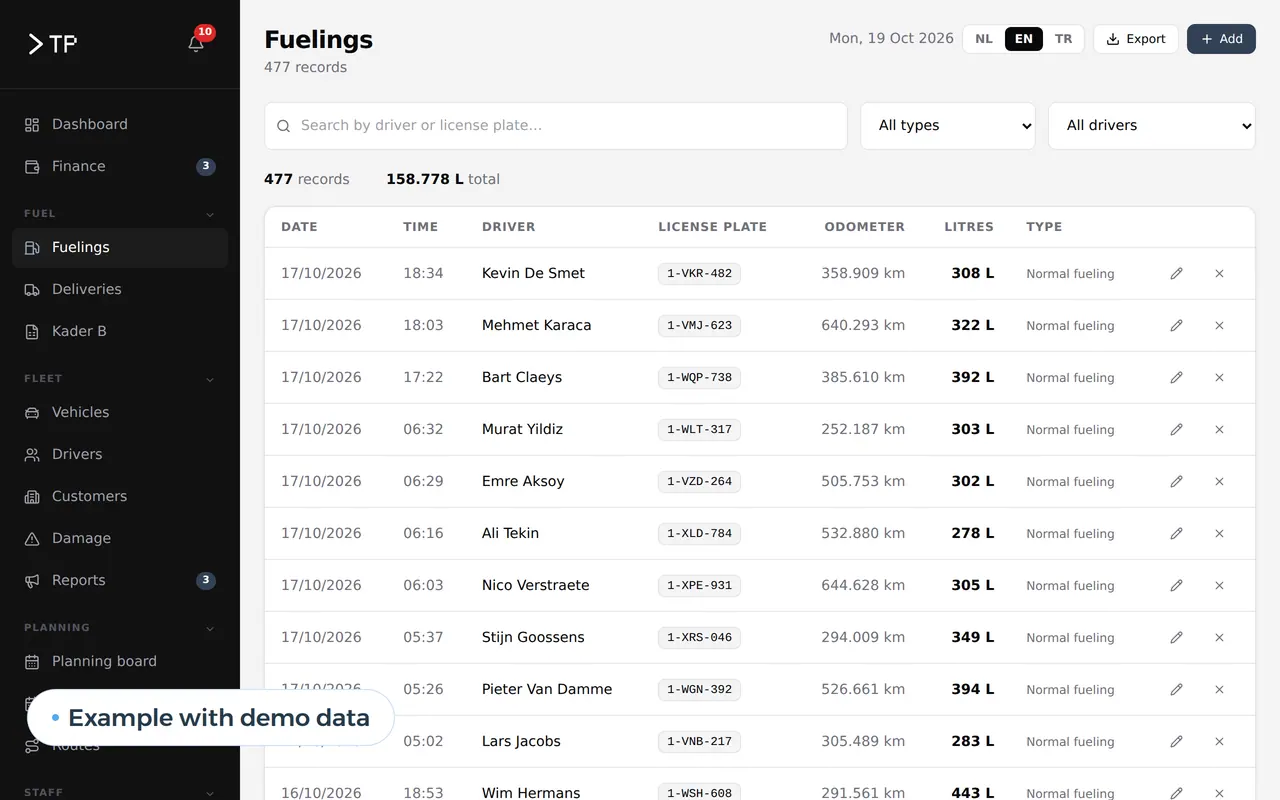
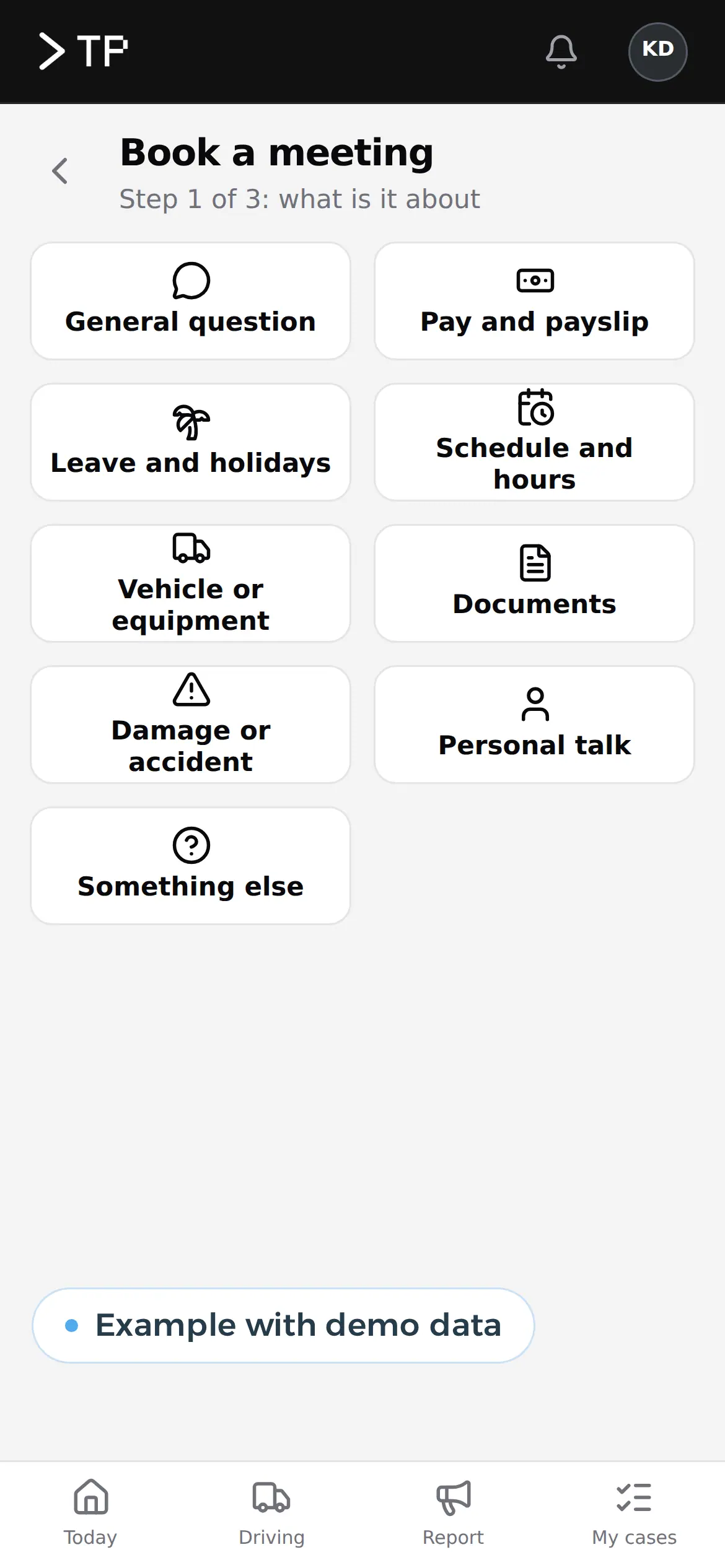
For DA Logistics, a Belgian haulier, we built a platform for fuel, fleet and planning: refuels, trips, a weekly planning board and an app in which about thirty drivers request leave and report receipts and damage themselves, in Dutch, English or Turkish.
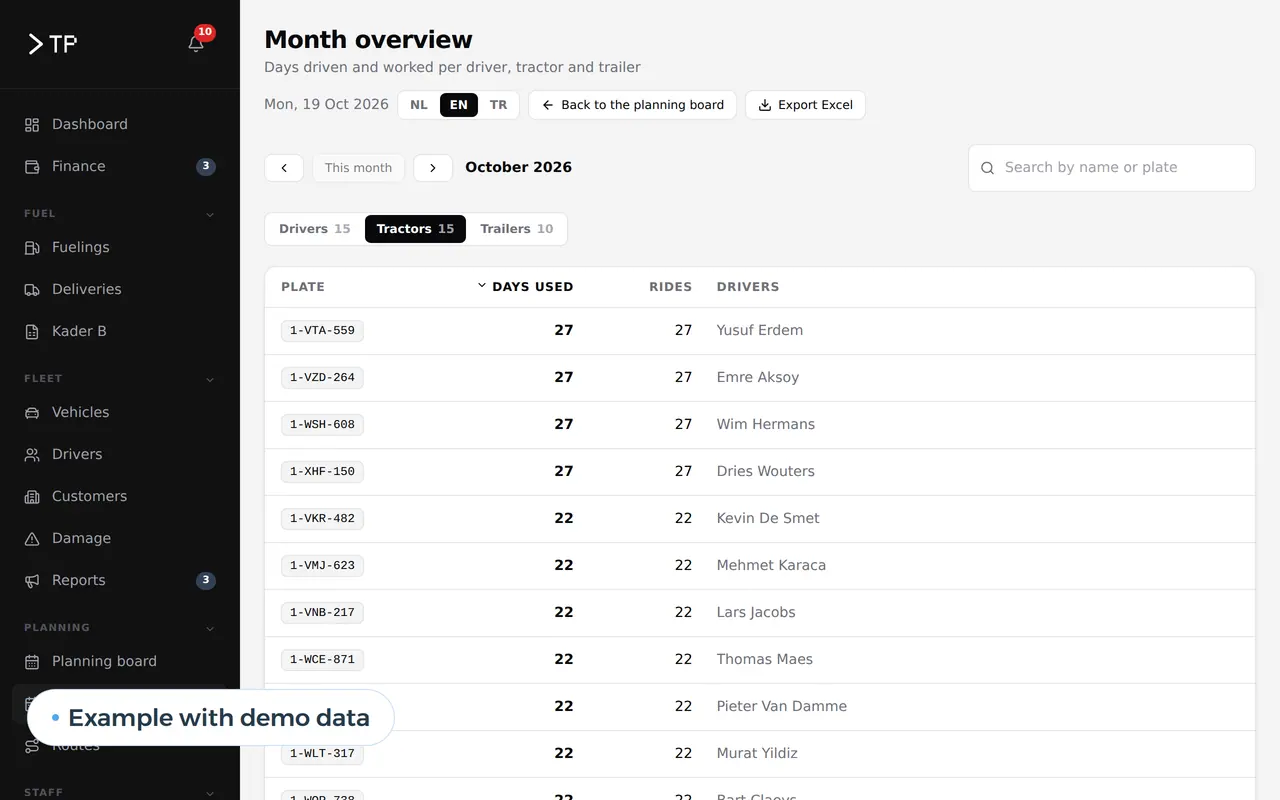
Besides those refuels, on 3 August 2026 it held 668 trips, collected since the platform went live in July. That is exactly the kind of data an AI model can work with: per driver, per number plate, per day, with litres and odometer readings attached.
- Refuels per vehicle and driver, down to the litre
- Days driven per month
- Reports from the driver app, with photos
The EU rules that already apply
AI in a transport business falls under the EU AI Act, also when you use a system rather than build it. After the AI Omnibus, in force since 27 July 2026, these are the dates. They apply in every EU country; a UK haulier selling into the EU meets them too.
| Rule | Since or from | What it means for transport |
|---|---|---|
| AI literacy (Art. 4) | 2 February 2025 | Staff who work with an AI system know its limits. A short training for planners and the office is often enough |
| Ban on emotion recognition at work | 2 February 2025 | A camera that reads a driver's mood is not allowed. Systems that detect drowsiness for safety reasons fall under the safety exception |
| Transparency (Art. 50) | 2 August 2026 | If a chatbot talks to customers or drivers, they must know it is AI |
| High risk, Annex III | 2 December 2027 | AI that allocates tasks based on workers' behaviour or traits, or monitors and evaluates their performance, carries heavy obligations |
The GDPR sits on top. Location data, fuel cards per driver and photos of damage are personal data: you have to state why you process them, how long you keep them and who sees them. Our platforms run on servers in a European AWS region.
Which risk class your idea falls into takes two minutes with the EU AI Act compliance checker. Whether you need an AI policy as an employer is answered on do I need an AI policy?
Thirty trucks worked out: diesel and hours
Take a haulier with 30 tractors, each driving 100,000 km a year at 30 litres per 100 km. The figures are assumptions; run them again with your own fleet.
| Item | Without AI | With AI on your own data | Difference per year |
|---|---|---|---|
| Diesel per year | 900,000 litres | 891,000 litres, if anomalies surface one percent faster | 9,000 litres |
| Value at an assumed 1.60 euros per litre excl. VAT | 1,440,000 euros | 1,425,600 euros | 14,400 euros |
| Retyping receipts and fuel slips, 300 a month | 15 hours a month | 2.5 hours of checking | 150 hours |
| Chasing and summarising damage reports, 8 a month | 8 hours a month | 2 hours | 72 hours |
The hours add up to 222 a year, worth 9,990 euros at an assumed 45 euros an hour. With the diesel, this example yields about 24,000 euros a year.
And the AI itself? Reading one receipt takes a model about 2,000 input tokens and 300 output tokens. With a fast model such as Claude Haiku 5.5 or GPT-6 Luna, at 0.10 dollars per million input tokens and 0.50 dollars per million output tokens, 300 receipts a month cost about 10 dollar cents. The model is rarely the cost; the data and the integrations are the work. Deviations per vehicle sit best on a custom dashboard, next to the rest of your figures. Run your own case through the ChatGPT API cost calculator, and see how the models compare in ChatGPT vs Claude.
An investment of 20,000 to 25,000 euros in AI on top of a platform you already have pays back in about a year in this example.
Damage reports that AI summarises for the office
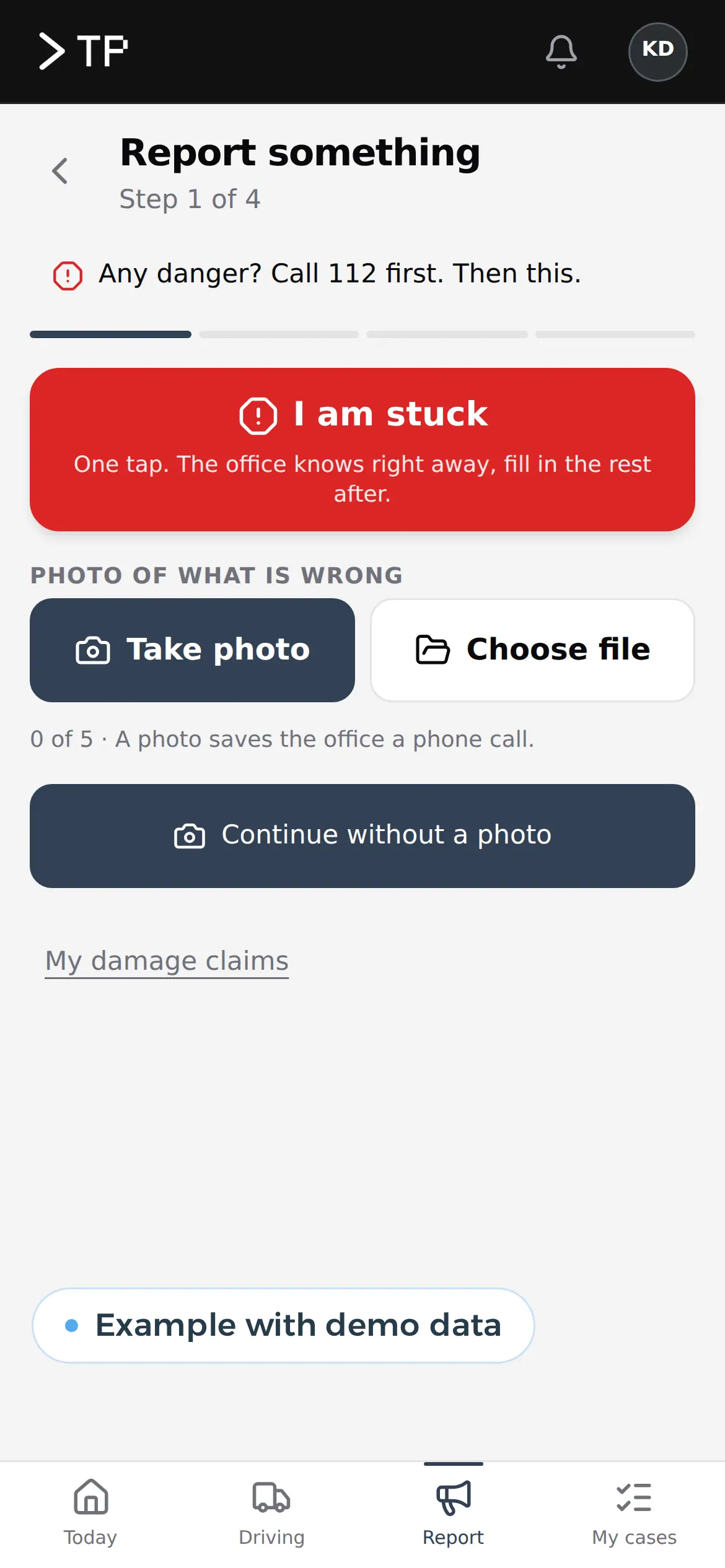
In the driver app a driver reports something in four steps: first a button if he is stopped, then photos, then what happened. The office knows at once.
AI can build on that: the photos and the text become a short summary with the plate, the location and the urgency, ready to forward to the garage or the insurer. A person checks it and sends it.
Four steps, from data to a measured trial
- The data in one placeIf refuels, trips and reports still live in spreadsheets or on paper, we first build the platform that collects them. If they already sit in a system, we read its export.
- One use case you can measureFuel, receipts or damage reports: together we pick the place with the biggest gain and agree how to measure it.
- A four to six week trialThe model runs on your real data while the office approves every suggestion. After the trial you see how many hours and litres it saved.
- Roll out or stopIf it works, it moves into the platform. If it does not, we stop and you know why. Then the next use case.
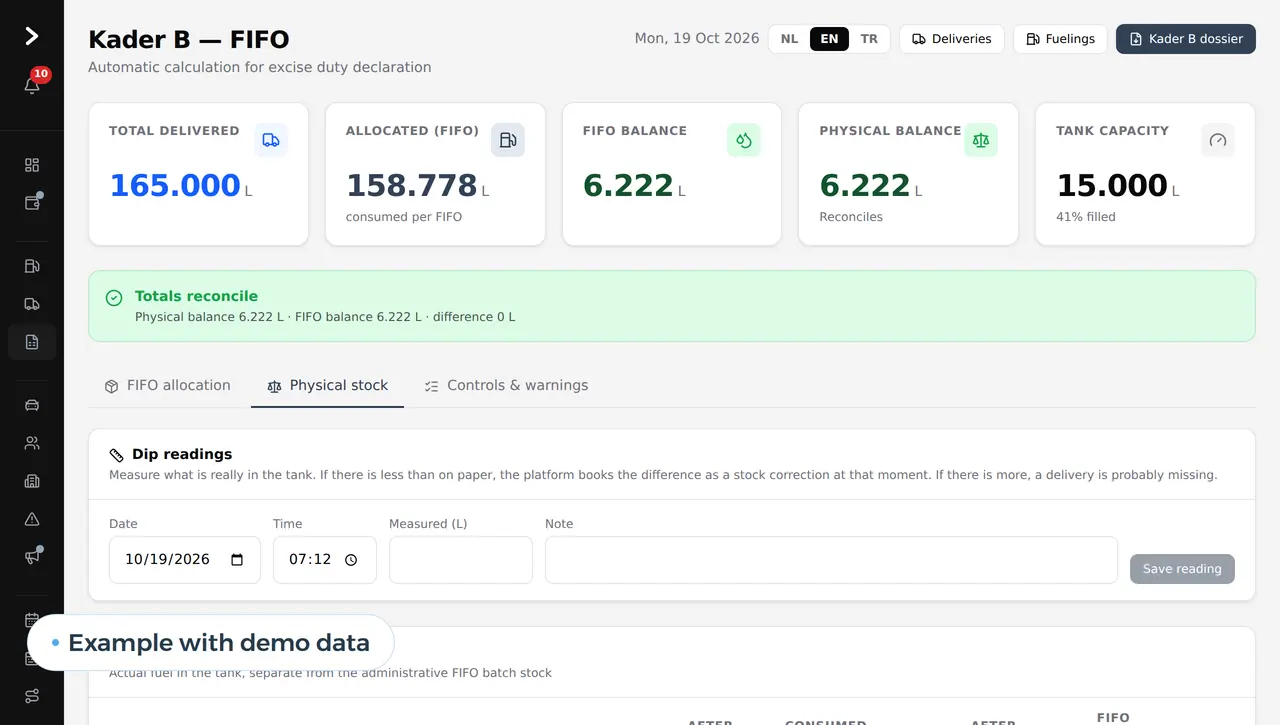
Transport screens the AI would read along with
The data is already there: DA Logistics and Zuco
Most agencies selling AI start with the model. We start with the data, because we already collect it for transport companies. The platform at DA Logistics is in daily use: about thirty drivers, 34 vehicles, fuel tracked down to the litre. At Zuco Logistics the same core went live in 57 minutes with its own fuel model. There is no AI in those platforms yet; it is the layer we add where it pays.
What we do for you:
- We look at your data first: what is there, what is missing, and whether AI adds anything or a plain rule will do.
- We run a trial on your real trips, not a demo, and measure the result in litres and hours.
- A person always decides: the system points and explains why.
- We keep you within the AI Act and the GDPR, with data on servers in the EU, and kick off on site when it helps.
Tell us where your office loses the most time. Book a call and we will tell you honestly whether AI is the answer.
What hauliers ask us about AI
Do I have enough data for AI?
A few months of refuels and trips per number plate are enough to see unusual fuel use. If your data still lives in spreadsheets or on paper, we first build the platform that collects it, as we did for DA Logistics.
Does it work with my TMS or fuel card?
Where your provider offers an export or integration, we read it. Where a piece is missing, we build it, or the driver enters it in the app.
Will my drivers understand it?
The driver app runs in Dutch, English and Turkish, with a name tile and a four-digit code to log in. AI can also translate office messages into each driver's language.
May I rate my drivers' performance with AI?
You can, but under the AI Act it is a high-risk use with heavy obligations from 2 December 2027. For most carriers a signal about a vehicle is wiser than a score for a driver.
Does our data go to ChatGPT?
Not without you knowing. We pick models with a data processing agreement and no training on your data, and keep data on servers in the EU where possible.
Who decides when the system flags something?
Always the office. The system points and explains why; a person looks and decides.
AI for business
How VBS helps you with this
We build AI into your own work: it drafts emails, reads documents and answers questions, and you stay the one who decides.
- First a task that costs time, then a working prototype
- On your own documents and your own data
- An AI policy your team understands
How we approach it is on our page about AI for business.
Where does your office lose the most time?
Tell us. We will say honestly whether AI helps there, and how much.
Rather get in touch right away?