SaaS development
Build a SaaS platform that more clients can run on

57 minutes
Build a SaaS platform: a first version live fast, on a core that takes a second and third client.
Software that others use starts with a core
You built a tool for your own company and peers in your industry want it too. Or you see a problem every business in your sector has, and no package that solves it. Then you do not need a website, you need a platform: software your customers log into, each with their own data, and pay for every month.
Building a SaaS platform takes different decisions from an internal tool. Every customer sees their own data and nothing of anyone else's. A new customer has to come on board without a rebuild. Payments, roles, backups and updates must run without you awake at night. And when it grows, it must not fall over.
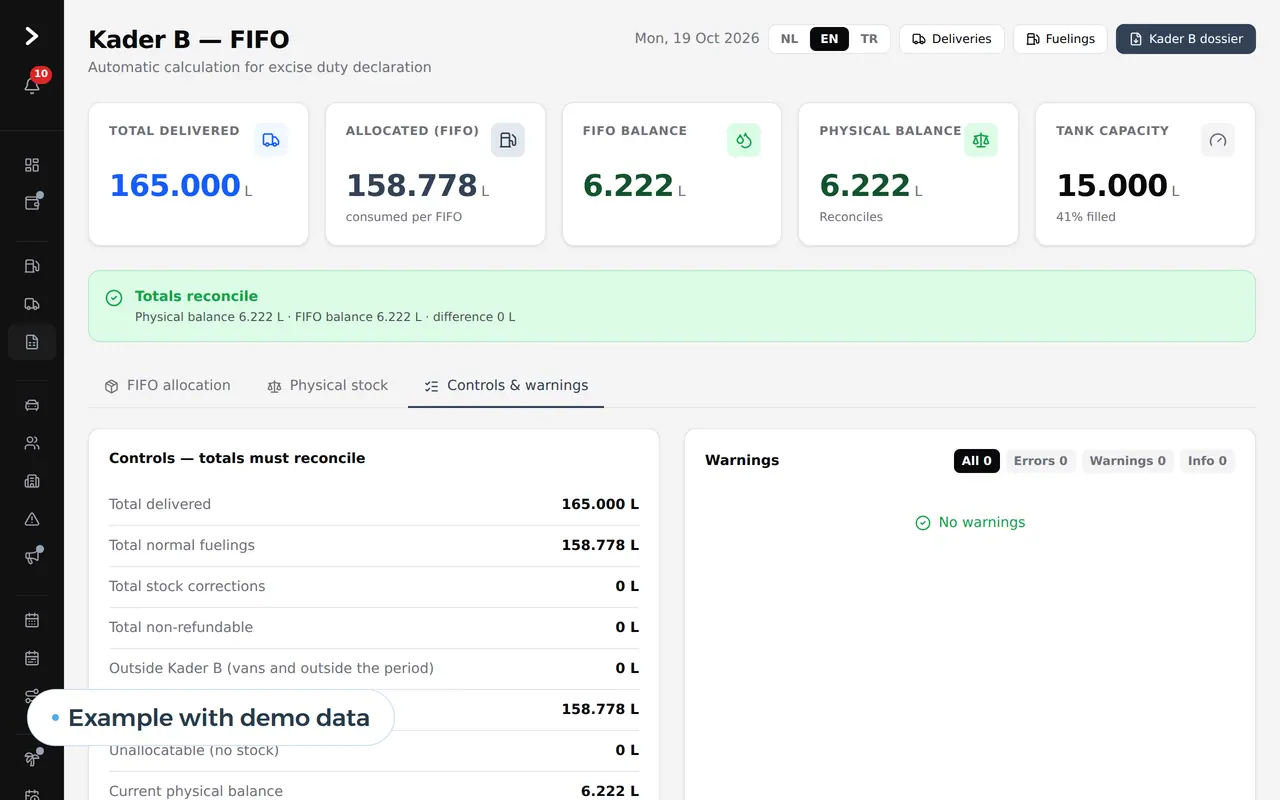
We build these platforms, and built one for ourselves: AMOSI, our own marketing software, went live in July 2026. The transport platform we built for DA Logistics became a product a second haulier now runs on, with its own server and fuel model.
One SaaS core, one profile per customer
DA Logistics
Excise refund scheme with FIFO
Own server, own domain
Live since July 2026
Zuco Logistics
Depot with purchases
Own server, own domain
Live since September 2026
Next customer
Fuel card
A profile folder and a script
Ready to start
What started as custom work for one customer became a product: a new customer is a profile on top of the same core. A bug fixed in the core is fixed for everyone.
What sits under the bonnet of a platform, and what it costs when it is missing
A platform customers trust needs more than screens. This sits under the hood of every platform we build, and this is what it costs you when it is missing.
| Part | What it does | What you gain | When it is missing |
|---|---|---|---|
| Separated customer data | Each customer sees only their own data, enforced in the database | A promise you can make and prove | One bug shows another customer's data: a breach |
| Customer profile | Branding, modules, language and rules per customer as settings | A new customer is a profile, not a project | Every customer becomes a fork you maintain separately |
| Roles and login | Admin, staff, customer; two-factor authentication, revocable sessions | Customers manage their own people | Shared passwords and support tickets |
| Subscriptions and payments | Plans, trials, invoices and VAT through a payment provider | Money arrives monthly without work | Invoices by email and chasing payments |
| Backups and monitoring | Daily backups, alerts on errors, a firewall | You see a problem before your customer does | Your customer reports it, or leaves |
| Releases | New versions live in seconds, with a way back | You can improve every week | Friday-night updates and held breath |
| Audit log | Who did what and when | An answer to a question or an audit | Arguments without evidence |
On our platforms a release switches over in 2 to 6 seconds, with a backup and a way back. When building beats buying, and when it does not, is worked through in our build vs buy comparison.
A new customer on the platform in one afternoon
This is how Zuco Logistics joined the transport platform on 14 September 2026.
- 15:28Domain registeredIts own address for the new customer, in its own name.
- 15:37Certificate activeA secure connection for the new address.
- 16:25Site and server liveA dedicated server with the Zuco profile: branding, modules and its own fuel model. 57 minutes after the start.

An MVP you can show customers straight away
An MVP is the smallest version a customer can really use: a login, the one function that matters, and an admin side for you. It is small so it reaches your first users quickly. Then we build on what they say.
We build an MVP with the same stack as a platform in production: React and TypeScript, its own server and database, hosted on AWS in Europe. If the idea works, you do not start over; you build on what is there.
- A login per customer, with their own data
- The function that proves your idea
- An admin side for you
- Hosting that grows with you
40 customers at 149 euros: what running it costs
What does a platform cost once it runs? Less than most founders expect.
| Item | Price per month | Service |
|---|---|---|
| Server, 2 GB memory, 60 GB storage | 12 dollars | AWS Lightsail |
| Server, 4 GB memory, 80 GB storage | 24 dollars | AWS Lightsail |
| Managed database, 2 GB, high availability | 60 dollars | AWS Lightsail |
| Card payment with a standard EEA card | 1.5% plus 0.25 euros per payment | Stripe, Belgian account |
| Card payment with a UK card | 2.5% plus 0.25 euros per payment | Stripe, Belgian account |
| Subscription management | 0.7% of billing volume | Stripe Billing |
A worked example with assumed figures. Your platform has 40 customers at 149 euros a month: 5,960 euros a month. Stripe charges 1.5% plus 0.25 euros per payment, 99 euros in total, plus 0.7% for subscriptions, another 42 euros. A server and a high-availability database cost about 85 dollars together. With backups, email and monitoring you stay under 300 euros a month, or 5 percent of revenue.
So the big cost is building and building on, not running. If the first version wins 40 customers, the platform brings in 71,520 euros a year. An MVP of 40,000 euros pays back in under a year; a mature platform of 120,000 euros in about two, if customers stay. Where a European team sits on price against other markets is in best countries to outsource software development and web developer hourly rates; to brief any supplier, use our software requirements specification template.
The EU rules for anyone selling software to businesses
Selling software to other businesses means processing their data and their customers' data. These are the rules that apply today, and what they ask of your platform. If you are based outside the EU but sell into it, most of them reach you through your customers.
| Rule | Since or from | What it asks of your platform |
|---|---|---|
| GDPR, Article 28 | Since 2018 | You are a processor for your customers: a processing agreement with each, separated and secured data, a list of your own sub-processors such as hosting |
| NIS2 Directive | Transposed across the EU; in Belgium since 18 October 2024 | Medium and large companies in listed sectors, digital services among them, must register and manage their cyber risks. Customers that fall under it will ask the same of you |
| Cyber Resilience Act | Reporting duties since 11 September 2026, the rest from 11 December 2027 | Applies to products with digital elements, such as an app you sell. A pure web service usually falls outside, a mobile app or an on-premise agent not always |
| VAT on digital services | In force | To businesses in another EU country you invoice without VAT under reverse charge. To consumers in other EU countries, above 10,000 euros a year, their country's VAT via the OSS scheme |
| EU AI Act, Article 50 | Since 2 August 2026 | If your platform has a chatbot or AI feature, users must know they are dealing with AI |
That is why every platform we build runs on servers in Europe, with separated customer data, encryption of sensitive fields, two-factor authentication and an audit log. If your product includes AI, see custom ChatGPT for your business and check your duties with the EU AI Act compliance checker. Why a team in Belgium rather than one at home or offshore is set out on nearshore software development, and what a capable framework team brings on hire Next.js developers. The broader offer is custom software development and web application development; a dashboard inside your product is custom dashboard development, an app on your users' phones app development.
Custom SaaS or a no-code tool
A no-code tool or a white-label package gets you online fast. A custom platform is yours.
- First version
- No-code or white-labelDays to weeks
- Custom platformWeeks, on the stack you keep
- Cost per customer
- No-code or white-labelPer seat or per use, rising with success
- Custom platformHosting that barely grows
- Separated customer data
- No-code or white-labelAs far as the package allows
- Custom platformEnforced in the database
- Industry rules
- No-code or white-labelUp to the package's limits
- Custom platformAs deep as your customers need
- Value of your company
- No-code or white-labelBuilt on someone else's ground
- Custom platformCode and data are yours
Testing an idea with ten users? Start with no-code. Building a company on monthly subscriptions? Build the core custom.
1,396 automated tests guard every release
The DA Logistics transport platform runs on 1,396 automated tests. A release switches over in 2 to 6 seconds, with a backup and a way back.
That is how we build every platform customers rely on: tested before it ships, reversible when it does not behave.
A team that built and shipped a platform of its own
Most agencies build a platform and hand you the keys. We also built one for ourselves: AMOSI went live in July 2026, on an AWS environment of 172 resources with a firewall, backups and monitoring. The transport platform of DA Logistics became a product when Zuco Logistics joined: one core, a profile per customer, three fuel models, and a new customer live in 57 minutes.
What that means for your platform:
- We build the smallest version that sells first, and agree upfront what is left out.
- The core is ready for more customers from day one: separated data, profiles, roles.
- You own the code and the data, written into the contract.
- We stay after launch: hosting, backups, monitoring and building on what your customers ask.
Tell us what you want to build and for whom: book a call.
What founders ask at the start
- Who owns the code?
- We agree it upfront. For a platform that becomes your product, you own the code and the data. That is also what an investor will ask about later.
- Can the platform run in several languages?
- Yes. The transport platform runs in Dutch, English and Turkish. More languages are a matter of translating, not rebuilding.
- How long does an MVP take?
- It depends on the core function. We agree what the first version must do and plan in weeks, with a version you can see and show to your first customers along the way.
- What does it cost to build a SaaS platform?
- It depends on the features, the number of user types, the integrations and the hosting. After a call you get a price in euros for the MVP. Running it usually costs a few hundred euros a month.
- Can you host and maintain it afterwards?
- Yes. We host on AWS in Europe, with backups, monitoring and a firewall, and keep building as your platform grows.
- We are not in Belgium. Does that matter?
- No. We work by video call, invoice in euros, and for a business customer in another EU country VAT is usually reverse charged. UK and US founders work with us the same way.
Custom software
How VBS helps you with this
We build the platform your business runs on every day: your spreadsheets, emails and paperwork in one system that does what you do.
- Your workflow mapped first, then a fixed price
- Screens for the office, the client and the road
- Hosting, backups and security managed by us on AWS
How we approach it is on our page about Custom software.
An idea that could become a platform?
Tell us what you want to build and for whom. We will show you what the first version would be.
Rather get in touch right away?