Direct booking
Direct booking website for holiday homes and villas
Your house, your calendar and your returning guests, next to the platforms instead of under them.
The platforms find guests. Your site keeps them.
A direct booking website pays for one reason: guests who already know your villa, came back for a second summer or heard about it from friends would rather book with you. Without a site of your own they book through Airbnb or Booking anyway, and you pay a fee on a guest you brought in yourself.
You do not have to leave the platforms. They are good at finding people who have never heard of your house, in every country at once. Your own site stands beside them for everyone else. Below: how few booked weeks pay a site back, the calendar that keeps both in sync, what a guest checks before asking, the rules on listings that now reach your own site, and how to be found without a platform.
What a platform takes from each stay
Airbnb charges in two ways. Under the host-only fee, most hosts pay 15.5 percent and the guest sees one all-in price; listings run through property management software must use it. Under the split fee, most hosts pay 3 percent and the guest pays a separate service fee on top, a structure Airbnb is phasing out. Booking.com charges a commission set in your own partner agreement, which differs by property and market. What you keep after fees on each platform is worked out in Airbnb vs Booking.com for hosts.
From 1 July 2028 a platform also becomes liable for VAT on short stays when the host charges none; what that means for your choice is in ViDA VAT in the digital age.
That changes what a direct booking wins you. On the host-only fee you keep the whole 15.5 percent. On the split fee you keep 3 percent, but your guest pays noticeably less booking with you than on the platform, which is a reason to book direct you can state plainly on your site.
| Airbnb and Booking | Your own site | |
|---|---|---|
| New guests | strong, from every market at once | through Google, your network and returning guests |
| Cost per stay | a service fee or commission | no commission, only your payment provider |
| The guest's details | the platform keeps the relationship | name and email are yours, for next year |
| How the house is shown | inside the platform's template | your story, the area, the seasons, your languages |
| Reviews | on the platform, and they stay there | on your Google profile and your own site |
The third row is the quiet gain. A guest who booked direct can hear from you next spring when the summer weeks open; a platform guest you can only reach through the platform.
- Choose the platforms alone ifthe house is new, has no returning guests yet and nobody has time to answer requests.
- Choose your own site with a request form ifpart of your guests return or come through your network and you are happy to confirm each request yourself. That is where most owners start.
- Choose a site with a calendar that reads the platforms ifthe house is busy and selling a week twice would be a disaster. Taking payments online as well is a booking system for your website.
How the calendar stays in sync with the platforms for a guest house is on bed and breakfast booking software.
How many weeks booked direct pay for a site
A villa with a pool, 450 euros a night, 3,150 euros a week. The platform keeps 15.5 percent; a direct booking does not.
488.25 eurosstays with you for every week booked direct
A site with the house, prices and a request form
1,500 euros = 4 weeks
A site with a calendar, languages and bookings
5,000 euros = 11 weeks
Example. Each block is one week a guest books with you instead of through the platform. You still pay your bank or payment provider.
What a guest checks before sending a request
The house, large and from above
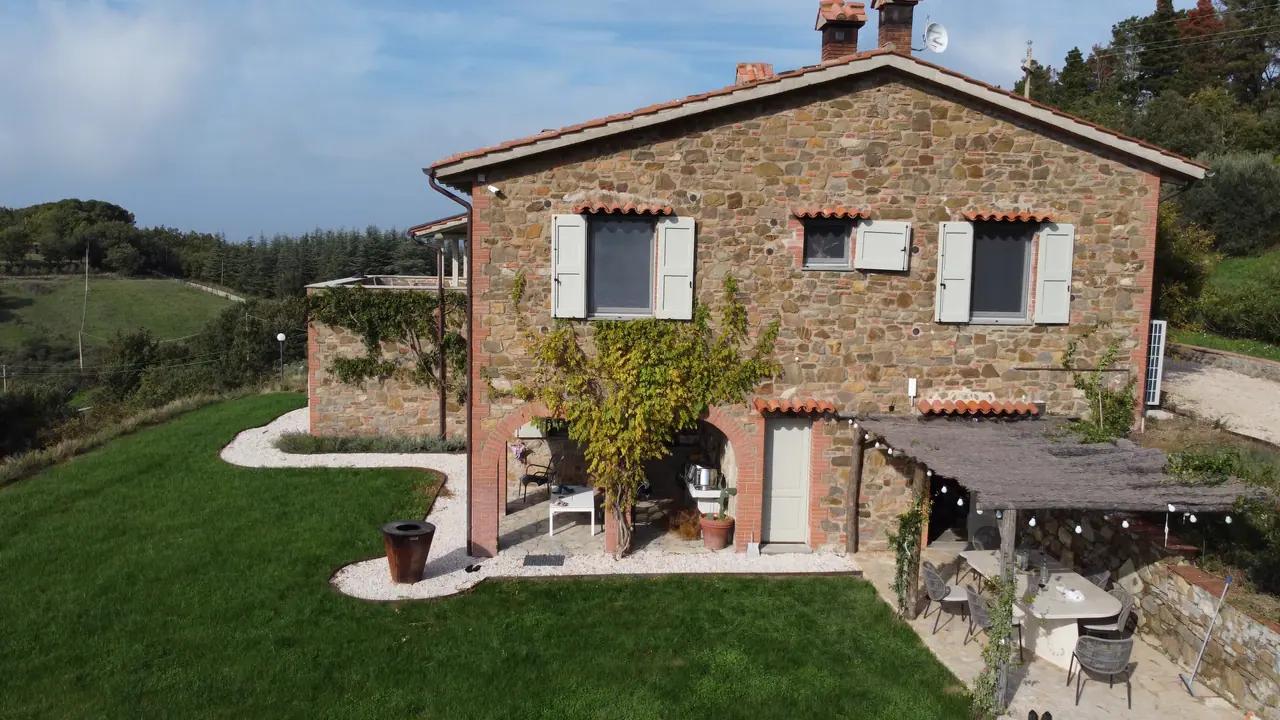
Guests book on feeling. Photos of the rooms, the garden and the pool, and an aerial shot that shows the setting, do more than any paragraph.
Who sleeps where
Bedrooms and beds per room, a cot, the kitchen and bathrooms. Concrete, without clicking through.
What is free
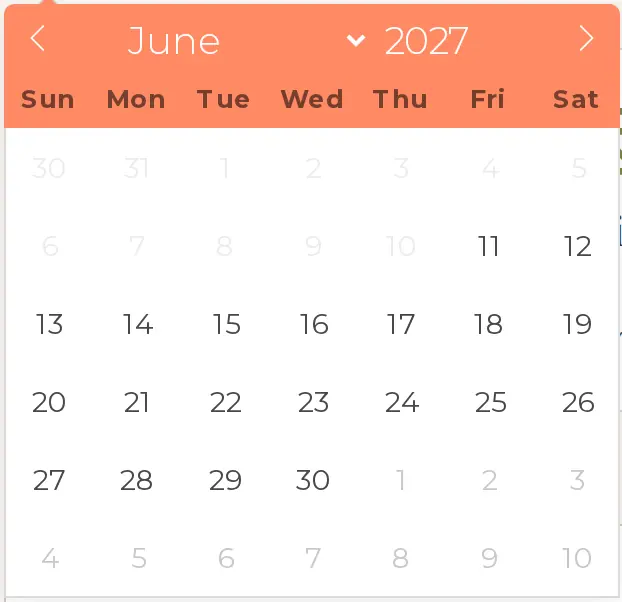
A calendar with available nights, so nobody writes for a week that has already gone.
The full price
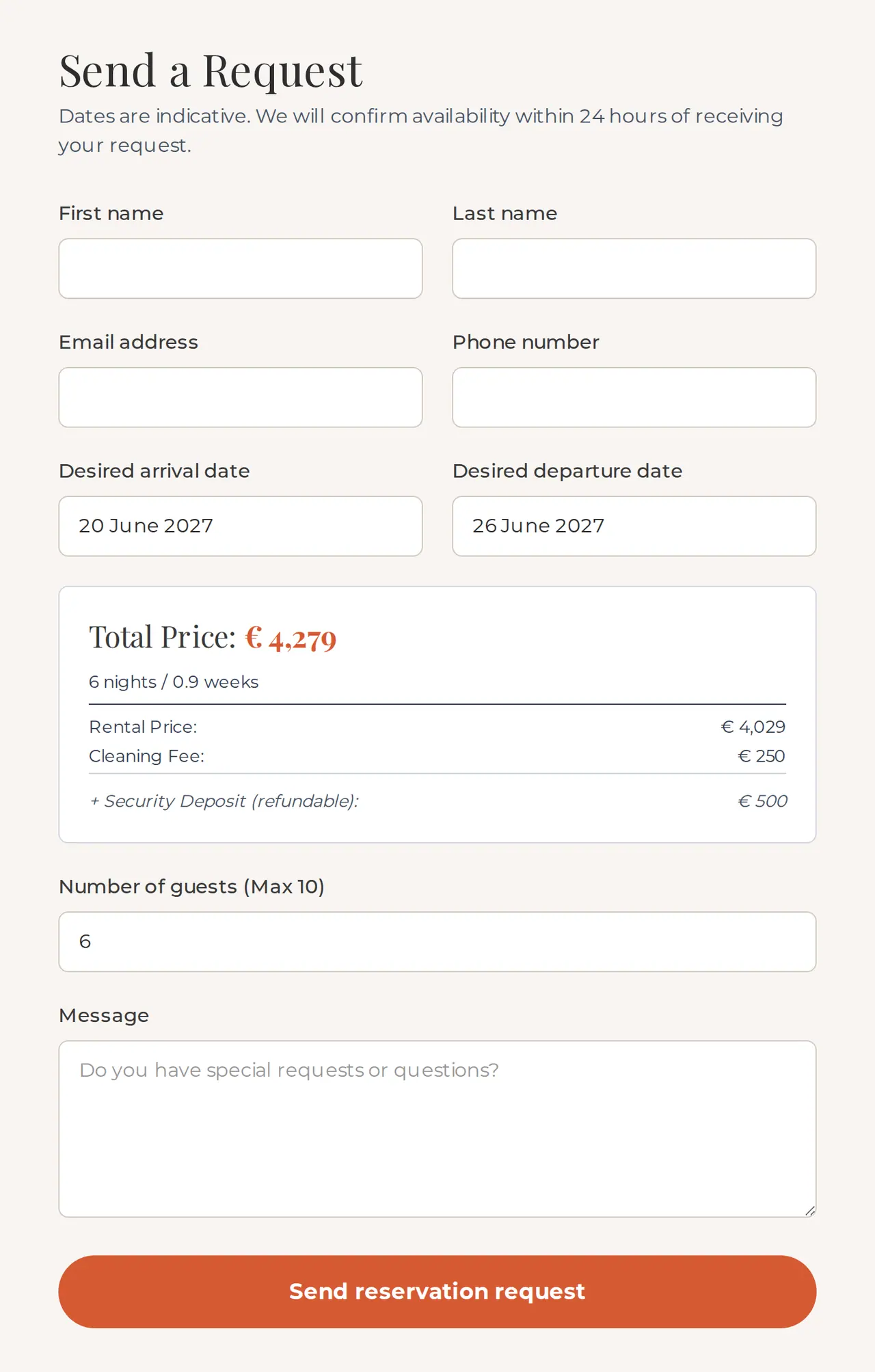
Per night or per week, with cleaning, tourist tax and deposit, and what happens if they cancel.
Why this place
Walks, villages, restaurants, a lake or a golf course nearby: the reason to come in the first place, and a page Google can find.
A calendar that never sells a week twice
A night sold on Airbnb must not show as free on your own site. Airbnb and Booking each give you an iCal address that your site's calendar reads, and your site gives one back. That is how the calendar of No.4 Lange Ast, a house for eight in Flanders, reads both platforms, built as a plugin on the WordPress site it already had.
Registration numbers now follow your listing
Since 20 May 2026 an EU regulation on short-term rentals applies in every member state. Where a country or region runs a registration scheme, platforms must ask for the property's registration number, show it on the listing and remove listings without one. Italy goes further: each holiday rental needs a national identification code, the CIN, shown outside the building and in every advert of the property wherever it is published. Treat your own site as one of those adverts, put the number in the footer and on the booking page, and check the rules of the region where your house stands before the first guest arrives.
Payments, deposits and cancellation, decided before the first request
| Decision | What most owners choose | Where it goes on the site |
|---|---|---|
| How a booking is confirmed | a request the owner confirms within a day | next to the booking button |
| Deposit | a share on confirmation by bank transfer or payment link | in the price summary |
| The balance | paid a few weeks before arrival | in the confirmation email and the terms |
| Security deposit | refundable, returned after checkout | in the price summary, marked refundable |
| Cancellation | clear deadlines with the refund at each one | on the booking page itself, not only in an email |
A platform answers all of this for the guest. On your own site you have to, or the guest goes back to the platform where it feels safer.
Returning guests and the seasons
A guest who loved the house is your cheapest next booking. With the email from a direct booking you can write once or twice a year, when the autumn weeks open or the summer fills up, never every week. Give the seasons their own pages too: spring walks, summer by the pool, autumn harvest. Each is a reason to return and a search to be found on. Plan the year with the content calendar template; reels of the house and the area reach people who are not searching yet, which is social media management. How and when to ask for reviews is in get more Google reviews.
Light pages, large photos
A holiday home sells on photos, and photos make sites slow. Villa Lidia's home page went from 8.4 MB to 1.4 MB with the same photos, each served in the size a screen needs, so a guest planning on a weak connection still sees the pool in a second. Test your own site with the website speed test; what slows sites down is in improve website speed.
Being found without a platform
People who do not know your house search on the region plus villa or holiday home, on a pool, a walking route or an event nearby. A page on the area and the seasons catches those searches. A Google Business Profile with photos and reviews puts the house on the map; ask each guest for a review after their stay with a link from the Google review link generator, and reply to every review in the guest's language. Guests come from many countries, so a site in their languages, with prices, house rules and cancellation terms clear, brings them in directly; see multilingual website development. How AI assistants pick places to recommend is part of being found in ChatGPT.
Taking guests' personal data yourself means a short privacy policy on the site, and analytics that run without cookies or after consent; see do I need a cookie banner.
Villa Lidia, booked from its own site
Website design
How VBS builds a direct booking site
We put the house large on screen with its rooms, its surroundings and a price that adds up, and add a calendar that reads Airbnb and Booking and a request form in your guests' languages. For Villa Lidia, a villa with an infinity pool in Umbria, we built a site in English and Dutch with a booking request form, an availability calendar and a small admin panel for the owner. No.4 Lange Ast runs in four languages. The way we build sites is set out on website design. Book a call and send us the link to your house on Airbnb or Booking.
Less commission on your bookings?
Send us the link to your house on Airbnb or Booking. We reply with what your own site would do.
Rather get in touch right away?