Transport planning
Transport management software built on your own lanes
668
Transport management software that plans your recurring lanes, drivers and trucks per week, and flags every conflict.
Haulage planning that starts from scratch every Monday
Most hauliers with ten to fifty drivers plan in a spreadsheet, on a whiteboard or in one planner's head. It works until a driver calls in sick, a tractor is in for its annual test or a shipper asks for an extra run on Friday afternoon.
Your recurring lanes are the same every week, yet the file starts empty. Which driver takes which tractor and trailer sits in another sheet. Leave requests arrive on WhatsApp. Whether the week still fits the EU driving and rest rules, nobody checks until the tachograph says so.
Off-the-shelf transport management software (TMS) is built for the average carrier and priced per user or per vehicle. We build transport management software around your lanes, your shifts and your shippers, from a team in Ghent, Belgium, that already runs this kind of platform for two hauliers every day.
Driving hours and the other EU rules a board must respect
In road haulage a plan is not a calendar. It has to fit European rules that an inspector later reads from the tachograph. These are the rules that most often break a week that looks fine on paper. They apply in every EU country, so they matter whether you run trucks out of Rotterdam, Hamburg or Ghent.
| Rule | What it requires | What it means for your plan |
|---|---|---|
| Daily driving (Regulation (EC) 561/2006) | At most 9 hours, 10 hours twice a week | Two long days early in the week leave less room on Thursday |
| Weekly and fortnightly driving | At most 56 hours a week and 90 hours over two weeks | A heavy week has to make the next one lighter |
| Breaks | 45 minutes after 4.5 hours of driving, which can be split into 15 and 30 minutes | A five-hour run without a stop is not allowed, even if the customer is waiting |
| Daily rest | At least 11 hours, reducible to 9 hours three times between weekly rests | A late return pushes back the next morning |
| EU Mobility Package | No regular weekly rest in the cab, drivers can go home every four weeks, trucks return to the operating base every eight weeks | International lanes need a plan over weeks, not days |
| Smart tachograph version 2 | Required in international haulage; since 1 July 2026 also for vans of 2.5 to 3.5 tonnes in international goods transport | Light commercial vehicles now count in the rules too |
| eFTI Regulation (EU) 2020/1056 | From 9 July 2027 authorities across the EU must accept freight information in electronic form | A plan that already knows who, what and where per trip supplies that data without retyping |
Road tolls add a cost the plan can see. In Flanders, a Euro VI truck above 32 tonnes pays between 0.245 and 0.285 euros per kilometre since 1 July 2026, depending on its CO2 class. An empty return or a detour shows up on the invoice.
How you record your drivers' hours is covered on custom time tracking software. What an expired inspection does to your plan is on fleet management software.
A conflict on the planning board, and the fix it proposes
Conflict
Murat is on leave on Wednesday
Jonas is free and drives no other lane that day
Solved: Jonas planned
Conflict
Tractor 1-VKR-482 is in for inspection on Thursday
Tractor Q-AKT-418 is free, Thomas takes it
Solved: Tractor swapped
Example with made-up names, shippers and plates. The board proposes, the planner decides.
Lanes per week, with drivers, tractors and trailers alongside
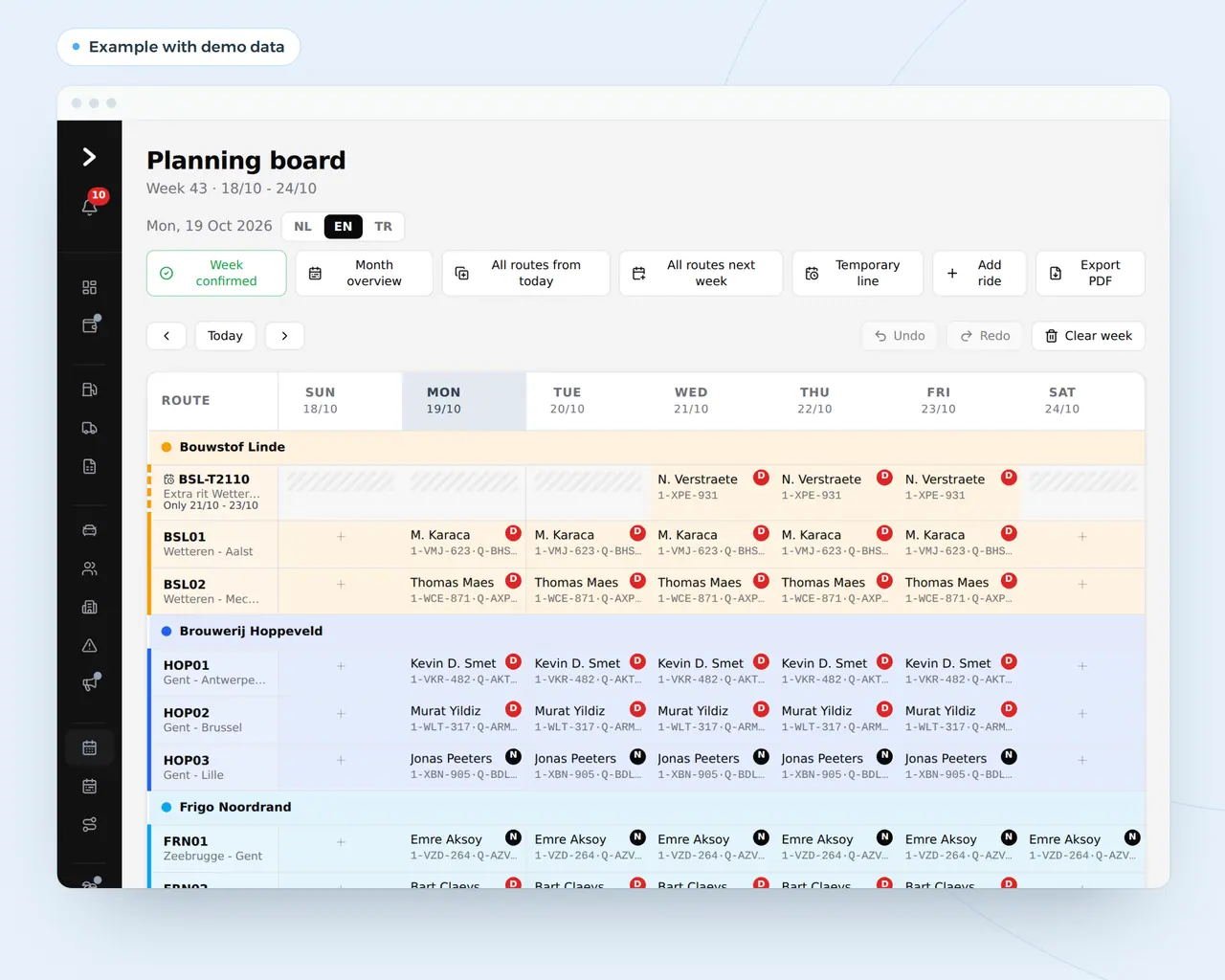
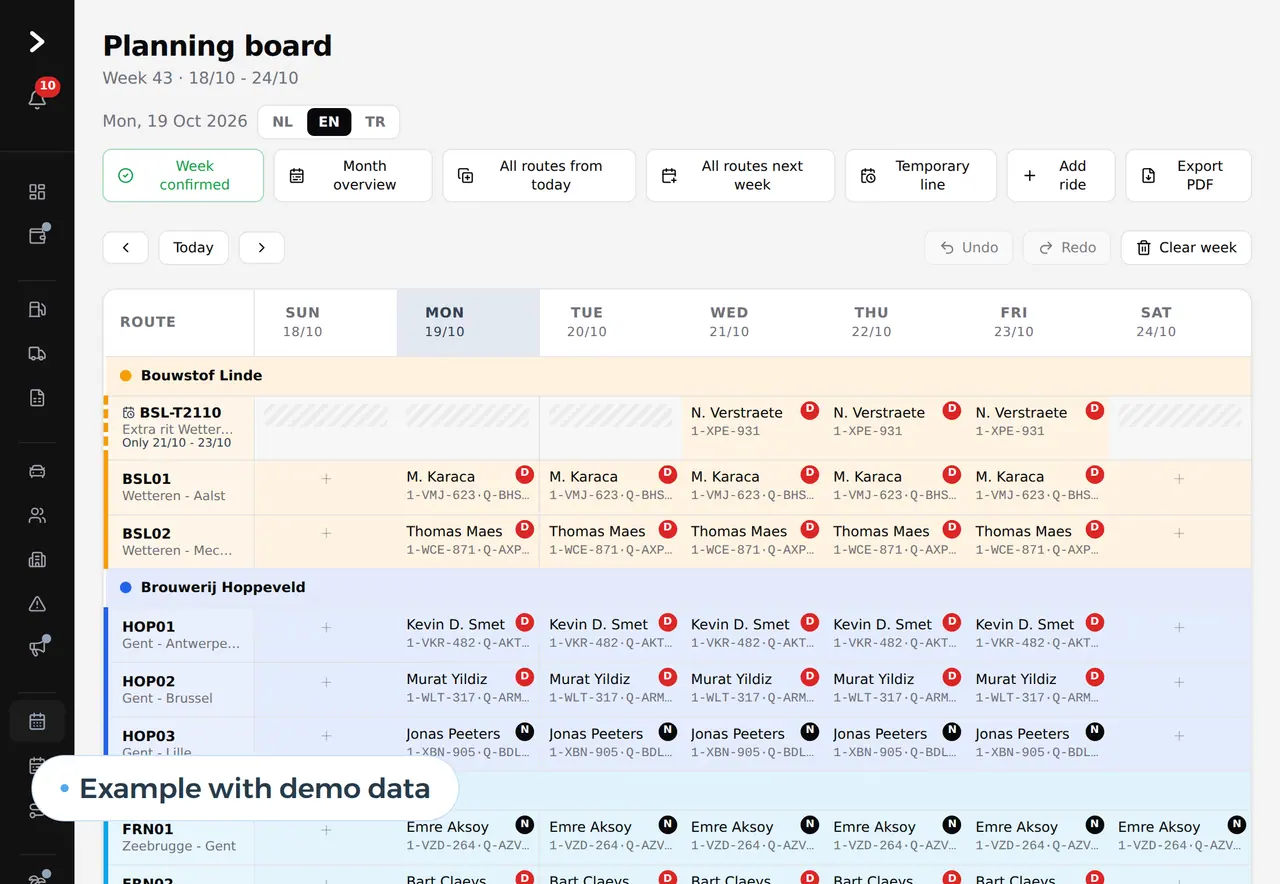
In the platform we built for DA Logistics, a Belgian haulier, the office plans per lane: recurring runs for a shipper, day or night, each with a driver, a tractor and a trailer. A temporary lane for one week, a paused lane or a stopped one never touches the rest of the plan.
If a driver is booked twice or is on leave, the board turns red and proposes a fix. When the week is right, the planner confirms it and it goes out as a PDF to whoever needs it. Each driver sees his own week in the app on his phone.
- Recurring lanes that come back every week
- Day and night shifts, temporary lanes and pauses
- Conflicts with a proposed fix
- Confirm the week and share it as a PDF
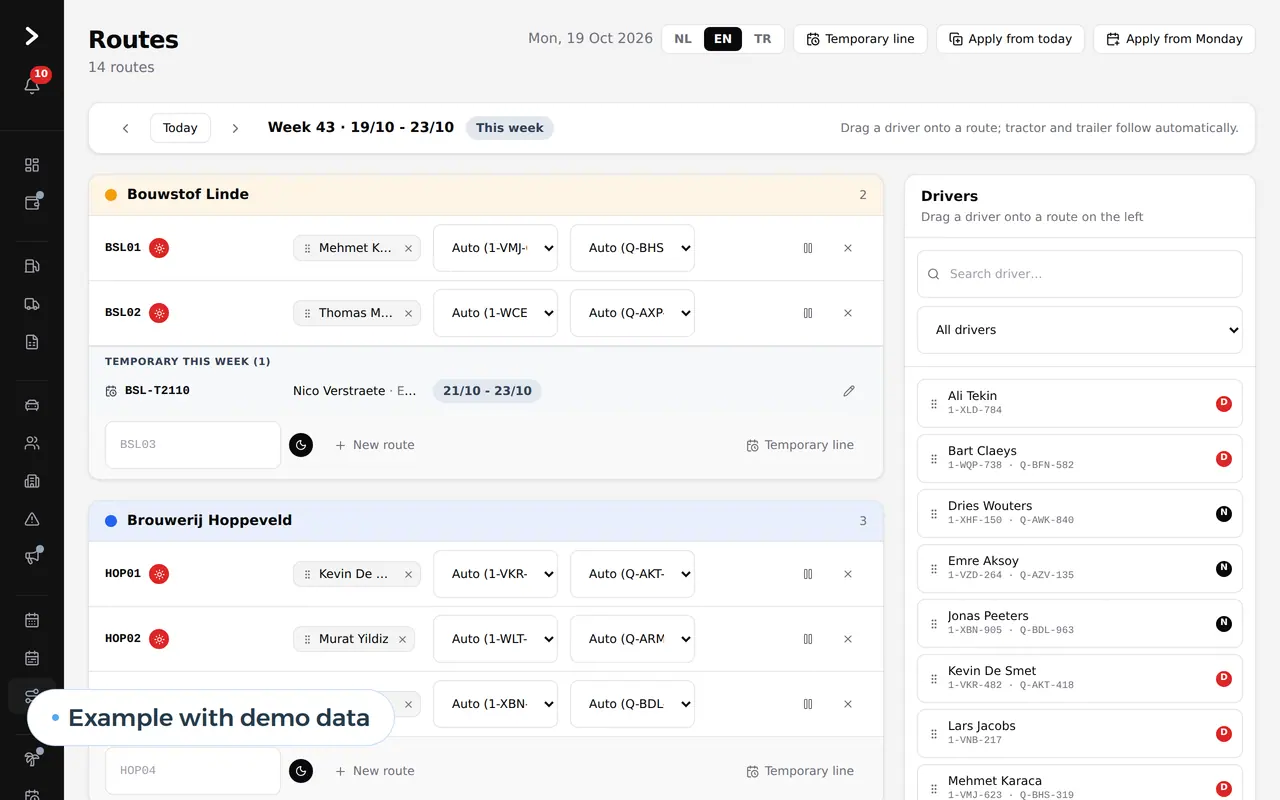
Step by step through your week: what your own board takes over
A planning board earns its keep when it takes over the work that eats hours today. This is what custom transport management software does at each step of your week.
| Process | Today | With your own board | What you gain |
|---|---|---|---|
| Building the week | An empty sheet every Monday, lanes retyped | Recurring lanes are already there, you change only what differs | Hours a week, and no forgotten lane |
| Matching driver, tractor and trailer | Three files side by side | One row per lane and day, with the fleet attached | A truck in for inspection cannot be planned |
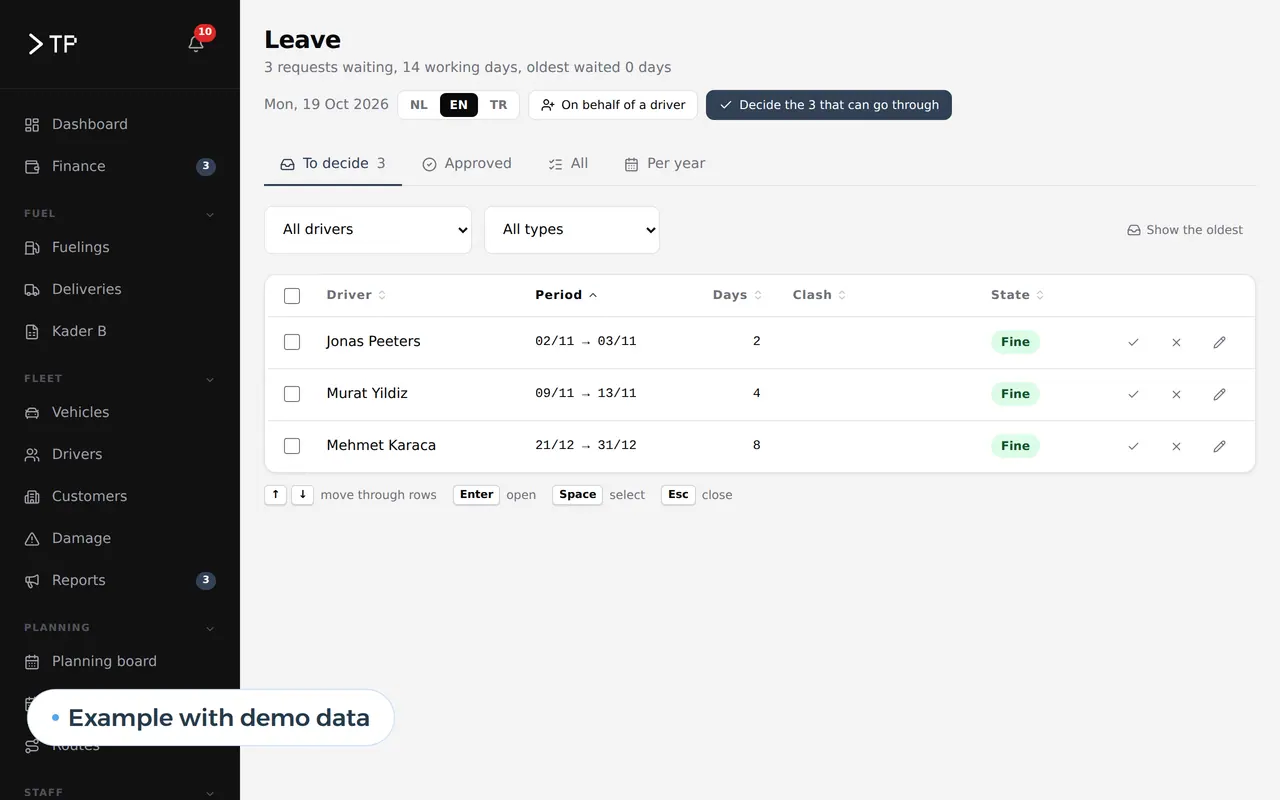
| Leave and sickness | Messages, paper, memory | Requests arrive from the driver app and clash visibly with the plan | No driver on a lane while he is on leave |
| Solving conflicts | Phoning until someone says yes | The board suggests a free driver or a swap | Faster decisions, the planner keeps the last word |
| Sharing the week | Screenshots in a group chat | A confirmed week as a PDF, each driver's own week in the app | One version of the truth |
| Afterwards | Searching who drove when | Every trip with date, driver and vehicle | An answer for the shipper, the accountant and an inspection |
If your plan feeds payroll, costs and fuel, the board becomes one module of a larger platform, a custom ERP. Not sure whether to build or to buy? Our build vs buy comparison works through the numbers, and Odoo alternatives shows where a package fits better. If your business runs on crews and sites rather than lanes, see construction scheduling software; for one screen with the week, the fuel and the fleet, custom dashboard development. What AI could add later, such as flagging unusual fuel use, is on AI in road transport; today the board solves conflicts with rules, so every decision can be explained. Why a team in Belgium rather than one at home or offshore is set out on nearshore software development.
The planning board, and what feeds into it
25 drivers and 22 lanes, worked out
Take a haulier with 25 drivers, 22 recurring lanes and one planner. These figures are assumptions, but they sit close to what we see in transport companies. Run them again with your own week.
| Task per week | Spreadsheet and WhatsApp | Own planning board |
|---|---|---|
| Building the week, retyping lanes | 6 hours | 1 hour |
| Changes, sickness and extra runs | 5 hours | 2 hours |
| Informing drivers and chasing replies | 3 hours | 0.5 hours |
| Finding who drove when, for a customer or the accountant | 2 hours | 0.5 hours |
| Total | 16 hours | 4 hours |
That is 12 hours a week. Over 46 working weeks that makes 552 hours. At an assumed cost of 45 euros an hour for a planner, it is worth 24,840 euros a year, before counting the mistakes. A run that does not happen because the driver turned out to be on leave, or a tractor leaving with an expired inspection, costs more than an hour of planning.
What does that mean for a budget? A board that frees 552 hours a year pays back an investment of 25,000 euros in about a year and one of 50,000 euros in two. With custom software you also do not pay per seat: one more driver adds no licence. What drives the cost of such a project, and how to brief it, is in our free software requirements specification template.
Transport management software: off the shelf or custom built
A TMS package is bought per user or per vehicle. Custom software is built for you. Both can be right.
- Getting started
- TMS packageFast, if you work the way the package thinks
- Custom transport planningA few weeks of building, on your own lanes
- Recurring lanes for a few shippers
- TMS packageOften loose orders, re-entered weekly
- Custom transport planningLanes that repeat, with day and night shifts
- Fuel, excise refunds, your own rules
- TMS packageRarely, or through an integration
- Custom transport planningIn the same platform, down to the litre
- Monthly cost
- TMS packagePer user or vehicle, rising with your fleet
- Custom transport planningHosting and maintenance, not per seat
- Who owns the software
- TMS packageThe vendor
- Custom transport planningYou, code and data included
Pick a package if you mostly run spot orders and your process looks like the package's. Pick custom if you run recurring lanes, shifts or your own fuel scheme and still plan beside the package in a spreadsheet.
Five steps to your first confirmed week
- A call and your current weekYou show us your spreadsheet, your lanes and your shippers over a video call. We look at where the hours go and which rules the board must know.
- A first board with your own lanesWithin a few weeks a first version runs with your real lanes and drivers on a test environment. Your planner works in it next to the spreadsheet.
- Live in the officeYou confirm the first week in the new board and close the spreadsheet. Every release goes live in seconds, with a backup and a way back.
- The app for your driversDrivers see their own week, request leave and report a problem with the truck, in their own language.
- Growing module by moduleFleet, fuel, staff or costs come in when you want them. At DA Logistics they were added month after month.
The DA Logistics planning board, in use every day
The planning board at DA Logistics, a Belgian haulier, runs every day: lanes per week, day and night, temporary lanes, conflicts with a proposed fix and a PDF for whoever needs the week. The same platform tracks fuel under the Belgian professional diesel scheme, the fleet and the staff. For Zuco Logistics we set up the same core with its own fuel model: domain, server and app were live in 57 minutes.
What that means if you are outside Belgium:
- Calls, screens and documents in English, an hour ahead of the UK and on the same clock as most of the EU.
- Your data stays in the EU, on servers in a European AWS region, under the GDPR.
- You own what we build: the code, the data and the server.
- Your drivers get an app that runs on any phone, in their own language, as on app development.
The whole platform, with fuel, costs and the driver app, is on transport software. Show us what your week looks like: book a call.
What planners abroad ask us
Can the platform run in English, or in our drivers' languages?
Yes. For you the office and the app can run in English, and the app in any language your drivers read.
Does the board take the EU driving and rest rules into account?
The board knows your lanes, their duration and who drives them, so it can warn when a week gets too heavy. The tachograph remains the evidence in an inspection. If you want the real tachograph data next to the plan, we connect to your download software where it offers an export.
Can we work with you from the Netherlands, Germany or the UK?
Yes. We work by video call and shared screens, and travel to you for a kick-off when that helps. Invoices are in euros; for a business customer in another EU country, VAT is usually reverse charged.
Can we import our lanes and drivers from Excel?
Yes. We load your current files, so your first week on the new board is already filled. Whatever is inconsistent in the spreadsheet shows up straight away.
Can it connect to our accounting or invoicing?
We build exports in the format your accountant asks for, or send trips straight to your package when it has an integration. That way you invoice what was actually driven.
What does custom transport management software cost?
It depends on the number of lanes, the modules and the integrations. After a call you get a price for the first version, in euros. No licence per driver or per vehicle comes on top.
Transport software
How VBS helps you with this
We build planning, trips, fuel and fleet on one platform, with an app for your drivers.
- A weekly planning board that shows conflicts
- Fuel under the Belgian Kader B scheme to the litre
- The driver app in their own language
How we approach it is on our page about Transport software.
Your lanes on one board, your drivers in the loop?
Show us what your week looks like today. We will sketch how it fits on a planning board of your own.
Rather get in touch right away?