Custom configurators
Custom product configurator development: customers build it, you get the quote
A configurator on your site that turns choices into a price and a request your sales team can act on.
Sell what people put together
Custom product configurator development pays off when your customer does not buy a product off a shelf but assembles one: a gate made to measure, a kitchen, a machine with options, a renovation. Without a configurator that customer sends an email with a few lines and asks for a price, and your sales team spends the first call finding out what they want.
With a configurator on your website the customer picks the type, the sizes, the finish and the options, sees a price or a range straight away, and sends a request that already holds every choice. You talk to someone who knows roughly what it costs and still wants it.
This page walks through how a configurator calculates, on one we built, what each level costs, how to set the price rules down before anyone writes code, and how we test it so it never shows a price you cannot honour.
How a configurator calculates, and where it goes wrong
Choices
- Type
- Full renovation
- Floor area
- 100 m²
- Finish
- Premium
- Extra
- Underfloor heating
Where it goes wrongA choice that does not fit the type: a carport with a bathroom.
Price rules
- Per m², premium
- 1,100 to 1,400 euro
- × 100 m²
- 110,000 to 140,000 euro
- Underfloor heating
- + 4,500 euro
Where it goes wrongA limit nobody tested: the largest area in the most expensive finish.
Request
- To
- The inbox or the CRM
- With
- Every choice and the range
- Plus
- Name, email, phone
- Then
- Site visit and quote
Where it goes wrongA range without the choices: sales starts asking all over again.
The price rules are those of the cost wizard on sngroupbv.be, the choices an example. The third column shows how we make a configurator end.
Five steps for a builder in Ghent
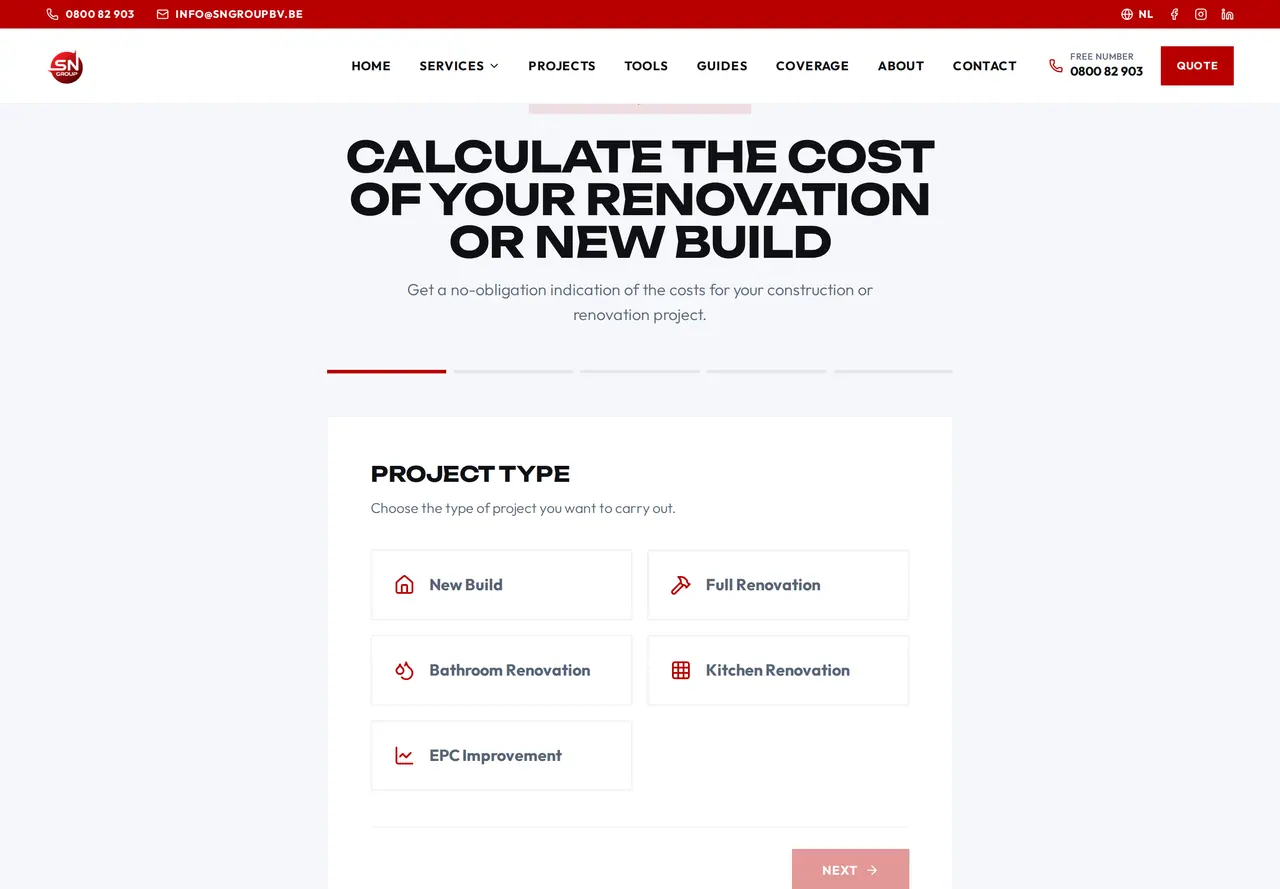
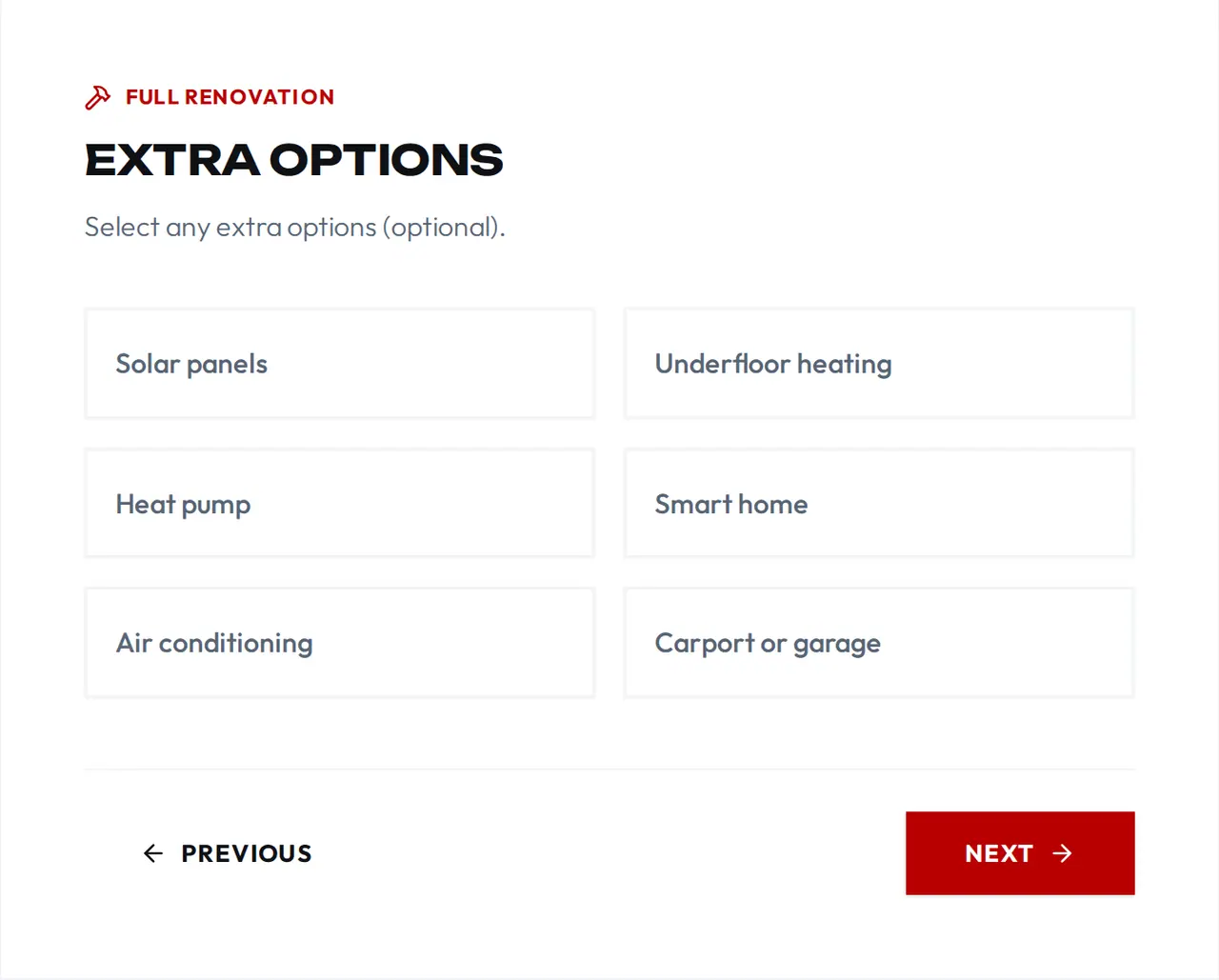
For SN Group, a construction company in Ghent, we built a cost calculator in five steps, in Dutch and English: the type of project (new build, full renovation, bathroom, kitchen or energy upgrade), the floor area, the finish (standard, premium or luxury), extra options such as solar panels, underfloor heating or a heat pump, and the contact details.
Each type has a price per square metre for each finish, each option a fixed amount. The calculator multiplies, adds and shows a range. It is the page on that site with the most impressions on searches without the brand name: people search for what a renovation costs and find a tool that works it out.
A second calculator works out an energy upgrade as a form. Together with the four calculators on the site of Business Centrum, that makes six live calculators we built.
What a configurator costs, level by level
What a configurator costs depends on three things: how many price rules it holds, whether it shows a picture per choice, and whether the request must land in your own system. The fair way to estimate it is in hours. Agencies in Belgium, where we work from, charge 50 to 150 euro an hour; check any quote you get against the same sum.
| Level | What is in it | Estimate in hours | At 50 to 150 euro an hour |
|---|---|---|---|
| 1. Rules and price | A step-by-step wizard of four to six questions, a price or range, a request to your inbox | 40 to 80 | 2,000 to 12,000 euro |
| 2. With 2D images | Level 1 plus an image that changes with each choice (colour, material, model) and a PDF summary | 80 to 160 | 4,000 to 24,000 euro |
| 3. With 3D | A model the customer can turn, showing every option, plus 3D models of your products if you do not have them | 200 to 400 | 10,000 to 60,000 euro |
| Integration on top | The request or order lands in your CRM, ERP or planning instead of an inbox | 20 to 80 more | 1,000 to 12,000 euro |
These are ranges for a first version; the rules decide where you land. Fifty options that exclude each other cost more than five you simply add up. We quote a fixed price per project after a first call about your price rules.
A store app or a custom configurator
If you already sell on Shopify or WooCommerce, an options app is the first thing to try. This is where it stops.
- Good for
- Options app in your storeA product with a few options that add a fixed amount
- Custom configuratorPrices per size, per area, or rules where one choice limits another
- Price
- Options app in your storeA monthly fee per store
- Custom configuratorA one-off build and hosting you already pay
- Rules
- Options app in your storeAdd or replace a price per option
- Custom configuratorAny rule you can write down: tables, minimums, combinations you do not make
- Result
- Options app in your storeAn order in the store
- Custom configuratorAn order, a quote as PDF, or a request in your CRM
- Findable in Google
- Options app in your storePart of a product page
- Custom configuratorIts own page aimed at the question people type, such as what something costs
Start with an app when your options are few and fixed. Move to custom once your sales team still has to call back to work out the price.
Who buys a configurator, and what it connects to
The configurators that earn their cost back fastest sit in three kinds of business.
| Business | What the configurator returns | What it connects to |
|---|---|---|
| Builders and installers who quote per square metre or unit | A price range and a request with sizes and choices | A website for contractors in front, software for construction companies behind it once the quote is signed |
| Manufacturers with options: gates, furniture, machines, signs | An order the workshop can read, with a parts list | Stock and production in a custom ERP |
| Stores selling made-to-order products | A configured product in the cart, with its price | The cart of a web store, or a headless site when the theme cannot carry it |
In each case the request is worth more when it lands where your team works. A configurator that writes straight into a custom CRM saves the retyping, and an API integration is what makes that link. To compare the cost of a configurator with other software you are weighing, use the ranges in custom software development cost.
Write the price rules before the code
A configurator is only as good as its rules, so we put them on paper first, with you.
- List the choices. Every question your sales team asks today before it gives a price, with the answers that are allowed.
- Price every choice. Per square metre, per piece or fixed. A price that depends on two choices at once becomes a table.
- Write down what does not go together. Options that only fit one type, sizes with a minimum and maximum, combinations your workshop does not make.
- Choose a range, not a figure, for work you still have to measure. A price to the euro sets an expectation you cannot keep.
- Decide what you want back. Which choices, which contact details and which system. Ask for no more data than you need: under the GDPR less is the rule, and every extra field costs requests.
Showing prices to consumers in the EU means showing the final price including VAT, which the Price Indication Directive requires. If the configurator should produce a quote as a PDF with your own template, it overlaps with an AI quote generator; if the request must land in your systems, read API integration services. A configurator is a small web application: it lives on your site but computes like software.
How we test a configurator before launch
- The smallest and largest size in the cheapest and the most expensive finish, with every option on
- Every option with every type: an option that does not belong to a type does not appear there
- Ten real quotes from your archive set against what the configurator returns, with the gap per quote
- Rounding and notation: 114,500 euro, not 114500 or 114,500.00
- Prices including VAT for consumers, at the rate that fits the work
- A request per type that arrives with every choice, in the right inbox or in your CRM
- Back to a previous step without losing a choice
- The whole wizard on a phone 390 pixels wide and with the keyboard alone
Questions before a configurator build
- How long does it take to build a product configurator?
- A level 1 wizard with clear rules goes live in three to five weeks, most of it spent on the rules and the tests. Images per choice add a few weeks; a 3D configurator depends on whether your 3D models exist.
- Can the configurator show a fixed price instead of a range?
- Yes, when your product is finished and the workshop can make it as configured. For work you still have to measure on site, a range is more honest and loses fewer customers at the quote.
- Will it work inside my Shopify or WooCommerce store?
- Yes. It can add the configured product to the cart with its price, or send a request instead of an order. How we set up a store for several countries is on Shopify agency.
- Does a configurator help in Google?
- Often more than a product page. People search for what something costs; a page that works it out answers that question. On SN Group's site it is the page with the most impressions without the brand name. More in a calculator on your website.
Web application
How VBS helps you with this
We build software in the browser for your whole team, on every computer and phone, around the way you work.
- Roles and permissions per person
- Links to your accounting and your email
- Releases without downtime, with backup and rollback
How we approach it is on our page about Web application.
A configurator for what you sell?
Send us your price list or three recent quotes, and the questions your sales team asks today. After a call you get the price rules on paper and a fixed price for the build, or contact us directly.
Rather get in touch right away?