On this page
E-invoicing will be mandatory in the UK from April 2029: at the Budget of 26 November 2025 the government announced that from that date businesses must issue all VAT invoices as e-invoices, for sales to other businesses and to the public sector. Sales to consumers stay out. The model is decentralised, with invoices travelling between the service providers of the two businesses, and in June 2026 Peppol was named as the core network. The detailed roadmap is due at the Autumn Budget on 28 October 2026.
That makes the UK the first large country outside the EU with a date, and one of the few to start with everyone at once: no turnover threshold and no phasing by size. It is also a mandate without real-time reporting at the start. HMRC chose to get invoices digital first and to decide later what data it wants.
This guide splits what is confirmed from what is still open, compares the UK with the EU countries that went first, and lists what a British business can do now with its invoicing or its own software.
What HMRC has said, and what it has not yet
Confirmed
- Every VAT invoice between businesses and to the public sector becomes an e-invoiceApril 2029
- Sales to consumers stay out26 Nov 2025
- A decentralised model: invoices travel between the two businesses' providers26 Nov 2025
- No real-time reporting to HMRC in 202926 Nov 2025
- No turnover threshold and no phasing by size26 Nov 2025
- Peppol named as the core network23 Jun 2026
Still open
- The detailed roadmap and legislationexpected at the Budget, 28 Oct 2026
- The data standard and fields on the invoiceto follow the roadmap
- Accreditation of service providersto follow the roadmap
- Penalties and any soft-landing periodnot announced
- What overseas suppliers must donot announced
Status on 24 October 2026, four days before the Autumn Budget.
How the UK got here
| Date | Step |
|---|---|
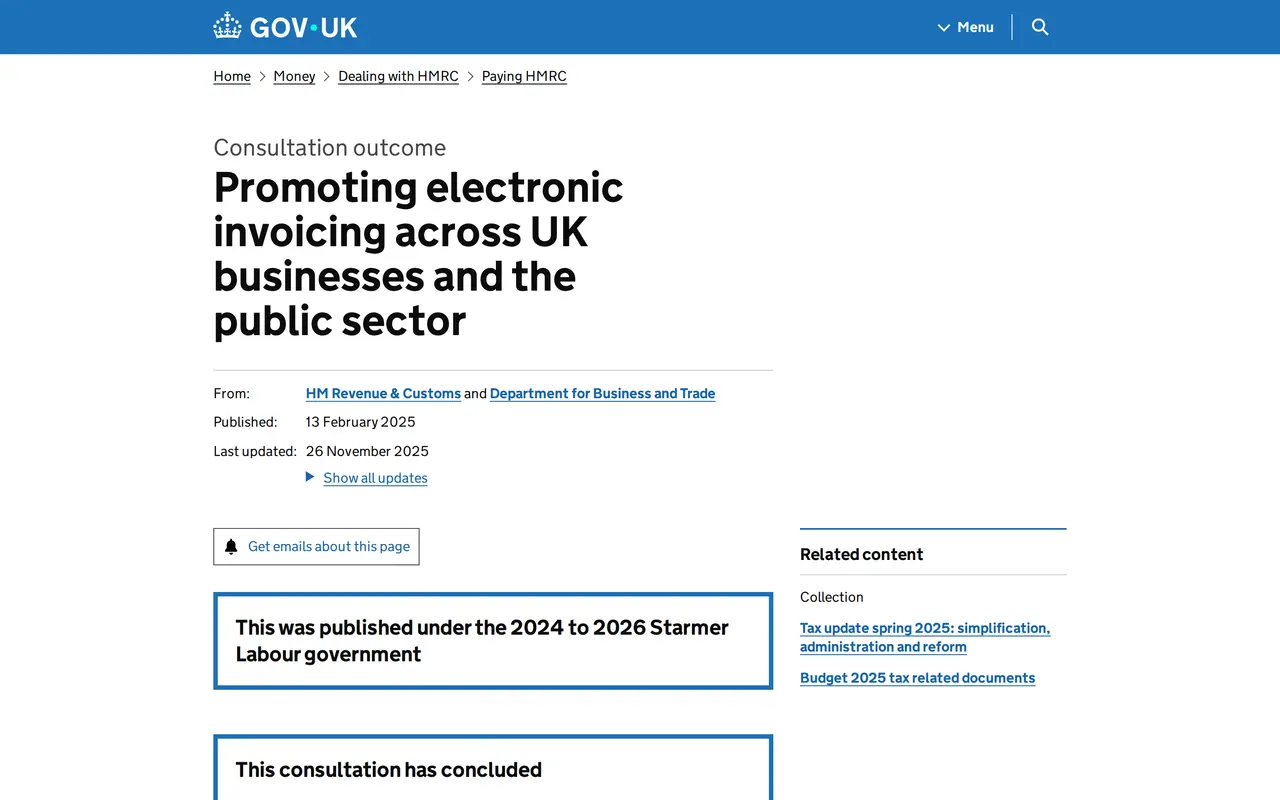
| 13 February 2025 | HMRC and the Department for Business and Trade open the consultation "Promoting electronic invoicing across UK businesses and the public sector" |
| 7 May 2025 | the consultation closes |
| 26 November 2025 | Budget 2025 and the consultation response: all VAT invoices as e-invoices from April 2029, B2B and B2G |
| 23 June 2026 | Tax Update 2026 names Peppol as the core network for the mandate |
| 28 October 2026 | Autumn Budget, where the roadmap is expected |
| April 2029 | the mandate starts |
What the confirmed points mean in practice
| Confirmed point | What it means for a UK business |
|---|---|
| All VAT invoices, B2B and B2G | every invoice to a VAT-registered customer or a public body becomes a structured e-invoice |
| No B2C | invoices and receipts to consumers stay as they are |
| Decentralised model | no government portal in the middle; your provider sends to your customer's provider |
| Peppol as core network | the same network Belgium, Australia and Singapore use; a Peppol registration is likely all you need to be reachable |
| No real-time reporting in 2029 | no invoice-by-invoice reporting to HMRC at the start; that may follow |
| No threshold, no phasing | small businesses start on the same day as large ones |
A PDF invoice by email will no longer count between VAT-registered businesses from April 2029. What replaces it is a data file that the customer's software reads without retyping, most likely a UBL invoice travelling over Peppol.
The UK next to the EU countries that went first
| United Kingdom | Belgium | Germany | France | |
|---|---|---|---|---|
| Start | April 2029 | 1 January 2026 | 2025 receive, 2027 or 2028 issue | 1 September 2026, SMEs 2027 |
| Model | decentralised, Peppol named | Peppol | format fixed, channel free | accredited platforms |
| Phasing | none | none | by turnover | by company size |
| Reporting | not in 2029 | planned for 2028 | not yet | e-reporting from the start |
| Consumers | out | out | out | e-reporting of the data |
Belgium is the closest example: a decentralised Peppol model, everyone at once, and a tolerance period of three months at the start. What Belgian businesses ran into, from missing registrations to invoices made in tools that did not speak Peppol, is what British businesses will meet in 2029. The Belgian details are in e-invoicing in Belgium, and the whole European picture in e-invoicing in Europe.
What a UK business can do now
- Find out where your invoices are madeIn your accounting software, in a job management or field service tool, in a web shop, in a spreadsheet. Each of those needs a route to an e-invoice.
- Ask your software provider about PeppolMany accounting packages that sell in Belgium, the Netherlands or Australia already send over Peppol; ask when they will offer it in the UK.
- Start receivingE-invoices from EU suppliers can already reach you over Peppol, and every one you do not type over is time saved.
- Look at your own systemsA bespoke platform that issues invoices, a booking system or a subscription tool will need an export to a structured format and a connection to a service provider.
- Watch the Budget of 28 October 2026The roadmap should settle the data standard, the accreditation of providers and the penalties.
What it means for custom software
If your invoices come out of software built for you, the mandate is a development job, not a settings change. The system has to produce an invoice with the fields the standard requires, in a format such as UBL, and hand it to an accredited provider; and it has to take in the e-invoices your suppliers send. That is two to three years of runway for a change that is easy to plan and hard to rush in the last quarter.
A plan from now to April 2029
| When | What to do |
|---|---|
| Now to the end of 2026 | list every place your invoices are made; read the roadmap published at the Budget |
| 2027 | choose a Peppol service provider or confirm that your software will act as one; start receiving e-invoices |
| 2028 | adapt your own systems to produce structured invoices; test with customers and suppliers who are ready |
| Early 2029 | switch every customer over, keep a fallback for anyone not yet reachable |
| April 2029 | every VAT invoice to a business or public body goes out as an e-invoice |
Questions to ask your software provider
- Will you send and receive over Peppol in the UK, and from when?
- Will you be an accredited service provider yourself, or work through one?
- Can invoices made in our other systems, such as our web shop or job management tool, go through you?
- What happens to supplier invoices that arrive as e-invoices: are they booked automatically?
- What will it cost per invoice or per month?
A provider that already serves Belgium, the Netherlands or Australia over Peppol has done this before; ask what they learned there.
What a UK e-invoice is likely to contain
The roadmap will set the data standard. If the UK follows the Peppol countries, as naming Peppol suggests, an e-invoice is a UBL file with fields such as these:
| Field | What goes in it |
|---|---|
| Electronic addresses | the Peppol ID of the seller and of the buyer, the address on the network |
| VAT numbers | both VAT registration numbers |
| VAT category per line | standard, zero-rated, exempt or reverse charge, as a code per line |
| Totals | net amount, VAT per rate and the amount due |
| Payment details | bank account and a payment reference |
| Buyer reference | an order or purchase number, which larger buyers use to match invoices |
| Attachments | a PDF copy or a timesheet, carried inside the same file |
Most of these already appear on a VAT invoice today. The change is that each sits in a fixed field a machine reads, instead of somewhere on a page.
Short answers on UK e-invoicing
When will e-invoicing be mandatory in the UK?
From April 2029, for all VAT invoices between businesses and to the public sector, as announced at the Budget of 26 November 2025.
Is Peppol mandatory in the UK?
Peppol was named as the core network for the mandate in June 2026. The details, including the accreditation of providers, are expected with the roadmap.
Does UK e-invoicing apply to small businesses?
Yes. There is no turnover threshold and no phasing by size: every VAT-registered business starts in April 2029.
Does it cover invoices to consumers?
No. B2C sales stay outside the mandate.
Will HMRC require real-time reporting?
Not in 2029. The consultation response rules out real-time reporting at the start of the mandate.