Invoicing
Peppol invoicing software from your own job sheets
Invoices from the planning or job sheets already in your system, sent over Peppol with a Belgian payment reference.
Peppol invoicing starts with the work, not the package
Since 1 January 2026, VAT-registered businesses in Belgium exchange structured e-invoices with each other over the Peppol network, with fines of 1,500 euros, then 3,000 and 5,000 euros for repeat breaches. Germany has required every business to receive e-invoices since January 2025, and the EU makes e-invoicing the rule for cross-border B2B sales from 1 July 2030, as e-invoicing in Europe sets out country by country. Peppol is not Belgian: it is an international network, so one connection reaches customers in every Peppol country.
A standard invoicing package handles the sending. The gap is often before it: hours, trips and materials live in a planning tool or on a job sheet, and someone retypes them at the end of the month. That is where mistakes creep in: forgotten extra work, a wrong VAT rate, an invoice that leaves a week late.
Custom invoicing builds the invoice from the work already in your system, with the right VAT per line and payment reference, and hands it to a certified Peppol provider. We build it from Ghent, Belgium, in English, for companies inside and outside Belgium.
The route of an invoice, from job sheet to accounting
- Job sheet or tripHours, material and travel are already in your own planning.
- Corner 1Your invoiceMade from the job sheet, with VAT per line and a structured payment reference.
- Corner 2Your access pointAn approved provider puts it on Peppol as a UBL file.
- Corner 3Your customer's access pointFinds your customer by its company number and accepts the invoice.
- Corner 4Your customer's accountingThe invoice arrives as data, not as a PDF to retype.
In Belgium you do not register on Peppol yourself, only through an approved provider. Your Peppol ID is your company number.
What Belgian and EU e-invoicing rules ask of you
These are the rules that apply today in Belgium, with the EU steps that follow.
| When | What | What it means |
|---|---|---|
| Belgium, 1 January 2026 | Structured e-invoices mandatory between Belgian VAT-registered businesses | A PDF by email is no longer an e-invoice; at least the Peppol BIS format |
| Belgium, early 2026 | Grace periods for good-faith preparation and self-billing | Both ended; checks are running |
| Belgium, on a breach | Fines of 1,500 euros, then 3,000 and 5,000 euros | Every invoice that does not leave over Peppol is a risk |
| Belgium, receiver unreachable | A PDF as fallback | Your software must know who can receive and who cannot |
| Belgium, since 1 January 2025 | 20 percent investment deduction for e-invoicing software, including software you have built | A custom invoicing module counts |
| Germany, since 1 January 2025 | Every business must be able to receive e-invoices; issuing phases in from 2027 | Selling to Germany means structured invoices soon |
| EU, from 1 July 2030 | E-invoicing for intra-EU B2B sales under the VAT in the Digital Age package | One structured flow serves every market |
Whether a Belgian customer can already receive over Peppol shows in the Peppol check. The rules in plain English are on e-invoicing in Belgium and is Peppol mandatory in Belgium?; registering is explained on Peppol registration. Which package or connection fits you is on which software for Peppol?
What changes at each step, from job sheet to payment
This is what invoicing in your own software does per step, and what you gain.
| Process | Today | With custom invoicing | What you gain |
|---|---|---|---|
| Invoice lines | Retyped from planning, job sheet or spreadsheet | Hours, materials and extra work come from the job or trip | Nothing forgotten, no typos |
| VAT per line | Thought through per invoice | The right rate by fixed rules, including reverse charge where it applies | Right the first time |
| Payment reference | By hand, or from the package | Calculated per invoice, with its check digits | Payments find their invoice by themselves |
| Sending | PDF by email, or retyped into a second package | Through a certified Peppol provider, PDF only as fallback | Compliant in Belgium, ready for other markets |
| Payment follow-up | Bank statements next to a list | Paid, open and overdue per customer, with a reminder ready | Paid faster |
| Accounting | Bundling invoices and sending them on | An export in the format your accountant imports | Fewer questions at quarter end |
You can also create a Belgian payment reference on its own with our structured communication tool. How AI reads supplier invoices that do not arrive over Peppol is on invoice automation. In construction the invoice usually starts in a work order app or in software for construction companies; for installers in software for installers. Why a team in Belgium can build it for you is on nearshore software development.
Where the lines of an invoice come from
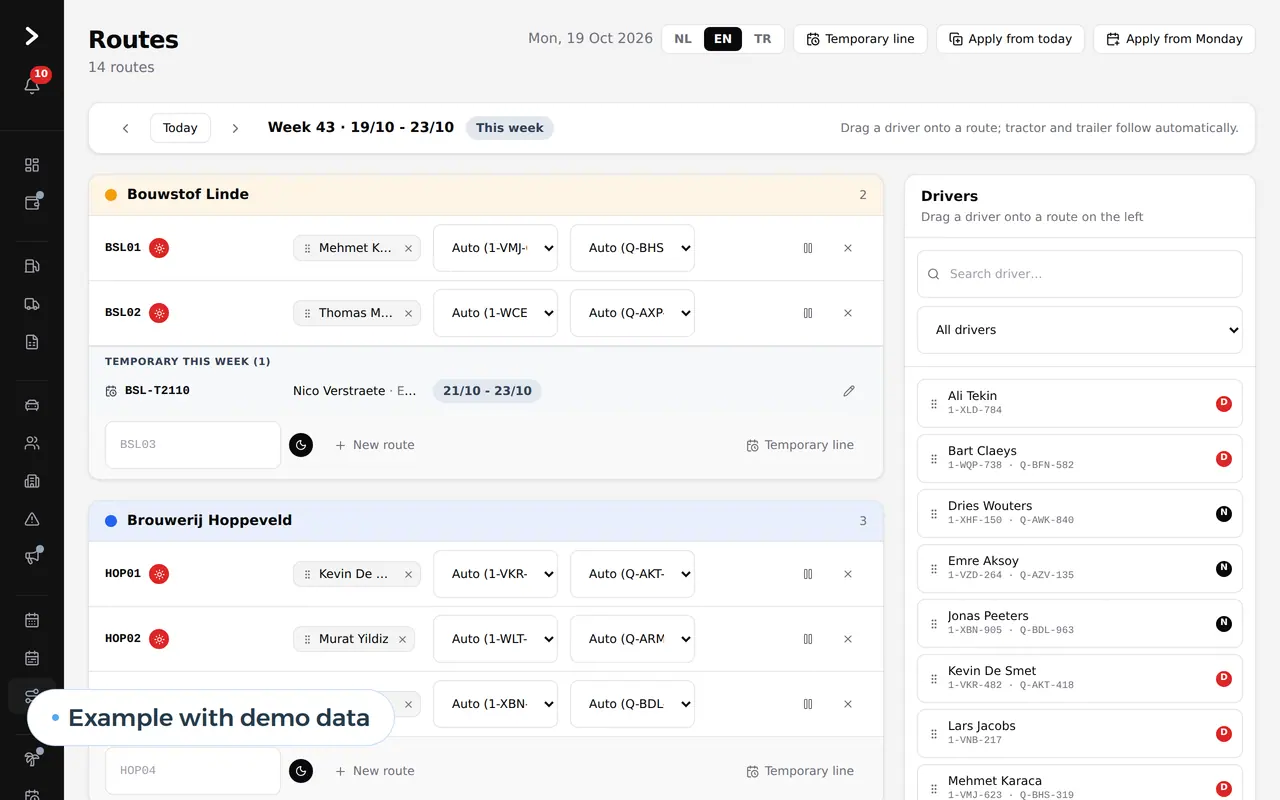
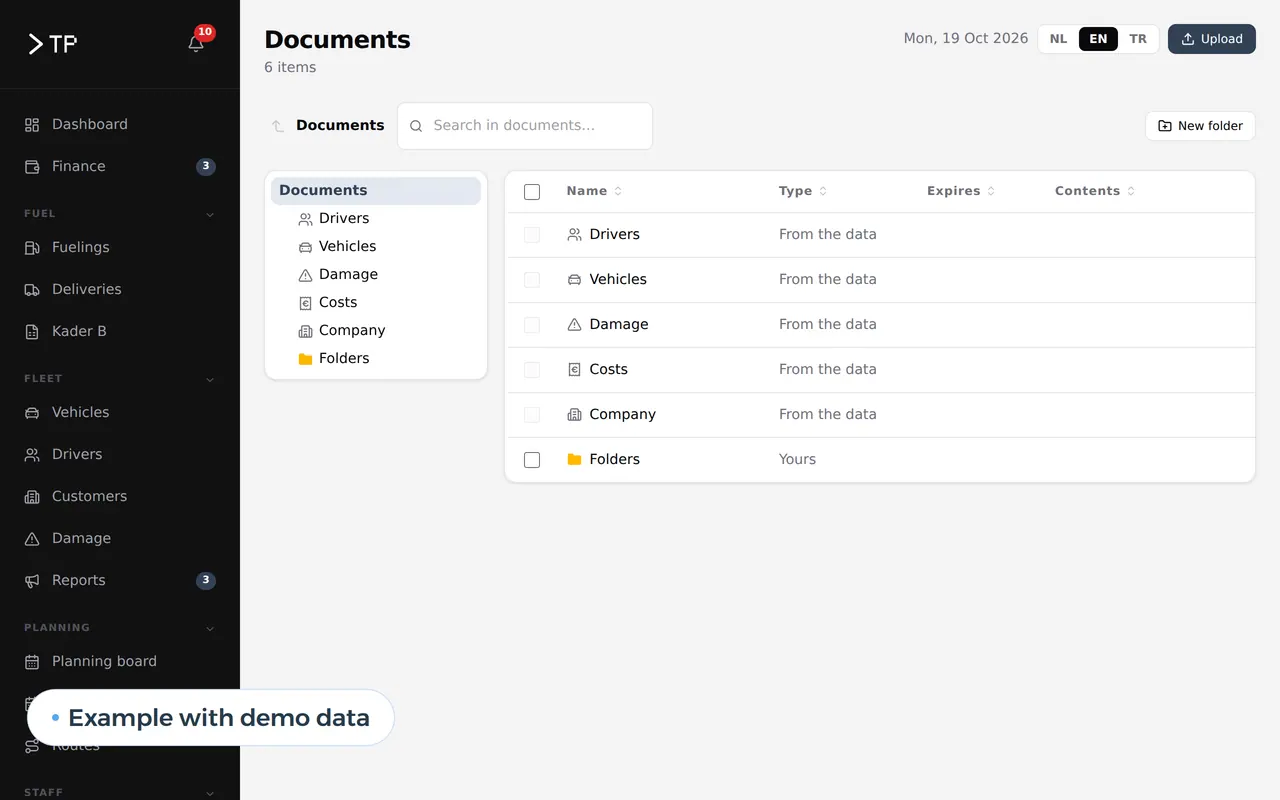
For DA Logistics, a Belgian haulage company, trips, fuel and costs live in the platform we built; every month a bundle goes to the accountant. That is where invoicing connects: the data is already there, correct and per customer.
For a contractor it is the job sheet with hours and material, for an installer the service visit, for a service firm the time logged per file. We build the invoice on that, and leave the sending to a certified Peppol provider.
150 invoices a month: package, custom and the sum
Take a contractor or installer that sends 150 invoices a month from job sheets. The figures are assumptions; run them again with your own administration.
| Task per month | Retyping into a package | Invoices from your own software |
|---|---|---|
| Retyping invoice lines, 8 minutes per invoice | 20 hours | 2 hours of checking |
| Fixing mistakes with credit notes, 1 in 20 invoices | 2.5 hours | 0.5 hours |
| Matching payments to invoices | 3 hours | 0.5 hours |
| Total | 25.5 hours | 3 hours |
That is 22.5 hours a month, or 270 hours a year, worth 12,150 euros at an assumed 45 euros an hour, before counting extra work that never gets invoiced today.
In Belgium the tax authority chips in: custom e-invoicing software falls under the 20 percent investment deduction. If the invoicing module costs 20,000 euros, you deduct an extra 4,000 euros; at the standard corporate tax rate of 25 percent that is 1,000 euros less tax.
And a package? This is what they ask, excluding VAT:
| Package | Price per month |
|---|---|
| Robaws, built for construction and installation, Peppol included | Starter 29, Go 59, Pro 119 euros with one user, extra user 24, 49 or 89 euros |
| Teamleader Focus | SMART 25, GROW 33, FLOW 45 euros per user, billed yearly |
| Odoo Standard | 19.90 euros per user in the first year, then 24.90 |
A package is often the right call. Custom pays off when your job sheets, trips or hours already live in your own software, or when retyping costs you hours every week. The alternatives are compared in Teamleader alternatives and Odoo pricing.
An invoicing package, or invoices from your own software
- Where the invoice starts
- Standard invoicing packageYou retype lines from your planning or job sheet
- Invoicing in your own softwareLines come from the job or trip already in your system
- Peppol
- Standard invoicing packageBuilt in
- Invoicing in your own softwareThrough a certified Peppol provider we connect
- Belgian payment reference
- Standard invoicing packageUsually built in
- Invoicing in your own softwareComputed per invoice, with its check digits
- Cost
- Standard invoicing packageA subscription per user or per month
- Invoicing in your own softwareBuilt once, then maintenance and the provider fee
- Choose this if
- Standard invoicing packageYou send few invoices, or your planning lives in a package too
- Invoicing in your own softwareYou send many invoices from work already in your own system
A package is often the right choice. Custom pays off when retyping costs you hours every week.
Custom invoicing rollout: how it runs
- Last month's invoicesWe put them next to your job sheets or planning and see where the retyping and the mistakes sit.
- Choosing a Peppol providerWe connect a certified provider, and register your company if that has not happened yet.
- The invoice from your workLines, VAT per line and the payment reference from your own data, first on a test environment with real examples.
- Live, with your accountant on boardThe first month runs next to your old way, until your accountant confirms everything reconciles.
We build the software your invoices come from
We do not build an invoicing package; we build the software your invoices come from. At DA Logistics, a Belgian haulier, trips, refuels, costs and staff live in a platform that prepares a bundle for the accountant every month. For SN Group, a construction company in Ghent, we built a cost calculator that gives customers a price themselves.
What we do for you:
- We first check whether a package will do. If it does, we say so.
- We build the invoice from your work: job sheet, trip or logged time.
- We connect a certified Peppol provider, so you are compliant in Belgium and ready for the markets that follow.
- Your accountant stays your accountant: we deliver in the format they import.
How we approach custom builds is on custom software development. Tell us where your hours, trips or job sheets live today: book a call.
What business owners ask us about invoicing
Do I have to choose a Peppol provider myself?
In Belgium registration on Peppol always runs through a certified provider, on your company number. We choose one with you that fits your volume and connect it to your software.
We are not Belgian. Do we need Peppol?
If you sell to Belgian businesses, they now expect structured invoices, and Peppol is the common route. If your own country uses Peppol too, as many in Europe do, the same connection serves both.
What if my customer has no Peppol?
Then your software sends a PDF as fallback, as the Belgian rules allow when a receiver is technically unreachable. Your software knows per customer which route works.
Can it handle progress invoices and extra work?
Yes. A progress invoice is an invoice on a share of the work, extra work an extra line from the job sheet. Both come from the data already in your software.
Can invoices go out in several languages?
Yes. The invoice language belongs to the customer, not the software. French, Dutch, German or English customers get their invoice in their language, with the same data underneath.
What about real-time reporting later?
Belgium plans e-reporting for 2028, and the EU's 2030 rules build on structured invoices. Whoever invoices in a structured way now has taken the biggest step already.
Custom software
How VBS helps you with this
We build the platform your business runs on every day: your spreadsheets, emails and paperwork in one system that does what you do.
- Your workflow mapped first, then a fixed price
- Screens for the office, the client and the road
- Hosting, backups and security managed by us on AWS
How we approach it is on our page about Custom software.
Invoices from your own planning?
Tell us where your hours, trips or job sheets live today. We will tell you whether custom pays off, or a package will do.
Rather get in touch right away?