On this page
The most popular payment methods in Europe differ by country: iDEAL, now becoming Wero, in the Netherlands; Bancontact in Belgium; PayPal and purchase on invoice in Germany; the Cartes Bancaires card scheme in France; BLIK in Poland; MB Way and Multibanco in Portugal; Swish and Klarna in Sweden. International cards work everywhere, but in several of these countries they are the second or third choice of shoppers, and a checkout that offers only cards loses part of every market at the last step.
This guide lists, per country, the method shoppers expect, what it is, and what it means for your checkout and your payment provider. It is written for a shop that sells, or wants to sell, in more than one European country. Germany has the most detailed public data, from the EHI Retail Institute; for the other countries we name the methods that payment providers themselves list as essential, without shares where no reliable public figure exists.
Country by country
| Country | Method shoppers expect | What it is | For your checkout |
|---|---|---|---|
| Netherlands | iDEAL, moving to Wero | a bank payment confirmed in the banking app | must have; plan for the move to Wero |
| Belgium | Bancontact | the national debit card scheme, also as an app with a QR code | must have, next to Visa and Mastercard |
| Germany | PayPal and purchase on invoice | a wallet, and paying after delivery through a provider that takes the risk | both, plus SEPA direct debit and cards |
| France | Cartes Bancaires | the national card scheme, often co-badged with Visa or Mastercard | route French cards through CB where your provider supports it |
| Austria | eps bank transfer, invoice | an online bank transfer, and pay after delivery | invoice and PayPal matter, as in Germany |
| Poland | BLIK | a six-digit code generated in the banking app | must have for Polish shoppers |
| Portugal | MB Way, Multibanco | a mobile payment linked to the bank, and a payment reference paid at an ATM or in banking | at least one of the two |
| Spain | cards, Bizum | cards first; Bizum, a mobile payment between banks, is growing online | cards plus Bizum if your provider offers it |
| Italy | cards, PayPal | cards, including prepaid cards such as PostePay, and PayPal | cards and PayPal |
| Sweden | Swish, Klarna | a mobile payment between bank accounts, and pay later or by invoice | both, alongside cards |
| Switzerland | TWINT | the national mobile payment app | must have for Swiss shoppers |
Two methods cross borders: PayPal, accepted almost everywhere and the leader in Germany, and Klarna, which offers invoice and instalments in Germany, Austria, Sweden, the Netherlands and beyond. Apple Pay and Google Pay run on the cards stored in them and help on mobile in every market.
How Germany paid online in 2025
PayPal28.5 percent in 2024
28.7%Purchase on invoice25.8 percent in 2024
26.1%SEPA direct debit17.3 percent in 2024
14.4%Credit and debit cards12.3 percent in 2024
13.7%
Share of online turnover at the shops surveyed, 2025.
Cards are the fourth choice in Europe's largest market. A card-only checkout asks most German shoppers to pay in a way they rarely choose.
Germany in numbers
Germany is the one large market with an annual study of how online shoppers pay, by the EHI Retail Institute. Its 2026 edition, covering 2025, gives the shares of online turnover at the shops it surveyed.
The figure above shows the four main methods. Direct debit lost almost three points in a year, while PayPal, invoice and cards all grew. PayPal and invoice together take more than half. A card-only checkout in Germany asks most shoppers to pay in a way they do not usually choose. What else a shop meets in Germany is in selling online in Germany.
The Netherlands: from iDEAL to Wero
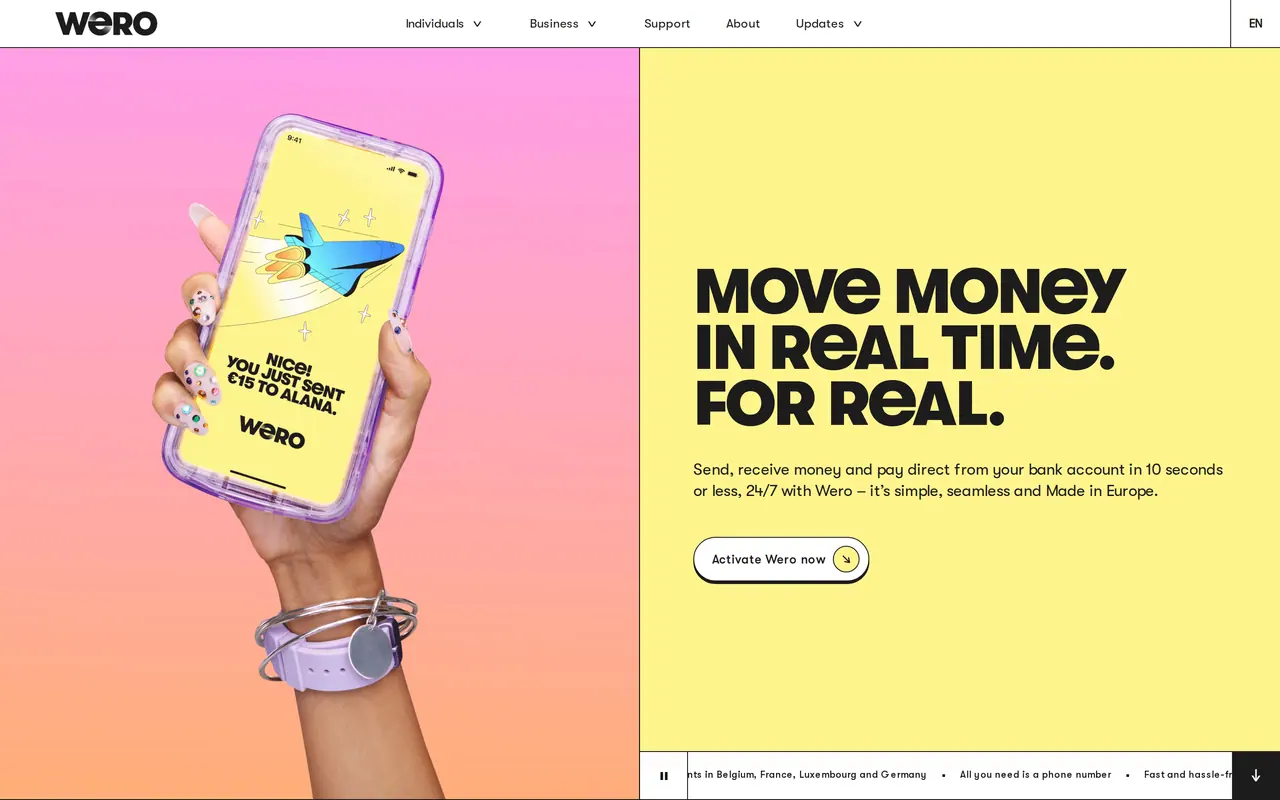
iDEAL has been the default online payment in the Netherlands for two decades. It is now moving into Wero, the wallet of the European Payments Initiative, a company owned by European banks and payment firms. In the first phase, from 29 January to 31 March 2026, checkouts switched to a combined iDEAL and Wero logo while existing contracts stayed valid. The full migration of shops and customers starts in the fourth quarter of 2026 and is planned to be complete by the end of 2027.
For a shop this means little work if your payment provider handles it: ask your provider when it moves your checkout to Wero, and make sure the logo and wording in your shop follow. Wero is also used for payments between people in Belgium, France and Germany, which may make it a cross-border option in the years ahead.
What local methods cost a shop
Fees depend on your payment provider and your volume, so compare quotes rather than list prices. A few structural points hold everywhere:
- Cardscarry an interchange fee capped in the EU at 0.2 percent of the transaction for consumer debit cards and 0.3 percent for consumer credit cards, plus scheme fees and the provider's margin.
- Bank-based methodssuch as iDEAL, Bancontact, BLIK or MB Way are usually priced per transaction, often a fixed amount, which makes them cheap on large baskets.
- Invoice and pay latercost the shop more, because the provider takes the credit risk and pays you upfront; shoppers in Germany, Austria and the Nordics expect them anyway.
- Walletssuch as PayPal charge a percentage plus a fixed fee per transaction, typically more than cards.
What a webshop costs to run, payments included, is in ecommerce website cost.
Choosing a payment provider for Europe
One provider that covers all the local methods you need keeps your checkout simple and your reconciliation in one place. Ask each candidate:
| Question | Why it matters |
|---|---|
| Which local methods do you support in each of my countries? | a provider without Bancontact or BLIK sends those shoppers away |
| Do you support purchase on invoice in Germany and Austria, and who carries the risk? | invoice is a quarter of German online turnover |
| How and when will you move iDEAL to Wero? | Dutch shoppers will see the change in 2026 and 2027 |
| Do you route French cards through Cartes Bancaires? | it can lower fees and declines in France |
| What do you charge per method, and in which currency do you pay out? | local methods differ widely in cost |
| Does your checkout work with a keyboard and a screen reader? | the payment step is part of your service under the accessibility rules |
European providers such as Mollie and Adyen, and global ones such as Stripe, cover most of the methods above; their country lists change, so check them for your markets. A shop on Shopify uses Shopify Payments where available, with local methods through apps or third-party providers; how European shop platforms compare is in Shopify alternatives made in Europe.
Showing payment methods in the shop
Shoppers look for their method before they start the checkout. Show the logos of the methods each country expects in the footer and on the product page, in the order that country prefers: Bancontact first for Belgian visitors, iDEAL or Wero for Dutch ones, PayPal and invoice for German ones. A multilingual shop can switch the order by language or country. In Belgium, Bancontact belongs on the site next to two languages and a few other local rules; see selling online in Belgium.
Card payments and strong customer authentication
Card payments in the EU fall under the Payment Services Directive (PSD2), which has required strong customer authentication for most online card payments since 2021: the customer confirms the payment with two of three factors, usually in the banking app, through 3-D Secure. A checkout that handles this badly loses buyers at the confirmation step. Payment providers apply exemptions for low amounts and trusted merchants; ask yours how it uses them, and test the flow on a phone, because that is where most customers confirm.
Pay later under new rules
Buy now, pay later services such as Klarna's instalments are popular in Germany, Austria, the Netherlands and the Nordics. The revised Consumer Credit Directive (EU) 2023/2225 brings most of these interest-free and small loans under consumer credit rules, with information duties and creditworthiness checks; member states apply it from 20 November 2026. The provider carries most of these duties, but your checkout shows its information. If pay later is a large share of your sales, ask your provider what changes in its flow.
Payment methods, briefly
What is the most popular online payment method in Europe?
There is no single one: cards lead in Spain, Italy and France, iDEAL in the Netherlands, Bancontact in Belgium, PayPal and invoice in Germany, BLIK in Poland. A European checkout combines cards, PayPal and the local method of each market.
Is iDEAL being replaced?
Yes, by Wero. The co-branded logo appeared in early 2026, the full migration of shops starts in the fourth quarter of 2026, and it is planned to be complete by the end of 2027.
Which payment methods do I need for Belgium?
Bancontact, plus Visa and Mastercard. Many shops add PayPal, Apple Pay and Google Pay.
Why do German shoppers pay by invoice?
They pay after the goods arrive, which feels safe. Shops offer it through providers that take the credit risk; it took 26.1 percent of German online turnover in 2025.