
Nearshore development
Nearshore software development from Belgium
A team in Ghent that builds the platforms companies run on: your working hours, English in every ticket and every call, EU data law by default.
Close enough to work with every day
Nearshore software development means hiring a team close enough to work with you daily: the same office hours or one hour apart, a language you share, and a train ride instead of a long-haul flight between you. For a company in the UK, the Netherlands, Germany or the Nordics, a team in Belgium gives you all three, under the same EU data rules that already bind you.
Belgium is not the cheapest place to build software, and this page does not pretend otherwise. It sets out what a developer hour costs per country, how we turn your scope into a fixed price per module, how long it takes to reach us, which contract shape fits which project, and the risks of any nearshore deal with what we do about each. Then you can judge whether proximity is worth the price for your project.
The office hours a team in Ghent shares with yours
- 6:00
- 9:00
- 12:00
- 15:00
- 18:00
- 21:00
- Ghent
- London7 h shared
- Amsterdam, Berlin, Paris8 h shared
- Stockholm, Copenhagen8 h shared
- New York2 h shared
Office hours 9 to 17 local time. Europe and the UK change to summer time on the same day; the US a few weeks apart.
What a developer hour costs, country by country
There is no neutral price list for software agencies, so start with two numbers that are public. The first is what an employer pays for an hour worked in the IT sector, wages and charges included, in 2024, the latest year with Belgian figures:
| Country | Employer cost per IT hour, 2024 | Office hours shared with Ghent |
|---|---|---|
| Denmark | 61.50 euros | 8 |
| Belgium | 58.70 euros | 8 |
| Sweden | 58.30 euros | 8 |
| Netherlands | 58.00 euros | 8 |
| Germany | 57.40 euros | 8 |
| Portugal | 26.60 euros | 7 |
| Poland | 26.30 euros | 8 |
| Romania | 23.70 euros | 7 |
The second is what senior freelance developers ask per hour in 2026: 80 to 125 dollars in the Netherlands, 85 to 140 in Germany, 78 to 125 in the United Kingdom, 75 to 120 in Denmark, 72 to 118 in Sweden, 95 to 150 in the United States, and 40 to 85 in Eastern Europe. A UK contract web developer's median day rate stands at 475 pounds. An agency charges more than an employee's cost, because it carries project management, testing, holidays and the risk of the estimate.
The EU average is 46.30 euros. Two things follow. Belgium sits with Denmark, Sweden, the Netherlands and Germany, while Poland, Portugal and Romania cost less than half per hour of IT labour, inside the EU too. And for most buyers in Western Europe the real comparison is not Ghent against Krakow, but a team in Ghent against a senior freelancer or a new hire in your own city. Our guides go deeper on developer hourly rates per market and on the best countries to outsource software development.
How a scope becomes fixed prices
One scope, a fixed price per module
- Core flowThe one path every user takes, end to enduser rolesscreensrules
- IntegrationsAccounting, CRM, e-invoicing, a supplier's APIsystemsdata directionAPI quality
- Data migrationYour spreadsheets and old system, cleaned and importedsourcesdata quality
- Languages and messagesScreens, mails and PDFs in every language your users needlanguagesmessage types
You approve each line before work on it starts. A change never moves the price of a line you already signed.
How we arrive at a fixed price
We do not sell hours. After a first call we write your scope down in modules, put what drives the size of each module next to it, and give a fixed price per module. You sign the modules you want, in the order you want them, and nothing moves the price of a module once you signed it.
| What drives the price | It goes up when | It stays down when |
|---|---|---|
| User roles and screens | every role sees a different version of every screen | most users share a few screens |
| Rules | the software has to apply law, tariffs or contracts, like fuel duty or e-invoicing | the logic is a handful of checks |
| Integrations | systems with poor or no API, data in both directions | one export or one well documented API |
| Data migration | years of spreadsheets with free text in every column | a clean export from one system |
| Languages | screens, emails and PDFs in several languages | one language for staff |
What helps us price well, and you pay less for uncertainty, is what you send before the call:
- a description of the process today, in your own words, even as a list of steps;
- a few real examples: an export, a spreadsheet, a form, a report people print;
- the systems the software has to talk to, with a contact for each;
- who decides on priorities on your side, and how often they have time.
Our software requirements template holds these questions with room for your answers. A change after signing is no drama: we describe it, price it before anyone starts, and it becomes a new line in the quote, or moves to a later module. For what custom software tends to cost per type of project, see our guide to custom software development cost.
Nearshore, offshore or a hire in your own city
- Choose a team in Belgium ifthe hard part of your project is understanding the business: rules, data from several systems, users who are not technical, and a product owner who wants to sit at the table once a month.
- Choose Central or Eastern Europe ifyou need a large team working through a stable, well written backlog and price per hour decides. That is a sensible default and we will tell you so.
- Choose offshore ifthe work is well specified, needs little discussion and time zones do not matter.
- Hire in-house ifthe software is the core of your company and you will build on it for years. A nearshore team can still start it while you recruit, and hand over the code and the knowledge.
If you are not yet sure you need custom software at all, read build or buy software and why companies outsource software development.
Getting to a workshop in Ghent
| From | Route | Time |
|---|---|---|
| London St Pancras | Eurostar to Brussels-South in about 2 hours, then an InterCity to Gent-Sint-Pieters in about 30 minutes | under 3 hours with one change |
| Amsterdam Centraal | train with one change | about 2.5 hours |
| Paris Nord | Eurostar to Brussels-South in 1 hour 22, then the InterCity | about 2 hours |
| Cologne | ICE or Eurostar to Brussels in under 2 hours, then the InterCity | about 2.5 hours |
Our office is on Sint-Baafsplein in the centre of Ghent, a short tram ride from Gent-Sint-Pieters. Most work runs remotely: a fixed weekly call, a demo every second week and a shared issue list. The table is for discovery and for decisions that deserve a room.
Built for the people who use it, in their language
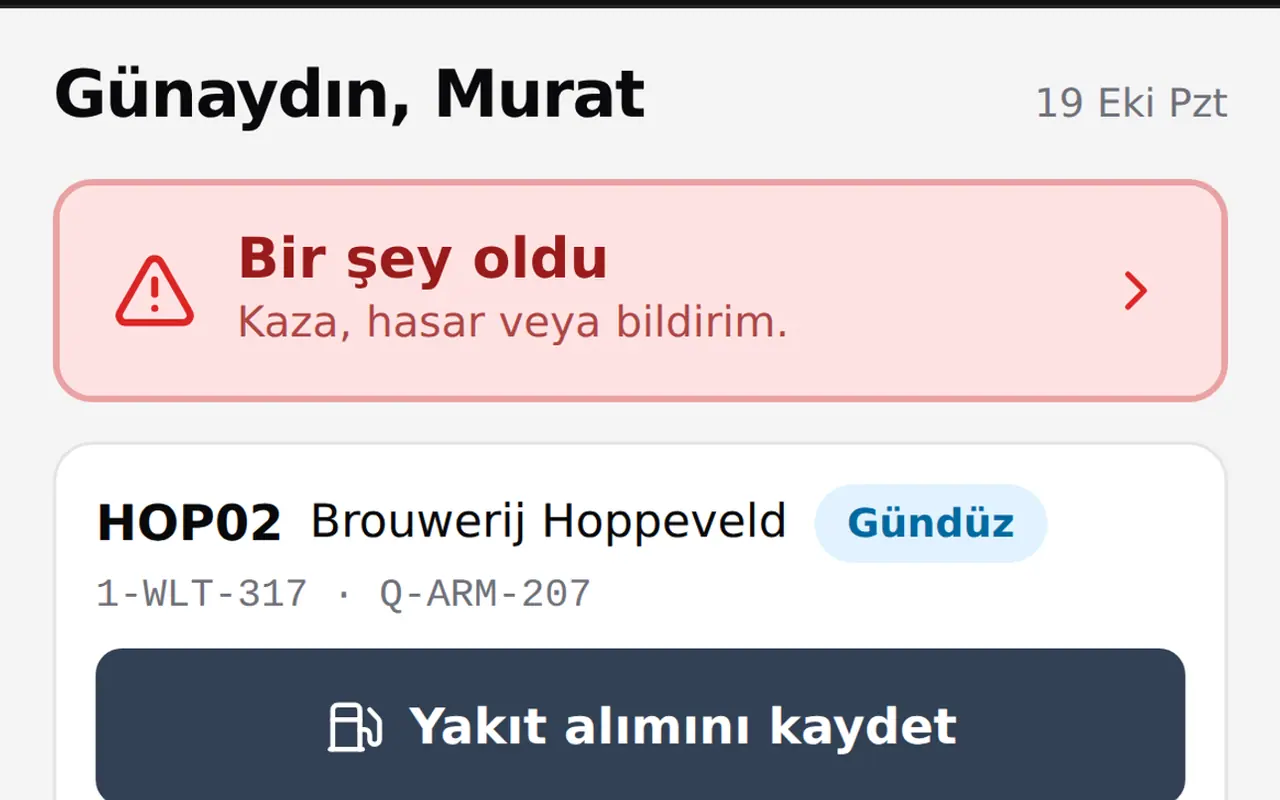
For DA Logistics, a haulier in Belgium, we built the platform the company runs on: a planning board, fuel stock under the Belgian Kader B regime down to the litre, fleet files and a driver app in Dutch, English and Turkish. Around thirty drivers use it every day; the screen shows the app in Turkish.
Zuco Logistics runs the same core as a product, with its own profile and server; domain, certificate and app went live in 57 minutes. The core logic of the DA platform is covered by 1,396 automated tests.
Three ways to contract a nearshore team
| Model | You pay for | Works when | Watch out for |
|---|---|---|---|
| Fixed price per module | a defined result | the scope of the module fits on a few pages | changes become new lines, so decide what matters early |
| Time and materials | hours worked, reported weekly | the product changes as users react | you need someone who decides every week |
| Dedicated team | a set of people for months | you run a roadmap of a year or more | the team is only as good as the backlog you give it |
We work with the first: a fixed price per module, delivered in sprints of two weeks with a demo at the end of each, so you see working software early, on a test link of your own.
Risks of nearshore development, and our answer to each
| Risk | What we do about it |
|---|---|
| Questions wait a day, decisions get lost | eight shared office hours with most of Europe, one written channel, a weekly decision log |
| Only the supplier can run the code | the repository is yours from the first commit; infrastructure can run in your own cloud account |
| Unclear ownership | a written transfer of the intellectual property in everything we build for you |
| Personal data leaves the EU | hosting in the EU by default, a data processing agreement, no transfer you did not approve |
| A key developer leaves | documentation in the repository, tests on the core logic, a second developer who knows each module |
| Bugs reach your users | automated tests, a test environment per release, and a way back on every deploy; our platform releases switch over in 2 to 6 seconds |
EU rules you get by default
A Belgian supplier works under the same GDPR as an EU client, with a data processing agreement and hosting in the EU. That matters just as much if you are outside the EU and sell to Europeans. Software that serves consumers has to meet the European Accessibility Act for many online services, an AI feature falls under the EU AI Act, and in Belgium every invoice between companies now travels as a structured e-invoice over Peppol. We build with these rules in the room, not as an afterthought.
Before you choose a team in Belgium
Do you work with companies outside Belgium?
Our software clients so far are Belgian companies, which is why our platforms handle rules like Kader B fuel accounting and Peppol. What we offer a company abroad is the same team, the same way of working and the same stack, in English, with references you can call in Belgium. We would rather say that plainly than borrow a logo.
Is nearshore cheaper than hiring in-house?
Often, because you pay for delivered modules, not for recruiting, management and idle weeks. Per hour, Belgium is not cheaper than the Netherlands, Germany or the UK.
How do you invoice a client in another country?
In euros, per module. A business client in another EU country with a valid VAT number is invoiced without Belgian VAT under the reverse charge; how that works for Belgian invoices is on our page about web design in Ghent. Your accountant confirms your own side.
Can we start small?
Yes. Sign the first module only. If the way we work does not suit you, you keep the code and the documentation of what was built.
Which stack do you use?
Mostly TypeScript: React on the front, Node with Fastify or Express on the back, Postgres or SQLite, and AWS in the EU. We adapt when your team already runs another stack.
Custom software
How VBS builds software for a company abroad
We design and build custom software and web applications: admin platforms that replace spreadsheets, client portals, apps for staff on the road and integrations with the tools you already pay for. You get a written scope in modules, a fixed price per module, a demo every two weeks and the code in your name. Read how the DA Logistics platform handles fuel, planning and drivers, and how Zuco Logistics runs the same core as its own product. Then book a call and tell us what you want built.
Looking for a nearshore team in your time zone?
Tell us what you want built and where your team sits. We reply with how we would split it into modules.
Rather get in touch right away?