Law firms
Website for law firms that answers the client's question first
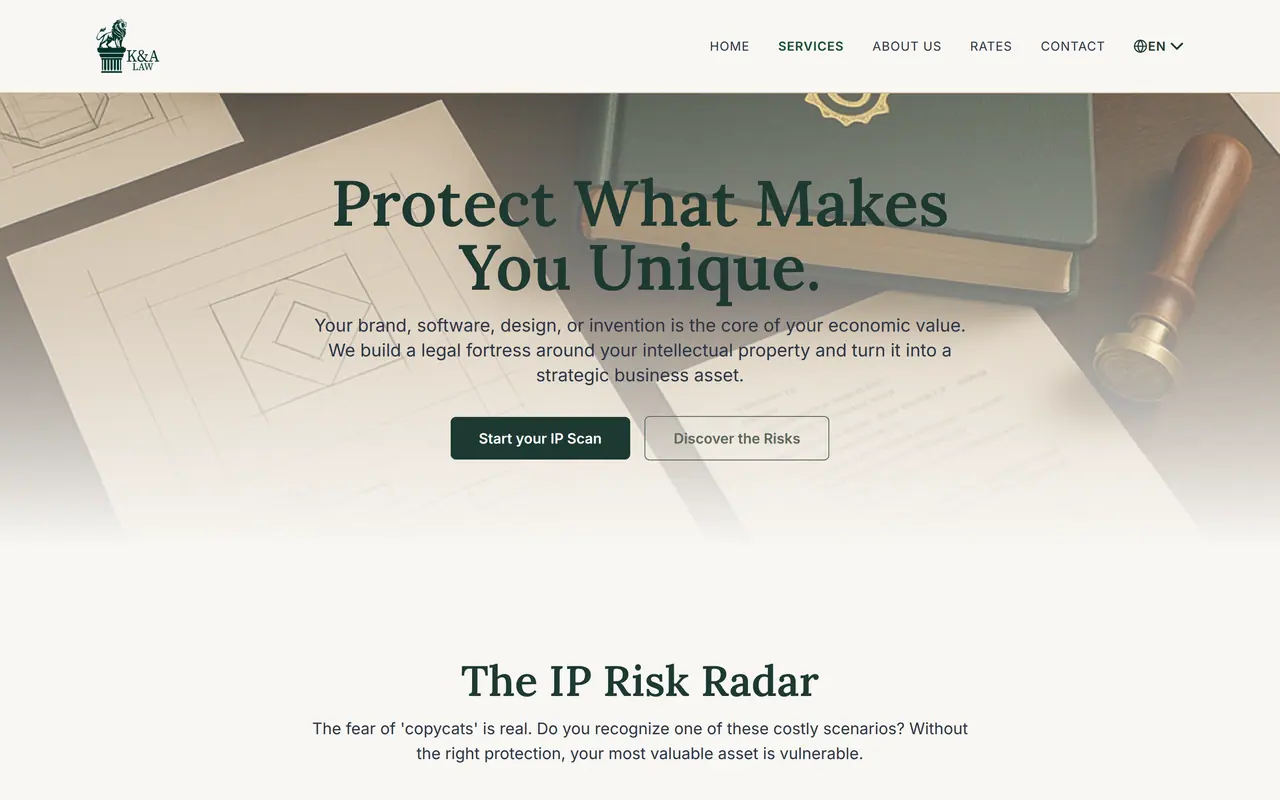
A page per practice area, the price information your regulator expects, your clients' languages and a contact form that asks for nothing privileged.
A client hires the lawyer who already answered their question.
A website for law firms is read by people in a hurry: a founder with a contract to sign tomorrow, an employer with a dismissal claim, a family with an estate. They land on the page that matches their problem, read whether you handle it, what it costs and who would take it on, and decide in minutes whether to call.
We build law firm sites from Ghent, Belgium. For K&A Law we built a site in Dutch, French, English and Turkish with ten service pages, twelve sector files and a rates page. Below: what regulators expect on a firm's website, which pages to build first, and the mistakes that cost firms clients or a complaint.
Your regulator has views on your website
Every bar or law society regulates how lawyers advertise, and the website is advertising. The rules differ per jurisdiction, so check yours before you write a line. The clearest example is England and Wales. Under the SRA Transparency Rules a firm that offers certain services must publish price and service information on its website, in a prominent place, clear and accessible. For those services the page has to show:
| Item | What the page shows |
|---|---|
| Total cost | the full price, or an average or range where that is not practicable |
| Basis of charges | hourly rates or fixed fees |
| Disbursements | what they are and what they likely cost |
| VAT | whether it applies and how much |
| What is included | the key stages and likely timescales, and what is not in the price |
| Who does the work | the experience and qualifications of the people on the matter and their supervisors |
Every firm regulated by the SRA also publishes its complaints procedure, including how to go to the Legal Ombudsman, and shows its SRA number and the SRA digital badge on the site. Elsewhere the rules point the same way. In Flanders, Belgium, the bar's code allows publicity that is not misleading, lets you name results without the client's name unless they agree, and forbids publishing only a base or minimum price. The software behind the firm, and a portal for clients, is on legal practice management software.
Where a firm in England and Wales must show its price
- Residential conveyancingindividuals: buying, selling or remortgaging a home
- Probateindividuals: an uncontested estate in the UK
- Immigrationindividuals: applications and appeals, asylum excluded
- Motoring offencesindividuals: summary-only offences at one hearing
- Employment tribunalemployees and employers: unfair or wrongful dismissal
- Debt recoverybusinesses: claims up to £100,000
- Licensingbusinesses: licences for business premises
Publicly funded work is out of scope. The firm's SRA number and digital badge belong on the site as well.
A fee page that reads clearly
The same structure works for any fixed-fee service anywhere: what the fee covers, what comes on top, the tax, the stages, and what changes the price. Hourly work is harder to publish, but you can still show your rates per seniority and a typical range for common matters.
The pages a firm's site needs
| Page | What it holds | Why |
|---|---|---|
| Practice area | what you do, for whom, how a matter runs | clients search their problem plus your city |
| Sector | the rules in one industry, with your experience | a founder wants a lawyer who knows their trade |
| Question | the answer to one concrete question, in plain words | that is how a client finds you months before calling |
| People | per lawyer the practice area, languages and a photo | clients choose a person, not a logo |
| Fees | rates, fixed fees, what is included | regulators expect it, clients reward it |
| Complaints | how to complain and to whom | required in many jurisdictions, and it builds trust |
A people page that builds trust follows the same pattern as in about us page examples. How those pages get found for clients' searches is in SEO for law firms, with your office on the map through local SEO; what AI can do for a firm without touching privilege is in AI for law firms.
A client on your firm's site, in five screens
- 01The page they land onRarely the home page: the page on their practice area or question, in their language.
- 02Whether you know thisWhat you do in this area, for which sectors, with the questions clients ask.
- 03Who works thereThe lawyer who takes the file, their practice area and languages.
- 04What it costsHow your fee is built: per hour, per file or a subscription.
- 05The contactA short form or a meeting, without documents, with the kind of question.
That is how we built the K&A Law site: four languages, a page per practice area, sector files and a rates page.
Where to start
- Choose a page per practice area ifyour firm covers three or more. A page on debt recovery is found by someone with an unpaid invoice; a page listing all your areas is found by nobody.
- Choose sector files ifmost clients are businesses. A construction company recognises itself faster in a page on construction than in a list of practice areas. K&A Law has twelve on its home page.
- Choose a fee page with fixed packages ifyou sell repeat work to businesses, such as a monthly retainer. A price per month is the easiest fee to publish clearly.
- Choose question pages ifyou want clients beyond your network. Each question you heard five times this month is a page.
- Choose more languages ifyour clients speak them at home. A full page per practice area in French or Turkish often has little competition; see multilingual website development and how search engines tell the versions apart in hreflang.
Privilege starts at your contact form
A form that asks for 'the facts of your case' invites a stranger to put confidential details in a mailbox before there is any engagement or conflict check. Ask only what you need to call back: name, contact details, practice area and urgency, and say on the form what should not be sent. Measure visits without cookies, or only after consent; see do I need a cookie banner and do I need a privacy policy. If you use AI to draft, set out what may never go into it, as in do I need an AI policy.
This week, at your own desk
- Open your site on your phone and find your main practice area. Is it there, with the area and your city in the title?
- Read your fee page against your regulator's rules: is the basis, the VAT and what is excluded on it?
- Remove every field from your contact form that asks for case details.
- List the five questions clients asked most this month: those are your first five question pages.
- Before you ask any web builder for a price, write down what you need in the website brief template, then compare the quotes line by line.
Do you build for firms outside Belgium?
Yes. We work in English, remotely, and write the regulatory pages with you for your own jurisdiction. You or your compliance partner signs off on every text about fees and complaints.
Can we publish case results?
Usually yes, within your code: describe the kind of matter and the outcome, without naming the client unless they agree in writing, and never where confidentiality forbids it.
How long does a build take?
A few weeks, depending on the number of pages and languages. Being found for clients' questions afterwards is the work of SEO for law firms.
Website design
How VBS builds a law firm site
We build your site with a page per practice area, sector and language, a people page and a fee page written to your regulator's rules, and a contact flow that protects privilege. For K&A Law that meant four languages, ten service pages and twelve sector files on the home page. A compact site starts at 1,500 euros; with several practice areas, sectors and languages it is 5,000 euros or more, at a fixed price per part. Rough budget first? Use the website cost calculator; the approach is on website design. Book a call.
A firm online, the way clients search for one.
Tell us your practice areas, your languages and how you charge today.
Rather get in touch right away?