On this page
One choice by your visitor, one place where it counts
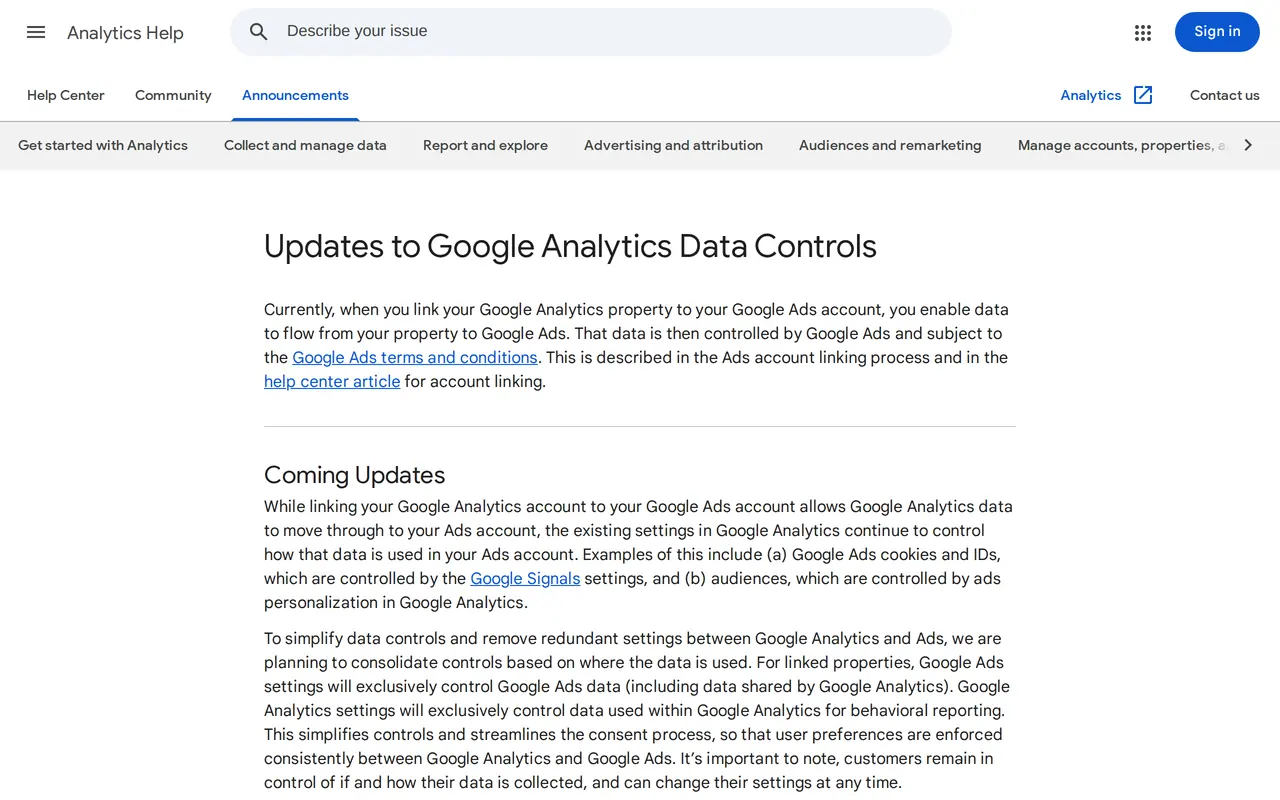
Consent Mode in Google Analytics took on a simpler role on 15 June 2026. If you link Google Analytics to Google Ads, data flows from one to the other. Until then two things decided whether the Analytics tag also collected Google Ads cookies and IDs: the Google Signals setting in Analytics and Consent Mode. Since 15 June only Consent Mode decides, which means the choice your visitor made in your cookie banner. Google Signals now only links data to signed-in users in your behavioural reports.
Two steps are still due in 2026, without a date: the ad_personalization signal alone will decide whether Analytics data feeds personalised ads, and IP addresses will flow encrypted to your Ads account. For anyone advertising in the EU, the cookie banner becomes the single point where it all comes together.
Visitor
Yes or no
Analytics cookies need a choice too under EU rules, and refusing must be as easy as accepting.
Banner
Four signals
ad_storage, analytics_storage, ad_user_data and ad_personalization, each granted or denied.
Since 15 June
Consent Mode alone decides
Whether the Analytics tag collects Google Ads cookies and IDs no longer depends on Google Signals.
Analytics
Signals for your reports
Google Signals still links data to signed-in users, in your behavioural reports only.
Later in 2026
ad_personalization takes over
Then that signal alone decides whether Analytics data is used for personalised ads.
Google has yet to give the day for ad_personalization and encrypted IP addresses. Until then, audiences follow your Analytics settings.
What already changed and what is still coming
| What Google Ads takes from Analytics | Until 15 June 2026 | Since 15 June 2026 | Later in 2026, no date yet |
|---|---|---|---|
| Google Ads cookies and IDs via the Analytics tag | Google Signals and Consent Mode together | Consent Mode only | As since June |
| Linking to signed-in users in reports | Google Signals | Google Signals, for Analytics only | As since June |
| Audiences and personalisation in Google Ads | Analytics settings on four levels | Still the same settings | ad_personalization in Consent Mode only |
| IP addresses | Not passed on | Not passed on | Encrypted to your Ads account, under Google Ads rules |
Consent Mode works with four signals your banner passes on: ad_storage (advertising cookies), analytics_storage (analytics cookies), ad_user_data (sending user data to Google for ads) and ad_personalization (personalised ads, such as retargeting). Each is granted or denied. A banner that passes these signals wrongly, or not at all, now sends either too much or too little. Your remarketing audiences still run on the old Analytics settings for now; review them as soon as Google announces the date for ad_personalization. In the UK, analytics without consent became possible in February 2026 under conditions; see UK cookie law. Setting up Analytics from scratch with consent mode is covered step by step in Google Analytics 4 setup.
What European cookie rules ask of your banner
EU data protection authorities read the ePrivacy rules strictly. Belgium's authority, for one, states that an analytics cookie is in principle not strictly necessary, so Google Analytics needs a yes from the visitor too. Continued browsing does not count as consent, and you may not infer consent from a browser's cookie settings. Refusing has to be as easy as accepting. Whether you need a banner and what it must contain is covered in do I need a cookie banner; what belongs in your privacy policy is covered there.
Europe is working on relief. On 21 October 2026 the Council of the EU agreed its position on the Digital Omnibus: cookie rules stay in the ePrivacy Directive, but new purposes are added that need no consent, such as audience measurement and security. That is not law yet: the European Parliament still has to set its position, and negotiations follow. Until then today's rules apply. The full story is in the Digital Omnibus and cookie rules.
How many visitors you need for modelled data
When a visitor refuses, Google Analytics can estimate their behaviour from visitors who said yes. That is behavioural modelling, and it fills part of the gap in your reports. But it only starts above a threshold: your property needs at least 1,000 daily users who gave consent on at least 7 of the last 28 days, plus at least 1,000 events a day from visitors who refused, for 7 days. Consent Mode also has to run in its advanced form, with tags loading before the banner appears.
| Share of visitors who say yes | Visitors a day needed for 1,000 who say yes |
|---|---|
| 30 percent | 3,334 |
| 50 percent | 2,000 |
| 70 percent | 1,429 |
A small business site with 600 visitors a day never reaches that threshold, however good the banner. For most small and mid-sized companies the Analytics reports therefore stay incomplete, and that is not a fault. Count enquiries on your own site as well, separately from Google, and set them beside your Google Ads conversions. A UTM code on every campaign shows in your own numbers where an enquiry came from.
Checking your banner and tags in four steps
- Open your site in a private windowRefuse everything and check in the developer tools that ad_storage and analytics_storage are denied before any tag fires.
- Accept and check againAfter a yes, the four signals should be granted, and only then may advertising tags load.
- Check the linkSee in Google Ads which conversions come from Analytics and whether they still arrive since 15 June.
- Put your own count beside itA large gap between enquiries on your site and conversions in Google Ads points to an error in your banner or tags.
Less data is not a fault, wrong data is
A visitor who refuses does not belong in your advertising data. Seeing fewer conversions than enquiries is normal. What is not acceptable: tags that fire before someone chose, or a banner without a real reject button.
Who notices this first
- Anyone who switched Google Signals off to share lessSince June that setting no longer held back Google Ads data. What you share now depends on Consent Mode alone.
- Online shops using remarketingYour audiences still run on the old settings; once ad_personalization takes over, they shrink to the people who said yes to it. Google Ads campaigns built on those audiences will need a new baseline.
- Advertisers on Meta and Google at onceMeta also counts differently since March, see Meta's click attribution change. Compare both channels on your own enquiries, not on their reports.
On 17 October 2025 Google also confirmed that Chrome keeps third-party cookies and retired most of Privacy Sandbox. That changes nothing about consent: across the EU, every cookie that is not strictly necessary needs a yes. If you rely on advertising, a banner people are happy to accept does more than any cookie trick. The ROAS calculator helps you read your return from the conversions you do see.
Doubts about your banner and Analytics
Do I need to change anything in Google Analytics itself?
Not for 15 June: Google made the switch. Your banner must pass Consent Mode on correctly, since it alone decides now. For the ad_personalization step later in 2026, Google has yet to give the date.
Will I see fewer conversions in Google Ads?
Only if your banner used to pass on more than the visitor chose, or if Google Signals was set differently from Consent Mode. If everything was set correctly, you will see little difference.
May I load Google Analytics without consent in the EU?
Not with analytics cookies under today's rules: those need a yes too. The Council wants to exempt audience measurement, but that is not law yet.
Do I need a paid consent management platform?
Not necessarily. Your own banner is fine, as long as it passes the Consent Mode signals correctly and refusing is as easy as accepting.