Software development Antwerpen
Software development in Antwerpen
266.5
Custom platforms for firms that plan, drive and deliver around Europe's second port.
Where spreadsheets stop working
Software development in Antwerpen usually starts with a spreadsheet that has grown too big. The port of Antwerp-Bruges handled 266.5 million tonnes of cargo in 2025, and around it work thousands of hauliers, forwarders, warehouses and contractors. At the end of 2025, 2,815 transport and storage companies had their seat in the city of Antwerpen alone, and 5,313 construction firms. Many of them are run by international teams that work in English, with drivers and crews who often speak another language at home.
At twenty drivers, three depots and a customs office that wants to see the figures, a spreadsheet no longer holds. You then have two roads: buy a package and fit your work to it, or have custom software built that follows your work. This page explains when each is cheaper, what a first version costs in the Belgian market and how long it takes, and what we built for two transport companies.
Google shows the demand: 'software development antwerp' completes to 'software development antwerpen', with the Dutch name of the city, and 'software companies antwerp' comes back too.
Five places where a haulier types the same thing twice
- 01Fuel and stockRefuels, deliveries and dip readings per tank, first in first out under the Belgian Kader B scheme.
- 02CustomsThe discrepancy report and the export customs asks for, from the same figures.
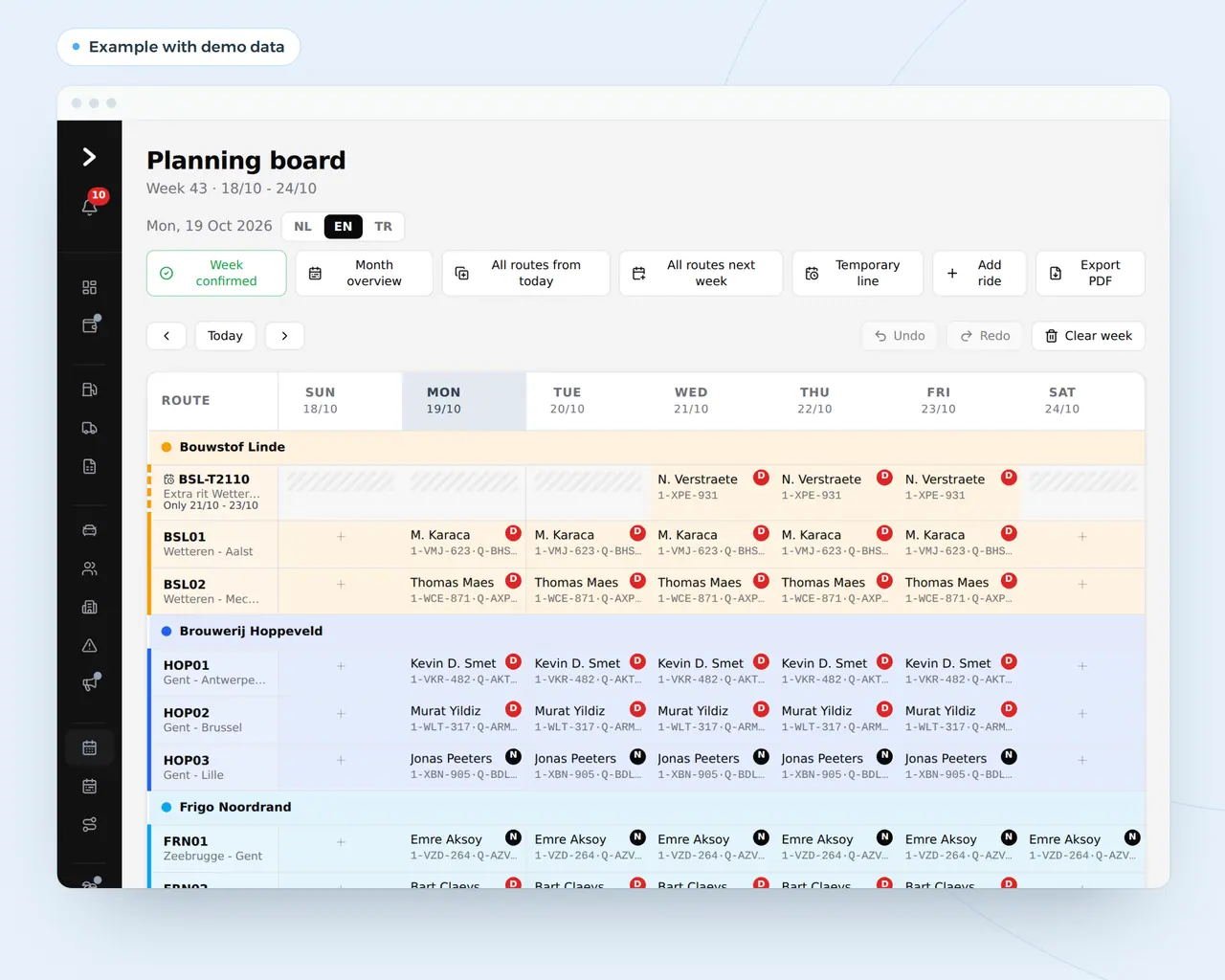
- 03Planning boardRoutes per week, day and night, with conflicts the board points out itself.
- 04Driver appLeave, receipts and truck issues, in Dutch, English and Turkish.
- 05AccountantOne bundle per period instead of a folder of loose PDFs.
This is how the DA Logistics platform works; Zuco Logistics runs on the same core with its own fuel model.
Five questions that decide what is cheaper in three years
| Question | Points to a package if | Points to custom if |
|---|---|---|
| How many users pay a licence? | fewer than ten | twenty or more, drivers included |
| Do you work like the rest of your sector? | yes, the package follows your process | no, your process is your edge |
| Must it link to customs, fuel cards or your accountant? | the package already has that link | the link does not exist or costs extra each month |
| How often does your way of working change? | rarely | every quarter, a new client or rule |
| Who owns your data? | you accept the vendor's format | you want ownership and export without conditions |
If three or more answers fall in the right-hand column, it pays to have custom software priced. The full trade-off is in build vs buy software, and for teams comparing with Odoo in Odoo or custom software.
Thirty drivers, 34 vehicles and fuel tracked to the litre
For DA Logistics, a transport company, we built a platform for fuel, fleet and planning. Professional diesel in Belgium falls under the Kader B scheme: every litre has to be traceable from delivery to tank. The platform keeps the stock first in, first out, with a correction log and a discrepancy report for customs. The planning board shows routes per week, day and night, and points out conflicts itself.
Drivers use it on their phones in Dutch, English or Turkish, for leave, receipts and truck problems. About thirty drivers and 34 vehicles are on the system, and new versions go live in two to six seconds, with a backup beforehand and a way back.
One platform, two hauliers, three fuel models
When Zuco Logistics needed the same, we turned the platform into a product for several clients: a core without client names, a profile per client with its own branding, modules and language, and its own server per client. Zuco got its own fuel variant, a depot with purchases on invoice, stock first in, first out and an excise screen with an export for customs. From the domain registration to the first login took 57 minutes, on one afternoon.
For an Antwerp firm that means you do not start from zero: the core exists, and what your way of working needs is added. The cases are on DA Logistics and Zuco Logistics. What a transport platform can do in general is on our pages on transport software, transport management software and fleet management software.
Not only transport
| Type of firm around the port | What the platform replaces | Where to read more |
|---|---|---|
| Transport and logistics | planning in Excel, fuel slips on paper | the two cases above |
| Construction and installation | site planning by email, paper work orders | work order app, construction scheduling |
| Storage and distribution | stock lists emailed to clients | inventory management, client portal |
| Services | quotes in Word, follow-up in an inbox | custom CRM |
For construction, read construction scheduling software and the work order app; for storage, inventory management software and our page on client portals; for following up clients, custom CRM development.
Why fuel and customs decide the design
For a haulier with its own diesel tank, Kader B is not a detail. Professional diesel carries a lower excise duty, and customs can ask at any moment where each litre went. If deliveries, tank readings and refuels sit in three different places, that question costs days. A platform that keeps them together answers it with one report. That is why, at DA Logistics, fuel came first and the planning board second.
Drivers first
A platform that drivers do not use is a platform without data. Ask early how drivers will log in, in which language, and on which phones.
What a first version costs and takes
In the Belgian market custom software is priced by the hour, usually 50 to 150 euros. A first version of a planning board with drivers, vehicles and conflicts is easily 250 to 300 hours, including design, security and testing. At those market rates that is roughly 12,500 to 45,000 euros, for a first version that can be live in three to four months.
Our quotes are not hourly. We spend one or two conversations on what version one must do, and price that scope as a whole. How such a quote is built is in our guide to custom software development cost; if you still run on spreadsheets, start with replacing Excel with software.
From Ghent, for Antwerp
From our office on the Sint-Baafsplein it is 60 kilometres to Antwerp, 49 minutes by car. We build remotely and come to your office or depot for the mapping workshops, held in English or Dutch. We do not have a client in Antwerp, and DA Logistics and Zuco are hauliers, not port companies. But anyone who plans, drives and delivers around the port will recognise their problems. How we build is on our page on custom software; for a site in English and Dutch, read web design in Antwerpen.
Antwerp questions about custom software
- When is custom software cheaper than a package for an Antwerp transport firm?
- Usually from twenty or more users, when you need integrations a package charges for separately, or when your way of working differs from the sector. Licences per head then weigh more over three to five years than the build.
- Can drivers use it in their own language?
- Yes. The driver app we built for DA Logistics works in Dutch, English and Turkish, and other languages can be added per client profile.
- How long does a first version take?
- A first version with the most important screens is usually live after three to four months. After that the platform grows module by module.
- Who owns the software when it is done?
- You do. Your data can be exported, and you are not tied to licences per user.
Custom software
How VBS helps you with this
We build the platform your business runs on every day: your spreadsheets, emails and paperwork in one system that does what you do.
- Your workflow mapped first, then a fixed price
- Screens for the office, the client and the road
- Hosting, backups and security managed by us on AWS
How we approach it is on our page about Custom software.
Has your spreadsheet outgrown the business?
Show us how you plan and report today. We will tell you honestly whether a package will do or custom pays off.
Rather get in touch right away?