Software development Leuven
Software development in Leuven
From a prototype on a researcher's laptop to a platform your first clients log into.
When research gets its first customer
Most Leuven teams look for software development at one moment: when research turns into a product someone pays for.
Leuven is built on that moment. At the end of 2025 more than one in ten companies in the city worked in information and communication, 1,237 of 10,788, about twice the Flemish share. The Haasrode Research Park counts more than 5,000 people on 136 hectares, and the city started the 2026 academic year with about 60,000 students. A prototype that runs on a researcher's laptop is not what a customer buys. A customer wants to log in, see their own data, download a report and know that their data is safe. This page covers that step: what you must own from day one, what a first version looks like, what it costs in the Belgian market and which security comes with each stage. Google shows the search: 'software development leuven' comes back as typed, and so does 'software development ku leuven'.
What you own, from the first line of code
For a spin-off, software is part of what investors buy. Settle three points on paper before development starts.
| What | Why it matters | What to agree |
|---|---|---|
| The source code | an investor or buyer wants to know the product is yours | the code is yours, in a repository in your name |
| Your clients' data | you are responsible under the GDPR | data in Europe, exportable, a data processing agreement |
| The knowledge | a product cannot depend on one developer | documentation and tests that grow with it |
For the legal side of ownership and licences, ask a lawyer. For the technical side, so you are never locked in, read our answer to why outsource software development.
What a first version looks like
- Choose a client portal ifyour clients need to see results, reports or measurements from you. They log in, see their own file and download what they need. See client portals.
- Choose a dashboard ifdata from devices, sensors or analyses has to reach a client or an internal team in one view. See custom dashboard development.
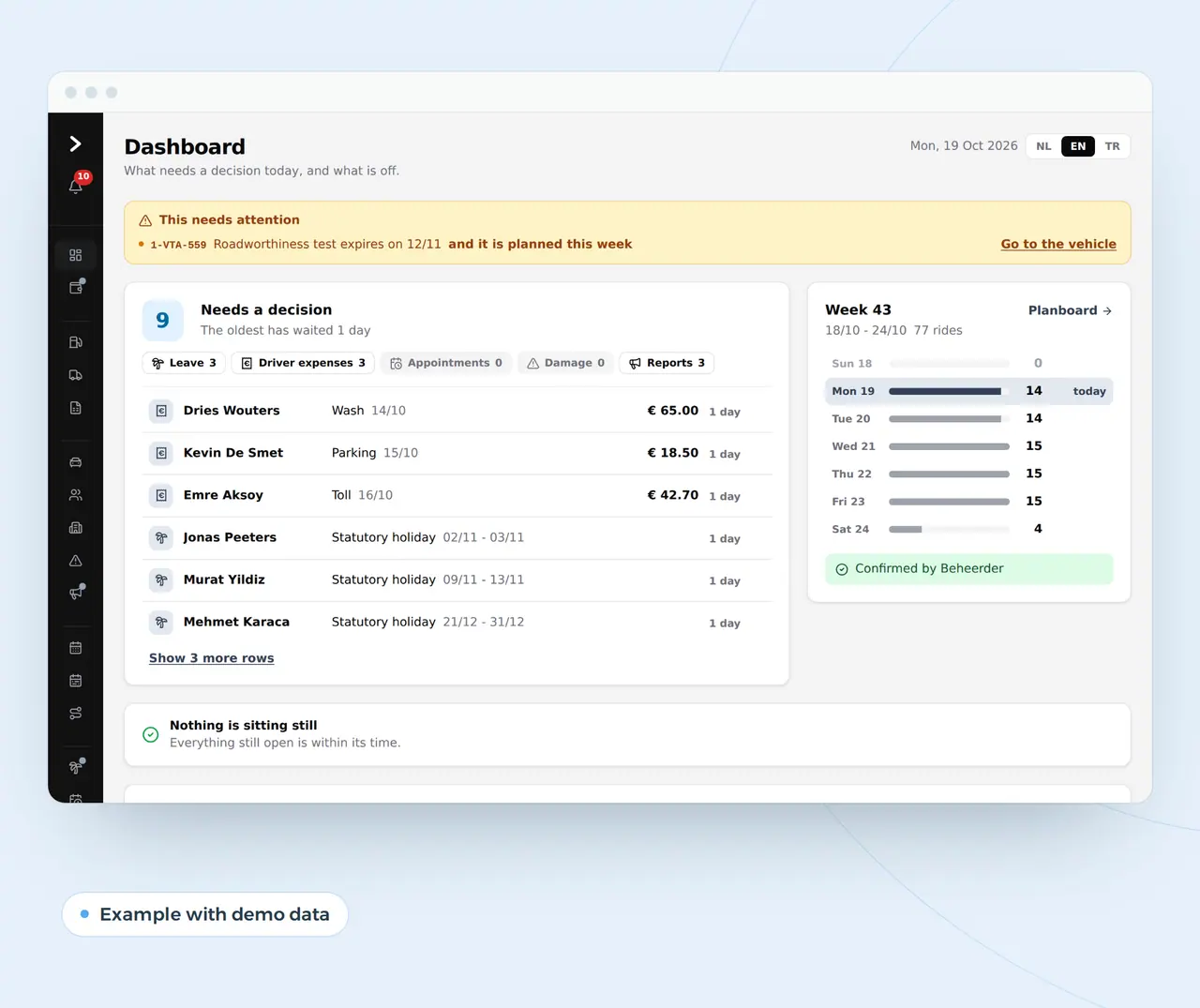
- Choose a platform with roles ifdifferent users do different things: an admin, a client, a partner. That is what we built for Business Centrum.
A first version does not have ten features. It does have a secure login, a backup that runs every day and tests that check on every change that everything still works.
Prototype to product: what each step adds
| Login and roles | Two-factor login | Encryption | Abuse tests | Own server per client | |
|---|---|---|---|---|---|
| Prototypea demo for partners and investors | Recommended | Not yet needed | Not yet needed | Not yet needed | Not yet needed |
| First versionreal users, real data | Needed | Needed | Needed | Recommended | Not yet needed |
| Productseveral clients on one core | Needed | Needed | Needed | Needed | Needed |
Prototypea demo for partners and investors
- Login and roles: Recommended
- Two-factor login: Not yet needed
- Encryption: Not yet needed
- Abuse tests: Not yet needed
- Own server per client: Not yet needed
First versionreal users, real data
- Login and roles: Needed
- Two-factor login: Needed
- Encryption: Needed
- Abuse tests: Recommended
- Own server per client: Not yet needed
Productseveral clients on one core
- Login and roles: Needed
- Two-factor login: Needed
- Encryption: Needed
- Abuse tests: Needed
- Own server per client: Needed
This is how we built the Business Centrum management platform and the Zuco Logistics core.
A management platform with product-grade security
For Business Centrum, a social secretariat office in Ghent, we built a management platform that replaced their spreadsheet: employers, employees, work permits, meal vouchers, documents, and a portal for their clients with a sign-in link by email. Sensitive data is encrypted at rest, two-factor login is an option for every user, sessions can be revoked, and there is a nightly backup. Each change is checked by 31 unit tests and by 65 abuse tests that behave like an intruder. The case is on Business Centrum platform.
From one client to many
A spin-off that succeeds sells the same product to several clients. The software has to handle that without a copy per client. We did exactly that with the DA Logistics platform, which now runs as a product: a neutral core, a profile per client with branding, modules and language, and a separate server for each. Zuco Logistics went live on it in an afternoon, 57 minutes from registering the domain to the first login. Build version one so that client two is a profile, not a new project. The case is on Zuco Logistics; what a product for many clients involves is on our page on SaaS development.
What a first platform costs in the market
Belgian developers and agencies bill custom work at roughly 50 to 150 euros an hour. Our own rough hour counts, multiplied by that, give these ranges for a spin-off's first version, VAT excluded.
| First build | Rough hours | In euros, at market rates |
|---|---|---|
| A portal where clients log in and download results | 150 to 250 | 7,500 to 37,500 |
| A dashboard on data you already have | 100 to 200 | 5,000 to 30,000 |
| A platform with roles, admin and a client side | 250 to 400 | 12,500 to 60,000 |
The spread comes from what exists already and from the integrations. With us there is no hourly bill: we agree on version one and price it as one project. The anatomy of such a quote is in our guide to custom software development cost, and the build-or-buy question in build vs buy software.
What goes on the table in the first workshop
Version one starts with half a day around a table, in Leuven or online. After it, everyone knows what will be built and what will not. We fix five things:
- Who uses it, and what each role may doA researcher, a client and an admin each see different screens and different data.
- Which data exists and where it livesIn a database, in spreadsheets, in an instrument. The integration depends on it.
- The one screen that has to work on day oneUsually the overview a client sees after logging in.
- The legal frameWhich personal data enters the system, and who processes it on whose behalf.
- What an investor wants to seeA demo with real data, an architecture that grows, and the code and data in your name.
From that half day comes a short description of version one, with sketched screens and a fixed price. Only then does anyone write code.
Mistakes we see with spin-offs
- Putting the prototype into productionWhat works on a laptop is rarely safe enough for client data. Rebuild the core, reuse the logic.
- A freelancer with no handoverIf the only developer leaves, your product stops. Ask for documentation and tests.
- Not knowing where the data sitsResearch data and client data belong on EU servers, backups included.
- Postponing two-factor loginA break-in later costs more than the day it takes to build in now.
After version one
A first version is not the end of the build. Once real users work with it, the next steps become clear: a report a client asks for, an import from an instrument, a second language for a partner abroad. We plan those as small, separately priced steps, so the product grows with its users instead of with a wish list written before anyone used it.
Hosting and ownership in one sentence
Your platform runs on servers in Europe, in an account you can own, with code in a repository in your name.
From Ghent, for Leuven
Leuven is 88 kilometres from the Sint-Baafsplein, 68 minutes by car and about an hour by train. Building happens remotely; for the workshop where we map your product we come to Leuven, and we run it in English or Dutch. We have no client in Leuven and have not worked for a spin-off yet. What we can show are platforms that faced the same questions, for Business Centrum, DA Logistics and Zuco. Our approach to platforms is on custom software, and the site that goes with it on web design in Leuven.
Custom software
How VBS helps you with this
We build the platform your business runs on every day: your spreadsheets, emails and paperwork in one system that does what you do.
- Your workflow mapped first, then a fixed price
- Screens for the office, the client and the road
- Hosting, backups and security managed by us on AWS
How we approach it is on our page about Custom software.
Is your prototype ready for its first client?
Show us the prototype and tell us who will use it first. We will tell you what version one has to do, and what can wait.
Rather get in touch right away?