On this page
A payment reminder template for clients in Belgium has to answer one question first: is your client a business or a consumer? A Belgian business owes statutory interest from the day after the due date plus a fixed EUR 40 fee, no reminder needed. A Belgian consumer first gets a free reminder with at least 14 days to pay, and only then can anything be added.
So this template holds two sets of three letters in Word and an Excel calculator that works out interest, the fixed fee or the consumer damages, and the end of the consumer's term. It is written for a supplier outside Belgium with Belgian clients: an agency in Dublin, a software firm in Amsterdam, a consultant in Paris. You download it without leaving an email address.
Business or consumer: two sets of rules
Belgium implemented the EU Late Payment Directive in its Act of 2 August 2002, so the business side will look familiar if you sell elsewhere in the EU. The consumer side is Belgian and stricter: Book XIX of the Code of Economic Law, in force since December 2023.
| Topic | Belgian business | Belgian consumer |
|---|---|---|
| Law | Act of 2 August 2002 | Book XIX Code of Economic Law |
| First reminder | Optional | Required, free, at least 14 days to pay |
| Interest | By operation of law from the day after the due date | Only after the term, and only if your terms say so |
| Compensation | Fixed EUR 40 recovery fee | Damages capped per slice, at most EUR 2,000 |
| Rate in 2026 | 10.5% a year | At most the same 10.5% |
Which law applies to a consumer depends on the contract and where the consumer lives; for a consumer living in Belgium, assume the Belgian rules. If the claim is disputed or large, ask a lawyer before the formal notice.
Day 0
Due date
Business: interest runs from tomorrow
Day 4 to 7
Free reminder
Consumer: required, 14 days to pay
Day 21
Second reminder
Business: interest plus EUR 40 fee
After the term
Damages
Consumer: only if your terms provide for it
Day 35
Formal notice
Registered mail, fifteen days to pay
The days are an example. Between businesses, interest does not wait for a letter.
Three letters to a Belgian business
Most late business payments are an invoice in the wrong inbox. Start polite; the law already protects your money.
| Letter | When | What it says |
|---|---|---|
| Friendly reminder | A week after the due date | Invoice number, amount, IBAN, an open door if something is wrong |
| Second reminder | Three weeks after | Interest to date, the EUR 40 fee, eight days to pay |
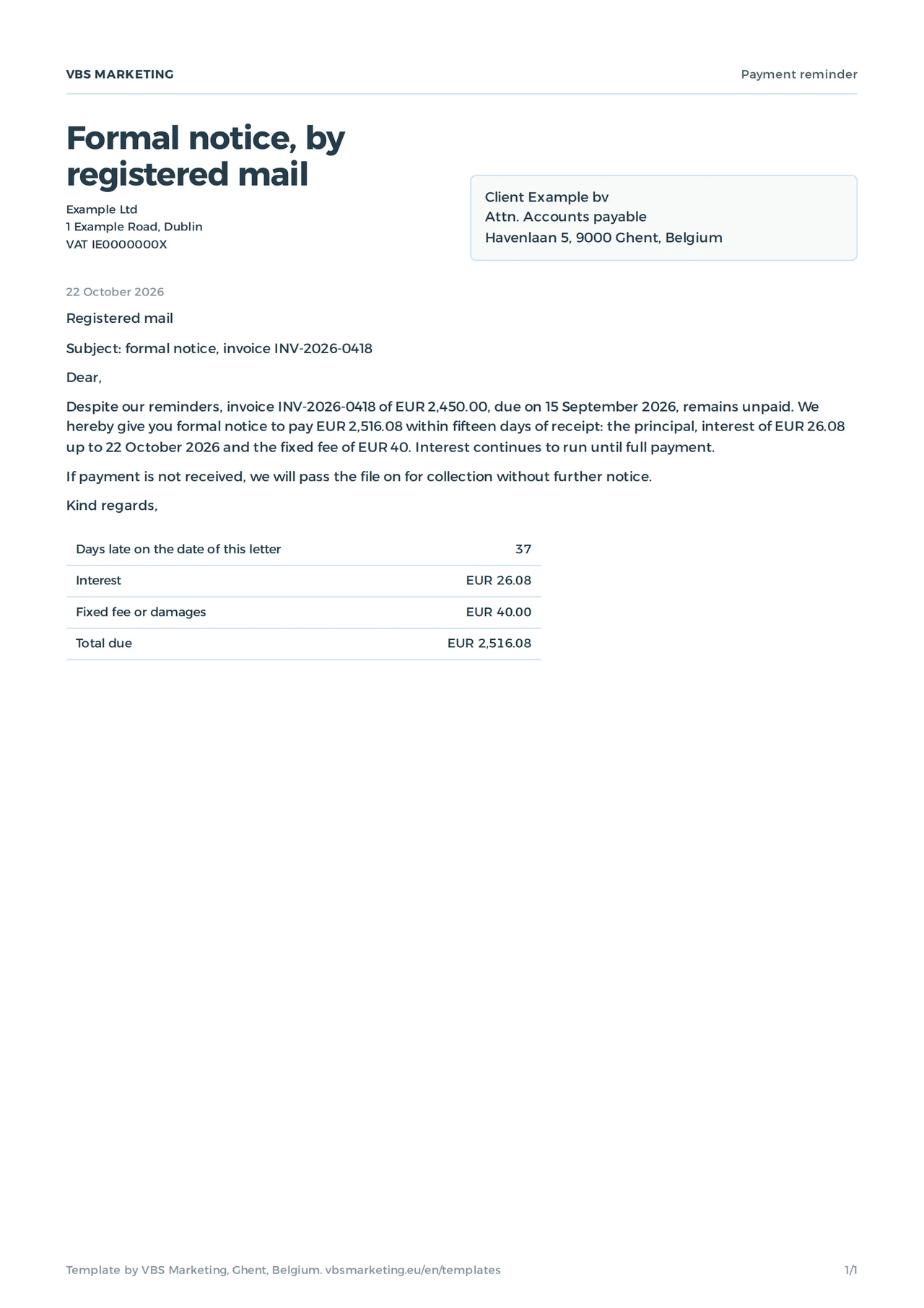
| Formal notice | Five weeks after, registered | The total, fifteen days, what happens next |
The 10.5% follows the European Central Bank rate plus eight points, set each half year; check it in January and July. Put the Belgian structured communication of the original invoice on every letter so the client's bank matches the payment; make one with the structured communication tool. If the client is a Belgian company that books invoices from Peppol, your PDF may simply have been missed: check whether they are on the network with the Peppol check, and read what changed with e-invoicing in Belgium.
Three letters to a Belgian consumer
The free reminder must contain the amount, what it is for, the term with its end date, the damages that will follow, and your company details. The term does not start on the day you send: by email it starts the day after, by letter on the third working day after sending. The sheet does this for you.
| Debt | Maximum damages |
|---|---|
| Up to EUR 150 | EUR 20 |
| EUR 150.01 to 500 | EUR 30 plus 10% of the part above EUR 150 |
| Above EUR 500 | EUR 65 plus 5% of the part above EUR 500, at most EUR 2,000 |
In the sheet, a consumer's interest only starts the day after the term, so you never charge too much. A first reminder that adds costs is not valid, and you would have to start again.
Chasing a Belgian client: the questions we hear
Can I charge interest on a late invoice to a Belgian company?
Yes. Under the Act of 2 August 2002, interest runs by operation of law from the day after the due date, at 10.5% a year in 2026, plus a fixed EUR 40 fee. You do not need to send a reminder first.
Can I charge a Belgian consumer a late fee in the first reminder?
No. The first reminder must be free and give at least 14 calendar days to pay. Only after that term may you charge damages and interest, and only if your terms provide for them.
Should a payment reminder letter be in Dutch or French?
There is no legal language rule for a private invoice reminder, but a client reads a letter in his own language faster. Flanders reads Dutch, Wallonia French, Brussels both; English works for most businesses.
When do I send a formal notice?
When reminders have not worked and you plan to involve a collection agency, a bailiff or a lawyer. Send it by registered mail, so receipt cannot be denied.
A reminder that reaches the inbox
An emailed reminder only counts if it arrives. Send it from the address your invoices come from, on a domain that passes the sender checks Gmail and Outlook require: SPF, DKIM and DMARC. The same rules apply to any mail you send in volume; our guide on how to write a newsletter explains them. Keep a list per invoice with the date of every letter. Once that list outgrows a spreadsheet, read how to replace Excel with software.
Agree the payment term in the quote and show the due date on every invoice to a Belgian client. Between businesses under Belgian law, an agreed term can be at most 60 days; without an agreement it is 30 days after receipt.
When the formal notice gets no answer
After a formal notice by registered mail, you have three routes. For an undisputed debt between businesses, a Belgian bailiff can collect without a court case; for anything else, a collection agency or a lawyer takes over. If the client disputes the invoice, stop chasing and answer the dispute first: a reminder about an invoice the client contests only hardens positions. If the client goes bankrupt, you file your claim with the trustee instead of sending letters.
Two details decide how strong your file is. Your terms must state the interest and damages before you can charge a consumer anything; the difference between a B2B and a B2C client matters from the first line. And every letter carries your full company details, the same duty that applies to your company number on your website. Have a lawyer read your terms once; it costs less than one lost claim.