On this page
A 301 redirect is invisible when it works and very expensive when it is missing. Most lost traffic after a relaunch does not come from the new design or the new copy. It comes from old URLs that now return an error: links from partners, bookmarks, and above all Google's index, which slowly drops every address that no longer answers.
Merging three country sites into one domain
A common case for companies selling across Europe: a machine builder runs example.de, example.nl and example.co.uk as three separate sites and moves them to one domain with a folder per language. Each old URL needs exactly one new home. Search Console shows the old .de site alone earns 4,000 impressions a month; skip the mapping and those impressions start again from zero.
| Old URL | New URL | Code | Why |
|---|---|---|---|
| example.de/produkte/pressen | example.com/de/pressen | 301 | Same page, new address |
| example.co.uk/products/presses | example.com/en/presses | 301 | Same page, new address |
| example.nl/nieuws/beurs-2024 | none | 410 | Event over, no successor |
| example.de/kontakt | example.com/de/kontakt | 301 | Contact per language stays |
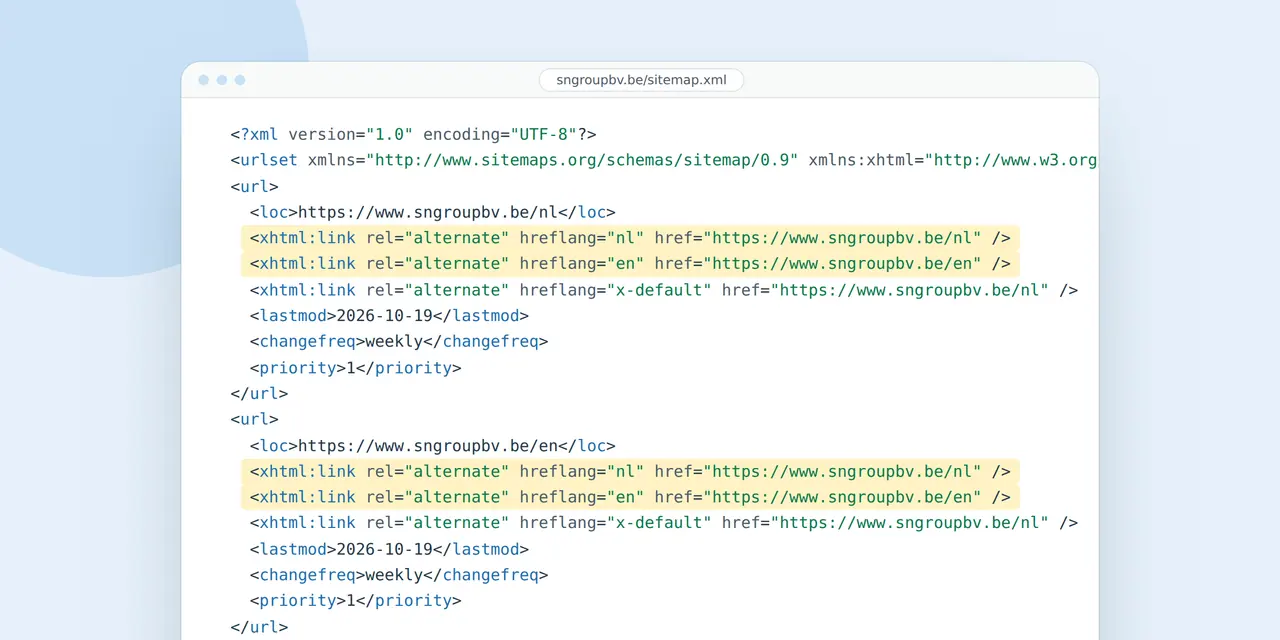
The mapping is the real work. Allow five minutes per page to pick the right counterpart, so a 300-page estate is a few days, plus a day of testing after launch. Language folders also need hreflang so Google shows each market its own version; how we set up sites in several languages is on our multilingual websites page. Planning a full rebuild? A website redesign agency should hand you the redirect map before launch.
What the server says when someone asks for an old URL
Someone requests the old address/produkte/pressen
- Visitorlands on /de/pressenGoogleshows /de/pressen in resultsUse it for a move
- 302FoundVisitorlands on /de/pressenGoogleusually keeps the old addressUse it for something temporary
- 404Not FoundVisitorsees an error pageGoogledrops the address from the indexUse it for no successor
A chain of redirects
ABCDthree hops
Aone hop
Google follows up to 10 hops, but wants the final address straight away.
301, 302, 308 or 410: picking the right answer
The 301 has been in the HTTP standard since HTTP/1.0 in May 1996, alongside the temporary 302. The 307 and 308 codes came later and behave the same, except that they pass a form submission on unchanged, which matters for APIs and checkouts.
| Code | What Google does | Use it for |
|---|---|---|
| 301 or 308 | Strong signal: the new URL replaces the old in results | Relaunches, domain moves, merged pages |
| 302 or 307 | Weak signal: the old URL usually stays | Maintenance, a promotion of a few weeks |
| 404 or 410 | The URL drops out of the index | Pages with no successor |
Google treats 404 and 410 the same way; a 410 simply tells everyone else that the removal was deliberate. Redirects inside the page, by meta refresh or JavaScript, are picked up too but less reliably. Put them on the server or the CDN.
Where a redirect ends and a canonical begins
A redirect sends the visitor away: the old URL shows nothing any more. A canonical tag keeps both URLs live and tells Google which one is the main version, for instance a product listed in two categories. Noindex keeps a page reachable but out of the results. Robots.txt stops Google visiting a URL at all, so if you block an old address there, Google never sees its 301. After a move, list only the new addresses in your XML sitemap.
What a migration costs
The rules themselves are free. On Apache it is a line in .htaccess, on Nginx a line of configuration, on Cloudflare's free plan up to 10 single redirect rules per domain plus bulk lists totalling 10,000 URLs, rising to 25 rules and 25,000 URLs on Pro. To list every old URL and test every redirect after launch, a crawler such as Screaming Frog is free up to 500 URLs and paid per year above that. Search Console is free and shows which old addresses still return errors. How long a brand-new domain waits is covered in how long until my website shows on Google. If traffic dips after a move, the website not showing on Google checker narrows down the cause, and the SEO checker shows the status code and canonical of any page.
Questions that come up mid-migration
Do 301 redirects lose ranking power?
Google says a permanent redirect passes its signals to the new URL. Rankings can wobble for a few weeks while Google recrawls. That recovers; an old URL returning an error does not.
How long does Google take to process a site move?
For a small to medium site, Google says most pages move within a few weeks; larger sites take longer. A new site with no history waits longer still.
We relaunched without redirects. Is it too late?
No. Add them now, starting with old URLs that still have impressions or external links in Search Console. The sooner you do, the more of the old signals carry over.