On this page
Your client is the hero, not your company
With storytelling you tell what you do as a story instead of a list of features. Every story needs a main character, and in marketing that is almost never your company. It is your client, or someone like them. You are the expert who makes the turn possible.
Compare two lines. "We install walk-in showers with a ten-year guarantee" is a feature list. "After thirty years, Maria could no longer step over the edge of her bath. Three days later she had a shower without a step" is a story. Both say what you do; only the second shows what it means to the reader.
Storytelling is not a channel of its own. It is a way of telling that works in a reel, a case study, a LinkedIn post, a company film or the first minute of a sales call.
Stage stories that work in the feed
- 1863Freytag's pyramidIn Die Technik des Dramas, Gustav Freytag describes a play as a pyramid in five parts: introduction, rising action, climax, falling action, catastrophe.
- 1949Campbell's heroIn The Hero with a Thousand Faces, Joseph Campbell shows that hero tales across cultures share one pattern: separation, initiation and return.
- 2000Green and Brock measure itFour experiments with almost 700 readers show that the more a story absorbs people, the more they come to think as the story suggests.
A 45-second reel, taken apart
A 45-second reel for a tiler in Bruges (example)
- 0 to 3 sSettingA bath with a shower curtain and tiles from 1985. On-screen text: thirty years, the same bathroom.
- 3 to 15 sProblemThe owner, 78, struggles to step over the bath edge. She cannot stay like this.
- 15 to 35 sTurnThree working days in five shots: strip out, drain, tiles, a walk-in shower without a step.
The same line in Gustav Freytag (1863)
- Exposition
- Rising action
- Climax
- Falling action and resolution
The product only appears at the turn. Viewers first want to know how it ends for someone like them.
Why people remember a story and not a list
The strongest evidence comes from psychologists Melanie Green and Timothy Brock. In 2000 they published four experiments with 97, 69, 274 and 258 participants. The more readers were carried into a story, which they called transportation, the more their beliefs moved towards the story and the more favourably they judged its main character. Absorbed readers also spotted fewer false notes. Whether the story was labelled true or invented made little difference to the effect.
For a business, that means a buyer who gets absorbed in a story accepts your argument without you listing it. Be careful with figures that circulate online, such as stories being "22 times more memorable". There is no source you can check for that one, so leave it out of your own story.
Five stories you already have
You do not need a brand film to work with stories. These are already in your business.
| Story | The hero | The turn | Where it works |
|---|---|---|---|
| Before and after | The client | Your work | Reel on social media, project page |
| Client case | A named client | The moment it went wrong, and what you did | Site page, proposal, retargeting |
| Why you started | You as founder | The reason you began | About page, personal branding on LinkedIn |
| Behind the scenes | Your team | A day that went differently than planned | Instagram, job ads |
| Product in use | The user | What they can do now that they could not before | Online store, ad |
A story makes your USP believable. "Leak sealed within 24 hours" is a promise; the family who called at nine on Friday night and was dry by ten on Saturday is the proof. Whether you tell it warmly or plainly depends on your tone of voice.
One story, several languages
If you sell in several countries, a story has to be retold, not translated. The hero should live where the reader lives, the problem should be one they know, and the turn should use their words. A Dutch buyer and a German buyer may share the problem but not the phrasing that makes them nod. Plan one source story, then a version per market, and write the captions in the language of the feed. Our sites for Business Centrum and FK Boekhouding run in four languages for that reason; see multilingual website development.
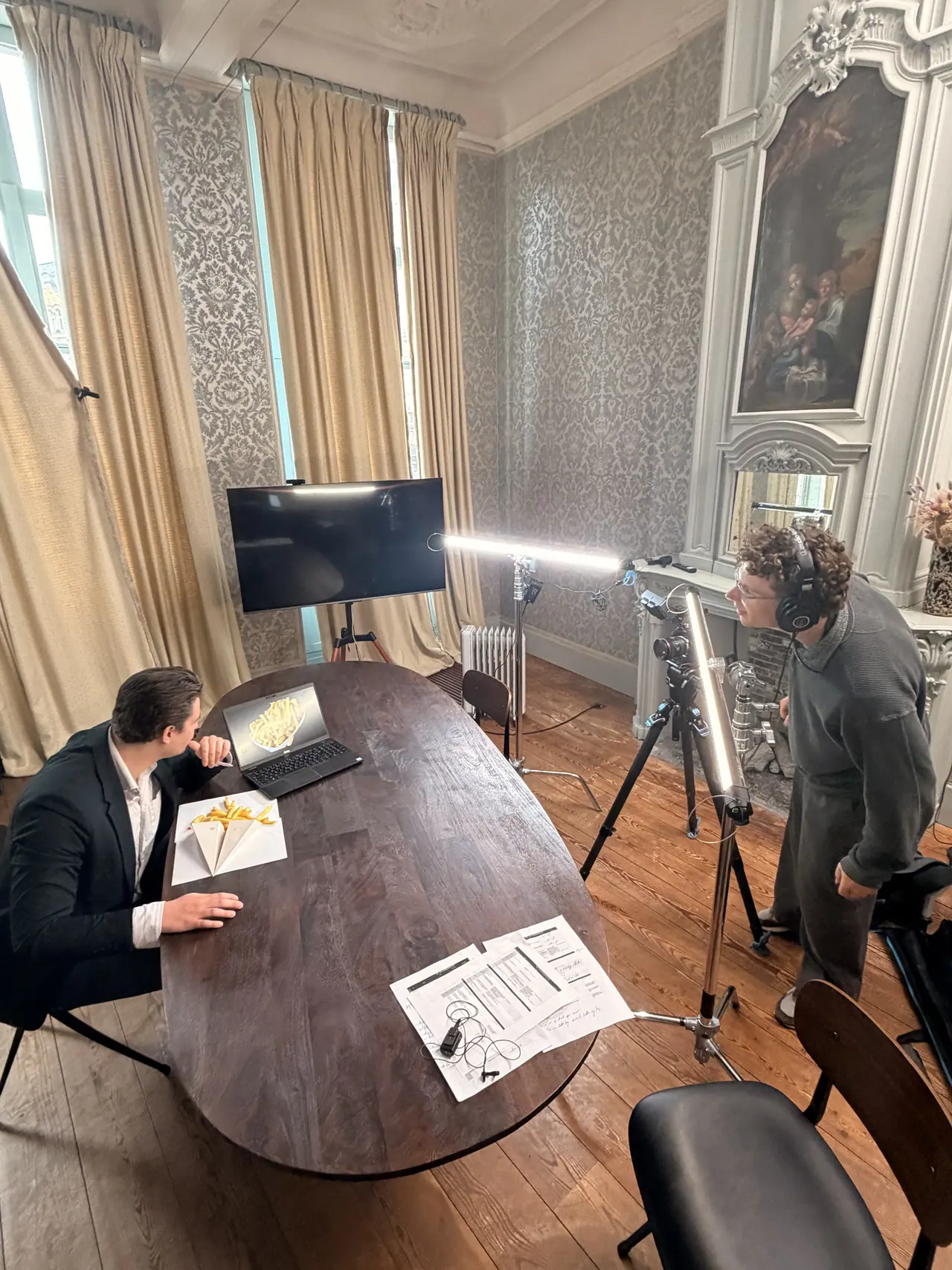
A day of filming, and what you do with it
Writing costs mainly time: a conversation with a client and an hour for the script. The footage costs more. A phone reel can work, but a shoot day with camera, light and sound gives you material for months; day rates, editing and reel packages in euros are in our guide to corporate video cost. If you want stories made and posted every month, compare the packages in social media management pricing. Measure the return in enquiries and shorter sales calls, not in likes, and plan a quarter of stories ahead in a content calendar.
Before the first shoot
What are the steps of storytelling in marketing?
The simplest form has four: setting, problem, turn and new situation. Freytag described five parts for the stage in 1863 and Campbell the hero's journey in 1949. For a reel or a post, four steps are enough.
What is an example of storytelling for a small business?
A tiler shows in 45 seconds how a 78-year-old could no longer step over her bath edge, how a walk-in shower went in within three days, and how she now walks in on her own. The product appears only at the turn.
Is storytelling the same as a company video?
No. A company video is a format; storytelling is a way of telling. A company video without a story is a tour; a three-line post can be a story.
Who should be the hero of a brand story?
Your client, almost always. When the company is the hero, the buyer has nobody to identify with. Put yourself in the role of the expert who makes the turn possible.