On this page
Order to invoice in one system
A TMS, a transport management system, brings orders, trips, drivers, vehicles and invoicing together in one system. Where a small haulier works with a whiteboard, an Excel plan and WhatsApp groups, a TMS brings it into one place. The planner sees who drives where, the driver sees the trip on a phone, and accounting gets what was driven.
The word covers two kinds of company. For a haulier, the TMS is the heart of the business. For a shipper, a company that has goods moved, it is the software to choose carriers and follow shipments. This page is mainly about the first kind.
From a board on the wall to an app on the road
Transport planning was paperwork for a long time: trip sheets, consignment notes and a planning board on the wall. PCs brought the first planning programs, smartphones the driver apps, and the cloud systems that connect office and road in real time. Today a TMS also handles rules specific to transport: driving and rest times, documents that expire, and in Belgium since 2026 invoices that leave as UBL over the Peppol network.
Seven modules, and which you really need
The core is always the same: take in orders, plan them on drivers and vehicles, run and track the trip, invoice. Around it sit modules that differ per company: fleet management with inspections and insurance, fuel, staff and leave, a driver app, and links to accounting or to customers' systems.
One trip through the system, and what sits beside it
One trip through a TMS
- 01OrderA shipper books a transport: pickup, delivery, time window.
- 02PlanningThe planning board links order, driver, tractor and trailer.
- 03TripThe driver sees the trip and reports on the phone.
- 04TrackingThe office sees where each trip stands and what goes wrong.
Next to a TMS
What is on the road
Trips, planning, drivers, vehicles, transport invoices.
What is in the warehouse
Locations, stock, picking and loading.
The whole company
Accounting, purchasing, sales, staff.
A TMS does not have to do everything: it has to do planning and trips well and talk to what you already have.
Next to an ERP and a WMS
| What | TMS | WMS | ERP |
|---|---|---|---|
| What it is about | What is on the road | What is in the warehouse | The whole company |
| Typical users | Planners, drivers, dispatch | Warehouse staff, stock control | Accounting, purchasing, sales |
| Core screen | Planning board | Locations and orders to pick | Ledger and orders |
| Sample question | Who drives the night route to Antwerp tomorrow? | Where is pallet 412? | Which invoices are open? |
Many small transport companies need no separate ERP: their TMS invoices and gives the accountant what they need. The difference between business systems is laid out in CRM vs ERP.
Thirty drivers and a weekly planning board
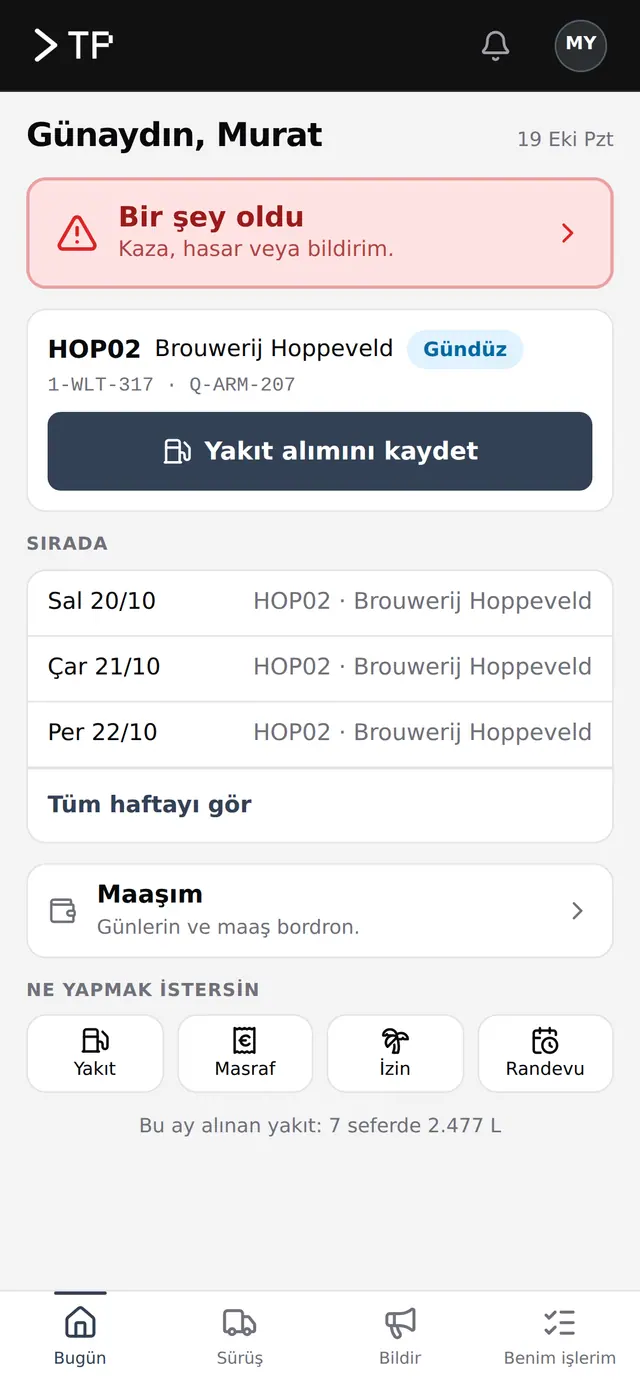
DA Logistics is a Belgian haulier with about thirty drivers and 34 vehicles. Planning runs on a weekly board with day and night routes, temporary routes and conflicts the system flags itself. Drivers use an app in Dutch, English or Turkish: requesting leave, sending receipts, reporting a truck problem. The office sees five queues of what needs attention. On top of regular TMS work runs fuel under Belgium's Kader B scheme, to the litre, something no standard package handled that way. In early August 2026 it held 1,182 fuel entries and 668 trips. Zuco Logistics runs on the same core, with its own profile and fuel model.
Rent per vehicle or have one built
A standard package is paid per user or per vehicle per month; it starts fast, but you work the way the package wants. A custom TMS costs more to build and little per month, and follows your own way of working, with only the modules you use. Build vs buy software sets the two side by side, and custom software shows how we build. Always count over three to five years, and add the hours the planning board and app save each week: that is your ROI.
Across borders: tachographs, CMR and languages
Hauliers that cross borders need a TMS that handles several languages for drivers, cross-border documents, tolls and fuel in more than one country. A driver app in the driver's own language cuts errors on the road; at DA Logistics drivers pick Dutch, English or Turkish themselves.
Choosing: what to check first
- Does planning work the way you plan: per route, per trip or per order?
- Do drivers get an app they understand in their own language?
- Does it track inspections, licences and documents that expire?
- Can it invoice over Peppol, or talk to your accounting package?
- How fast do you get a change when your way of working changes?
Choose a standard package if you mostly plan and invoice like any other haulier, with a common accounting package beside it.
Choose a build if your own rules drive the work: fuel stock under a customs regime, routes that change every week, a driver app in your drivers' languages, or links with customers who run their own systems.
Choose a mix if a package covers 80 percent: connect it to a small module of your own for what is missing, instead of rebuilding everything.
What hauliers ask us
What is the difference between a TMS and an ERP?
A TMS is about transport: orders, planning, trips, drivers and vehicles. An ERP covers the whole company: accounting, purchasing, sales and staff. A haulier mainly needs a TMS that talks to accounting.
From how many vehicles do you need a TMS?
There is no fixed line. Once planning in Excel and WhatsApp causes mistakes, or a planner spends the day retyping, a TMS pays for itself. With five to ten vehicles that often happens already.
What is a TMS for a shipper?
For a company that has goods moved, a TMS is the software to choose carriers, compare rates and follow shipments. It does not drive; it directs who drives.
Can a custom TMS talk to my accounting?
Yes. Invoices can leave over Peppol, or you build an export for your accountant. At DA Logistics the platform produces a bundle for the accountant.