On this page
CRM vs ERP comes down to the question you ask most often. If it is about customers and sales, such as who spoke to this client last week or which deals should close this quarter, you need a CRM. If it is about what moves through your company, such as what is in stock, which orders ship tomorrow or what a job really cost, you need an ERP. Many companies end up needing both, and then the real question is how well the two talk to each other. The terms themselves are in the glossary: CRM and ERP.
The difference in two sentences
A CRM (customer relationship management) records what happens before the sale: contacts, conversations, quotes and the pipeline of deals. An ERP (enterprise resource planning) records what happens after it: orders, stock, purchasing, planning, invoicing and usually the bookkeeping. What each costs is in CRM cost per month and ERP cost.
The CRM stops where the customer signs. That is where the ERP starts, and that hand-over, the signed quote that becomes an order, is where two separate systems cause the most friction.
What the difference means in a company of ten to fifty people
In a small company the two worlds overlap. The founder calls the customer, writes the quote and then checks whether the materials are in. That is why the choice can feel artificial. Three questions make it concrete:
- Who works in it every day?Sales people and account managers live in a CRM. Warehouse, planning and finance live in an ERP. If most users are in sales, start with the CRM.
- Where does it go wrong today?Forgotten follow-ups and quotes nobody chases point to a CRM. Stock-outs, double deliveries and late invoices point to an ERP.
- What does your accountant need?An ERP issues your invoices, and in more and more countries those have to be e-invoices. Belgium, for one, has required structured e-invoices between businesses since 1 January 2026, in practice over the Peppol network. If you sell into such a market, check that the system sends them itself or through a connector.
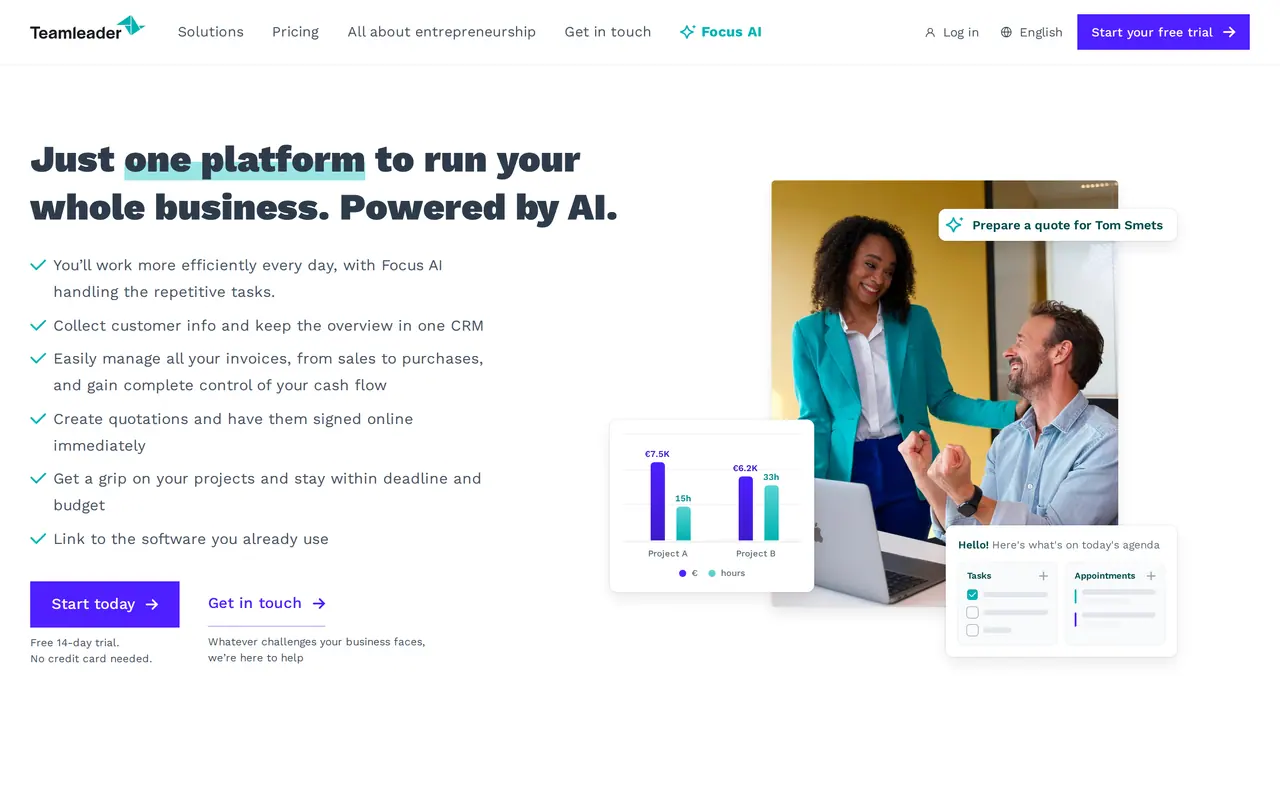
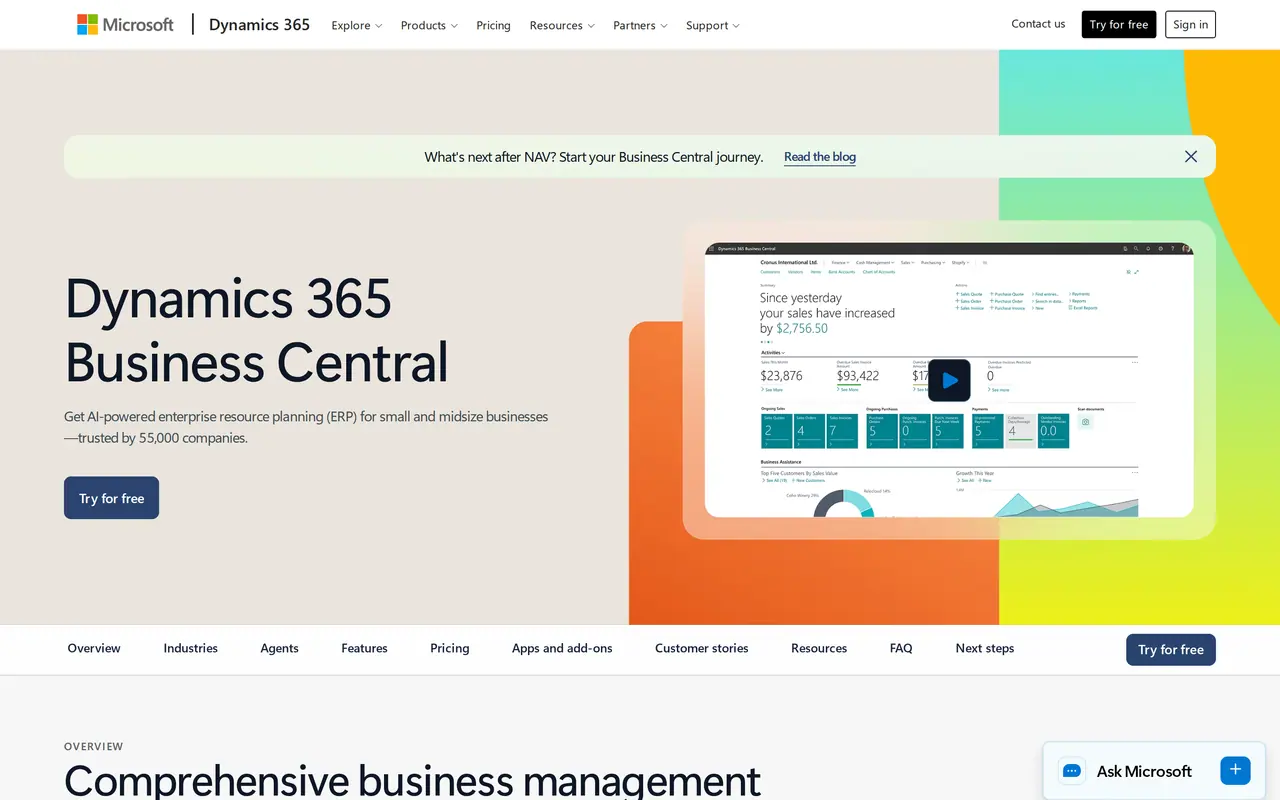
The packages follow the same line. Pipedrive, HubSpot and Teamleader Focus are CRMs; Teamleader, built in Ghent and sold in Belgium, the Netherlands and Germany, runs on to the invoice, with customer, quote, project and invoice in one line, but without stock. Exact Online and Microsoft Dynamics 365 Business Central are ERPs built around the accounts. Odoo has an app for both on one database.
When one tailored platform replaces both
Sometimes your work fits neither box. A haulier gets little from a pipeline of quotes and a lot from a weekly planning board, drivers who see their trips on their phone, and fuel records that match to the litre for customs. We built that platform for DA Logistics, a Belgian transport company: planning, fleet, staff and fuel under Belgium's Kader B excise rules in one system, used every day by about thirty drivers with 34 vehicles. A CRM and an ERP would each have covered part of it, with a spreadsheet in between. The full story is on the DA Logistics case.
For Business Centrum, a payroll and HR office in Ghent, the work was about files rather than orders: employers, employees, work permits, meal and eco vouchers, documents and a portal for their own clients. All of it lived in Excel. We built them their own management platform to replace that spreadsheet, shaped around exactly those files: see the Business Centrum platform.
A tailored build is not a reflex. A standard package is cheaper as long as your work looks like that of thousands of other companies. It pays off when your process is your edge, when customers or staff need to work in the system themselves, or when you are tying three tools and a spreadsheet together. Then start small, around the task that costs you the most hours. That is what we do as a custom software team from Ghent, Belgium, for companies anywhere in Europe.
Seven questions, two systems
Who spoke to this customer last week?
CRMWhich deals should close this quarter?
CRMWho follows up on yesterday's demo request?
CRMHow many units are left in the warehouse?
ERPWhich orders ship tomorrow, and from where?
ERPWhat was the real margin on this job?
ERPIs this customer about to renew while an invoice is overdue?Both
CRMERP
One tailored platformAt DA Logistics, a Belgian haulier, the planning board, fleet, staff and fuel records sit in one system. The question picks the screen, not the package.
The last question is the hard one: either your CRM and ERP talk to each other, or someone searches two systems.
A CRM and an ERP on the same points
- The question it answers
- CRMWho is my customer, what did we discuss and what do I need to follow up?
- ERPWhat did we deliver, what is in stock and what did it earn?
- Who works in it
- CRMSales people, account managers, the founder
- ERPPlanning, warehouse, purchasing, finance
- Where it stops
- CRMAt the signed quote
- ERPStarts at the order and runs to the paid invoice
- Examples
- CRMPipedrive, HubSpot, Teamleader Focus, the CRM in Odoo
- ERPMicrosoft Dynamics 365 Business Central, Exact Online, Odoo
- Price
- CRMPipedrive Lite 14 euro per licence per month billed yearly, excl. VAT; HubSpot has free CRM tools for two users
- ERPBusiness Central Essentials 69.30 euro per user per month billed yearly, excl. VAT
- Set-up
- CRMOften days: fields, pipeline stages, a link to your mailbox
- ERPOften weeks or months: products, stock, user rights and the accounts all have to be right
A CRM helps you sell more, an ERP helps you deliver and invoice correctly. If you need both, pick a package that has both or connect them, and look at a tailored build only when neither knows your work.
Where to start, by type of business
| Type of business | Where it usually goes wrong | Start with |
|---|---|---|
| Service business, consultancy | Quotes nobody follows up, hours not invoiced | A CRM with quotes and invoices, such as Teamleader |
| Installer, contractor | Job sheets, planning, materials per site | A construction package or an own planning tool |
| Wholesaler | Stock, purchasing, deliveries, prices per customer | An ERP with stock, such as Exact Online or Odoo |
| Online shop | Orders, stock, shipping, returns | Your shop platform plus an ERP or stock tool |
| Transport and logistics | Planning, trips, fleet, fuel | Often neither, but a planning platform |
| Office with case files | Documents, deadlines, clients who email everything | A case management platform with a client portal |
A haulier's options are on transport software, an office that wants clients to log in on client portal. A service business outgrowing Teamleader reads Teamleader alternatives.
What CRM and ERP cost for ten people
Our own worked example with October 2026 prices, billed yearly, before VAT and without setup. Teamleader charges 25 euro per user a month for SMART, and half that from the sixth user.
| Package | Kind | Per month | Per year |
|---|---|---|---|
| Pipedrive Lite | CRM | 140 euro | 1,680 euro |
| Teamleader Focus SMART | CRM with quotes and invoices | 187.50 euro | 2,250 euro |
| Odoo Standard, year one | CRM and ERP | 199 euro | 2,388 euro |
| Business Central Essentials | ERP | 693 euro | 8,316 euro |
HubSpot is left out: its free CRM tools cover two users, so a team of ten pays per seat anyway. The licence is rarely the biggest line of an ERP: setting up stock, rights, products and accounting takes weeks. What Odoo costs with implementation is in Odoo pricing; when something else fits better, in Odoo alternatives. Belgian businesses must also send structured e-invoices since 2026; see e-invoicing in Belgium.
Short answers on CRM and ERP
Can a CRM replace an ERP?
No. A CRM knows your customers and sales, not your stock, purchasing or accounts. Some CRMs do quotes and invoices, which can be enough for a service business without stock.
Which comes first, CRM or ERP?
The one for the place where you lose money today. If deals slip away, start with a CRM. If deliveries, stock or invoices go wrong, start with an ERP.
Does Odoo have a CRM and an ERP?
Yes. Odoo has a CRM app next to apps for sales, inventory, purchasing and accounting, all on the same data. The licence is per user; the implementation is often the larger bill.
Is accounting software an ERP?
Not quite. Accounting software handles invoices, VAT and the annual accounts. An ERP adds orders, stock and planning, and either includes the accounts or connects to them.