On this page
Developer rates by country follow labour costs. In 2024 an employer in the EU paid on average 46.30 euros for an hour of work in information and communication, the sector where software developers sit: from about 22 euros in Bulgaria and Hungary and 26 euros in Poland and Portugal to 57 to 62 euros in Germany, France, the Netherlands, Belgium, Sweden, Austria and Denmark, and 70 euros in Ireland. Senior freelancers charge roughly 40 to 85 dollars an hour in Eastern Europe, 70 to 140 dollars in Western Europe and the UK, and 95 to 150 dollars in the United States.
This guide puts the three ways of buying developer time side by side, per country: employing someone, hiring a freelancer, and buying from an agency. It uses one neutral source for cost, Eurostat, read on 24 October 2026, and public surveys for rates, each with its date. It is a companion to our guide on web developer hourly rates, which covers website work in six markets; this one covers software and platforms across Europe. UK contract day rates are in UK developer day rates.
What an hour of IT work costs an employer
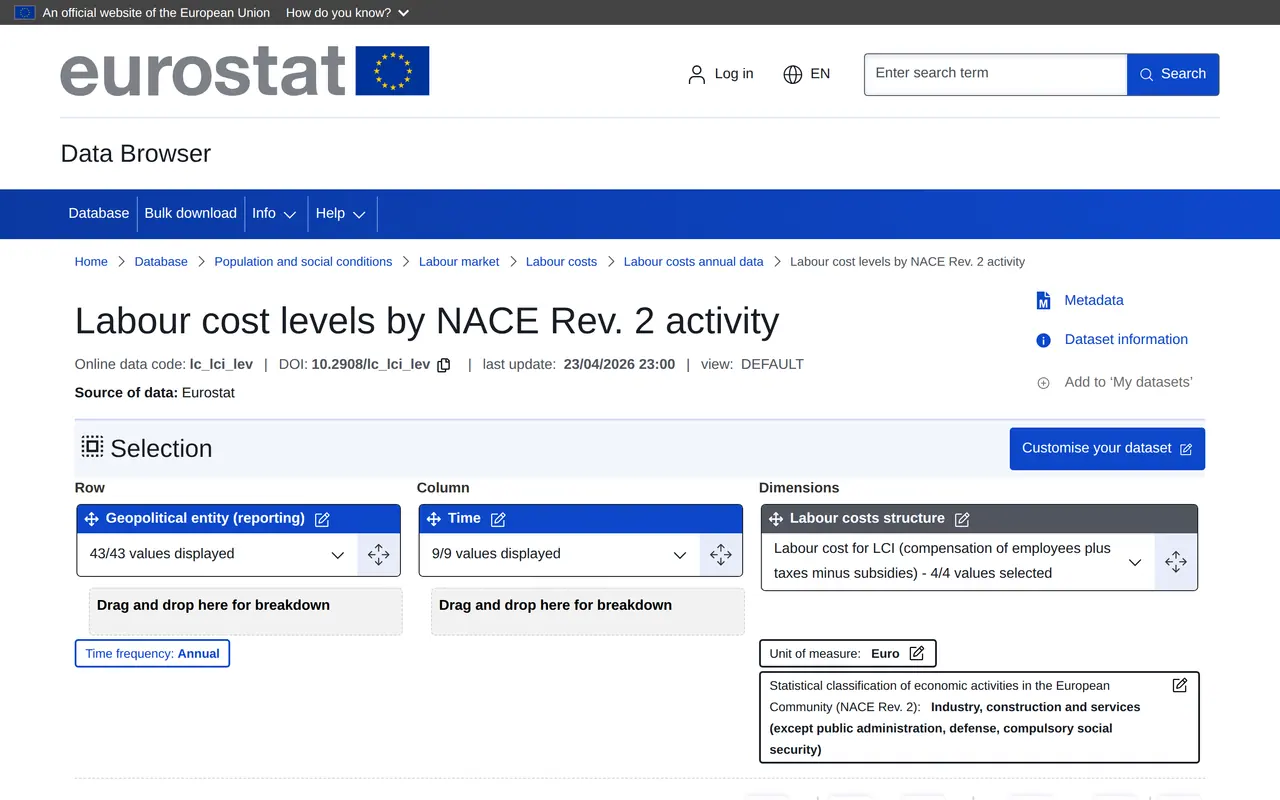
Eurostat publishes what employers pay per hour actually worked, wages plus social charges, per country and per sector. For the information and communication sector:
| Country | IT labour cost per hour, 2024 | 2025, where published | Whole economy, 2025 |
|---|---|---|---|
| Ireland | €70.10 | €71.70 | €44.20 |
| Denmark | €61.50 | €63.50 | €51.70 |
| Luxembourg | €61.00 | €63.10 | €56.80 |
| Austria | €59.00 | €61.60 | €46.30 |
| Belgium | €58.70 | not yet published | €48.20 (2024) |
| Sweden | €58.30 | €62.50 | €43.10 |
| Netherlands | €58.00 | not yet published | €47.90 |
| Germany | €57.40 | €58.50 | €45.00 |
| France | €57.20 | €59.20 | €44.30 |
| EU average | €46.30 | €48.20 | €34.90 |
| Italy | €37.40 | €38.40 | €32.00 |
| Spain | €33.30 | €34.80 | €26.40 |
| Czechia | €31.90 | €34.90 | €19.80 |
| Portugal | €26.60 | €28.20 | €19.40 |
| Poland | €26.30 | €29.30 | €19.10 |
| Romania | €23.70 | €26.00 | €13.60 |
| Hungary | €22.50 | €24.40 | €15.20 |
| Bulgaria | €21.70 | €24.00 | €12.00 |
Three things stand out. IT work costs more than the average job everywhere, from a fifth more in Belgium to almost double in Romania. The order between countries is stable from year to year. And Belgium, where we are, is among the most expensive: above Germany and France, at more than twice the hourly cost of Poland or Portugal. Anyone selling you a Belgian team on price per hour is not telling you the whole story.
What an hour of IT work costs an employer, country by country
Ireland
€70.10Denmark
€61.50Luxembourg
€61.00Austria
€59.00Belgium
€58.70Sweden
€58.30Netherlands
€58.00Germany
€57.40France
€57.20Finland
€48.60EU average
€46.30Italy
€37.40Spain
€33.30Czechia
€31.90Portugal
€26.60Poland
€26.30Romania
€23.70Hungary
€22.50Bulgaria
€21.70
Euros per hour worked in information and communication, wages plus employer charges, 2024.
Belgium sits with the most expensive countries; Poland, Portugal and Romania cost less than half per hour.
Employer cost, not the rate a freelancer or agency charges. 2024 is the latest year with figures for every country shown.
What senior freelancers charge
Freelance rates are less neatly measured than labour costs. The most recent cross-country survey we found, published by the freelance platform Arc in May 2026 from 5,302 freelancers and described by Arc itself as directional, gives these ranges for senior developers:
| Market | Senior freelance developer, per hour |
|---|---|
| United States | 95 to 150 dollars |
| Germany | 85 to 140 dollars |
| Netherlands | 80 to 125 dollars |
| United Kingdom | 78 to 125 dollars |
| Denmark | 75 to 120 dollars |
| Sweden | 72 to 118 dollars |
| Eastern Europe | 40 to 85 dollars |
For Germany, Austria and Switzerland together, the freelancermap survey puts the average hourly rate of IT freelancers at 103 euros in 2026. In the UK the market thinks in day rates: a median of 525 pounds for a contract software developer in the six months to 24 October 2026.
A freelance rate buys the hours of one person. Review, testing, holidays, a second pair of eyes on the code and replacing them when they leave stay with you.
What agencies charge
Agency rates are the least transparent. Directories such as Clutch show the most common hourly band per country: 100 to 149 dollars for web development agencies in the United States, 50 to 99 dollars for many agencies in the UK and in Belgium, with a long tail above. Belgian agencies quote 50 to 150 euros an hour, most between 45 and 90 for website work and higher for software.
An agency hour costs more than an employee hour because it carries more: project management, design, testing, a team that covers holidays and departures, and the risk of the estimate. Agencies in low-cost countries charge less per hour for the same reasons they pay less per hour.
The gap is closing, slowly
Labour costs in IT rise faster in Central and Eastern Europe than in the west. Between 2024 and 2025, the hourly cost of IT work grew by more than 9 percent in Poland, Bulgaria, Romania and Czechia, against 1.9 to 3.5 percent in Germany, Ireland, Denmark and France:
| Country | IT labour cost per hour, 2024 | 2025 | Change |
|---|---|---|---|
| Poland | €26.30 | €29.30 | +11.4 percent |
| Bulgaria | €21.70 | €24.00 | +10.6 percent |
| Romania | €23.70 | €26.00 | +9.7 percent |
| Czechia | €31.90 | €34.90 | +9.4 percent |
| Hungary | €22.50 | €24.40 | +8.4 percent |
| Sweden | €58.30 | €62.50 | +7.2 percent |
| Portugal | €26.60 | €28.20 | +6.0 percent |
| EU average | €46.30 | €48.20 | +4.1 percent |
| Spain | €33.30 | €34.80 | +4.5 percent |
| Austria | €59.00 | €61.60 | +4.4 percent |
| France | €57.20 | €59.20 | +3.5 percent |
| Denmark | €61.50 | €63.50 | +3.3 percent |
| Italy | €37.40 | €38.40 | +2.7 percent |
| Ireland | €70.10 | €71.70 | +2.3 percent |
| Germany | €57.40 | €58.50 | +1.9 percent |
At that pace the difference shrinks by a few percent a year, not by half in a decade: an hour of IT work in Poland still cost about half of an hour in Germany in 2025. Belgium and the Netherlands had not published 2025 figures for the sector when we checked. Two more things move the price you pay: exchange rates, for countries outside the euro such as Poland, Czechia, Hungary and Romania, and demand for specific skills, which can push rates for a scarce stack far above the national average.
Salary or rate: what a buyer actually compares
An employer pays labour cost per hour worked; a freelancer or agency charges a rate per hour billed. The two differ by more than margin: a freelancer bills only part of the year's hours and carries their own holidays, equipment and gaps between clients, and an agency adds management, testing and the risk of the estimate. A rate two or three times the labour cost of the same country is normal, not a sign of overcharging. Compare rates with rates, and labour cost with labour cost.
Turning rates into a budget
A rate only becomes a price once you know the hours. A rough way to compare countries for the same piece of work:
| Way of buying | Example: 1,000 hours of senior development | What is not in the number |
|---|---|---|
| Employ in Belgium, at IT labour cost | about 58,700 euros | recruiting, equipment, management, the months before and after |
| Employ in Poland, at IT labour cost | about 26,300 euros | the same, plus distance and a second language |
| Senior freelancer in the Netherlands | 80,000 to 125,000 dollars | review, testing, holidays, replacement |
| Senior freelancer in Eastern Europe | 40,000 to 85,000 dollars | the same, often one time zone further |
| Agency in Belgium, market range | 50,000 to 150,000 euros | your own time as product owner |
The hours are the uncertain part. Two suppliers can quote the same rate and a very different number of hours for the same module, and the cheaper rate often comes with more hours. That is why many buyers ask for a fixed price per module instead, and compare those. What custom software costs per type of project is in custom software development cost.
Choosing on more than the rate
- Choose the lowest rate ifthe work is well specified, a strong product owner on your side writes the backlog, and the team can work mostly in writing.
- Choose a team in your own time zone and legal system ifthe hard part is understanding your business, the rules your software must apply and the data it must connect.
- Choose a fixed price per module ifyou want the supplier to carry the risk of the estimate and you prefer comparing outcomes to comparing hours.
How Eastern and Western Europe compare on more than cost is in Eastern vs Western Europe developers, and the full country-by-country view in best countries to outsource software development.
Rates by country, answered
How much do software developers cost per hour by country?
Employers pay from about 22 euros an hour for IT work in Bulgaria and Hungary to 57 to 62 euros in Germany, France, the Netherlands, Belgium and the Nordics, and 70 euros in Ireland (Eurostat, 2024). Freelancers and agencies charge more than that cost.
Which country in Europe has the cheapest software developers?
On labour cost, Bulgaria, Hungary and Romania, followed by Poland and Portugal, all around a half or less of the EU average for IT work.
Is Belgium expensive for software development?
Yes. An hour of IT work cost an employer 58.70 euros in Belgium in 2024, above Germany and France and well above the EU average of 46.30 euros.
Why do agency rates differ so much within one country?
Because the hour includes different things: project management, testing, design, a team behind the developer, and the risk of the estimate. Compare the price of the same outcome, not the rate.