On this page
What an accessibility statement is for
An accessibility statement tells visitors how accessible your website is, which standard you aim for, what does not work yet, and how to get help when something fails. For an online shop or booking service sold to EU consumers it is required: the European Accessibility Act asks you to publish how your service meets the accessibility requirements, in your terms and conditions or another place customers can find. In the UK it is required for public sector bodies and good practice for everyone else. In the US no law requires one, but it shows good faith and gives a customer a way to reach you before a lawyer does.
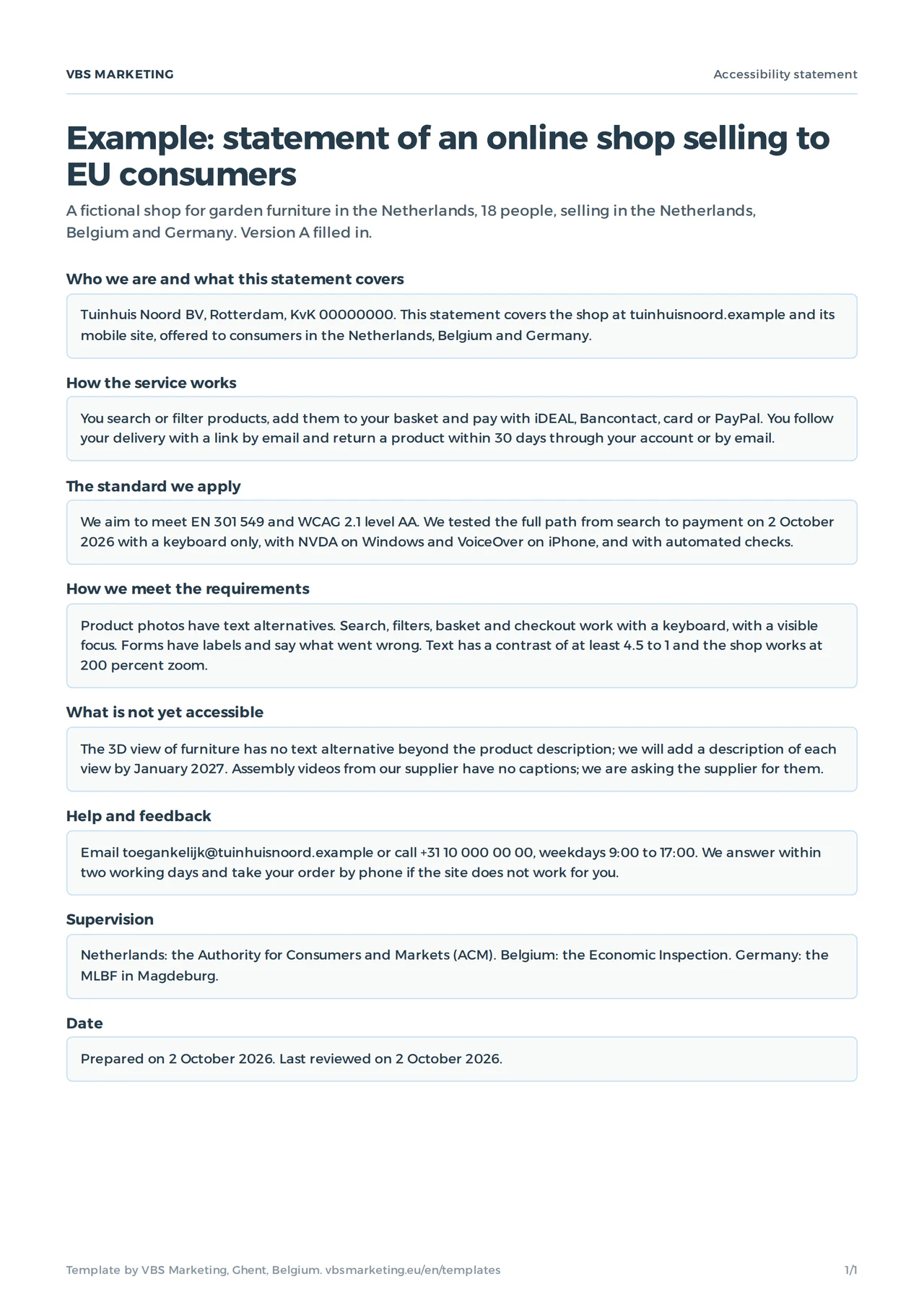
This template holds three versions in one Word file, because most businesses selling online meet more than one regime. Fill in the version for each market, or merge them into one statement that covers all three.
| Market | Required? | What the statement must cover | Where it goes |
|---|---|---|---|
| EU consumers (EAA, since 28 June 2025) | yes, for e-commerce and other covered services | how the service works, how it meets the requirements, the standard | terms and conditions, or a page linked from every page |
| EU countries' own laws | yes, as each country wrote it | the same, plus the national authority | in the language of each market |
| UK public sector | yes, under the 2018 regulations | compliance status, gaps, how to report, enforcement | a page linked from every page |
| UK private business | no, recommended | commitment, gaps, another format on request | a page linked from the footer |
| US business | no, recommended | standard, limitations, assistance | a page linked from the footer |
What each law asks of the site itself is in UK website accessibility law, ADA website compliance and the German Accessibility Act.
What goes into the statement, market by market
How the service works, in plain words
EU, European Accessibility Act: required
UK, private business: helpful
US, ADA: helpful
The standard you aim for
EU, European Accessibility Act: EN 301 549, WCAG 2.1 AA
UK, private business: WCAG 2.2 AA
US, ADA: WCAG 2.1 AA
What does not work yet, and when it will
EU, European Accessibility Act: include it
UK, private business: include it
US, ADA: include it
A contact route that is itself accessible
EU, European Accessibility Act: include it
UK, private business: include it
US, ADA: include it
Another format on request
EU, European Accessibility Act: good practice
UK, private business: part of reasonable adjustments
US, ADA: as an alternative way to the service
The supervising authority
EU, European Accessibility Act: per country you sell in
UK, private business: EHRC, or the advisory service EASS
US, ADA: none to name
The Word file holds a version for each column. Merge them into one statement if you sell in all three markets.
Writing your statement in an afternoon
- Test the main pathOrder or book from start to finish with only a keyboard, then with a screen reader. Note every point where you get stuck.
- Pick your versionsOne per market you sell in. Delete the others from the file, or merge them.
- Describe how the service worksIn plain words: finding, ordering, paying, delivery, returns. The EU version needs this; it helps every reader.
- Be honest about the gapsName what does not work yet, why, and when you fix it. A statement that claims full compliance invites a test.
- Publish and date itIn your terms and on a page linked from every page, in each language you sell in. Review it after every redesign.
The parts that trip people up
- Claiming full complianceFew sites meet every WCAG criterion. A statement that says so is the first thing a complainant tests. Say "we aim to meet" and list what falls short.
- No real contact routeAn email address that nobody reads, or a contact form that is itself inaccessible, defeats the purpose. Give an email address, a phone number and the hours someone answers.
- One language for many marketsA German customer reads the statement in German. Translate it with the rest of the site; see multilingual website development.
- Forgetting third partiesYour payment provider, booking widget and cookie banner are part of the service your customer meets. Name them, and what you do when they fail.
- Never updating itDate it, and review it after every redesign, every new checkout step and every new plugin.
The standard to name
Name the standard you actually test against. For the EU, the harmonised standard EN 301 549 points to WCAG 2.1 level AA for websites. For the UK, WCAG 2.2 level AA is the current benchmark, and what the public sector rules require. For the US, settlements and the Justice Department's 2024 rule for public bodies use WCAG 2.1 level AA. Building to WCAG 2.2 AA covers all three.
Checks before you publish
| Check | Why |
|---|---|
| Every bracketed part filled in or removed | a template left half-filled reads as no statement at all |
| The gaps listed match what you found in testing | a reader can check them in a minute |
| The contact route works with a keyboard and a screen reader | the route is for the people the barriers stop |
| The supervising authority is named for each EU country you sell in | the EAA lets customers complain to it |
| The statement is linked from every page and in your terms | customers must be able to find it |
| The date is today, with a review date | it shows the statement is maintained |
Statement questions
Is an accessibility statement mandatory for an online shop?
For shops selling to EU consumers, yes: the European Accessibility Act asks you to publish how your service meets the requirements, since 28 June 2025. In the UK and the US it is not required for private businesses, but recommended.
Where should the accessibility statement be published?
In your terms and conditions for EU sales, and on a page linked from every page of the site, usually in the footer, in each language you sell in.
Can I say my website is fully accessible?
Only if you tested every page against the full standard. Most statements say which standard they aim for and list the known gaps with a date to fix them.
Is there a Dutch version of this template?
Yes, written for shops in Belgium and the Netherlands under Belgian and Dutch law: the toegankelijkheidsverklaring template on our Dutch site.