On this page
A website brief template gives every agency you talk to the same questions, so you get quotes you can compare. This one holds the twelve questions we ask before we quote, in Word, with the five that move the price most marked with a euro sign. A filled-in example of a B2B software company selling in three countries comes with it as a PDF. Free, no email address needed.
Most companies send agencies a short email and a link to their current site. Each agency fills the gaps with its own assumptions, and three quotes end up describing three different websites. A brief closes those gaps before anyone prices anything. If you are hiring outside your own country, which is often the point of a web development agency in Europe, the brief also replaces the half-day workshop you would otherwise need.
Website brief template or website RFP?
A website RFP is the formal version: it asks agencies for a proposal against fixed criteria and a deadline, often with scoring. A brief comes first and says what you want to reach and what you already have, so an agency can price it. For most company sites the brief is enough. Turn it into your RFP by adding three lines: a budget range, a go-live date and the date you want proposals back.
| Document | Who writes it | When | Enough for |
|---|---|---|---|
| Website brief | you | before you ask for prices | a company site, also multilingual |
| Website RFP | you, sometimes procurement | for a formal selection | larger organisations, public bodies |
| Software requirements | you | when the site becomes a tool | portals, integrations, custom calculators |
| Proposal or quote | the agency | after the brief | price and what is included |
Building a site with a customer portal or integrations into your own systems? Write a software requirements specification next to the brief. Who reads the brief: the agency's project lead, who builds the quote from it, and later the designer and the writer.
The twelve questions, and which ones set the price
| Question | Price | Why it counts |
|---|---|---|
| 1. Your company | what you do differently becomes the message | |
| 2. The goal | leads, sales or trust | |
| 3. Pages | EUR | every page type is design and copy |
| 4. Languages | EUR | each language needs its own copy, terms and URLs |
| 5. Features | EUR | demo booking, calculator, portal, CRM |
| 6. Copy and images | EUR | writing and a shoot take days |
| 7. Current site | EUR | redirects protect your rankings |
| 8. Search | which terms, in which countries | |
| 9. Rules | cookies, privacy, accessibility | |
| 10. After launch | who runs it, who owns it | |
| 11. Budget and timing | a range and a date | |
| 12. Examples | what you like, and what you do not |
The five questions with a euro sign explain most of the gap between two quotes. Languages weigh most for companies selling across borders: a site in three languages is not one site translated twice, but three sites with their own search terms. That is why we treat multilingual website development as its own discipline.
Five answers that make a quote cheaper or dearer
- How many pages, and which kinds: product, features, industries, customer stories
- How many languages, and who writes or translates
- Which features: demo booking, calculator, portal, CRM integration
- Who makes the copy and the images, and whether a shoot is needed
- Whether an old site exists whose URLs must redirect
The example: a software company in three languages
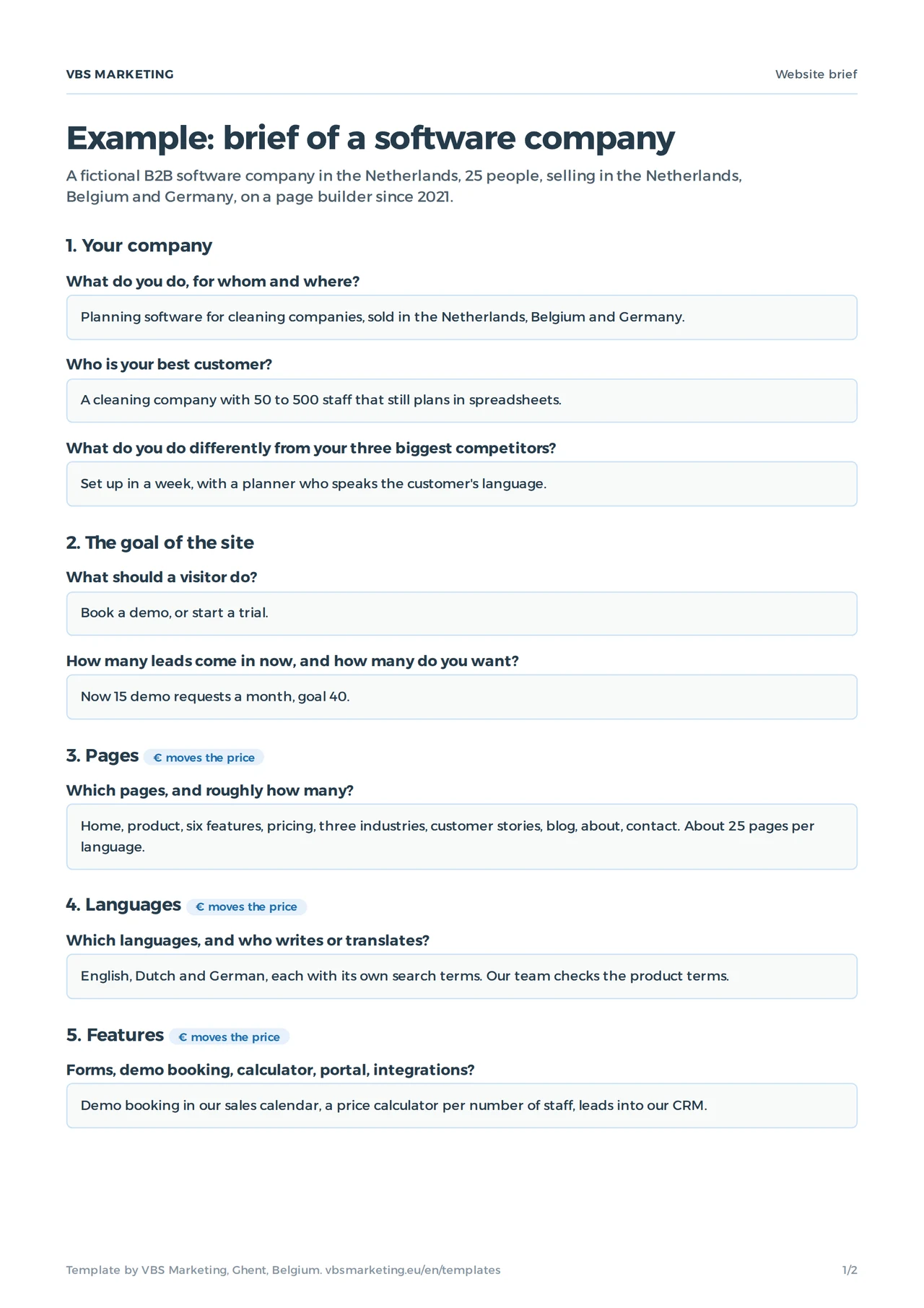
The filled-in example is a fictional B2B software company in the Netherlands with 25 people, selling planning software to cleaning companies in the Netherlands, Belgium and Germany. It runs on a page builder since 2021. Its answers let an agency calculate:
- Pageshome, product, six features, pricing, three industries, customer stories, blog, about and contact, about 25 pages per language.
- LanguagesEnglish, Dutch and German, each with its own search terms; the team checks product terms.
- Featuresdemo booking in the sales calendar, a price calculator per number of staff, leads into the CRM.
- Copy and imagesthe agency writes from interviews; product screenshots with demo data, team photos in the office.
- Current siteevery old URL must redirect, because the blog brings most visitors today.
- BudgetEUR 15,000 to 25,000, live before the spring trade fair.
Languages move the price most here. Three languages at 25 pages is 75 pages of copy, each with its own URL, title and search terms, plus hreflang so Google shows the right one in each country. Want a feel for agency rates before the quotes arrive? Read digital agency cost and web developer hourly rates. How long a build like this takes, see how long it takes to build a website.
Rules your new site has to meet in the EU
Question 9 asks about rules. They are not a footnote: they decide forms, analytics and sometimes the whole structure. If you sell into the EU, these come back on every company site. The table follows Belgian law; most of it rests on EU rules, so it looks much the same elsewhere in the EU.
| Rule | What the site must do | What it means for the brief |
|---|---|---|
| Company details | name, legal form, address, company number, email | a fixed place in the footer or a legal page |
| Cookies | consent for anything not strictly necessary, analytics included | cookieless analytics, or a banner with refuse next to accept |
| Privacy | explain what you do with form data | a privacy policy that matches your forms |
| Accessibility | for services sold to consumers, such as e-commerce | in force since 28 June 2025 |
| Copyright | design, copy and photos belong to their maker | a written transfer in the contract |
The Belgian data protection authority does not exempt analytics cookies from consent and expects a refuse-all button on the same layer as accept-all. Do you need a banner at all? See do I need a cookie banner, and for the policy, do I need a privacy policy.
Who will own the design, copy and photos? Under Belgian law copyright stays with whoever made the work unless it is transferred, and a transfer is proven in writing. Other countries have their own rules, so put it in the contract either way. That is why question 10 asks it now, not when you switch agencies.
Using one brief with three agencies
- Fill it in yourselfAn hour is enough. What you do not know, leave open: that tells an agency something too.
- Send the same one to every agencyThey quote on the same thing, and you compare prices instead of interpretations.
- Watch what they ask backAn agency that asks about your goal or your old URLs has read the brief.
- Put the quotes side by sidePer question with a euro sign: what is in, and what is not.
Which template or tool fits instead
- Choose this website brief ifyou are commissioning or rebuilding a company site and want three quotes you can compare.
- Choose the requirements template ifyour site becomes a working tool, with a portal, bookings or integrations: the software requirements specification template lists requirements with a priority.
- Choose the SEO checklist ifyour site exists and mainly needs to be found: the SEO checklist walks the points, and the SEO checker gives you a first measurement.
- Choose the marketing plan ifyou do not yet know what role the site plays next to ads and social: start with the marketing plan template.
- Choose a site builder ifa simple site will do and you want to build it yourself; read Lovable vs WordPress first.
Mistakes in a website brief
- Describing the design instead of the goal"A big slider on the home page" says nothing about the demo request you want.
- No budgetEvery agency guesses, and you compare three different sites.
- Forgetting the old URLsMoving without redirects costs rankings; read moving a website to a new host.
- Treating languages as translationEach language needs its own search terms, so the English, Dutch and German pages are written, not copied.
- Not asking about ownershipWithout a written transfer, design and copy stay with their maker.
- Too many agenciesThree is enough; with ten, you read none of the proposals properly.
Your brief ready for three agencies
- Download the brief and fill it in within an hour. What you do not know, leave open.
- Look in Search Console for the pages that bring visitors today; they belong in question 7.
- Test your current site with the website speed test and put the result in question 7.
- Write a budget range and a date in question 11.
- Send the same brief to three agencies with a reply date, and compare the proposals per euro question.
What buyers abroad ask us
Should I fill in a budget?
A range helps. Without one an agency guesses, and you get three quotes that each propose something else.
Does it matter that you are in Belgium and we are not?
Less than you might think. Belgium shares a time zone with the Netherlands, Germany and France, and we work in English and Dutch. We meet online, and in person when the project asks for it.
How long should the brief be?
Two pages. Longer briefs tend to describe the design instead of the goal.
Is a brief the same as a website RFP?
Almost. Add a budget range, a go-live date and a reply date, and the brief works as your RFP.