On this page
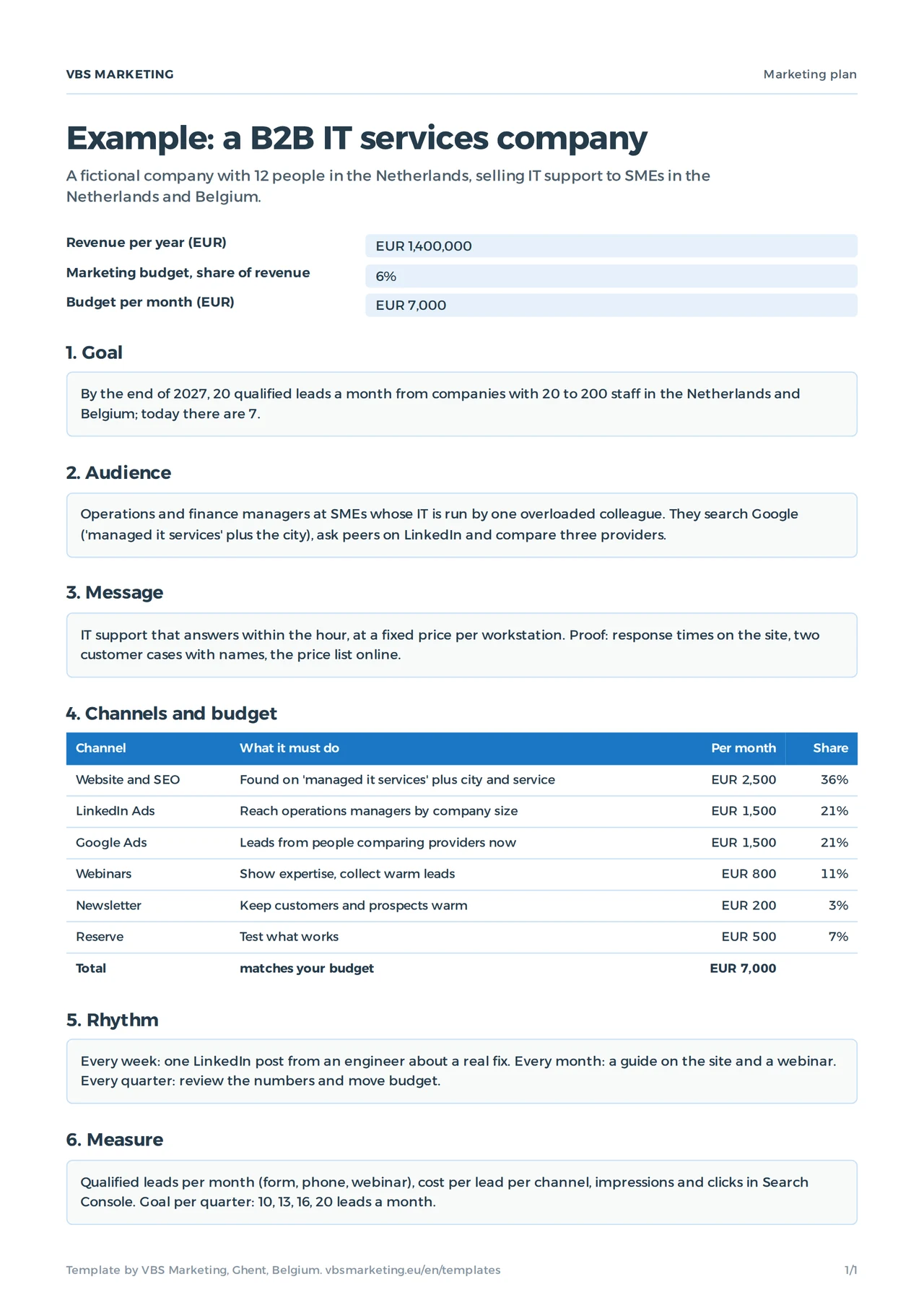
A marketing plan template puts on one page what you want marketing to achieve this year, for whom, with which message, through which channels and on what budget. This one, in Excel and Word, has six parts: goal, audience, message, channels and budget, rhythm, and measurement. Enter your revenue and the share you spend on marketing, and the sheet computes your monthly budget and tells you whether your split over channels is over or under it. A filled-in example of a B2B IT services company sits on the second tab.
Why one page? Because a plan nobody rereads steers nothing. A company with 10 or 100 people does not need a forty-page plan; it needs one sheet that the managing director, the team and any agency put next to the numbers every quarter. If you are weighing outside help, read what a marketing agency does and what it tends to cost in digital agency cost.
The six parts of this marketing plan template
| Part | The question | In the example |
|---|---|---|
| 1. Goal | a number and a date | 20 qualified leads a month by end of 2027 |
| 2. Audience | who buys, where they look | operations and finance managers at SMEs |
| 3. Message | your promise and the proof | answer within the hour, fixed price |
| 4. Channels and budget | what each channel must do | six channels, EUR 7,000 a month |
| 5. Rhythm | what happens weekly, monthly, quarterly | a post a week, a guide and a webinar a month |
| 6. Measure | three numbers a quarter | leads, cost per lead, Search Console |
Start with the goal, not the channels. "Be more active on LinkedIn" is a means; "20 qualified leads a month" can be checked. The audience comes next and decides the channels: buyers who compare three providers online before they call are found in search, so that is where the biggest share goes. A message without proof is a slogan; put the proof next to it.
How much budget goes into the plan
There is no fixed percentage. A useful anchor is the spring 2026 edition of The CMO Survey, which asks marketing leaders what share of revenue they spend on marketing, split by type of business.
| Type of business | Marketing as share of revenue |
|---|---|
| B2C, products | 12.0 percent |
| B2C, services | 7.2 percent |
| B2B, products | 7.0 percent |
| B2B, services | 10.1 percent |
A company still finding its first customers in a new market often spends more; one that grows through referrals, less. The template lets you set your own share. Not sure? Run your numbers through the marketing budget calculator first. What each channel costs per month is in Google Ads cost, Facebook ads cost, SEO cost and social media management pricing.
How to fill in the marketing plan
- A goal with a number and a dateNot 'more leads' but '20 qualified leads a month by the end of 2027'. A goal without a number cannot be checked.
- One audience, not everyoneWho buys, which problem do you solve, and where do they look for a solution: Google, peers, LinkedIn?
- Your message in one sentenceWhat you promise, and the proof that it holds: response times, customer cases, prices on the site.
- Channels and budgetEnter your revenue and the share you spend on marketing. The sheet computes the monthly budget and says whether your split is over or under it.
- A rhythm and three numbersWhat happens every week, month and quarter, and which three numbers you check every quarter to steer.
The B2B example in the template
The second tab is a fictional IT services company with 12 people in the Netherlands, selling IT support to SMEs in the Netherlands and Belgium. Today 7 qualified leads come in a month; the goal is 20 by the end of 2027. The audience is operations and finance managers at companies whose IT is run by one overloaded colleague. They search Google, ask peers on LinkedIn and compare three providers. The message: IT support that answers within the hour, at a fixed price per workstation.
| Channel | What it must do | Per month | Share |
|---|---|---|---|
| Website and SEO | found on managed IT services plus city | EUR 2,500 | 36% |
| LinkedIn Ads | reach operations managers by company size | EUR 1,500 | 21% |
| Google Ads | leads from people comparing now | EUR 1,500 | 21% |
| Webinars | show expertise, collect warm leads | EUR 800 | 11% |
| Newsletter | keep customers and prospects warm | EUR 200 | 3% |
| Reserve | test what works | EUR 500 | 7% |
Why this split? Buyers compare providers online before they call, so the website and SEO get the biggest share. LinkedIn Ads reach operations managers by company size, which search cannot do. Google Ads catch people comparing right now; the Google Ads budget calculator tells you what that line buys. Webinars turn cold readers into warm leads. The reserve of 7 percent is room to test a new channel without breaking the rest.
The rhythm keeps the plan alive: every week a LinkedIn post from an engineer about a real fix, every month a guide on the site and a webinar, every quarter a review of the numbers and the budget. Three numbers are measured: qualified leads a month from form, phone and webinar, cost per lead per channel, and impressions and clicks in Search Console. The goal rises per quarter: 10, 13, 16 and 20 leads a month.
Selling in more than one country? Copy the plan tab per market: channels, budgets, languages and public holidays differ, and a plan that averages two markets fits neither.
Your quarterly plan review
- Does the goal still carry a number and a date?
- Does the audience match the customers who actually came in this quarter?
- Do the channels add up to your budget, and does each earn its share?
- Was the reserve used to test something new?
- Were the three numbers measured the same way as last quarter?
- Did every address on your mailing list give consent?
- Which channel gets more next quarter, and which gets less?
EU rules that touch your plan
Some channels come with rules. Miss them and you plan a campaign that is not allowed or cannot be measured. The table follows Belgian law, which rests on EU rules; check the details in each country you market into.
| Rule | Channel | What goes in the plan |
|---|---|---|
| Advertising by email needs prior consent | newsletter, mailings | how you collect and keep sign-ups |
| Unsubscribing must be easy | newsletter, mailings | an unsubscribe link in every mail |
| Cookies and pixels need consent, analytics too | website, ads | cookieless analytics, or a banner with refuse |
| Comparative advertising is allowed on conditions | ads, website | only fair, verifiable comparisons |
In Belgium, whoever sends advertising by email has to be able to prove the recipient asked for it, so a stack of trade fair business cards is not a newsletter list. On the website, a pixel or an analytics cookie may only run after consent, and the Belgian data protection authority expects a refuse-all button next to accept-all. See do I need a cookie banner.
Comparative advertising is allowed in Belgium if it does not mislead, compares services that meet the same need, compares objectively on material, verifiable features such as price, and does not denigrate the competitor. "Faster response than provider X" is fine if it is true and you can prove it.
Which template or tool fits your question
- Choose this marketing plan template ifyou want to set out what you do for the first time, or your budget and channels no longer match.
- Choose the content calendar ifthe plan exists and you need to know what goes out each week: the content calendar template turns part 5 into dates.
- Choose the social media plan ifsocial takes a large share of the budget: the social media plan template works out that one channel.
- Choose the SEO checklist ifthe website is your main channel: the SEO checklist lists what the site needs. Being cited by AI search is a channel of its own; read SEO vs GEO.
- Choose the website brief ifthe plan says the site must improve first: give agencies the same questions with the website brief template.
- Choose the ROAS calculator ifyou want to know whether a channel pays for itself: the ROAS calculator sets revenue against cost.
Mistakes in a marketing plan
- A goal without a number"More brand awareness" cannot be checked in any quarter.
- Everyone as the audienceThen no message really fits, and every channel wins a little.
- Choosing channels because a competitor is thereChoose them because your buyers look there; what competitors really do, you measure in an hour with the competitor analysis template.
- No reserveWithout room to test, last year's plan becomes next year's plan.
- A mailing list without consentIt costs more than it brings.
- Never rereading itPut the quarterly review in your calendar now.
Your plan on paper in one afternoon
- Write your goal in one sentence with a number and a date.
- Pick your three best customers from your customer list and describe them as your audience.
- Enter your revenue and share, and split the budget over six channels at most.
- Choose three numbers and note where each comes from: your form, Search Console, your CRM.
- Book the first quarterly review now, and reread the plan with the numbers next to it.
What managers ask about a one-page plan
How long should a marketing plan be?
One page is enough for most small and mid-sized companies. What does not fit on a page, nobody rereads, and a plan nobody rereads steers nothing.
Do I need to give my email address to download it?
No. You download it straight away, in Excel or Word, and may change and share it.
Does it work in Google Sheets?
Yes. Open the Excel file in Google Sheets; the formulas for the monthly budget and the split keep working.
How often do I update the plan?
Every quarter. Check your three numbers and move budget from what does not deliver to what does.