Industries: dental practices
Dental practice software for UK practices, built around the system you already run
2013
Your practice management system keeps the clinical record and sends the FP17s. We build what it leaves to the front desk: booking that only offers real free slots, a rota for every surgery and domiciliary visit, treatment plans patients can follow, and an inbox sorted before 8am.
A dental practice runs on the front desk and the diary
Dental practice software in the UK usually means one big package: Dentally, SOE, R4 or similar. It holds the charts, the clinical notes, the NHS claims and the private invoices, and you should keep it. What it rarely fixes is the morning: phones ringing from 8am, three surgeries and a hygienist in one diary, a care home visit that collides with a crown fit, and a pile of messages that arrived overnight.
This page sets out what we would build around that system for an NHS, mixed or fully private practice in England, need by need and by practice size, with the rules that come with it: GDC standards and advertising guidance, CQC registration, UK GDPR special category data and the ICO fee. Everything you see is an example with made-up names.
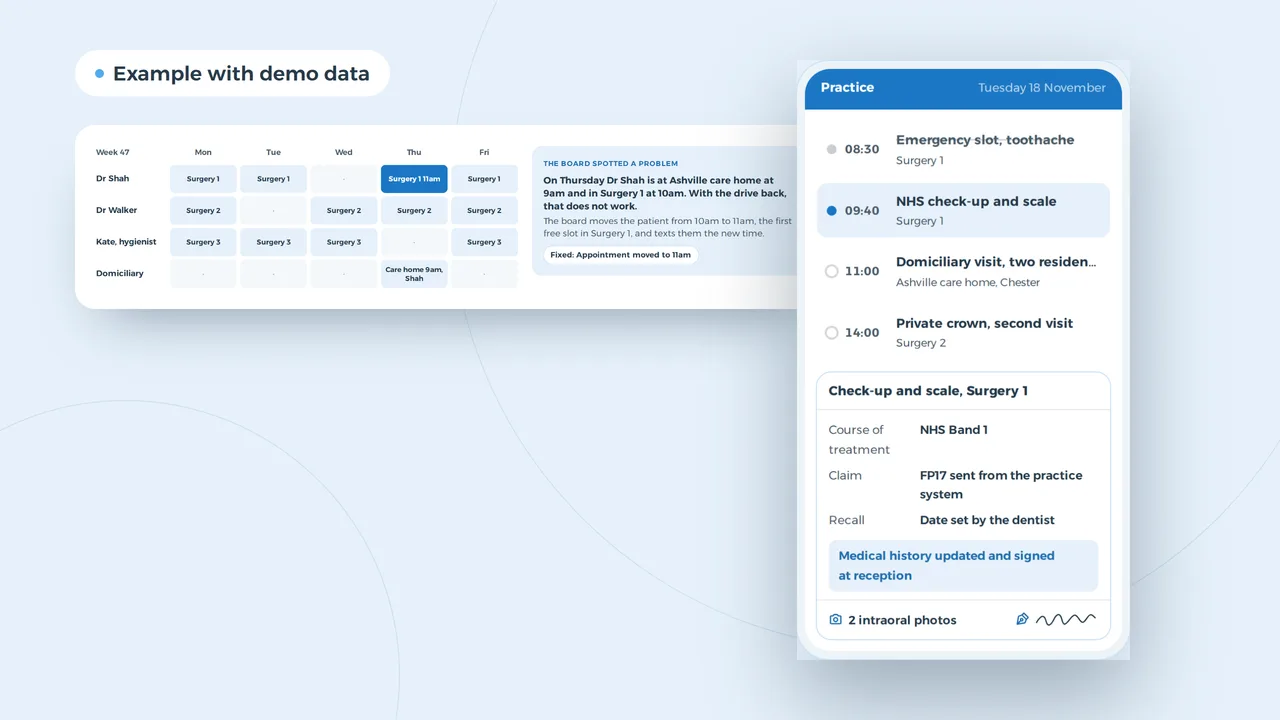
Today's list and the open check-up record, on the dentist's phone
- Claims stay in your practice systemThe app shows whether today's FP17 went out. Your practice management software sends it to the NHS, we connect to it where it allows.
- The care home visit is on the same listAddress, residents and the consent forms are on the phone before the dentist leaves.
- Health data stays in the systemThe phone shows the appointment. Notes and photos are stored in the practice system, not in the camera roll.
An example of what we can build, with made-up names and appointments. You choose what the record shows.
Where a practice day leaks time
Dentists rarely lose time in the chair. It goes at the edges: a receptionist on the phone while someone waits at the desk, an appointment moved three times, a patient asking again for a receipt for their health cash plan, an emergency squeezed in between check-ups.
| Moment | How it often goes | With an app beside your practice system |
|---|---|---|
| 8am, phones start | Reception answers, hunts for a gap in three diaries, rings back | Part of the bookings arrive online, only in slots that are really free |
| A patient cancels | Calls, crossings out, trying to fill the gap | A link in the reminder to move it, and the freed slot goes back online |
| Domiciliary visit to a care home | A list of names on paper, travel time guessed | The visit sits on the rota with travel time, the residents and the agreed time with the care staff |
| A private crown | Estimate on paper, the patient rings to ask whether the lab has finished | The patient follows the steps and the estimate through a secure link |
| Overnight messages | A full inbox at 8am with the urgent one buried | A list sorted by urgency, with a suggested reply |
| NHS claims | The system sends, nobody sees what got stuck | Per appointment you see whether the FP17 went and what is still open |
None of this replaces your clinical system. NHS claims go to the NHS Business Services Authority from software built for it, so we build alongside and connect where your supplier allows it. How such a connection works, and what it asks of your supplier, is on API integration services.
The rota spots that a care home visit and the next patient will not fit
The board spotted a problem
On Thursday Dr Shah is at Ashville care home at 9am and in Surgery 1 at 10am. With the drive back, that does not work.
The board moves the patient from 10am to 11am, the first free slot in Surgery 1, and texts them the new time.
Fixed: Appointment moved to 11am
An example of what we can build, with made-up names. You choose what the board checks.
Three surgeries, a hygienist and the drive to the care home
The diary in your practice system knows the appointments. It seldom knows the rules of your practice: that Dr Shah does domiciliary visits on Thursday mornings, that surgery 3 belongs to the hygienist, that a long private case cannot start after 5pm because the nurse leaves. A rota built for you holds those rules and warns before a patient notices.
The board shows the week per dentist, per surgery and per visit outside. It counts travel time, catches double bookings and proposes a fix that reception accepts with one click. It also plans the team itself: who works which day, who is on leave, who covers the out of hours rota. That part is staff scheduling software and sits on the same screen. For an NHS practice, the same board can show how the UDAs booked so far compare with the year's contract, using the figures your system already holds.
Dental practice software UK and the rules it has to respect
These are the rules that most often have to live inside a practice's systems, checked against the GDC, CQC, NHS and ICO in October 2026. Scotland, Wales and Northern Ireland have their own regulators and NHS arrangements; the table follows England.
| Situation | What the rule asks | What the software does |
|---|---|---|
| Prices | GDC standard 2.4.1: a simple price list in reception. Standard 2.4.2: clear prices in practice literature and on websites, so patients do not have to ask | The website carries the same price list as reception, NHS and private side by side |
| Before treatment | GDC standard 2.3.6: a written treatment plan before treatment starts, with a realistic indication of cost | The treatment plan holds the signed estimate and shows the patient what is invoiced so far |
| Your website | GDC guidance on advertising: the name, qualifications and GDC number of each dental professional, the practice address, how to complain, the date the site was last updated and a link to the GDC | A team page that pulls names and GDC numbers from one list, and a footer with the date and the GDC link |
| Titles | Only dentists on a GDC specialist list may call themselves specialist | Titles per person come from that same list |
| Cosmetic injections | Botulinum toxin is a prescription-only medicine and may not be advertised to the public | Explaining a treatment is fine; a promotion for it is not, and the site flags such copy |
| Registration | Practices providing regulated activities in England register with the CQC | Policies and checks live in one place, ready for an inspection |
| NHS work | Courses of treatment are claimed on an FP17 and counted against the contract in UDAs | Your system claims; the app shows status and progress |
| Patient data | Health data is special category data under UK GDPR, processed for healthcare under Article 9(2)(h), and the practice pays the ICO data protection fee | Forms ask for name, phone and type of appointment only. Data stays in the UK or EU, access per role, with a log |
The difference between UK and EU rules on data, and what it means for a practice that uses European suppliers, is in UK GDPR vs EU GDPR.
A search for an NHS dentist in Chester that turns into a booked slot
New patient form
Check-up and hygienist, prefers Saturday morning
Daniel, Chester, yesterday 20:42
- A page per treatment that explains, with fees and no promises
- A Google profile with hours, emergency arrangements and practice photos
- Online booking that only shows free slots
Example with made-up practices and reviews.
Found in your own town, and booked online
Someone types 'nhs dentist' and their town, and sees three practices on the map. Then comes the question reception hears most: are you taking on NHS patients? A site that answers that itself, with opening hours, the emergency arrangements, the price list and a button to book a free slot, takes the question off the phone.
Three things matter. A page per treatment that explains what happens, without offers or promises, because GDC guidance expects advertising to be accurate and not misleading. A Google Business Profile with the right hours and photos of the practice. And online booking that only shows the slots the rota releases, with a form that asks for no clinical detail. How such a practice gets found within the rules is on dental SEO; the booking itself is a booking system for your website.
A private crown in five steps, with the estimate set against what is invoiced
The patient sees the stages, the next appointment and the estimate through a secure link. Clinical notes stay in the record.
An example of what we can build, with a made-up patient and amounts.
A treatment plan the patient can follow
A crown, a bridge or a denture runs over weeks: examination, estimate, preparation, the lab, fitting. The patient wants to know where it stands and what it costs; reception gets those questions by phone. One record per treatment plan puts the steps, the signed estimate, what has been invoiced and when the lab work is due back in one place. The patient follows along through a secure link that shows only the practical side. Clinical details stay in your practice system.
At its core that is a client portal, with the limits that healthcare sets: no diagnosis by email, no photos in a chat, access per role and a log of who opened what.
Six messages in the inbox, and what reception does first
An example of what we can build, with made-up messages. The AI sorts and drafts, a person decides. Health data stays inside the practice's own systems.
Overnight messages, sorted before 8am
AI makes no diagnosis and decides nothing in a practice. It does what reception has to do first at 8am: read the messages and sort them. A child with a broken tooth goes to the top with a request to call. A cancellation gets two free slots as a suggestion. A request for a receipt for a cash plan claim is prepared. A person calls or sends.
Because this is health data, the model runs in an environment the practice controls, with data in the UK or EU and messages never used to train a model. How that works in practice is on AI customer service.
By practice size
A single-handed dentist needs no ERP and usually no custom rota either. A group with eight surgeries over two sites needs more than a diary. This is what we would build at each size, beside your practice system.
| Size | What you need | What you do not need (yet) |
|---|---|---|
| Single-handed, with a nurse and a receptionist | A site with a page per treatment and the price list, a Google Business Profile, online booking in free slots | A rota, roles and permissions, an app of your own |
| Group practice, two to four dentists and a hygienist | A rota per surgery with domiciliary visits, a front desk inbox with AI, reminders with a link to move the appointment | A second clinical record beside the one you have |
| Several sites | One board across all sites, team scheduling and out of hours cover, treatment plans patients can follow, figures per site | A second system doing what the first already does |
What drives the cost of a custom build in general is in custom software development cost.
Other clinics work with the same building blocks. A physiotherapy clinic plans rooms, classes and home visits in much the same way: see physiotherapy software. A veterinary practice shares the rota and the emergency arrangements, without the NHS: see veterinary practice software.
A mixed practice with three surgeries, in hours
| Task | Time back for reception per week |
|---|---|
| Online booking: 25 x 0.4 x 3 minutes x 5 days | 2.5 hours |
| Sorting messages: 20 x 2 minutes x 5 days | 3.3 hours |
| Replanning clashes: 2 x 15 minutes | 0.5 hours |
| Total | 6.3 hours |
Over 46 weeks that is about 291 hours. At £18: 291 x 18 = £5,238 a year of reception time, in this example. What the practice does with those hours is its own call: calmer help at the desk, chasing estimates, leaving on time. This example says nothing about patient numbers or income. Count your calls and messages for one week, and run the sums.
A conversation first, then a fixed price per project
- A morning at your front deskWe sit in on reception and look at the diary: where calls go, which rules live in people's heads, what your practice system already does and where it lets us connect.
- A proposal with a fixed priceWhat we build, in which order, and a fixed price per project, agreed after that first conversation.
- The biggest time sink firstUsually online booking and the site, then the rota, then the front desk inbox. Each part works on its own.
- Data in its placeA data processing agreement, data in the UK or EU, access per role. Clinical records stay in your practice system.
We have no dental practice as a client yet, but the Business Centrum management platform also holds sensitive records, encrypted, with two-factor sign-in and a portal where clients follow along.
Questions dental practices ask us
Does this replace Dentally, SOE or R4?
No. Charts, clinical notes and NHS claims stay in your practice management system. We build what sits beside it: online booking, a rota, a front desk inbox, treatment plans patients can follow, and we connect where your supplier allows it.
Do we have to show prices on our website?
Yes. GDC standard 2.4.2 asks for clear information on prices in practice literature and on websites, so patients do not have to ask. A simple price list also has to be on display in reception.
What must a dental website show under GDC guidance?
The name, qualifications and GDC number of each dental professional, the practice address and contact details, how to complain, the date the site was last updated, and the GDC's details or a link to its website.
Will online booking collect health data?
Not if we build it. The form asks for name, phone and type of appointment. Symptoms and clinical detail belong in the record, not in an inbox or a chatbot.
What does dental practice software cost?
It depends on what you need. After a first conversation you get a fixed price per project.
Custom software
How VBS helps you with this
We build the platform your business runs on every day: your spreadsheets, emails and paperwork in one system that does what you do.
- Your workflow mapped first, then a fixed price
- Screens for the office, the client and the road
- Hosting, backups and security managed by us on AWS
How we approach it is on our page about Custom software.
A front desk that is on top of things by 8am?
Tell us how your practice handles bookings, messages and domiciliary visits today. We will look and say what we would build beside your practice system.
Rather get in touch right away?