Industries: recruitment agencies
Recruitment agency software for temps, clients and the checks the law asks for
A board that shows which temp is with which client and whether the right ticket comes with them, an app for consultants out on site visits, and job ads candidates answer in three taps. Built around how your branch works.
Temp desks juggle candidates, clients and compliance
Recruitment agency software starts on a Monday morning. Two temps begin their first day at a manufacturer, a warehouse wants four pickers for the November peak, a site needs someone with a CSCS card tomorrow, and a candidate who applied on Friday is still waiting for a call back. Meanwhile the consultant is driving to meet a new client.
In many agencies that is spread across a back-office package for contracts and pay, a spreadsheet for the rota, an inbox full of CVs and the consultant's phone. Who holds which ticket sits in a folder. Who has worked how many weeks in the same role, someone counts at month end. And the assignment details for a client are on paper in the car of the consultant who took them.
Recruitment agency software built for you brings temps, clients, bookings and checks into one system. Below, need by need, is what we build, which UK rules for agencies belong in it and how much software fits the size of your agency. Your existing payroll or back-office package does not have to go.
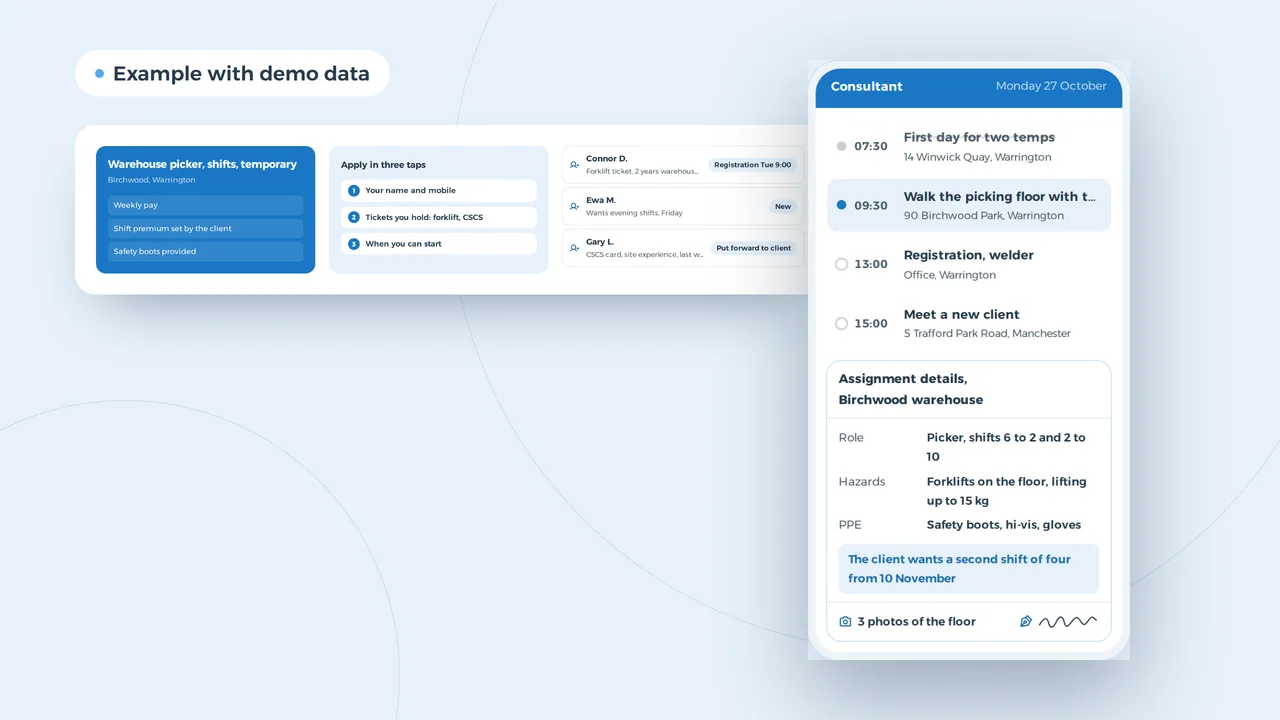
Assignment details taken and signed on site
- The site belongs to the bookingWhoever starts in Birchwood next week knows which boots and hi-vis to bring before they arrive.
- A new request becomes a job orderThe second shift is open as a job order before the consultant is back at the office.
- The office sees the day happenThe first day in Winwick is ticked off, so the planner knows both temps turned up.
One way a consultant app could look, with addresses and bookings that do not exist. You decide what the assignment form asks.
First days, registrations and a client on the phone
An agency earns on hours worked. It loses on the candidate nobody rang back, the temp who turns up on site without the right ticket and the timesheets still missing on Friday.
| Moment | How it often goes | With software built for you |
|---|---|---|
| A client needs people | An email or call noted on a pad | A job order with role, hours, headcount and tickets, visible to the whole branch |
| Finding someone | Scrolling a spreadsheet and a folder of CVs | A list of who fits, who is free and who holds the ticket |
| Before the first day | Chasing the Key Information Document, right to work and the site details | Everything sits on the booking: terms, KID, checks, site details, start time |
| On site | The consultant writes on paper | Assignment details, photos and the client's signature on the phone |
| Timesheets | Arriving by email or as a photo | Hours per temp and per client, ready to approve |
| Invoicing | Retyping hours into the invoicing package | Approved hours per client, ready to invoice |
Temps can log their own hours in a time tracking app. Who is where and when is staff scheduling software, but with two sides: your own temps and the clients who book them. When a spreadsheet stops being enough is covered in Excel scheduling or planning software.
Job ads candidates answer in three taps
With names that do not exist. You choose the questions and the details the ad has to show.
Temps apply on their phone, often to several agencies at once. Whoever rings back first wins. So we build job ads on your own site that take three steps: name and mobile, which tickets, when they can start. The consultant gets a notification and sees the candidate in the list with their status. Ads per role and per town also bring in people searching for "warehouse jobs Warrington"; that is local SEO. How your agency comes across as an employer is employer branding, and whether to build this yourself or buy a package is weighed up in build vs buy software.
Forklift ticket missing for Wednesday's shift
Ticket missing
On Wednesday Kyle is booked on the forklift in Winwick. The client needs a counterbalance ticket and Kyle has none.
Rhys holds the ticket and already works in Winwick that week. The board moves him to the forklift and keeps Kyle on picking.
Swapped: Rhys to the forklift
A sample agency board with temps and clients we made up. You set which tickets and checks it looks for.
A temp board does more than put people on days. It sets each temp against what the client asks for: the role, the shift, the tickets, the site. If someone without a CSCS card is booked on a building site, or a picker without a forklift ticket goes where the client wants one, the board says so before the first day. It also counts weeks in the same role with the same client, so the branch sees the 12-week point under the Agency Workers Regulations coming.
At the core of such a system is a database of candidates and clients, which is a custom CRM; what a CRM is, is explained in CRM. If a back-office package already handles contracts and payroll, we build an integration instead of replacing it. Fill rates and margin per client go into a dashboard.
Client email turned into a shortlist for the consultant
A sample of what we build. AI searches your own database and drafts text; the consultant decides who gets a call.
AI does not pick temps for you. It does the groundwork: a client's email becomes a job order with role, hours and tickets, a first draft of the ad, and a list of people from your own database who fit and are free. The consultant checks, chooses and calls. CVs that come in work the same way: AI pulls out tickets, licences and languages, and a person decides. More in AI for HR. An AI agent that sends candidates a first message is something we only build with a consultant approving each one. Because CVs and right-to-work documents are personal data, how long you keep them and who sees them matters; UK GDPR vs EU GDPR covers the basics.
Local warehouses searching for an agency
New client request
4 pickers from 10 November, shifts, forklift ticket a plus
Warehouse, Birchwood, today 08:47
- A page per sector and per role you fill
- A Google profile per branch
- Two forms: one for clients, one for candidates
Branches and reviews in this sample are invented.
Clients find a branch by sector and by town
An agency has two kinds of visitor: people looking for work and businesses looking for people. The site has to serve both, each with its own way in. For clients, a page per sector you are strong in works best, warehousing, manufacturing, construction, office, with a form that asks what the consultant needs: how many people, which shifts, which tickets, from when.
A Google profile per branch helps, because businesses search by town; setting one up is in create a Google Business Profile, and getting reviews from clients and temps in get more Google reviews. A site with both forms starts from 1,500 euro; see website design.
Conduct Regulations, AWR and umbrella liability
Agency work is one of the more tightly regulated kinds of employment in the UK. These are the rules that most often belong in your system.
| What | What the rule asks | What the software does |
|---|---|---|
| Fees | No fees charged to work-seekers for finding them work, under the Conduct of Employment Agencies and Employment Businesses Regulations 2003 | No payment step exists on the candidate side |
| Terms first | Terms agreed with the work-seeker before any service is provided | A booking cannot start until the terms are signed |
| Checks before placing | Identity, the qualifications the role needs and right to work in the UK | Each check has a date and a document; a temp without them stays off the board |
| Records | Kept for at least 12 months | Records stored and searchable for as long as you set |
| Key Information Document | Given to every new agency worker since 6 April 2020 | The KID is drafted per worker from the booking |
| Agency Workers Regulations | Equal treatment on basic pay and conditions after 12 weeks in the same role with the same hirer | A week counter per temp and client, with a warning before week 12 |
| Umbrella companies | Agencies are jointly and severally liable for umbrella PAYE since 6 April 2026 | Umbrella used, per temp, visible on every booking |
| Food and agriculture | A gangmaster licence | Clients in those sectors marked, so bookings only go out under the licence |
| Pay and holiday | National Living Wage £12.71 from 1 April 2026, £13.21 from 1 April 2027; 12.07% holiday accrual for irregular hours | Pay rates checked against the floor, holiday accrued per hour |
Enforcement moved to the Fair Work Agency, which replaced the Employment Agency Standards Inspectorate on 7 April 2026. Employers also need employers' liability insurance of at least £5 million. VAT runs through Making Tax Digital, and B2B e-invoicing over Peppol becomes mandatory from 1 April 2029; see e-invoicing in the UK. The software files nothing for you; it makes sure the branch sees what applies.
Branch count decides how much system
A sole recruiter working on permanent roles does not need an ERP. A network of ten branches needs more than a shared spreadsheet. Here is what fits each size of firm.
| Size | What you need | What you do not need (yet) |
|---|---|---|
| Sole recruiter | A website with two forms, a Google profile, a candidate list with checks | A temp board, roles and permissions, an ERP |
| Team of 5 | The temp board with tickets and checks, the consultant app, job ads on your site | Your own payroll engine next to your existing package |
| Agency of 20 to 50 | Several branches on one board, AWR counters, timesheets per client, links with your back-office and payroll | A large package where you use half the screens |
| Larger company | A portal where clients post requests and approve timesheets, figures per sector and branch | A second system next to the first |
Once a few regular clients book often, a client portal where they post requests and approve their temps' timesheets pays off. The difference between a candidate database and a system for the whole business is in CRM vs ERP.
Call-back time costed for a three-consultant branch
| Task per week | Spreadsheet, email and paper | Software built for you |
|---|---|---|
| Retyping and checking timesheets | 6 hours | 1.5 hours |
| Finding candidates for a job order | 8 hours | 3 hours |
| Gathering assignment details and checks | 3 hours | 0.5 hours |
| Sorting applications and ringing back | 5 hours | 2.5 hours |
| Total | 22 hours | 7.5 hours |
That is 14.5 hours a week, 667 hours over 46 weeks. At £30: 667 x 30 = £20,010 a year. Add the candidates who signed with another agency because you called a day later; that figure depends on your margin, so add it yourself. Your own numbers will differ. What custom software costs in general is in custom software development cost, and the software development cost calculator gives a first estimate.
Consultants first: how a project begins
- A conversation about an ordinary weekHow do client requests come in, how do you find people, where are the checks kept, how do timesheets come back? We go through a real week at your branch.
- A fixed price per projectTogether we pick the piece where you lose the most time and set a fixed price for it. A website with forms starts from 1,500 euro; software is priced after the conversation.
- One branch works with itA consultant and the administrator use the first version on real bookings. What does not fit, we change before the other branches follow. You keep the code and the data.
We have no recruitment agency as a client yet; the closest work is the Business Centrum management platform we built to replace their spreadsheets.
Agency owners tend to ask
Does our payroll or back-office package have to go?
No. Contracts and pay stay where they are; the system sends or fetches the data, so nobody types it twice.
Can clients approve timesheets themselves?
Yes, in a portal that shows only their own temps, and approved hours go straight to invoicing.
Does it handle several branches?
Yes. Each branch sees its own board, and the owner sees everything.
Is this recruitment agency software for the UK only?
No. We build it around the rules where you operate; this page covers the UK rules, and Belgian agencies have their own version on our Dutch site.
I am setting up a new agency. Where do I start?
With the licences and terms first, covered in start a recruitment agency in the UK, then a website and a candidate list. A board can come later.
Do you build for the sectors we supply?
Yes. Many temps drive, so see courier companies and taxi companies. A full system as a web app is on web application development.
Custom software
How VBS helps you with this
We build the platform your business runs on every day: your spreadsheets, emails and paperwork in one system that does what you do.
- Your workflow mapped first, then a fixed price
- Screens for the office, the client and the road
- Hosting, backups and security managed by us on AWS
How we approach it is on our page about Custom software.
Temps and checks on one board?
Tell us how a week at your agency runs. We will show where we would start and what it could save you.
Rather get in touch right away?