Industries: removal companies
Removal company software that puts crews, vans and lifts on one board
A quote straight from the survey, a week board that sees when an external lift is booked twice, and a job sheet per move on the crew leader's phone. Built around how your removals firm works.
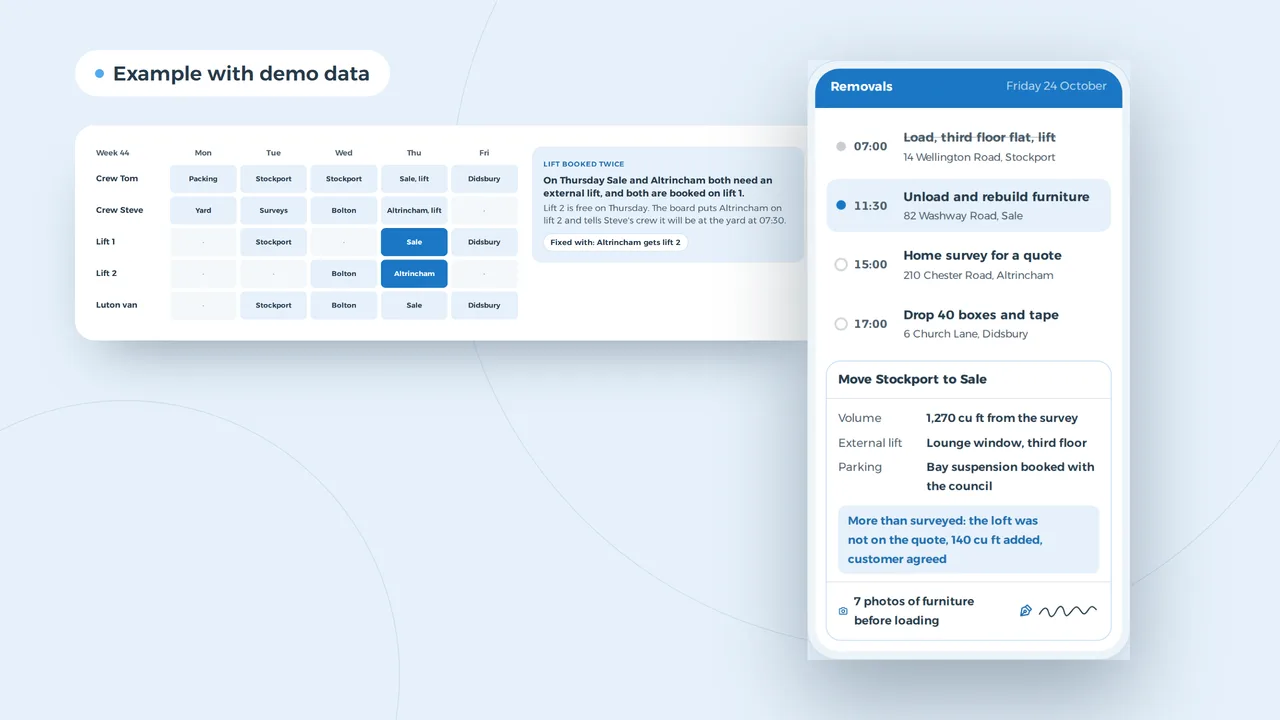
Moving days start the evening before
Removal company software has to fit an ordinary Friday. At seven a crew loads a third floor flat in Stockport with the external lift at the lounge window. By half eleven everything has to be off the van in Sale with the beds rebuilt. In the afternoon the surveyor walks round a house in Altrincham, and at five forty boxes go to a customer who moves next week. Meanwhile a customer rings to say completion has slipped and the date has to move.
That week usually lives in a diary, a spreadsheet of cubic feet per room and the planner's head. It holds until a lift is booked at two addresses at once, or until the crew finds a loft that was never on the quote. We build a system that ties the survey, the quote, the plan and the crew's job sheet together.
Job sheets on the crew leader's phone
- The survey travels with the crewWhat the surveyor noted is on the crew leader's phone: rooms, wardrobes to dismantle, the piano that will not go down the stairs.
- Extras are signed on the spotA loft nobody mentioned becomes a line on the sheet with the customer's approval, before the van leaves.
- Photos before loadingA scratch that was already there is on a photo with time and address, so a damage claim starts from a picture.
Addresses and moves are made up. You decide which fields a removal job sheet has.
Surveys, lifts and the loft nobody mentioned
A removals firm rarely loses money on the carrying itself. It leaks around the moving day: a survey that stays on paper, a quote that missed the garage, a lift nobody booked, a sideboard that turns up scratched at unloading with nobody sure whether the mark was already there. Each one costs an hour, a discount or an argument.
| Moment | Where it goes wrong now | What your own system does |
|---|---|---|
| Enquiry | The customer rings, emails and sends photos on WhatsApp | One form with addresses, floors, lift and date |
| Survey | Notes on paper, cubic feet from memory | Rooms and items on a tablet, the volume adds itself up |
| Quote | Typed again in Word and emailed | The quote comes from the survey, the customer accepts online |
| Moving day | The crew does not know what needs dismantling | The job sheet shows rooms, wardrobes and the piano |
| Afterwards | Arguments about extra hours, damage without proof | Extras are signed, photos before loading sit in the file |
You do not need a heavy package for that. It needs a work order app that suits a removals crew, and a plan that looks at crews, vans and lifts together.
External lifts and crews on one week board
Lift booked twice
On Thursday Sale and Altrincham both need an external lift, and both are booked on lift 1.
Lift 2 is free on Thursday. The board puts Altrincham on lift 2 and tells Steve's crew it will be at the yard at 07:30.
Fixed with: Altrincham gets lift 2
A made-up week with made-up crews. You choose which vans, lifts and people sit on the board.
Parking suspensions, vans and the council
Planning removals is more than putting people on days. A move with a lift needs the lift, someone trained to run it, a van big enough for the load and often a parking bay suspension from the council. The board puts those side by side. If a lift is booked at two addresses, or the big van is in for its service on the day of an office move, you see it before the crew leaves the yard.
The parking suspension is the task most easily forgotten. Every council has its own lead time and its own form. The system adds a task to each move that needs the street, with the last day to apply, so the suspension is there on the day and not after it.
The board works on the same logic as transport management software and staff scheduling software: who, what, where and when, and what clashes. For the vans and lifts themselves, with their services, inspections and insurance, there is fleet management software. If you plan in a spreadsheet today, the guide on replacing Excel with software helps you see when the step pays.
Removals enquiries from Stockport with floor and size
New enquiry
Second floor flat to a house in Sale, two bedrooms, external lift, 28 November
Jo, Stockport, Tuesday 22:10
- A page per kind of move: home, office, packing, storage
- A Google profile with photos of the crew and vans, and reviews
- An enquiry form that asks for floors, lift and moving date
Removal firms, stars and reviews invented for this example.
People look for a removals firm a few weeks before they move, mostly on their phone and mostly in the evening. They compare three or four firms on reviews, photos of the vans and how fast they get a price. A complete Google Business Profile with photos of your crew and your lifts does more than an advert. Ask for reviews on the evening of the move, once the beds are up, with a Google review link; the guide on getting more Google reviews shows how to keep it going.
A page per kind of move, such as home, office, packing, storage or moves to Europe, helps you get found for what people type. That is the work of local SEO. An enquiry form that asks for floors, lift and moving date straight away, or a booking system on your website for home surveys, saves a phone call.
Walk-through videos as a first inventory
An example. The AI works from your own cubic feet per item, whoever plans decides on crew and price.
AI does not quote a move instead of your surveyor. It prepares what takes the most time today: a first list of furniture and boxes from a video or photos, a volume worked out from your own cubic feet per item, and a note on whether a lift looks necessary. The planner checks it, books a home or video survey where needed, and decides on crew and price.
An AI quote generator is most useful for small moves, where a survey visit costs more than it brings. For the questions that come every week, such as how many boxes a two-bed flat needs or whether you move on Saturdays, we build AI customer service that answers from your own replies and passes anything uncertain to a person. How AI works in the wider transport trade is on the page about AI in transport.
Porters and HGV drivers found on your own site
The applicants here are invented. You choose the questions and who sees the answers.
Removal firm size and what to leave alone
A good porter is strong, careful and friendly with customers. One with a C licence and a valid Driver CPC is rarer still. A job ad that takes three taps on a phone wins: name, mobile, which licence, and when we may call. Students for Saturdays and the busy months come in the same way. Applications land in the same system as your plan, so you see who is free when, and a time tracking app keeps the crew's hours per move.
A one-van man and van does not need an ERP. A firm with five vehicles, lifts and storage needs more than a diary. Here is how we would scale it.
| Firm | What we would build | What can wait for now |
|---|---|---|
| One van, one or two people | Enquiry form, quotes by volume or by hour, a job sheet on the phone | A board for several crews |
| Team of 5 with a lift | A week board for crews, vans and lift, parking suspensions as tasks, extras signed on site | A module for every box in the warehouse |
| Firm of 20 to 50 staff | Several crews and lifts, storage with a location per customer, a custom CRM for office moves | A full ERP for everything at once |
| Larger business | European moves with partners, integrations with your accounts and a dashboard per depot | A second system beside what already works |
The rule is simple: build what costs time every week and leave the rest until it hurts. What a build costs is in custom software development cost.
- above this weight a removal van needs an operator licence
- 3,500 kg
- the longest gap between downloads of a vehicle's tachograph unit
- 90 days
- for an upper tier waste carrier registration, valid three years
- £191.02
Operator licences, tachographs and waste rules in the file
A removals firm is also a haulier. These are the rules that belong in your plan and your files.
| Rule | What the law asks | Where it sits in the plan |
|---|---|---|
| Operator licence | Vehicles above 3,500 kg need an O licence | Each vehicle shows whether it falls under the licence |
| Vans to Europe | Vans of 2.5 to 3.5 tonnes moving goods to the EU have needed a standard international licence since 21 May 2022 | A European move asks for a vehicle on the right licence |
| Smart tachograph | Since 1 July 2026 vehicles on international work need the second generation smart tachograph | The van for a European move is checked for its tachograph |
| Tachograph downloads | The vehicle unit every 90 days, each driver card every 28 days | Due dates per van and per driver, with a warning a week ahead |
| Driver CPC | 35 hours of training every five years | Each driver's hours and the expiry date of the card |
| GB domestic drivers' hours | At most 10 hours of driving and 11 hours on duty in a day | A move that runs too long shows on the board before it is booked |
| House clearances | Taking waste away needs a waste carrier registration. Upper tier costs £191.02 for three years | The registration and its renewal date sit in the company file |
| VAT and e-invoicing | Making Tax Digital covers all VAT-registered firms today, and B2B invoices must go through Peppol from 1 April 2029 | Digital records today, office moves invoiced as a UBL invoice when Peppol comes |
| Staff | From 1 April 2026 the National Living Wage is £12.71 an hour. Employers' liability insurance is compulsory, with cover of at least £5m | Hours and rates sit in the staff file |
What Peppol means for UK invoices is in the guide to e-invoicing in the UK.
Survey hours and pounds at twenty moves a month
| Where it leaks | Each month | Over a year |
|---|---|---|
| Typing up quotes | 4.2 hours | 46 hours |
| Chasing parking suspensions | 2 hours | 22 hours |
| Time together | 6.2 hours | 68 hours, or £2,380 |
| Discount on unsigned extras | £120 | £1,320 |
Treat it as an example on assumptions, not as a promise. The biggest sum is often not in the hours, but in the extras nobody signed and the enquiries that never got a quote because the planner rang back too late.
Removals conversation first, then a fixed price
- A conversation about your weekHow does an enquiry come in, who surveys, how do you price a move, who books the lift? We start from a real week in your diary.
- A fixed sum for the whole projectIt sets out each piece of work, the sequence and a fixed sum for the lot. A price up front exists only for a website, from 1,500 euros.
- The quote and the job sheet firstWe start with what costs time every week: the survey that becomes a quote and the job sheet on the crew leader's phone.
- Then the boardOnce quotes run smoothly, the week board for crews, vans and lifts follows, with parking suspensions as tasks.
We have no removals firm as a client yet, but the planning board and the driver app in Dutch, English and Turkish have run every day at DA Logistics since July 2026. What we build for hauliers is on the page about transport software.
Custom software
How VBS helps you with this
We build the platform your business runs on every day: your spreadsheets, emails and paperwork in one system that does what you do.
- Your workflow mapped first, then a fixed price
- Screens for the office, the client and the road
- Hosting, backups and security managed by us on AWS
How we approach it is on our page about Custom software.
Crews, lifts and quotes in one place?
Tell us how a move runs at your firm, from the first enquiry to the invoice. We sketch the first piece we would build and what it brings in an ordinary month.
Rather get in touch right away?