Industries: body shops
Body shop management software that follows every claim to collection
A file per repair with the photos, the authorised amount and the parts, a plan for panel work and the spray booth, and customers who know where their car is. Built around how your shop repairs.
Bodywork Mondays start with a handful of photos
Body shop management software has to fit a Monday after a wet weekend. Four customers send photos of a dented door or a pushed-in bumper, two insurers want an estimate by noon, the spray booth is full until Wednesday, and a lease company asks why its car is not back yet. In the middle of that, the panel beater needs to know which car comes first.
In most accident repair centres that week is spread over a diary, an inbox, a folder per car and the owner's phone full of customer photos. Every claim has its own path: enquiry, estimate, engineer's approval, parts, panel work, prep, paint, refit, valet, collection. One missing part or an engineer who reports a day late, and the whole plan slips. We build a system that tracks that path per car and shows the workshop what can be done today.
Repair sheets on the panel beater's phone
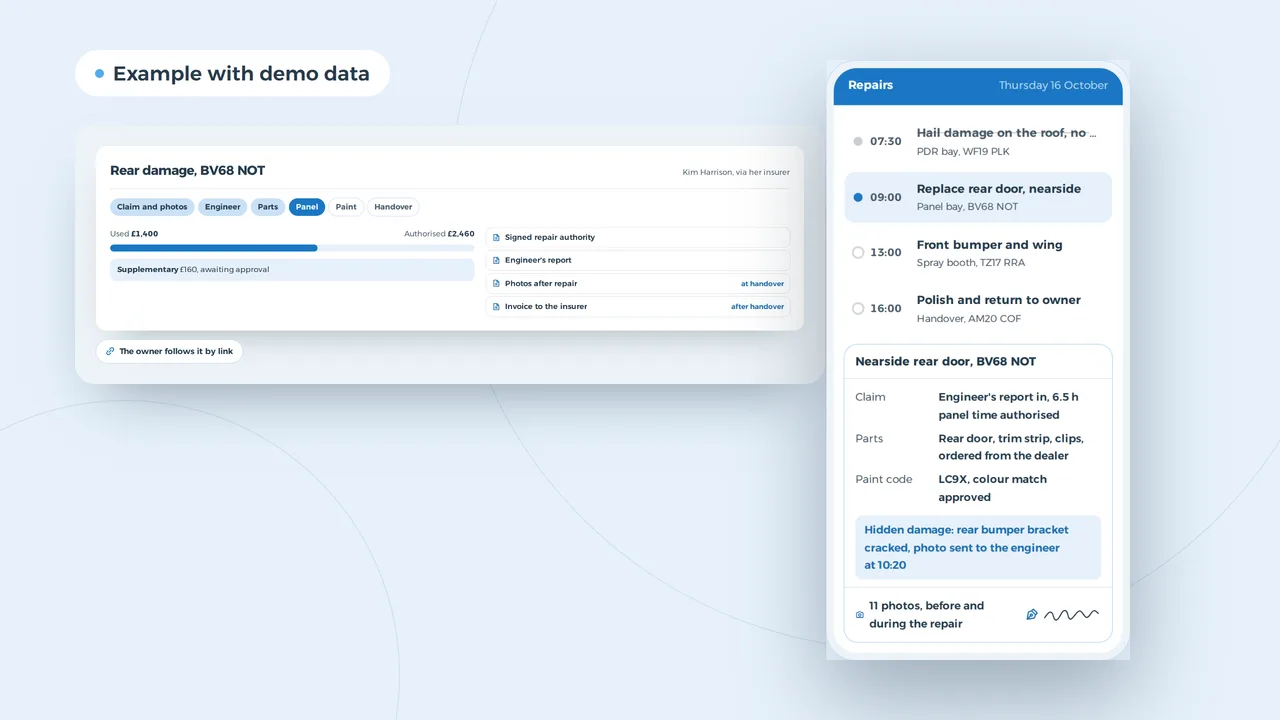
- The engineer gets what they ask forBefore, during and after photos sit in each claim in the order the insurer wants them.
- Supplementaries do not stall the jobA photo and a line of extra work go straight to the engineer, and the authorisation comes back into the claim.
- The booth knows what is comingPaint code and parts are on the job, so nobody mixes paint for a car still waiting on a door.
Made-up damaged cars and registrations. You choose the steps and photos a claim needs.
Estimates, parts and the car standing still
A body shop rarely loses time on the repair itself. It goes on waiting and searching: for the engineer to authorise the estimate, for a bumper ordered in the wrong colour code, for the customer who brings the courtesy car back late. A car that sits in the yard for three days with nothing happening costs space and patience, and often a customer.
| Stage | Where it sticks now | What your own system does |
|---|---|---|
| Enquiry | Photos come by WhatsApp, email and text | One form with photos, registration and insurer, all in one file |
| Estimate and approval | Nobody knows when the engineer will report | The request sits in the file, the report hangs on it once it lands |
| Parts | Ordered on paper, deliveries not checked | Each part has a status, a missing one holds the plan back |
| Repair | Panel bays and the booth planned by feel | The board knows the hours per stage and sees when the booth is full |
| Collection | Customer rings three times, invoice goes later | The customer gets a message, the invoice to the insurer leaves with the file |
For an accident repair centre the file is the heart, not the diary. It looks more like a work order app with stages than a normal planner. If you also do servicing and MOTs, software for garages covers the workshop side with ramps.
Claim files with every stage and the authorised amount
The owner follows it by link
Made-up owner, amounts and insurer. You pick the stages, so they match how your shop repairs.
Insurers, engineers and the supplementary
Most repairs are not paid by the driver but by an insurer or a lease company. That makes the work different from an ordinary garage. The amount the engineer authorises is your budget. When stripping the car shows hidden damage, a supplementary goes back for approval before you carry on. A system that puts the authorised amount beside what has been used shows at once when a repair is running over.
The file holds the engineer's report, photos before, during and after the repair, the parts with their prices and the hours per stage. When an insurer asks why the invoice is higher than the estimate, the answer is in the file with a photo and a date. Courtesy cars hang off the file of the car in repair, so you see who has which car and until when.
Customers mostly want to know when their car will be ready. A simple client portal or a link by text shows the stage of their file, so nobody at the desk has to ring round. Planning panel beaters and painters works like staff scheduling software, with the spray booth as the bottleneck.
Paint shop on paper or on one board
- Booth planning
- Paper, phone and memoryThe painter decides in the morning what goes in
- One claim file per carThe board knows which cars are prepped and books the booth
- Paint code
- Paper, phone and memoryRead off the car again, sometimes wrong
- One claim file per carOn the file from the estimate, on the painter's screen
- Supplementary
- Paper, phone and memoryRung through, sometimes forgotten
- One claim file per carPhoto and price go to the engineer from the file
- Customer update
- Paper, phone and memoryThe customer rings the desk
- One claim file per carA text when the stage changes
The paint shop is where a day lost upstream shows. A board that sees prepped cars keeps the booth full.
Bodywork searches in Kingswood that bring in photos
New estimate request
Rear door dented in a car park, 3 photos, private repair, no claim
Kim, Hanham, Monday 08:05
- A page per kind of damage: accident, hail, smart repair, alloys
- A Google profile with repaired cars and reviews
- A photo estimate form that asks for the registration and the insurer
Body shops and stars invented for this example.
After a bump people search on their phone for a body shop in their area, often with the damage photos still open. They pick whoever sits at the top with good reviews and a way to send photos straight away. A complete Google Business Profile with photos of your workshop and booth helps more than a leaflet at the insurer. Reviews are best asked for when the customer sees the car gleaming and straight; a Google review link in the collection message does that, and the guide on getting more Google reviews explains how to keep it up. A page per kind of repair, such as paintless dent removal, smart repair or alloy wheel refurbishment, helps you get found for what people actually search. For that, see local SEO.
Dent photos from a customer as a first estimate
An example. A photo cannot show hidden damage, so it stays an estimate a person checks.
AI does not price damage instead of your estimator. It prepares what you type today: the registration and the insurer pulled from the message, the photos filed, the likely operations drafted from your own labour rates and parts prices, and a note of what is still missing. You check it, change it and decide whether the customer gets a price or needs to bring the car in.
An AI quote generator mostly saves time in the evening, when the day's photos come in. For the questions that come back every day, such as whether the car is ready or what to bring at collection, we build AI customer service that answers from the file and passes anything uncertain to a person. Invoices from paint and parts suppliers can be processed automatically and matched to the right file.
Panel beaters and painters found without an agency
Applicants with made-up names. You choose the questions in the form.
Body shop size and how much system it carries
An experienced panel beater or painter is harder to find than a customer with a dent. People who already work in a body shop check other jobs on their phone in the evening, so a short ad with three questions works: what you do (panel, paint, prep or PDR), which paint systems you know, and when we may call. Applications land in the same system as your claims.
A one-person smart repairer does not need an ERP. A shop with two sites and insurer work needs more than a folder per car. At each size, this is where we would put the effort.
| Shop | Worth building | Leave for later |
|---|---|---|
| Sole trader or smart repairer | A file per repair with photos, the estimate and the invoice from the file | A planning board, insurer links |
| Team of 5 | Planning for panel bays and the booth, parts with status, courtesy cars per file | A stock module for every clip |
| Shop of 20 to 50 staff | Several bays and booths on one board, inventory management for paint and consumables, a report per insurer | A full ERP for everything at once |
| Larger business or network | Integrations with insurer and lease platforms, a dashboard per site | A second system beside what the network requires |
Where an insurer or an estimating platform offers a link, we look at it with you. Where it does not, the report sits in the file as a document and the system takes over the authorised amount. Photos on your phone today can move into the files, usually per folder or per registration.
Spray booth permits, refrigerant and VAT rules per repair
A body shop works with rules that come back with every car. These are the ones that belong in the file.
| Rule | What it asks | What the claim file does |
|---|---|---|
| Respraying permit | A shop that uses 1 tonne or more of solvent a year needs a Part B permit | Paint and solvent use add up per year, with a warning as you near the threshold |
| Vehicle air-con | Whoever recovers or recharges refrigerant needs an F-gas vehicle air-con qualification, from City & Guilds or IMI | An air-con line only goes to a qualified technician or the partner who does it |
| Waste oil and batteries | Waste oil and old batteries count as hazardous waste and are collected with a consignment note | Every collection is stored with its note in the file |
| Consumer Rights Act 2015 | A repair is done with reasonable care and skill (s.49). Goods carry a 30-day right to reject (s.22) | Photos, approvals and the work done stay on the file |
| VAT and e-invoicing | Every VAT-registered business keeps digital records under Making Tax Digital. Peppol e-invoicing between businesses becomes mandatory on 1 April 2029 | Digital records today, invoices to insurers that can leave as a UBL invoice |
| Staff | Pay at least the National Living Wage of £12.71 an hour from 1 April 2026, and hold employers' liability cover of at least £5m | Hours and rates sit in the staff file |
The guide to e-invoicing in the UK sets out what changes for invoices to insurers and fleets.
Repair hours and pounds in a week of fifteen claims
| Where the time goes | Per week | Per year |
|---|---|---|
| Chasing files | 5 hours | 230 hours |
| Calls about progress | 2.7 hours | 124 hours |
| Time together | 7.7 hours | 354 hours, or £15,930 |
| Supplementaries not claimed | £100 | £4,600 |
It stays an example built on assumptions; your numbers may be higher or lower. It shows where the gain is: in a file that is complete when the engineer or the insurer asks for it. Price ranges for a build are in custom software development cost.
Repairer conversation first, then a fixed price
- A conversation about your claimsHow does a job come in, who talks to the engineer, who plans the booth, when does the invoice go? We look at an ordinary week.
- A proposal and a fixed project priceThe proposal lists the parts, the order and one fixed price. We quote ahead of time only for websites, which start at 1,500 euros.
- The claim file firstWe start with the file: photos, estimate, parts and hours. A panel beater tries it on the cars in that week.
- Then the plan and the customerOnce the file runs, the plan for bays and booth follows, with courtesy cars and the message to the customer.
We have no body shop as a client yet; the nearest is Park & Wash, a small one-page site for mobile car detailing in Ghent. Our way of working on a build is on the custom software.
Custom software
How VBS helps you with this
We build the platform your business runs on every day: your spreadsheets, emails and paperwork in one system that does what you do.
- Your workflow mapped first, then a fixed price
- Screens for the office, the client and the road
- Hosting, backups and security managed by us on AWS
How we approach it is on our page about Custom software.
Claims, engineers and the booth in one place?
Tell us how a claim runs at your shop, from the first photos to the keys going back. We tell you where we would start and what it would save.
Rather get in touch right away?