Industries: cleaning companies
Cleaning business software built around sites, keys and cover
A cleaning spec per site on the phone, a rota that finds cover at 5am, and clients who can see the work was done. Built around how your teams already run.
Contract cleaning happens while the client sleeps
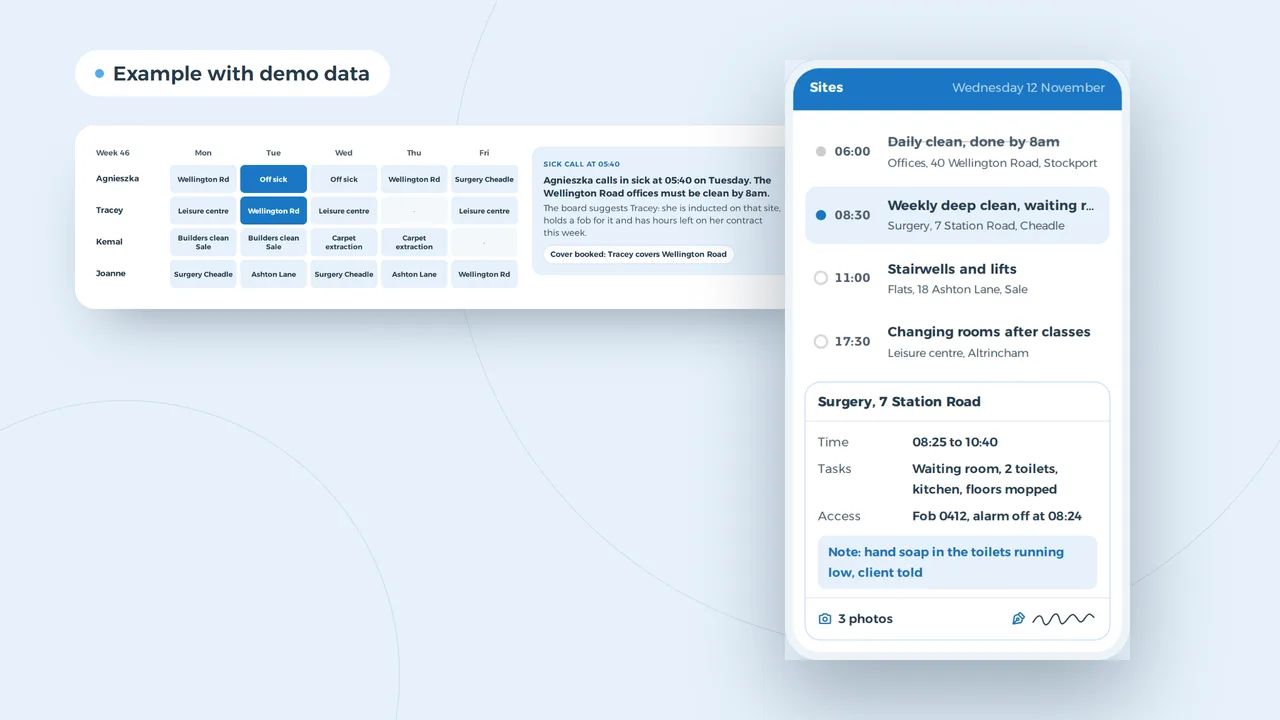
Cleaning business software has to work at the hours the office is shut. At 6am someone is at a block of offices in Stockport with a fob that should still open the door. At half eight the weekly deep clean starts at a surgery in Cheadle, at midday the stairwells in Sale, and in the evening the changing rooms at a leisure centre in Altrincham. The client rarely meets the cleaner; they only notice whether the bins are empty.
In most contract cleaning firms that day hangs on an owner whose phone is on before five. The specs live in a folder, the keys on a board with paper tags, the rota in a spreadsheet only the supervisor can read. When someone calls in sick, the ringing round begins. A system of your own puts the site at the centre: what each visit covers, who holds access, who already knows the building and who is free today.
Site spec, fob and sign-off on the cleaner's phone
- Every site has its own specWhat each visit covers sits with the address. Cover staff see the same sheet as the regular cleaner.
- Fobs and alarm codes per siteWhich key or fob belongs to which building, and who holds it, lives in the system rather than on a hook in the office.
- The client sees the job was doneA sign-off and a photo per visit settle the question of whether anyone came in last night.
Every client and address here is invented. You set which tasks each site's sheet lists.
Contract cleaners lose hours between the sites
The cleaning itself usually goes fine. The money goes elsewhere: the spec the cover cleaner never saw, the key left in the wrong car, the client who emails that the meeting room was missed and nobody can prove it was done.
| Moment | How it often goes | With a system of your own |
|---|---|---|
| A new contract starts | A spec in a Word file, explained once on site | A task sheet per site with frequencies, room photos and access notes |
| Access | A key board in the office, codes in a notebook | Which fob or key belongs to which site, who holds it and since when |
| Sick call at 5am | Phoning until someone answers | The rota shows who knows the site, is free and has contracted hours left |
| The visit itself | Nobody knows if it happened | Start and finish times, a photo and a sign-off per visit |
| A client complaint | An argument with no evidence | That day's sheet and photo are one tap away |
| Hours per site | Typed up from paper on Friday | Hours per site and per cleaner, ready for payroll |
The hours a cleaner works on each site belong in a time tracking app built for your firm. The task sheet with its photo and sign-off works like a work order app, except it repeats every week at the same address. And the clients themselves, with their contracts, buildings and contacts, fit a custom CRM built around sites rather than sales leads.
Rota cover sorted two minutes after a 5:40 sick call
Sick call at 05:40
Agnieszka calls in sick at 05:40 on Tuesday. The Wellington Road offices must be clean by 8am.
The board suggests Tracey: she is inducted on that site, holds a fob for it and has hours left on her contract this week.
Cover booked: Tracey covers Wellington Road
The cleaners and sites on this board are made up. You decide whether it checks fobs, inductions or contracted hours.
Cleaning rotas built on who knows which building
A cleaning rota looks simple at first: the same people at the same addresses every week. It gets hard with everything that changes. A builders clean that needs a team for three days. Carpet extraction once a quarter. A cleaner moving from 16 to 30 hours. A client who wants the visit after 6pm from next month.
In a spreadsheet the supervisor carries all of that in their head. A board built for you knows each person's contracted hours, which sites they are inducted on, who drives to the far sites and who cannot do Wednesday afternoons. When a sick call comes in, it looks first at cleaners who already know the building, then at those working nearby. The supervisor decides. How a board like that works for shifts in general is on staff scheduling software. If you are still weighing up leaving the spreadsheet, read Excel scheduling or planning software.
The rota also has to respect the law on hours. Most workers may not average more than 48 hours a week over 17 weeks unless they opt out in writing, and get 11 hours rest between working days. With early and late sites on the same day, a board that counts those gaps saves an awkward conversation later.
Hiring evening cleaners in three steps
These applicants are fictional. Which questions the form asks is up to you.
Recruiting cleaners who stay past the first month
For many owners finding staff is a bigger problem than finding clients. People apply on their phone, often in a second language, and give up on a form that asks for a CV. A vacancy on your own site with three short questions gets more applicants than an advert that wants a cover letter.
What a candidate looks for is plain: regular sites, travel between sites paid, a rota fixed a week ahead. How you tell that story as an employer is called employer branding. AI can help shortlist and book interviews, as we explain under AI for HR. If you lean on agency staff for cover, see what we build for recruitment agencies too.
Office managers in Stockport searching for a cleaner
New enquiry
320 m² office, twice a week after 6pm, key in a lockbox
Peter, Cheadle, yesterday 16:52
- A page per type of work: offices, surgeries, builders cleans
- Reviews from contract clients on your Google profile
- A form that asks for floor area, frequency and access
Firm names, ratings and the enquiry were invented for this example.
Cleaning contracts start with a local search
A new contract nearly always starts with a search. An office manager in Cheadle or a managing agent in Sale types office cleaning and the town, then rings the first three names that look reliable. If you are not on the map, you are not in the running.
That calls for a site with a page per type of work, such as offices, surgeries, communal areas and builders cleans, and a Google Business Profile with recent photos. Reviews from contract clients carry weight, because a facilities manager wants to know you turn up; get more Google reviews shows how to ask without fuss. What a site for your trade needs is set out on cleaning company website, and showing up town by town is the job of local SEO.
The form makes the difference. Ask for floor area, frequency, the preferred time and how the cleaner gets in. Then you start with a site survey instead of three phone calls.
Survey notes turned into a first cleaning spec
A made-up survey. The AI works from your own production rates per square metre, a person decides what goes out.
After a survey you have a page of notes: floor area, toilets, floor types, how often. Turning that into a spec with tasks per frequency and an estimated time per visit takes an evening. AI can do the groundwork from your own production rates per square metre and per room type. It stays a draft: the planner checks the time fits that building, sets the price and decides what goes out. We do not build AI that sends quotes on its own. How that groundwork runs in practice is on AI quote generator, and you can check the margin on a contract with the margin calculator.
Sole trader or 50 cleaners: how much system fits
A sole trader with five regular clients does not need an ERP. A firm with fifty cleaners across forty sites needs more than a shared calendar. This is what we would suggest at each size.
| Size | What you need | What you do not need (yet) |
|---|---|---|
| Sole trader | A site with an enquiry form, a Google profile, a task sheet per client and invoices that go out by themselves | A rota board, roles and permissions |
| Team of five | A weekly rota, a task sheet per site, fobs and keys in the system | A payroll module of your own, a client portal |
| 20 to 50 staff | Cover based on site knowledge, hours per site to payroll, travel time and holiday pay worked out | A packaged suite with modules you never open |
| Larger firm | Contracts with frequencies and annual price reviews, a client portal with visits and complaints, links to accounts and payroll | A second system beside the first |
From around twenty people the questions move to buying supplies, kit per van and contract terms; that pushes towards custom ERP development. The difference is set out in CRM vs ERP.
Cleaning payroll and safety rules the system tracks
Cleaning looks like a trade without paperwork until an employment claim or a client audit asks for proof. These are the rules that most often need a place in your system.
| Situation | What the rule asks | What the software does |
|---|---|---|
| Pay per hour | National Living Wage of £12.71 from 1 April 2026 and £13.21 from 1 April 2027 | Flags any cleaner whose pay for the week drops under the rate |
| Travel between client sites | Travel time between clients counts as working time for minimum wage | Adds the gap between two sites to the hours, not just time on site |
| Irregular hours | Holiday for irregular-hours workers can build up at 12.07% of hours worked | Holiday hours build up per shift and show on the cleaner's app |
| A contract moves to you | Usually a TUPE service provision change; cleaners are likely protected, and employee liability information arrives at least 4 weeks before | The transferring staff and their terms are loaded before the first shift |
| Ladders, steps and high cleaning | Work at Height Regulations 2005 | Each site lists the kit needed, such as steps or a tower |
| Chemicals | COSHH: assess the products your cleaners use | Each site lists the products used and links the safety data sheets |
| Staff on the payroll | Employers' liability insurance with cover of at least £5m | The certificate and renewal date sit in the system |
| Invoices to businesses | Making Tax Digital for VAT now, Peppol e-invoicing between businesses from 1 April 2029 | Invoices per site or per month, ready for the switch |
The software does not file anything for you. It puts each step on screen at the right moment. How e-invoicing will work is covered in e-invoicing in the UK and Peppol invoicing software. If you are just starting out, start a cleaning business in the UK covers the first steps.
Cleaning hours turned into pounds
| Task per week | Spreadsheet, key board and phone | A system of your own |
|---|---|---|
| Covering sick calls, 40 minutes each | 2 hours | 0.5 hours |
| Typing up hours per site for payroll | 3 hours | 0.5 hours |
| Adding travel time between sites to timesheets | 1.5 hours | 0.25 hours |
| Looking into complaints, 15 minutes each | 1.25 hours | 0.25 hours |
| Total | 7.75 hours | 1.5 hours |
That is 6.25 hours a week, or 287.5 hours over 46 weeks. At £35: 287.5 x 35 = £10,062.50 a year. Say also that photos and sign-offs keep one contract a year that would have been lost over a missed visit: 12 x 500 = £6,000. Together £16,062.50 in this example. Yours may be higher or lower. What drives the cost of a build is set out in custom software development cost.
Cleaning firm software starts with a normal week
- A conversation about your sitesHow does a contract come in, who builds the rota, how do keys move around, what happens with a sick call at 5am? We look at a real week, not a feature list.
- A fixed price per projectWe pick the part that costs you the most hours and give a fixed price for it. Websites start from 1,500 euro; software is priced after the conversation.
- One team cleans with it firstA supervisor and a few cleaners use the first version on real sites. What does not fit gets changed before everyone else moves over. Code and data stay yours.
We do not have a cleaning firm as a client yet, though a planning board that flags clashes and proposes its own fix has run every day at DA Logistics since July 2026, and the rest of what we build is on custom software.
Cleaning owners ask us before switching
Do I have to replace my payroll or accounting software?
No. Hours per site and per cleaner go to your payroll, invoices to the package your accountant uses. What we build connects to them through an API integration.
Does it work for cleaners whose first language is not English?
Yes, if we build it that way. The task sheet can show icons and photos per room, and the app can run in several languages. We settle that at the start, with you.
Can my client see when the cleaning was done?
Yes. A client can see the sign-off and photos per visit and report a problem against the right site, which ends most arguments before they start.
We just won a contract with staff coming over under TUPE. Can the system take them on?
Yes. The employee liability information you receive goes in before the first shift: hours, sites, pay and holiday. The rota then plans with their real terms from day one.
We also do windows and security on some sites. Does that fit?
It can. See what we build for window cleaners and security companies; the same site file can carry all three.
Custom software
How VBS helps you with this
We build the platform your business runs on every day: your spreadsheets, emails and paperwork in one system that does what you do.
- Your workflow mapped first, then a fixed price
- Screens for the office, the client and the road
- Hosting, backups and security managed by us on AWS
How we approach it is on our page about Custom software.
Your sites, keys and rota in one place?
Tell us how a week runs for you, from the first clean at 6am to the last changing room. We will show you where we would start.
Rather get in touch right away?