Industries: courier companies
Courier management software for multi-drop rounds, same-day jobs and proof of delivery
£50,000
A driver app with every drop in order and a signature at the door, a dispatch board that spots double bookings, and a website where businesses ask for a regular round. Built around how your company actually runs.
Multi-drop days rarely go to plan
Courier management software starts at six in the morning. The pharmacy round leaves the depot, a lab rings for a same-day sample run to the hospital, an online shop emails eighteen addresses for today and a driver texts that the tail lift on his vehicle is playing up again. By lunchtime a customer wants to know where their parcel is, and nobody can answer in one go.
In a lot of courier firms the day lives in a WhatsApp group, a spreadsheet of rounds and the controller's head. Proof of delivery is a scrawl on paper or a photo stuck on somebody's phone. Whoever does the invoicing counts drops and waiting time out of that chat at the end of the month and hopes none went missing.
Courier software built for you pulls those pieces together: drops on the phone with a signature at each door, a dispatch board for regular rounds and same-day work, and a website where businesses find you and ask for a round. Below, need by need, is what we build, which UK rules couriers deal with and how much system fits the size of your fleet.
Signature and photo at every drop
- The customer sees the drop as it happensThe lab gets the proof of delivery by email. Nobody rings the office to ask whether the parcel arrived.
- A same-day job slots into the routeThe office drops the documents run between two stops that are close anyway, and the driver sees the new order.
- Damage is on camera before handoverA dented box is logged with time and place, so a claim later starts from facts.
This is how a courier app could look. The addresses and drops are invented; you decide what a proof of delivery asks for.
Same-day jobs break the planned round
A courier makes its margin in the order of the drops and loses it in everything around them: the call that breaks the round, the delivery without proof, the drop that never reached an invoice.
| Moment | How it often goes | With courier management software |
|---|---|---|
| A customer books a job | Phone or email, retyped into a spreadsheet | The request arrives with collection address, delivery address, time window and weight |
| Building the round | The controller drags addresses around a list | Drops grouped by area, regular customers first |
| Same-day work comes in | Ringing round to see who is nearest | The board shows who is free and where they are now |
| Delivery | A scrawl on paper, sometimes nothing | Signature, name and photo on the phone, with the time |
| A customer asks where their parcel is | Ringing the driver | A tracking link with the status, no phone call |
| Invoicing | Counting drops out of the chat | Drops, waiting time and extra miles ready per account |
A regular round, a same-day job and a return are three different things to a courier, each with its own price. So we build the job as the unit, with a type and a rate, not as a line in a calendar. How scheduling for people on the road works in general is covered on transport management software. The vehicles themselves, with servicing, insurance and MOT dates, belong in fleet management software. Driver hours go into a time tracking app.
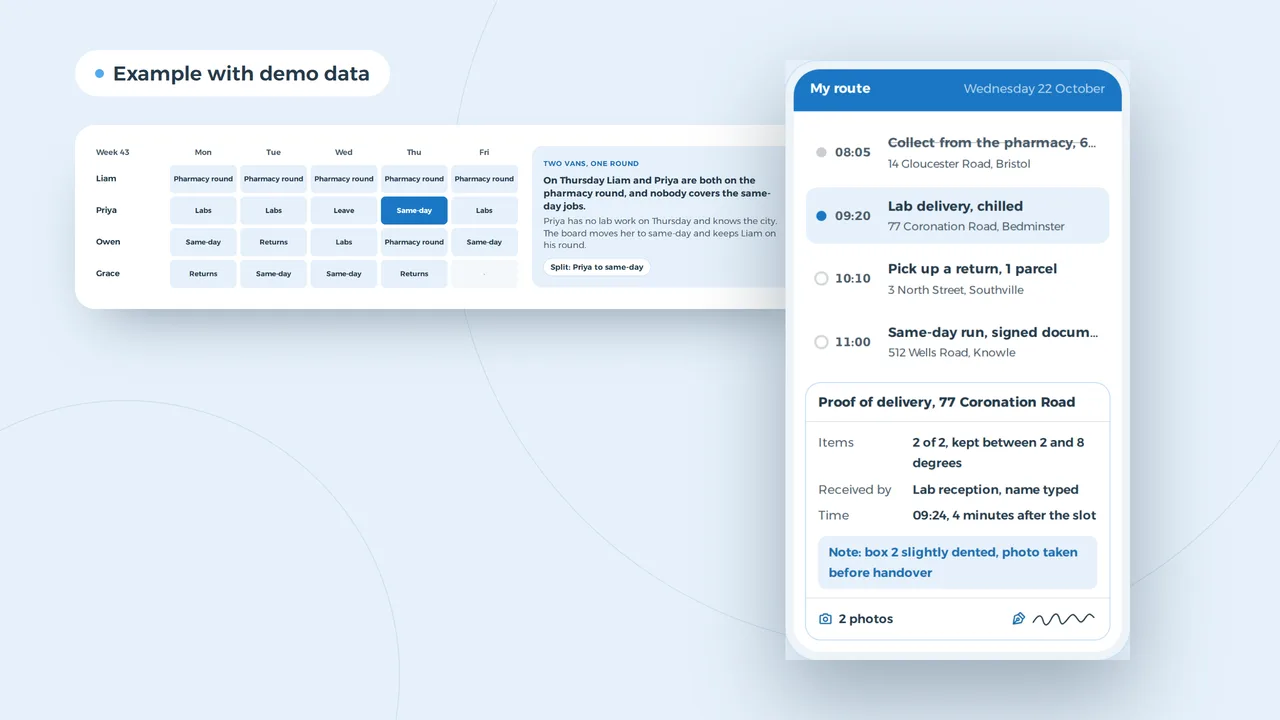
Dispatch board catches two vans on the pharmacy round
Two vans, one round
On Thursday Liam and Priya are both on the pharmacy round, and nobody covers the same-day jobs.
Priya has no lab work on Thursday and knows the city. The board moves her to same-day and keeps Liam on his round.
Split: Priya to same-day
A sample board for a courier firm with names that belong to nobody. You set which clashes it looks for.
A dispatch board for couriers is not a calendar with names on it. It knows which round is fixed and which job is urgent, which vehicle has a tail lift or a chiller, and who has already done ten hours. When the lab calls at half ten, the controller sees at once who is nearby and whether their next drops can wait. If one job clashes with another, the board says so before the driver sets off, not when they are standing at a locked door.
If you run rounds for several accounts, each one gets its own windows: the pharmacies before nine, the lab every two hours, the online shop after lunch. A spreadsheet can carry you a long way; when it stops working is the subject of Excel scheduling or planning software, and the move itself is in replace Excel with software.
Labs and online shops searching for a local courier
New enquiry
Samples to the lab every weekday, collect at 4pm, about 3 boxes
GP practice, Bedminster, today 11:52
- A page per type of job: medical, documents, same-day, regular rounds
- A Google profile with the areas you cover
- A form that asks for stops, times and weight
The firms and reviews in this sample are made up.
Pharmacies, labs and shops as regular accounts
A courier lives on regular accounts: the pharmacy that sends prescriptions out every morning, the lab with samples, the online shop whose parcels have to go today. Those customers search for "same day courier Bristol" or "medical courier" and choose between the first three names on the map.
Three things help. A website with a page for each kind of work you want: medical runs, same-day, scheduled rounds for online shops, documents between offices. A Google profile with the right category and recent reviews; setting one up is in create a Google Business Profile, and collecting reviews in get more Google reviews. And a form that asks what the controller needs: jobs per week, windows, weights, chilled or not.
We build a site like that from 1,500 euro; how that works is on website design, and a rough budget for the UK is in website cost in the UK. Showing up in the towns you cover is local SEO. After a good month, send a regular customer a Google review link.
Eighteen addresses in an email turned into a route
A sample of what we build. The AI works from your rates and zones; the planner decides what goes out.
AI does not plan your round for you. It does the retyping: addresses from an email, a customer's spreadsheet or a photo of a consignment note land on the board as drops, grouped by area with their windows. The controller moves things around, approves and sends the round to the drivers. The inbox works the same way: a new enquiry, a complaint about a late delivery and a request for a proof of delivery each land in their own list, with a draft reply a person checks. More on that in AI in transport and AI customer service. An AI agent that books jobs on its own is something we only build with a person confirming each one.
Drivers who know the city and stay
Sample with names we invented. You choose the questions on the form.
Couriers look for work on their phone, often in the evening after a round. A good driver knows the city, turns up on time and brings the vehicle back in one piece; you will not find them with a two-page form. We put the vacancy on your own site with the questions that matter to you: licence and how long held, which area, employed or self-employed, when they can start. The controller sees applicants in a list with their status. What you show as an employer is called employer branding. Once they are on board, rotas go into staff scheduling software, and AI for HR speeds up the first replies to applicants.
Fleet size decides how much system you need
An owner-driver with one vehicle does not need an ERP. A firm with thirty vans needs more than a shared calendar. This is what we would build at each size.
| Size | What you need | What you do not need (yet) |
|---|---|---|
| Owner-driver | A website with an enquiry form, a Google profile, a job list on the phone with proof of delivery that turns into an invoice | A dispatch board, roles and permissions, an ERP |
| Team of 5 | A board for regular rounds and same-day work, the driver app, a tracking link for customers | Route optimisation over hundreds of drops, a warehouse module |
| Firm of 20 to 50 | Areas and windows per account, rates per job type, subcontracted drivers on the board, a link to your accounts package | A large package where half the screens are about HGVs |
| Larger company | A portal where accounts book their own jobs, links with online shops, figures per customer | A second system next to the first |
If self-employed drivers work for you, the board has to show their jobs without putting them on your staff list. Once a few regular accounts want to book themselves, a client portal is the natural next step. The difference between a customer system and one for the whole business is in CRM vs ERP.
Licences, clean air zones and Making Tax Digital
Most couriers drive vans, and vans carry fewer rules than lorries. Fewer is not none. These are the ones that most often belong in your system.
| Situation | What the rule asks | What the software does |
|---|---|---|
| Vans up to 3.5 tonnes within Great Britain | No operator licence needed | The vehicle record holds the weight, so the board flags anything heavier |
| Vans of 2.5 to 3.5 tonnes carrying goods to the EU | A standard international operator licence since 21 May 2022, and a smart tachograph 2 from 1 July 2026 | A flag on every vehicle that crosses the Channel |
| Driving in central London | ULEZ at £12.50 a day for vehicles that do not meet the standard, plus the Congestion Charge at £18 | Charges logged per job, so they can go on the invoice |
| Clean air zones | Charging zones in Bath, Birmingham, Bradford, Bristol, Sheffield and Tyneside | The vehicle record shows which vans are compliant |
| Drivers working through their own limited company | IR35 decides their status; HMRC's CEST tool helps check it | Contract type held per driver |
| Self-employed couriers | Making Tax Digital for Income Tax above £50,000 since 6 April 2026, £30,000 from 2027 and £20,000 from 2028 | Income and costs per job, ready for quarterly updates |
| Employing drivers | Employers' liability insurance of at least £5 million | A reminder before the policy runs out |
VAT returns already go through Making Tax Digital, and B2B e-invoicing over Peppol becomes mandatory from 1 April 2029; how that will work is in e-invoicing in the UK, and what an invoicing tool needs today is on Peppol invoicing software. The software files nothing for you; it keeps track of what applies to which vehicle and which driver.
Drop rates checked against a six-van example
| Task per week | WhatsApp and a spreadsheet | Courier management software |
|---|---|---|
| Retyping customer jobs | 5 hours | 1 hour |
| Ringing drivers about where a parcel is | 4 hours | 1 hour |
| Finding proof of delivery for a complaint | 2 hours | 0.5 hours |
| Counting drops for invoices | 3 hours | 0.5 hours |
| Total | 14 hours | 3 hours |
That is 11 hours a week, 517 hours over 47 weeks. At £30: 517 x 30 = £15,510 a year. Add the drops that never reached an invoice. Six vans with 35 drops over five days make 1,050 drops a week. If 1 in 200 slips through, that is 5 a week; at £5 a drop, 5 x 5 x 47 = £1,175. Together £16,685 a year in this example. Yours may be more or less. What building software costs in general is in custom software development cost, and the software development cost calculator gives a first estimate.
Couriers start with a call, a price and a test round
- A conversation about your roundsWho books, who dispatches, how proof of delivery comes back, when invoices go out? We walk through an ordinary week with your real accounts and windows.
- A fixed price per projectTogether we pick where you lose the most time and set a fixed price for that piece. A website with an enquiry form starts from 1,500 euro; software gets its price after the conversation.
- One round runs on itTwo drivers and the controller use the first version on a real round. What rubs, we change before everyone else joins. The code and the data belong to you.
We have no courier firm as a client yet, but at DA Logistics a dispatch board that flags clashes and a driver app in three languages have run every day since July 2026, for about thirty drivers and 34 vehicles.
Courier owners usually ask
Can customers track their own deliveries?
Yes. Every job gets a link with its status, sent by email or text, and the customer does not need an account.
Can self-employed drivers use the same app?
Yes, with their own role that shows only their jobs. Their drops are listed separately, ready for the invoice they send you.
Does it work in a basement car park with no signal?
It can, if we build it that way. The proof of delivery is stored on the phone and sent once there is signal again. We decide that at the start, because it shapes how the app works.
Do I have to replace my accounts package?
No. Customers, jobs and invoices go to the package your accountant uses; API integration services cover the link.
We also run lorries. Is this the right page?
Partly. For heavier vehicles, tachographs and operator licences, transport software is the wider page. Passenger work is on taxi companies.
I am just starting out. Where do I begin?
With the basics in start a courier business in the UK, then a website and a job list on the phone. A board can come later.
Custom software
How VBS helps you with this
We build the platform your business runs on every day: your spreadsheets, emails and paperwork in one system that does what you do.
- Your workflow mapped first, then a fixed price
- Screens for the office, the client and the road
- Hosting, backups and security managed by us on AWS
How we approach it is on our page about Custom software.
Rounds and same-day work on one board?
Tell us how a day at your firm runs. We will show where we would start and what it could save you.
Rather get in touch right away?