Industries: physiotherapy
Physiotherapy software for the work your practice system leaves to you
Notes, invoicing and insurer billing stay in the practice system you already pay for. We build what sits around it: the site that fills your diary, exercises on the patient's phone, a rota for rooms and classes, and letters you only have to check.
A physio's day runs in 30-minute slots
Physiotherapy software has to fit a day cut into half hours. Four patients back to back from eight, a home visit at half ten, a new low back in the afternoon and a Pilates class at six. Between them the phone rings, an insurer wants an authorisation code and a GP is waiting for a progress letter.
Most clinics already run notes and invoicing in a practice management system such as Cliniko, TM3 or WriteUpp, and they do that job well. What happens around it often still lives on paper or in someone's head: printed exercise sheets, a gym timetable on the wall, a job advert that sits on a board for three months. That is the part we build.
Where a clinic week leaks time
Time is rarely lost during the treatment itself. It leaks before and after: the phone that rings while you are mobilising a knee, the exercise sheet the patient lost on the bus, the gym that two colleagues booked for the same hour.
| Moment | How it often goes | With your own app beside the practice system |
|---|---|---|
| A new patient looks for an appointment | They ring during a session and you call back at seven | They book a free slot with the right physio online, and say whether they are self-paying or insured |
| The session | Notes on paper, typed up later | A short record on the phone, at home visits too and without signal |
| Exercises at home | A printed sheet with stick figures | A video per exercise on the patient's phone, changed after each session |
| Insured patients | Counting how many authorised sessions are left | The number and expiry sit with the patient, with a nudge before the last one |
| The gym and classes | A sheet on the wall | A rota that sees when two people want the same room |
| Letters to the GP or consultant | In the evening or at the weekend | A draft from your own notes, which you read and send |
What we do not build is a second clinical record with billing. Your practice system already holds that, and splitting the record across two places is a risk for the patient and for you. Where your system offers an API, our app reads from it or writes to it; how such a link works is under API integration services.
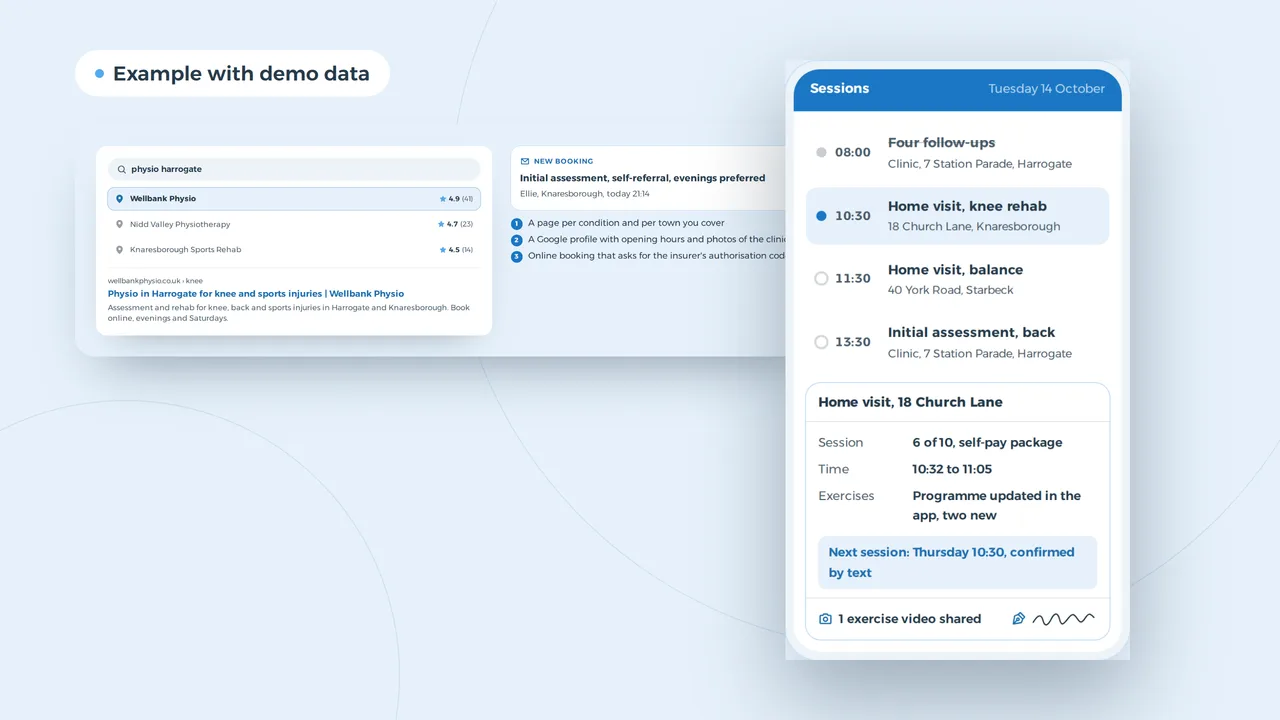
A search in Harrogate that turns into an initial assessment
New booking
Initial assessment, self-referral, evenings preferred
Ellie, Knaresborough, today 21:14
- A page per condition and per town you cover
- A Google profile with opening hours and photos of the clinic
- Online booking that asks for the insurer's authorisation code
Example with made-up clinics and reviews.
Being found in the towns you cover
People type the town and the problem: physio Harrogate, physio after knee replacement, sports massage Knaresborough. A clinic with its own page for those searches, listing the treatments you really offer and the places you visit, gets those patients. The Google profile counts as much: the right category, your hours, photos of the clinic and whether you take new patients. Setting it up is in create a Google Business Profile; how we handle local search is under local SEO.
A physiotherapy site is written differently from a shop's. HCPC standard 9.3 asks that your promotional material is accurate and not likely to mislead, and the CAP Code wants every objective claim backed by evidence. So no 'pain-free in five sessions', but a plain account of what happens at the first appointment and what it costs. The booking form asks for a name, a number, a time and whether the patient is insured, not what hurts; the complaint belongs in the assessment and in your record. We build such a site from 1,500 euros; what goes on each page is in website for therapists.
The home visit record, filled in at the bedside
- The note is written at the bedsideWhat you write at the patient's home is ready for the record, even without signal. Where your system allows a link, nothing is typed up in the evening.
- The package counts downYou see how many sessions are left and when the insurer's authorisation ends before you book the next block.
- Patients get their exercises on their phoneA short video per exercise instead of a printed sheet that ends up in a drawer.
An example of what we can build, with made-up addresses. You choose which fields a session note has.
An ACL rehab session moves out of the Pilates class
The board spotted a problem
Tom's ACL rehab session is in the gym at 6pm on Thursday, the same hour as Aisha's Pilates class.
The board moves the rehab session to treatment room 2, which is free at 6pm, and texts the patient the new room.
Fixed: Rehab moved to room 2
An example of what we can build, with made-up names. You choose what the board checks.
A diary that knows more than the hour
The diary in your practice system knows when someone is coming. A clinic of five wants to know more: who is out on home visits, which room is free, who runs the back class, and whether a patient's insurer still covers the next session. We build that rota around your own rules.
For the patient we build an exercise app: a video per exercise, the programme you adjust after each session and a tick per day when they did it. It does not have to be in the App Store; a web app that sits as an icon on the phone is often enough, as described under app development. Documents or videos that must be shared securely belong in a client portal with two-factor authentication, never in an email attachment.
Finding an MSK physiotherapist for the second treatment room
An example of what we can build, with made-up names. You choose what you ask.
Hiring without a three-month advert
A private clinic grows as fast as it finds physiotherapists. Band 5s leaving the NHS look in the evening on their phone at clinics near home; experienced MSK physios hear about you from a colleague first. An application that wants a CV in Word loses them. So we put the job on your own site with three questions that matter: name and number, HCPC registration or the date it is expected, and when to call. Employed or self-employed, you set the questions. What your clinic shows to people who might work there is called employer branding; who works when, you plan with staff scheduling software.
Letters you read instead of write
AI does not write a letter in your place and decides nothing about treatment. It drafts from what you dictated or noted after the session: progress, the exercises, the next step. You read, change and send. The same works for a discharge summary or a handover to a colleague who takes over your patient.
Four dictated notes become a progress letter for the GP
An example of what we can build, with a made-up patient. The AI drafts from your own notes, you decide what goes out.
Rules that belong in the software
Health data is special category data under UK GDPR, and the ICO is the regulator that enforces it. An AI model that reads your notes therefore runs with a supplier that signs a data processing agreement, keeps nothing to train on and stores data where your policy says it may. How we set up such a private assistant is under custom ChatGPT for business; whether the public version will do is in is ChatGPT safe for business. The rest of the rules we build in come from the HCPC standards of conduct, performance and ethics, checked at the source on 31 October 2026.
| Situation | What the rule asks | What the software does |
|---|---|---|
| Your website and adverts | HCPC 9.3: promotion must be accurate and not likely to mislead | No promise of an outcome, no discount on blocks of sessions |
| Patient information | HCPC 5.1: keep information about service users confidential | Booking forms do not ask about symptoms, access per role, two-factor sign-in |
| Records | HCPC 10.1: full, clear and accurate records | What is noted in our app lands in your record, not in a second file |
| Keeping records safe | HCPC 10.3: keep records secure | Encrypted storage, a log of who opened what, nothing kept longer than needed |
| Health data | UK GDPR article 9: special category data | Lawful basis and purpose written down per form, data in the UK or EU |
The software diagnoses nothing and decides nothing about treatment. It makes sure the rule is in front of you at the moment it counts. The difference between the UK and EU versions of the law is in UK GDPR vs EU GDPR.
How much system a clinic of your size needs
A sole practitioner does not need an ERP or a planning system of their own. A multidisciplinary clinic with thirty clinicians needs more than a diary. This is what we would build beside the practice system, by size.
| Size | What you need | What you do not need (yet) |
|---|---|---|
| Sole practitioner | A site with online booking and a Google profile, exercise videos by link, drafts for letters | A rota, roles and permissions, an app of your own |
| Clinic of five | A rota for physios, rooms, classes and home visits, an exercise app, a careers page | An intranet, a link to every system |
| Clinic of 20 to 50 | Several disciplines in one rota, roles per clinician, intake per discipline, a link with the practice system | An ERP or a large suite you use half of |
| Group or network | A platform across sites, a portal for referrers and insurers, reports per site | A second clinical record beside the first |
A group with several sites needs a platform of its own; what drives that cost is in custom software development cost, and whether to build at all in build vs buy software. Other health practices have their own page: software for dental practices, and for a health charity software for charities.
Three physios and a week of phone calls and paper
| Task per week | Phone and paper | With online booking, a rota and an exercise app |
|---|---|---|
| Booking calls | 90 minutes | 45 minutes |
| Writing letters | 120 minutes | 40 minutes checking |
| Reshuffling rooms and classes | 60 minutes | 15 minutes |
| Explaining exercises again | 60 minutes | 20 minutes |
| Total | 330 minutes | 120 minutes |
That is 210 minutes a week, or seven 30-minute slots now spent on paper. Over 46 working weeks it comes to 161 hours for the whole clinic. Whether those hours become appointments, an earlier finish or the class you have meant to start for a year is your choice. To run the sum with your own figures, use the software development cost calculator.
Starting from an ordinary clinic week
- A call about your weekHow do patients find you, who plans rooms and home visits, which practice system do you use, and where does the time go? We look at a normal week, not a feature list.
- A fixed price per projectWe pick the piece that costs the most time and give it a fixed price. A website starts from 1,500 euros; software gets its price after the call.
- One physio uses it firstA colleague works with the first version for a few weeks with real patients. What does not fit, we change before the rest of the clinic joins. You own the code and the data.
We do not have a physiotherapy clinic as a client yet; we did shield sensitive data in the management platform for Business Centrum, with two-factor sign-in, sessions you can revoke and encrypted storage.
Questions physiotherapists ask us
Does your software replace Cliniko, TM3 or WriteUpp?
No. Notes, invoicing and insurer billing stay in your practice system. We build what comes beside it: the site, online booking, the exercise app, the rota and drafts for letters, linked to your system where it offers an API.
Can patients book online without the site collecting health data?
Yes. The form asks for a name, a number, a time and whether they are insured or self-paying, not what hurts. The complaint is discussed at the assessment and belongs in your record.
Is AI for clinical letters safe with patient data?
Only when the supplier signs a data processing agreement, keeps nothing to train on and stores data where your policy allows. That is how we build it, and the physiotherapist checks every draft before it is sent.
Can my website show patient reviews?
Check your professional body's guidance and HCPC standard 9.3 first. A review that promises an outcome can mislead. Your approach, your registration and a clear fees page build more trust.
Do you work with clinics in the UK?
Yes. We work in English and remotely, and we write the regulated parts with you for the UK.
What does physiotherapy software from VBS cost?
You pay for the piece you want first, at a fixed price agreed after a call. A website starts from 1,500 euros.
Custom software
How VBS helps you with this
We build the platform your business runs on every day: your spreadsheets, emails and paperwork in one system that does what you do.
- Your workflow mapped first, then a fixed price
- Screens for the office, the client and the road
- Hosting, backups and security managed by us on AWS
How we approach it is on our page about Custom software.
Fewer phone calls and less paper in your clinic?
Tell us how a week runs at your clinic and which practice system you use. We will show you where we would start.
Rather get in touch right away?