AI for electricians
AI for electricians: the paperwork prepared, the decisions still yours
Quotes from a photo, enquiries sorted, job reports from a voice note. AI drafts, the electrician checks, nothing leaves without a person saying yes.
The evening shift nobody gets paid for
AI for electricians earns its place in the hours after the tools go down. The day ends at five, and then the second shift starts: three quotes from photos customers sent, a dozen emails, the notes from today's jobs to type up, a landlord asking when the report will arrive. None of it is wiring, all of it decides whether next month is busy.
That is the work AI is good at preparing. It reads a photo of a fuse board and a few lines from a customer and lays out the lines of a quote from your price list. It sorts the inbox into enquiries, complaints and supplier invoices. It turns a two-minute voice note recorded on the drive into a tidy job report.
It does not test, inspect or sign. Every draft goes to a person who checks it, changes what is wrong and decides what goes out. Below is where that line sits, what it looks like inside the tools your firm already uses, and a worked example for a small crew.
A photo of the fuse board becomes a first quote
An example of what we can build. The AI proposes from your own price list, you decide.
What AI prepares and what stays with the electrician
The split is simple: AI prepares text and lists, a qualified person makes every decision that touches safety, money or a customer.
| Task | What AI prepares | What the electrician decides |
|---|---|---|
| Quote from a photo and a note | The lines: new consumer unit, dedicated circuits, sockets, testing, from your own price list | The prices, what the photo does not show, whether to visit first |
| Enquiries by email or form | Sorted by job type and urgency, with a draft reply | Which reply goes out and when the job is booked |
| Voice note after a job | A written job report with materials and extra work | Whether it is right before it reaches the customer or the invoice |
| Landlord paperwork | A covering email with the report attached and the deadline for any remedial work | What the report says; AI never writes test results or codes |
| Supplier invoices | Lines read and matched to jobs | What gets paid and what gets queried |
| Certificates | Nothing. AI does not fill in or sign an EIC, a minor works certificate or an EICR | Everything |
The last row matters most. Under Approved Document P, notifiable work goes through a competent person scheme or building control, and the person who did the testing signs for it. No model takes that over. Where AI helps is everything around it: the email, the reminder, the report the landlord actually reads. For the full picture of software for an electrical firm, see software for electrical contractors.
Four places AI for electricians saves an evening
Quotes the same night
A customer sends a photo of the board and a note about a kitchen. The draft quote is ready in your system before you are home. How that works in general is on the AI quote generator page; the quote template shows the lines a good quote needs.
An inbox that sorts itself
Call-outs, EICR requests, complaints and wholesaler invoices each go to their own list with a draft answer. A person sends it. More on AI customer service.
Job reports from a voice note
Two minutes talking on the drive becomes a written report on the job sheet, with materials and extra work for the invoice. Our work order app page shows where it lands.
Supplier invoices matched to jobs
Cable, breakers and chargers from the wholesaler read from the PDF and booked to the right job, so job costing stays honest. See invoice automation.
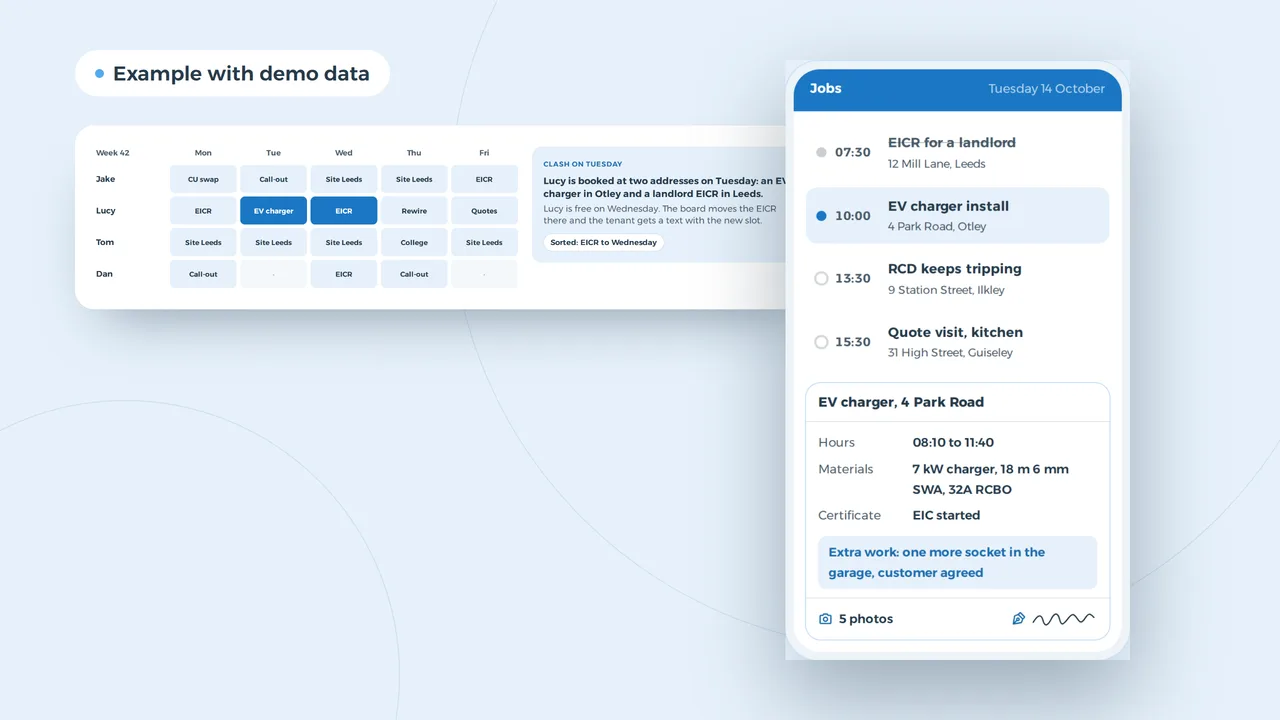
Where the drafts end up: the electrician's phone
- The office sees the job sheet at onceHours, materials and extras are ready for the invoice. Nobody types up paper sheets.
- Certificates stay with the addressAt the next EICR or call-out, the history of that property is already in the file.
- The customer signs on the phoneExtra work is agreed before you leave, so it does not turn into a dispute on the invoice.
An example of what we can build, with made-up addresses. You choose which fields a job sheet has.
Landlord deadlines kept without a spreadsheet
Landlord work is where the paperwork piles up fastest. In England a privately rented home needs an EICR at least every five years. The tenant gets a copy within 28 days of the inspection, remedial work is done within 28 days or less if the report says so, and the landlord confirms the work in writing to the tenant and the council within 28 days of finishing it. Since 2025 the same rules reach the social rented sector. A landlord who misses them can be fined up to 40,000 GBP, so they remember which electrician kept them on time.
AI is good at the admin around those dates. When the report is done, it drafts the email to the landlord with the report attached, the list of remedial items in plain words and the date the work has to be finished. It suggests a slot for the remedial visit from your planning. A month before an inspection falls due, it drafts the reminder for the next one. Your office checks each draft and sends it.
What AI never does here is decide the codes, the outcome or what counts as dangerous. That stays with the inspector who tested the installation, under BS 7671. For a lettings agent with forty properties, a firm that sends a clear report and a dated plan the same day is the firm that keeps the portfolio. How the jobs and reports fit together in one system is on software for installers.
Customer data, mistakes and the person who signs
Three questions come up with every electrical firm we talk to.
Where does the data go? Photos of a customer's home, addresses and tenant details are personal data. We choose a model provider with a data processing agreement and settings that keep your data out of training, and we store the files in your own system. If you use a public chatbot today, read is ChatGPT safe for business first, and write down what staff may paste into it with the AI policy template.
What if it gets something wrong? It will, sometimes. A model can miss what a photo does not show or invent a line that sounds right; that is called an AI hallucination. That is exactly why the electrician approves every draft, and why we build the screen so that checking takes seconds: the photo next to the quote, the voice note next to the report.
Who is responsible? You are, as you are now. AI changes who types, not who signs. A quote that goes out under your name is your quote, and a certificate is never touched by it.
If you want a broader look at where to start with AI in a small firm, our guide on implementing AI in a business goes step by step. A plumbing firm faces the same questions with different paperwork; compare AI for plumbers.
A clash on Tuesday, a suggested fix
Clash on Tuesday
Lucy is booked at two addresses on Tuesday: an EV charger in Otley and a landlord EICR in Leeds.
Lucy is free on Wednesday. The board moves the EICR there and the tenant gets a text with the new slot.
Sorted: EICR to Wednesday
An example of what we can build, with made-up names and addresses. You choose which rules the board checks.
Planning is the other place a suggestion saves time. When a call-out pushes a job, or two jobs land on the same electrician, the board flags the clash. AI looks at who is free, who holds the right qualification for an EV charger or an inspection, and how far the vans are apart, and suggests a move with a draft message to the customer. The person who plans the week accepts it, changes it or ignores it. For bigger firms that run site work too, AI for construction covers the same idea for longer projects, and AI automation is how we connect it to the tools you already use. A plain overview of what is on the market is in AI tools for business.
Six quotes a week, worked through
| Task per week | By hand | With AI drafts, checked by a person |
|---|---|---|
| Quotes, 45 minutes each | 4.5 hours | 1.5 hours |
| Sorting and answering email | 3 hours | 1 hour |
| Typing up job reports, 5 minutes each | 3.75 hours | 1 hour |
| Total | 11.25 hours | 3.5 hours |
That is 7.75 hours a week, about 356 hours over 46 weeks. At £45 an hour: 356 x 45 = £16,020 a year in this example. The bigger gain is often harder to count: a quote that arrives the same evening is more likely to be the one a customer accepts. Count a week of your own quotes and emails before you believe any number, ours included.
Starting with one task, not ten
- Pick the task you hate mostFor most electricians that is quoting or typing up reports. We start there and leave the rest until the first part works.
- Feed it your own way of workingYour price list, ten real quotes you were happy with, the words you use. The drafts should sound like your firm, not like a chatbot.
- Check every draft for the first weeksA person approves everything, always. In the first weeks you also note what the draft got wrong, and we adjust until checking is quick. Then the next task.
We build these tools as part of AI for business, and the same approach drives the AI quote generator. The site that brings in the enquiries in the first place is covered on electrician website design. We have not built AI for an electrical firm yet; the job-sheet app and planning board it plugs into run daily at DA Logistics.
AI for business
How VBS helps you with this
We build AI into your own work: it drafts emails, reads documents and answers questions, and you stay the one who decides.
- First a task that costs time, then a working prototype
- On your own documents and your own data
- An AI policy your team understands
How we approach it is on our page about AI for business.
Quotes out the same evening?
Tell us which part of the paperwork costs you the most evenings. We will show you what a first AI draft of it would look like.
Rather get in touch right away?