Industries: veterinary practices
Vet practice software that sits beside your PIMS, not in place of it
2013
Your practice management system keeps the clinical record, the diary and the invoices. We build what it leaves on paper: a dispensary that knows every batch in every car, farm visits recorded where they happen, medicine records ready for the VMD inspector, and a site that puts out-of-hours cover first.
A vet practice is a clinic, a dispensary and a fleet of cars
Vet practice software usually means the PIMS: the diary, the clinical record per animal, the invoices and the reminders. You have one. Around it sits work the PIMS rarely covers well. Every POM-V you supply needs a record with its batch and expiry. Each vet's car is a small dispensary. Farm visits end with a label, a withdrawal period and a note typed up back at the practice. And at 2am someone searches for a vet with a dog that cannot stand.
This page sets out what we would build for a UK practice, beside your PIMS: by need, by size, and with the rules from the RCVS, the VMD and the ICO that come with it. Everything you see is an example with made-up names and batch numbers.
Where a practice day leaks time
A mixed practice in Kendal starts at half seven on a dairy farm in Burneside, runs morning consults, drives up to a hill farm near Sedbergh and finishes at a livery yard in Windermere. The time is not lost with the animals. It leaks out around them.
| Moment | How it often goes | With an app built beside your PIMS |
|---|---|---|
| A bottle from the car | Written on a pad in the yard, typed into the PIMS that evening | You pick the product from your car's stock, batch and expiry come with it |
| The label and withdrawal period | Handwritten, the farmer keeps it somewhere | Printed or sent to the farmer, the record holds the same text |
| Restocking the cars | A shout across the dispensary on Monday morning | Each car has a minimum, the list builds itself from what was supplied |
| The annual stock audit | A weekend of counting, discrepancies chased through paper | A count per location, set against the records, discrepancies listed for the audit |
| A vaccine about to expire | Found in the fridge after the date | An alert thirty days ahead, with the booked boosters beside it |
| Out of hours | Clients find an old number, or the wrong practice | The out-of-hours number tops every page and your Google profile |
None of that replaces your PIMS. Where it has an API, we read from it and write back to it. How such a link works and what it asks of your supplier is on API integration services.
A round of three farms and a clinic, with the visit in progress
- The batch follows the bottleYou pick the medicine from what is in your car. Batch and expiry go on the label and into the supply record without retyping.
- Records the VMD inspector asks forDate, product, batch, quantity, recipient and prescriber in one place, kept for five years.
- No signal in the fellsThe app keeps the visit and sends it once there is signal again.
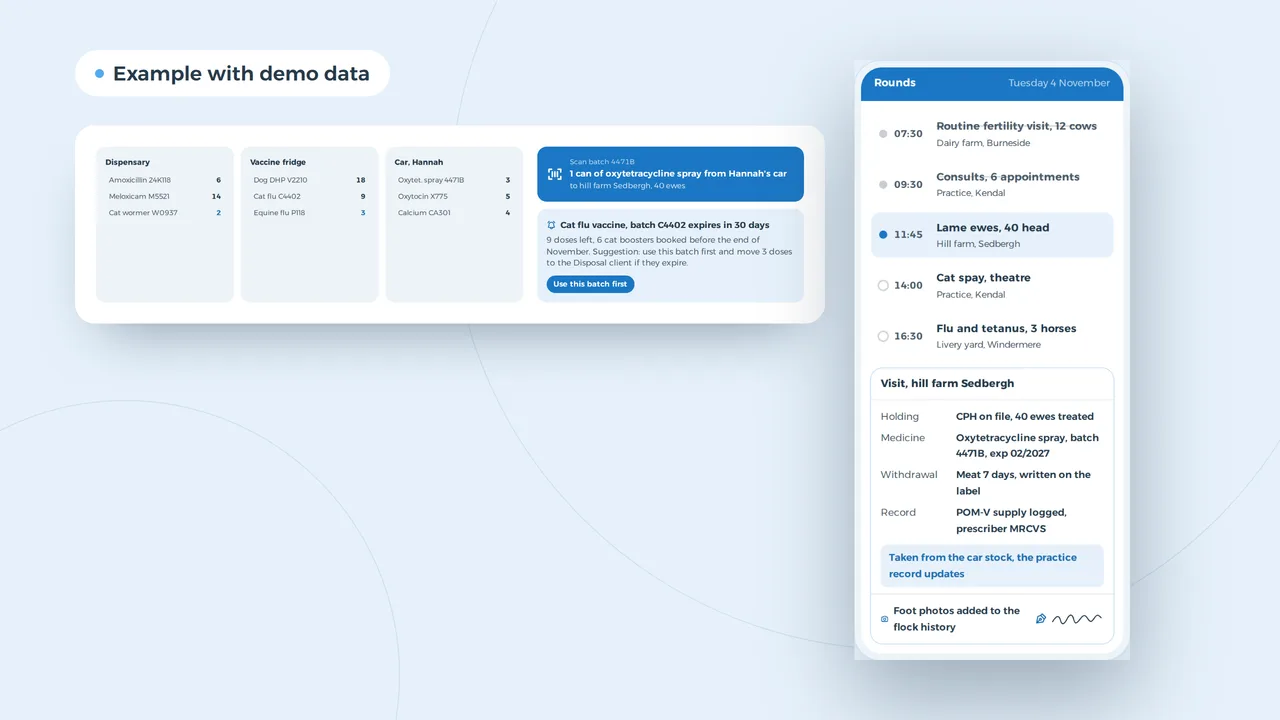
An example of what we can build, with made-up farms and batch numbers. You choose which fields a visit has.
Farm visits recorded in the yard
On a farm you administer, leave medicines behind or prescribe. For POM-V and POM-VPS products, regulation 23 of the Veterinary Medicines Regulations 2013 asks for a record of the date, the product, the batch number, the quantity, who received it and who prescribed it. On the phone you fill that in where you stand: the holding is already on file, the product comes from your car's stock, the withdrawal period from the data you set up once per product. The farmer signs on the screen and receives the label text by email, which helps with their own medicine book.
The same visit can feed the herd or flock history: what was treated, how many head, and the photos you took. The next vet on that farm sees what you saw.
The dispensary, the vaccine fridge and a vet's car, by batch and expiry
Cat flu vaccine, batch C4402 expires in 30 days
9 doses left, 6 cat boosters booked before the end of November. Suggestion: use this batch first and move 3 doses to the Disposal client if they expire.
An example of what we can build, with made-up batch numbers. You choose the locations and limits your practice has.
A dispensary that knows every batch
Most PIMS know what you sold. Fewer know what sits in which car, which batch runs out next month or where one particular bottle went. A dispensary built for you holds stock per location: the pharmacy, the vaccine fridge, every car. Goods in are scanned and recorded with batch, expiry and supplier. Every visit or sale records the recipient. A correction never overwrites: it is a new line with a reason, so the record stays complete for the inspector.
Once a year you count. The VMD's inspection criteria ask for a detailed stock audit at least annually, with discrepancies recorded. The software lays the count beside the records and lists the differences. Expired and returned stock goes to a Disposal client, the way the VMD suggests, so it leaves the shelves on paper too. Controlled drugs keep their own register, bound or electronic and not amendable, as the rules require. The general version of such a system is inventory management software; for a vet practice it adds batch, expiry and the medicine record.
Your PIMS, and what we build beside it
What stays in the system you already pay for, and what a separate app does. Where your PIMS does it well, we do not build it again.
- Clinical record
- In your PIMSStays there, with history and invoices
- In the app beside itReads along where the API allows
- Dispensary
- In your PIMSOften a sales list without location or batch
- In the app beside itPer location and per batch, with the annual audit set out
- Farm visits
- In your PIMSTyped in back at the practice
- In the app beside itRecorded on the phone in the yard, signal or not
- Out of hours and booking
- In your PIMSA diary for the clinic
- In the app beside itOnline booking for consults, out-of-hours cover on the site
- Recruitment
- In your PIMSNot its job
- In the app beside itA job page that MRCVS and RVN candidates apply to from their phone
A small companion-animal practice often needs only the dispensary and the site. The rest grows with the practice.
Found locally, with out-of-hours cover first
Someone types 'vets' and their town and sees three practices on the map. What they want next is plain: are you open now, and who do I ring tonight? A site that answers that on every page, with opening hours, the out-of-hours number and online booking for a vaccination or a check-up, takes those calls off the front desk.
The RCVS treats a practice name as advertising, so it has to be accurate: 'Veterinary Hospital' only with that accreditation under the Practice Standards Scheme, 'Specialist' only for someone on the RCVS list. The site keeps names and titles in one place, so they match on every page and on your profile. How to set that profile up is in create a Google Business Profile. The booking itself is a booking system for your website.
A search in Kendal that becomes a booking for a new kitten
New booking
New kitten, first vaccination and microchip, Saturday if possible
Sophie, Burneside, today 20:42
- Opening hours and out-of-hours cover at the top of every page
- A Google profile under a name the RCVS allows
- Online booking for consults, emergencies stay on the phone
Example with made-up practices and reviews.
Finding a vet or an RVN in a rural area
A mixed practice outside a city often spends longer looking for a vet than for clients. A new graduate wants to know how the out-of-hours rota is shared, how much farm work there is and whether the paperwork waits for them after a round. A job page that says so, with an application in three taps on the phone, beats a PDF. You ask only what you need to call back: name, mobile number and whether they are MRCVS or RVN registered. Planning the team itself, with on-call nights and leave, is staff scheduling software and fits on the same screen.
A job page for a mixed-practice vet near Kendal
An example of what we can build, with made-up names. You choose what you ask.
Discharge notes and reminders from your own notes
AI makes no diagnosis and decides nothing about an animal. It does the writing after a consult: four dictated notes become a draft discharge note for the owner, with home care, the medication as you prescribed it and the date of the recheck. The reminder for that recheck is ready as a text. The vet reads it, edits and sends.
The same works for messages that come in overnight: a booster question, a rebooking, a photo of a wound. The AI sorts them before reception starts at 8. Anything that looks urgent goes to the top with a call-back flag, and a person decides. How such a model handles data inside the UK or EU is on AI customer service.
Four notes after a spay become a discharge note
An example of what we can build, with a made-up patient. The AI drafts from your own notes, you decide what goes out.
Vet practice software by size
A single-vet companion-animal practice does not need an ERP, and usually not its own app either. A practice with five vets, three cars and an equine side needs more than a diary. This is what we would build per size, beside your veterinary software.
| Size | What you need | What you do not need (yet) |
|---|---|---|
| Single vet, companion animals | A site with hours and out-of-hours cover, a Google profile, online booking, vaccine reminders | Its own app, a planning board, roles and rights |
| Mixed practice, two to five vets | The dispensary per location and batch, farm visits on the phone, the annual audit set out | A second clinical record beside your PIMS |
| Group or several branches | One dispensary view across sites, staff scheduling with on-call, an inbox sorted by AI, figures per branch | A system that repeats what your PIMS does |
What drives the cost of a custom build in general is in custom software development cost.
Other care practices use the same building blocks. A dental practice plans surgeries and domiciliary visits with NHS claims instead of a dispensary: see dental practice software. Home care runs a round every day, much like a farm vet, with check-in at the door: see home care software.
Vet practice software and the rules it has to respect
These are the rules that most often have to live inside a practice's systems, checked against the RCVS, the VMD, legislation.gov.uk and the ICO in October 2026. The table follows Great Britain; Northern Ireland has its own medicines arrangements.
| Situation | What the rule asks | What the software does |
|---|---|---|
| Supplying POM-V and POM-VPS | Veterinary Medicines Regulations 2013, regulation 23: a record of date, product, batch, quantity, supplier or recipient and prescriber, kept for 5 years | Every supply recorded at the point it happens, batch from the stock it came from |
| Batch for pets | For non-food animals the batch may be recorded at receipt or at first supply | Scanned at goods in, so each later supply carries it |
| Stock audit | VMD inspection criteria: a detailed audit at least once a year, discrepancies recorded | A count per location beside the records, the differences listed |
| Expired and returned stock | VMD suggests a Disposal client for what leaves the shelves | A Disposal client in the stock, with the reason per line |
| Controlled drugs | A register that is bound, or electronic and not amendable | Its own register, corrections as new lines, never overwritten |
| Your website and your name | RCVS Code, chapter 23: advertising accurate and truthful, within the CAP Code. A practice name is advertising; 'Veterinary Hospital' only with PSS accreditation, 'Specialist' only for RCVS-listed specialists | Names and titles from one list, the same on the site and the profile |
| Client data | UK GDPR: owners' names, addresses and payments are personal data. The practice pays the ICO data protection fee unless exempt | Data in the UK or EU, access per role, a log of who opened what |
Owner data is ordinary personal data rather than special category data, but it still needs a lawful basis, a privacy notice and a processor agreement with every supplier. What differs between UK and EU rules, if you use European suppliers, is in UK GDPR vs EU GDPR.
A mixed practice with three cars, in hours
| Task | Time back per week |
|---|---|
| Online booking: 30 x 0.3 x 3 minutes x 5 days | 2.25 hours |
| No typing up after the round: 15 x 6 minutes | 1.5 hours |
| Sorting messages: 12 x 2 minutes x 5 days | 2 hours |
| Total | 5.75 hours |
Over 46 weeks that is about 265 hours. Add 10 hours from the audit and 12 x 1 = 12 hours from the controlled drug checks: 287 hours. At £17: 287 x 17 = £4,879 a year of time, in this example. What the practice does with those hours is its own call: longer with a patient, a lighter on-call week, leaving on time. This example says nothing about clients or income. Count your calls and visits for one week, and run the sums.
A conversation first, then a fixed price per project
- A morning on the roundWe ride along for a morning and look round the dispensary: which pad sits in the car, where records get typed up, what your PIMS already does and where its API lets us connect.
- A proposal with a fixed priceWhat we build, in which order, and a fixed price per project. A website starts from 1,500 euros; the rest is priced after the conversation.
- The slowest part firstIn a mixed practice usually the dispensary and farm visits on the phone, then the site with out-of-hours cover. Each part works on its own.
- Data in its placeA processor agreement, data in the UK or EU, access per role. The clinical record stays in your PIMS.
We do not have a veterinary practice as a client yet, but the platform we built for DA Logistics also keeps stock that a government body checks, with a correction log, a discrepancy report and an app for whoever is on the road.
Questions vets ask about software
- Does this replace our PIMS?
- No. The clinical record, diary and invoices stay in your practice management system. We build what sits beside it: a dispensary by location and batch, farm visits on the phone, the annual audit set out, a site with out-of-hours cover, and links where your PIMS has an API.
- What medicine records does a UK vet practice have to keep?
- For POM-V and POM-VPS: the date, product, batch, quantity, supplier or recipient and prescriber, kept for five years under regulation 23 of the Veterinary Medicines Regulations 2013. Controlled drugs keep their own register.
- How often does a practice have to audit its medicine stock?
- The VMD's inspection criteria ask for a detailed stock audit at least once a year, with discrepancies recorded. Software that counts per location and sets the count beside the records makes that a day rather than a weekend.
- Can we call ourselves a veterinary hospital on our website?
- Only with that accreditation under the RCVS Practice Standards Scheme. The RCVS treats a practice name as advertising, and 'Specialist' is kept for vets on the RCVS list.
- What does vet practice software cost?
- It depends on what you need. After a first conversation you get a fixed price per project, so you know the cost before work starts. A website starts from 1,500 euros.
Custom software
How VBS helps you with this
We build the platform your business runs on every day: your spreadsheets, emails and paperwork in one system that does what you do.
- Your workflow mapped first, then a fixed price
- Screens for the office, the client and the road
- Hosting, backups and security managed by us on AWS
How we approach it is on our page about Custom software.
A round with no typing up afterwards?
Tell us how your practice handles the dispensary, farm visits and out-of-hours cover today. We will look along and say what we would build, beside your PIMS.
Rather get in touch right away?