For US companies
Outsourcing to Europe from the USA: what a team in Belgium changes
Two shared office hours with New York, EU law built in, and a fixed price per module instead of an hourly meter.
Why a US company looks at Europe at all
Yes, a US company can outsource software development to Europe, and many do: you sign a contract with a European company, agree who owns the code, settle how data crosses the Atlantic, and plan your days around a time difference of six to nine hours. What you get in return is a team that works under EU law every day, often in several European languages, at rates that sit below most US agencies but above Eastern Europe and Asia.
This page is written for a buyer in the United States weighing a team in Western Europe. It covers the hours you share with Ghent from each US time zone, what a year of development costs per model, the contract and tax points that differ from a US vendor, the EU data rules, and when Europe is the wrong choice. Belgium is not the cheapest country in Europe, and we say so below; the case for it is time zone, language, EU law and a fixed price.
Your working day on our clock
Office hours 9:00 to 17:00 local time, drawn in Ghent time, outside the switch weeks of March and October
- Ghent
- New York, Boston, Atlanta2 h shared
- Chicago, Austin, Dallas1 h shared
- Denverno overlap
- San Francisco, Seattle, LAno overlap
1,200 developer hours, about one person for a year, at market rates
- US agency100 to 149 dollars an hour$120k to $179k
- US senior freelancer95 to 150 dollars an hour, one person$114k to $180k
- Belgian agency, market range50 to 150 euros an hour$67k to $201k
- Eastern Europe, senior freelancer40 to 85 dollars an hour, one person$48k to $102k
Thousands of US dollars. The euro range is converted at 1 euro = 1.12 dollars.
Market ranges, not quotes. We do not sell hours: after a first call you get a fixed price per module, and that price is what you compare.
The hours you share with Ghent
Ghent runs on Central European Time, six hours ahead of New York for most of the year. With office hours from 9:00 to 17:00 on both sides:
| Your time zone | Behind Ghent | Shared office hours | Your window |
|---|---|---|---|
| Eastern (New York, Boston, Atlanta) | 6 hours | 2 | 9:00 to 11:00 |
| Central (Chicago, Austin, Dallas) | 7 hours | 1 | 9:00 to 10:00 |
| Mountain (Denver) | 8 hours | 0 | none, unless one side flexes |
| Pacific (San Francisco, Seattle, Los Angeles) | 9 hours | 0 | 7:00 to 8:00 if you start early |
For about three weeks in March and one week around the end of October, the US and Europe are on different sides of daylight saving, and the gap shrinks by an hour. Our time zone overlap calculator shows the exact window for any date and city.
Two shared hours with the East Coast is enough for a daily call and same-day answers, if both sides work in writing around it. A team in Ghent ends its day as your afternoon starts: questions you send before 11:00 Eastern are answered the same day, questions you send in your afternoon are answered before you start the next morning. For the West Coast the rhythm is mostly written, with one fixed early call a week or two.
What a year of development costs, by model
Rates are only a start, but they set expectations. For 1,200 developer hours, roughly one full-time developer for a year:
| Model | Market rate | 1,200 hours | What the rate includes |
|---|---|---|---|
| US agency | 100 to 149 dollars an hour | 120,000 to 178,800 dollars | project management, QA, a team behind one contract |
| US senior freelancer | 95 to 150 dollars an hour | 114,000 to 180,000 dollars | one person; review, testing and holidays on your side |
| Agency in Belgium, market range | 50 to 150 euros an hour | 60,000 to 180,000 euros | as a US agency, in your morning |
| Senior freelancer in Eastern Europe | 40 to 85 dollars an hour | 48,000 to 102,000 dollars | one person, often in a time zone one hour further east |
Labor costs in Belgium are among the highest in Europe: Eurostat puts the average hourly labor cost in 2024 at 48.20 euros in Belgium, above Germany and France and against an EU average of 33.50 euros. A Belgian team does not win on price per hour against Poland, Portugal or Romania, and it should not claim to. Where it can win is on total cost: fewer misunderstandings, less rework, a supplier that knows EU law, and a price fixed per module before work starts.
We do not sell hours. After a first call we write your scope down in modules and give a fixed price per module; you sign what you need, in the order you need it. Comparing that price with an hourly quote is the honest test. How rates compare across Europe is in developer rates by country, and how a fixed price per module is built is on nearshore software development.
The contract points that differ from a US vendor
- Governing law and courtsA European supplier will propose its own law and courts. Agree on one in the contract, or on arbitration; many US buyers accept Belgian or English law for a supplier in Belgium.
- Ownership of the codeWork made for hire is a US concept. In Europe ownership of software moves by a written assignment of the intellectual property; put it in the contract, from the first commit.
- Currency and invoicesMost European agencies invoice in euros. Agree the currency up front; with a fixed price per module, the exchange rate is the only moving part.
- Data processing agreementIf the software touches personal data of people in the EU, the GDPR asks for a processing agreement between you and the supplier.
Taxes and payments, in plain terms
A Belgian company that provides software development to a business in the United States generally charges no Belgian VAT: under EU rules the place of supply of a service between businesses is where the customer is established, and that is outside the EU. The invoice states that VAT does not apply and why. US sales tax on custom software services depends on your state; ask your accountant how your state treats software services bought from abroad, and whether any withholding applies to the payment. Neither question changes the price a European supplier quotes you.
Payments run by international bank transfer, in euros or in dollars if the supplier accepts it. Agree on payment per delivered module rather than per month: you pay for working software you have seen on a test link.
Data, privacy and accessibility across the Atlantic
This is where a European team gives you something a US vendor usually does not: the rules of your European customers are its everyday work.
- GDPRIf your product serves people in the EU, the GDPR applies to you as well, wherever your servers are. A European team builds the consent, privacy notice and processing agreements in from the start; what the law asks of a US company is in GDPR for US companies.
- Data transfersData that moves from the EU to the US needs a legal route, today usually the EU-US Data Privacy Framework, upheld by the EU General Court on September 3, 2025 and under appeal at the Court of Justice. If your EU customers want their data kept in Europe, the software can run in an EU cloud region; see EU data residency.
- AccessibilityYour US site answers to the ADA; your EU sales answer to the European Accessibility Act, which has applied to online shops and many consumer services since June 28, 2025. One build can meet both, because both point to WCAG; see ADA website compliance and the European Accessibility Act.
- AIIf your product includes AI features sold in the EU, the EU AI Act sets obligations by risk level.
When Europe is the wrong choice
- Choose a US team ifyour users and stakeholders are on the West Coast and your product needs daily live collaboration: zero overlap is a real cost.
- Choose Eastern Europe, Latin America or Asia ifyou have a stable backlog, a strong product owner on your side, and price per hour decides. That is a sound choice; nearshore vs offshore and Eastern vs Western Europe developers set out the trade-offs.
- Choose a team in Western Europe ifyou sell or plan to sell in Europe, your product has to handle EU rules, languages and currencies, or the hard part is understanding a business process rather than typing code.
Questions US buyers ask before they sign
Can a US company outsource software development to Europe?
Yes. You contract with a European company as with any vendor, with an assignment of the intellectual property, a governing law, and, if EU personal data is involved, a data processing agreement.
How many working hours does New York share with Belgium?
Two office hours on most days, 9:00 to 11:00 in New York, and three in the weeks when daylight saving differs. Chicago shares one; the West Coast none unless someone starts early.
Is software development in Belgium cheaper than in the US?
Usually per hour, not always: Belgian agencies charge 50 to 150 euros an hour against 100 to 149 dollars for US agencies. Belgium is more expensive than Eastern Europe, Portugal or Germany in labor cost.
Do I pay Belgian VAT on software development as a US company?
Generally not: a service to a business outside the EU is supplied where the customer is. Your accountant can confirm the treatment on your side of the ocean.
Custom software
How VBS works with US companies
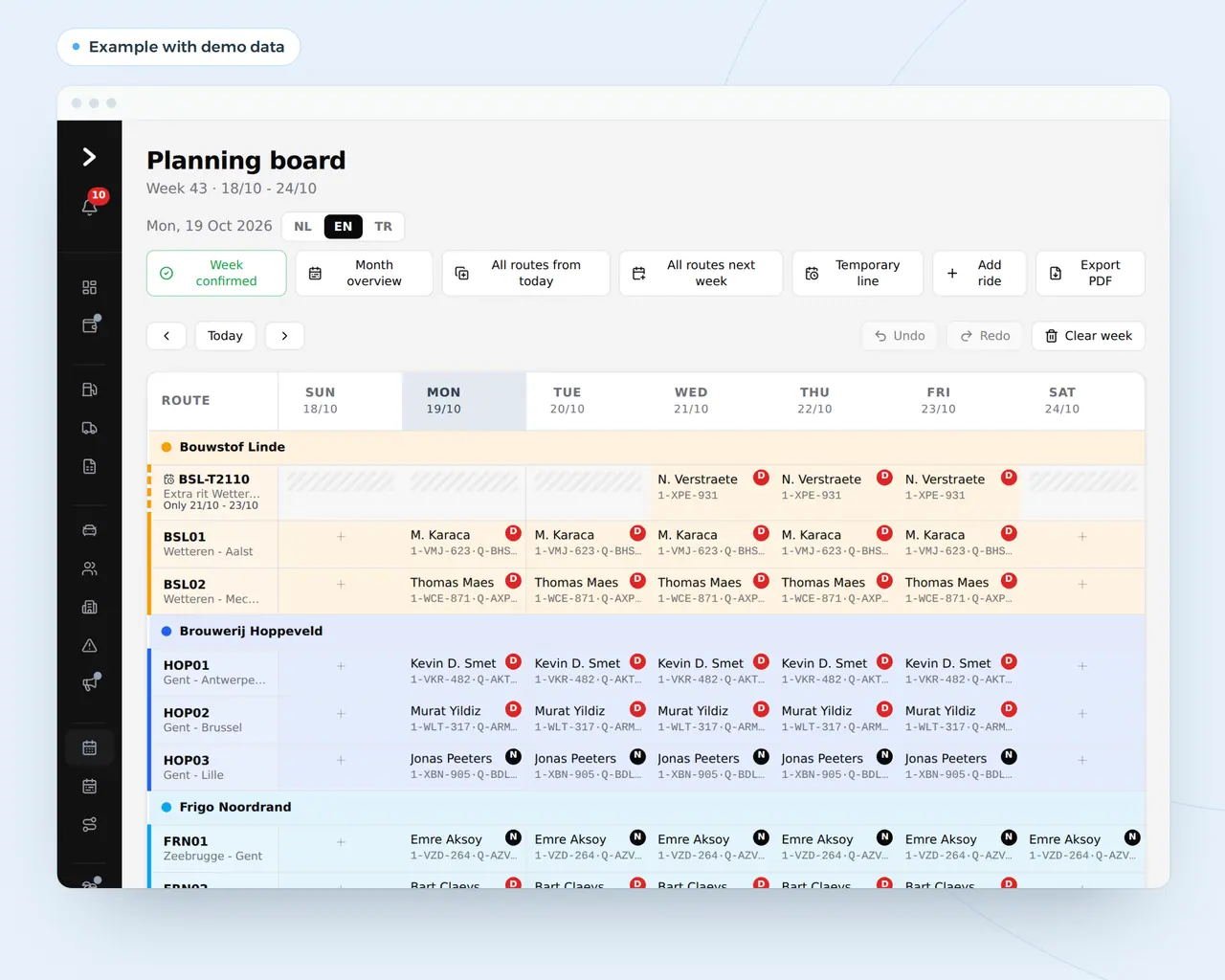
We are a team in Ghent, Belgium, that builds the platforms companies run on. For DA Logistics, a haulier in Belgium, we built planning, fuel stock under the Belgian Kader B rules, fleet files and a driver app in Dutch, English and Turkish, used every day by around thirty drivers. The same core runs as a product for Zuco Logistics, on a server of its own: domain, certificate and app went live in 57 minutes. Every release goes out with a backup and a way back, switching over in 2 to 6 seconds.
For a US client we plan a fixed call in your morning, work in English in every ticket and every document, host in the region your customers need, and price each module before we start. The repository is yours from the first commit. See custom software development and web application development, or book a call in your morning, our afternoon.
Planning a build with a team in Europe?
Tell us what the software has to do and where your users are. We come back with modules and a fixed price for each.
Rather get in touch right away?