Builders and renovators
Website for contractors that wins the job before the site visit
Your own projects, a price range up front and a request form that asks the right things, so the homeowner calls you and not the next name on a lead list.
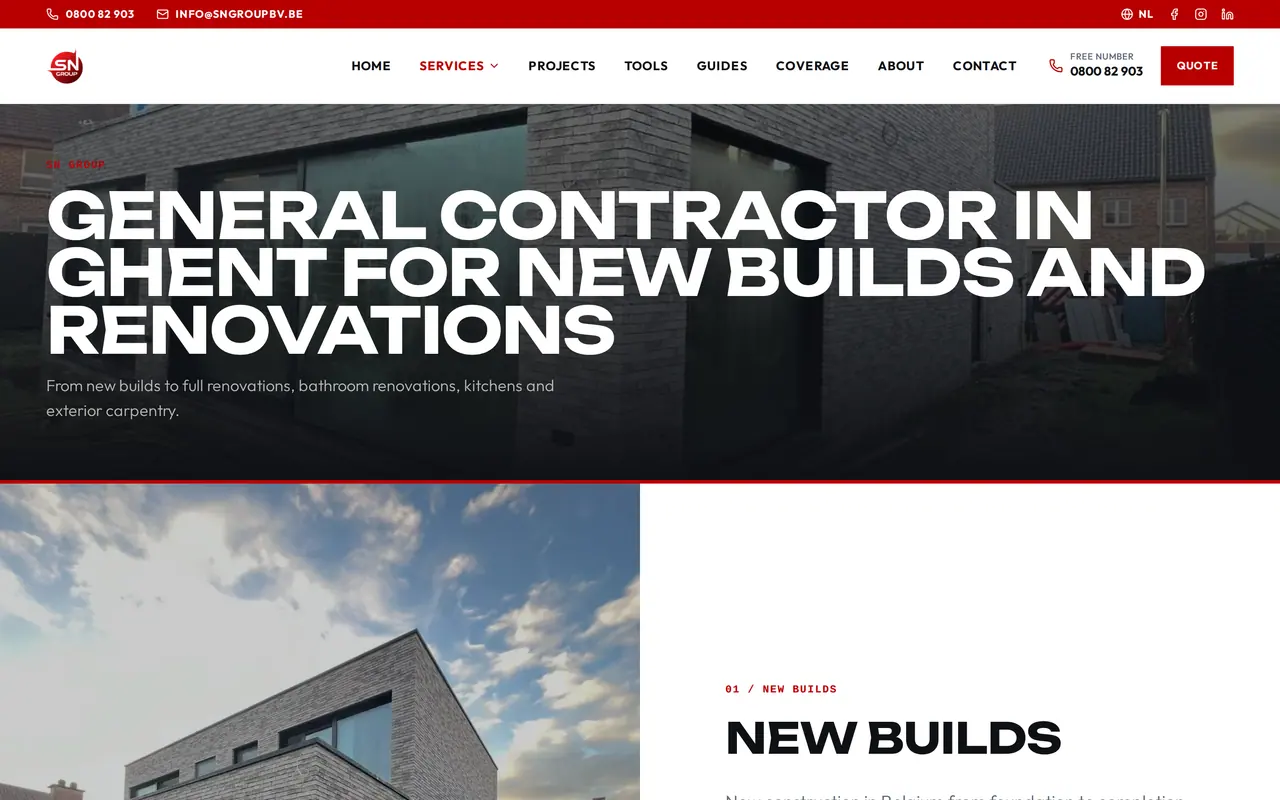
Homeowners shortlist builders on proof.
A website for contractors has one job: make a homeowner who plans a bathroom, a loft or a full renovation pick up the phone to you. They look for work like theirs, a rough price and a sign that you will turn up. Lead platforms sell that same homeowner to several firms at once; your own site keeps the request for you.
We build these sites for builders from our studio in Ghent, Belgium. For SN Group, a general contractor there, we made projects per kind of work, a five-step cost calculator, checks on grants, permits and VAT, and guides in Dutch and English. Below is what each part is worth in hours and money, and where to start on a tight budget.
The same three jobs, eight hours less on the road
No calculator12 visits of 2 hours, 1 in 4 signs
24 hours
With a calculatorwho finds the range too high drops out first
16 hours
96 hoursa year less driving and measuring, for the same number of bathrooms
A typical US bathroom remodel runs 6,651 to 17,660 dollars, about 12,154 on average. Three such jobs are some 36,500 dollars from twelve requests.
What one request from your own site is worth
Swap in your own numbers: your average job, your visits per month and your close rate. The gap between a visit that leads somewhere and one that dies on price is what a calculator earns you. More on how tools pull in search traffic in a calculator on your website.
Shared leads or your own site
| Question | Lead platform | Your own site |
|---|---|---|
| Who else gets the request | usually several firms | nobody |
| What you pay | per lead or per month | the build, then hosting |
| What the homeowner saw first | the platform's listing | your projects and your range |
| Data on the homeowner | what the platform passes on | the whole request, with photos |
| Works when you stop paying | no | yes |
Platforms are not wrong. They fill a quiet month. But every job you win there was a job you also had to price against others. A sensible split: keep a platform for areas where nobody knows you yet, and send everyone else, past clients and referrals included, to your own site. What a site costs in the first year and after is in website cost and website cost per year.
What to build first
- Choose projects and a good request form ifmost work comes by word of mouth and your diary is full. The site confirms what the homeowner heard, and the form asks for address, kind of job, timing and photos.
- Choose a page per service and per town ifyou want new clients in a fixed area. A bathroom page with your town in it gets found by people looking for a builder this month. How we work on local search: local SEO.
- Choose a calculator ifmany site visits die on price. It is the biggest build, and on SN Group's site the calculator draws the most search impressions outside the brand name.
- Choose guides and checks ifyou renovate where grants, VAT rates and permits decide the budget. Homeowners research those months ahead, and whoever answers gets the request.
Five steps from question to request
- 01Kind of projectNew build, full renovation, bathroom, kitchen or energy upgrade.
- 02Floor areaA slider in square metres, the number shown large.
- 03Quality levelStandard, premium or luxury: the range moves with it.
- 04ExtrasHeat pump, underfloor heating, solar panels.
- 05DetailsThe estimate goes by email, the builder gets the whole request.
The wizard on SN Group's site in Ghent. Whoever reaches the end has run the numbers before calling.
Guides that answer before the phone rings
SN Group's English guides explain the renovation rules in Flanders for expats who buy an older house in Ghent: what the energy label means, what must be done after the deed, which grants apply.
Each guide ends with the calculator or a request, so the reader who understood the rule can act on it straight away.
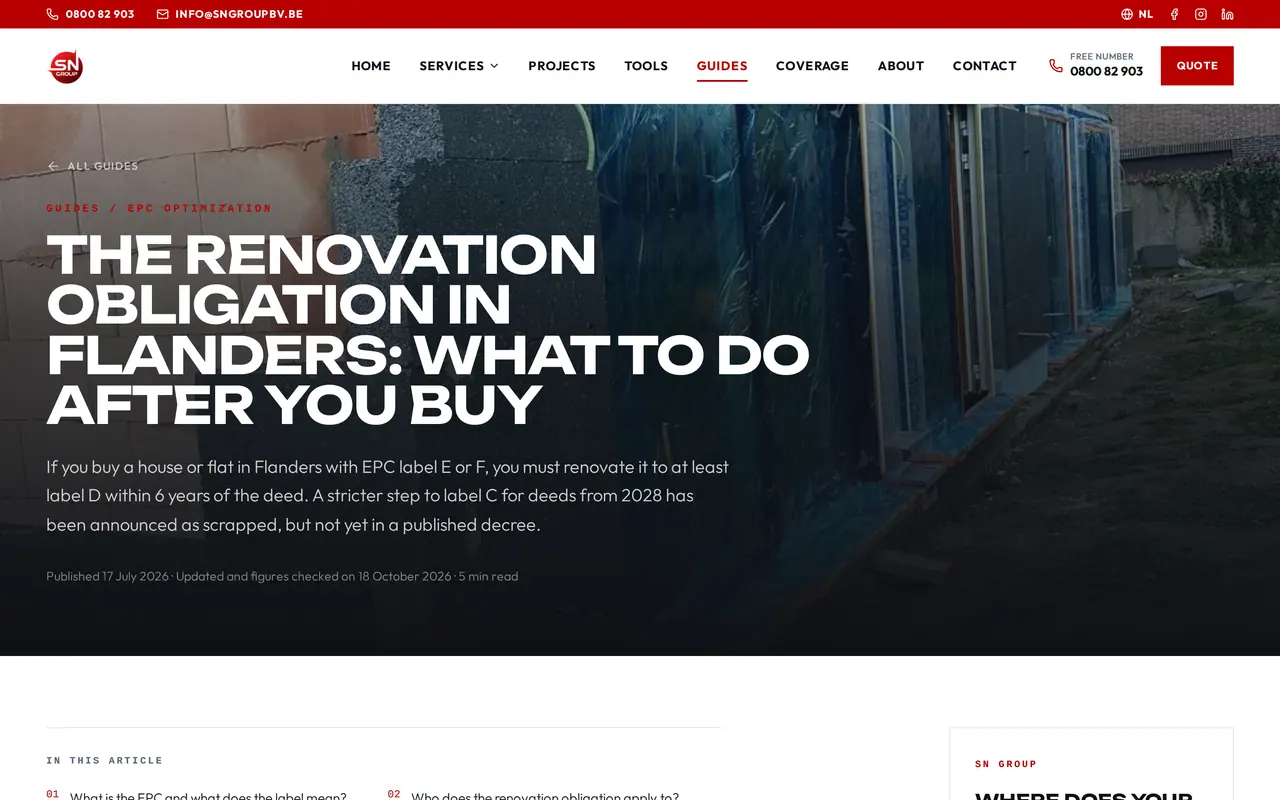
Rules differ per country, so the pages do too
What a homeowner wants explained depends on where you build. In Belgium it is the 6 or 21 percent VAT rate on renovation and the regional grants; in the UK it is planning permission and building regulations; in the US it is permits per city or county. We write those pages with you for your own market, with the answer in the first sentence and your quote as the next step. Got clients who speak another language? See multilingual website development.
The request form decides the visit
| Field | Why you want it | Keep it short |
|---|---|---|
| Address or postcode | you see at once whether it is in your area | one line |
| Kind of job | bathroom, kitchen, extension, full renovation | a choice, not free text |
| Timing | this month, this year, still dreaming | three options |
| Budget range | the same ranges as on your price page | optional |
| Photos | you judge the job before you drive out | up to five |
Five fields, most of them taps. A homeowner fills that in on a phone in a minute, and you call back knowing what to bring. The calculator above does the same in more detail.
Watch out for these five
Five things to do before Monday
- On every job finishing this month, take ten photos: start, work in progress, result.
- Put each project online with the town, the kind of work and one line on what the client wanted.
- Count the site visits of the last three months that died on price. That number tells you whether a calculator pays.
- Ask for a review at every handover with a link from the Google review link generator; when to ask is in get more Google reviews.
- Check your project pages on your own phone with the website speed test, and write down what you want from a web builder in the website brief template.
After the request comes the follow-up: a visit planned, a quote written, a crew scheduled. We build that too, see construction scheduling software, a work order app or an AI quote generator that drafts quotes from your site-visit notes.
What builders ask before they start
Do you work for contractors outside Belgium?
Yes. We build from Ghent, work in English and meet online. The site, the calculator and the request form work in any market; the pages on grants, permits and tax we write with you for yours.
Will a price range scare clients away?
It scares off the ones without the budget, which is the point. Whoever still sends a request after seeing the range knows what they are starting, and your visit is about the job instead of the price.
How soon does a site like this bring requests?
Your projects and your form work from day one for people who already know your name. Ranking for new searches takes months; a calculator and guides speed that up because they pull in homeowners who have no builder yet.
Website design
How VBS builds a contractor site
We build around your own jobs: projects per kind of work, a page per service and per town you really cover, and where it pays a calculator and checks on the rules of your market. For SN Group we made a cost calculator and an energy-label calculator, four checks and guides in two languages, 118 addresses in the sitemap. We film your sites for reels, see corporate video, and run them as Facebook and Instagram ads. A one-pager with projects starts at 1,500 euros; a site with service pages, guides and a calculator costs 5,000 euros or more, at a fixed price per part. The approach is on website design; how the marketing fits together in marketing for construction companies. Book a call.
Your work online, as it stands on site.
Tell us which jobs you want more of and how many site visits you drive a month.
Rather get in touch right away?