On this page
CPA is the point where advertising meets your profit and loss account. A high click-through rate or a low cost per click tells you how an ad performs; CPA tells you what it delivers. Spend £900, get 18 enquiries, and each enquiry cost £50. Whether that is good depends entirely on what an enquiry is worth to you, which no benchmark knows.
You decide what counts as a conversion: a submitted quote form, a phone call, a booking, a paid order. The idea comes from late-1990s affiliate marketing, when online shops paid partner sites only when a visitor bought. Today Google Ads lets you set a Target CPA and bids for you to stay near it, and Meta reports cost per result for every campaign.
A worked example: one software subscription
Take a B2B software firm selling a £99 per month subscription, with an average customer staying 20 months and a gross margin of 80 percent. A customer is worth £99 x 20 x 0.8 = £1,584 in margin. One trial in four becomes a paying customer.
If the firm is willing to spend a third of a customer's margin on winning them, it can pay £528 per customer, or £132 per trial sign-up. Its current campaigns bring trials at £95: room to raise the budget. Had they cost £180, the fix would not be more budget but a cheaper click, a better landing page or a trial that converts better.
How a monthly budget narrows to a handful of customers
- 500clicks2.40 euros per click (CPC)
- 30leads40 euros per lead (CPA)
- 6customers200 euros per customer (CAC)
Worked example: 6 percent of visitors request a quote, one in five quotes becomes a kitchen.
Four metrics that get confused
| Metric | Formula | Use it when |
|---|---|---|
| CPA | Cost / conversions | Any goal; the general measure |
| CPL | Cost / leads | Services and B2B, where a lead is an enquiry |
| CAC | All acquisition costs / new customers | Strategy: sales time and tools count too |
| ROAS | Revenue / ad spend | Online shops, where order values differ |
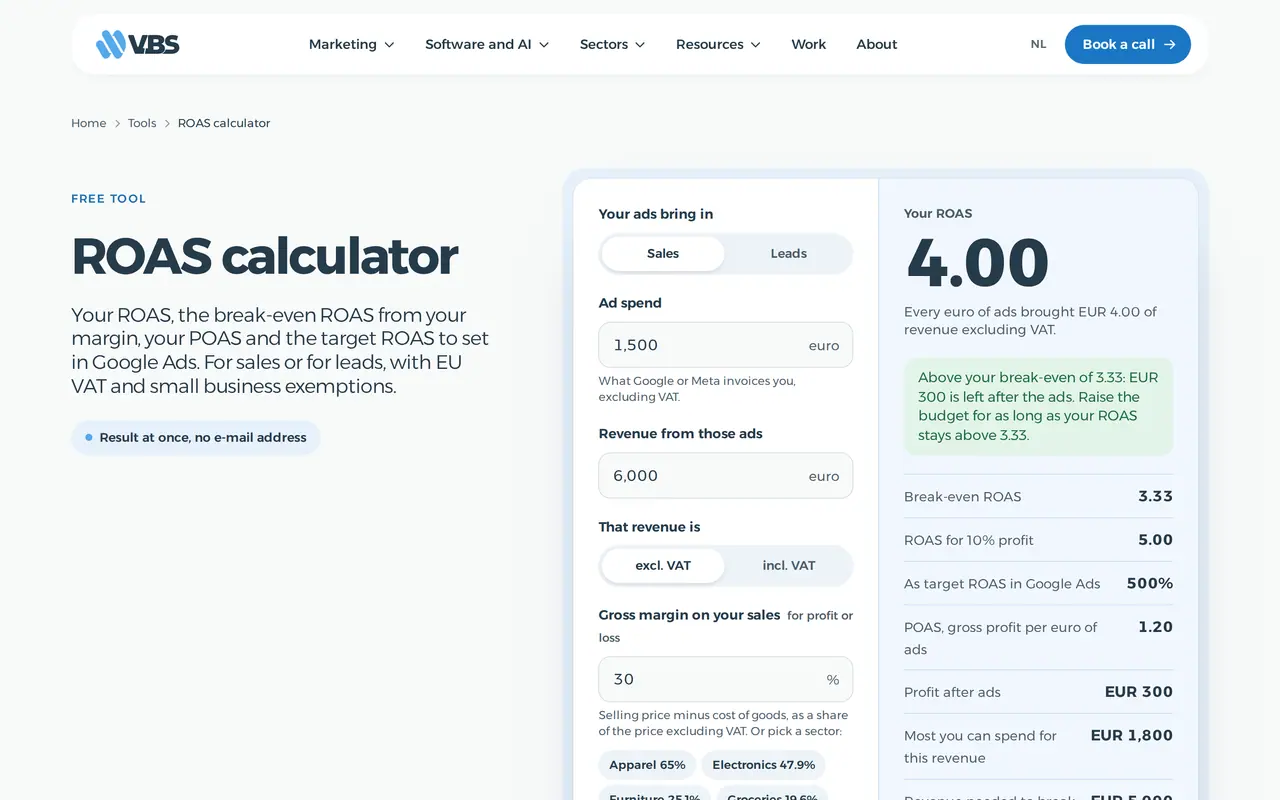
For an online shop ROAS is often the better guide; the ROAS calculator works it out. For a service business the cost per enquiry is the number to manage, and what separates a lead from a real enquiry is covered under lead generation.
Benchmarks give a sense of scale, not a target. Across US industries a lead from Google Ads cost $66.69 on average in 2026, from $29.96 for car repair to $131.63 for legal services and $102.51 for real estate. Your own maximum, worked from your margin, beats any average. Plug your figures into the Google Ads budget calculator, and read what Google Ads costs for budgets per month.
Why CPA jumps overnight
When CPA suddenly rises, check in this order. Did click prices rise, because a competitor entered the auction? Did the site convert fewer visitors, after a redesign or a broken form? Or did measurement change? Since March 2024, Google requires consent signals for visitors from the European Economic Area; a new cookie banner or consent setup can make conversions disappear from reports while customers keep arriving. A CPA that doubled overnight is more often a tracking change than a market change.
Setting a target CPA you can defend
- Count only real resultsA sent form, a call over a minute, a paid order. Never a page view.
- Work out the ceilingMargin per customer, times the share of leads that buy, times the share you will spend on winning them.
- Gather data firstLet campaigns collect a few dozen conversions a month before switching on Target CPA bidding.
- Look beneath the averageCompare CPA per keyword and audience; a few costly terms hide inside a healthy total.
What advertisers ask about CPA
What is a good CPA?
One well below your own maximum. An industry average says little about your margins and close rate.
Is CPL the same as CPA?
CPL, cost per lead, is a CPA where the conversion is a lead. CPA is the general term for any conversion.
Should I bid on Target CPA from day one?
No. Without a few dozen conversions a month, the algorithm has too little to learn from and spends erratically. Start with manual or maximise-clicks bidding and switch later.