On this page
CPC is the number most people look at first in Google Ads, and the one that misleads them most. Spend £600 on 240 clicks and you paid £2.50 per click. That tells you what a visitor costs. It says nothing about what a customer costs, which is the number your business runs on. On LinkedIn the CPC often runs above 6 dollar, see LinkedIn ads cost.
In search advertising you pay only when someone clicks, which is why the model is called pay per click. On Facebook and Instagram you usually buy impressions by the thousand, the CPM, and the cost per click is something you work out afterwards.
Why the highest bid rarely wins
Every search starts an auction among the advertisers bidding on that query. Google does not rank them by bid. It ranks them by ad rank, roughly your bid multiplied by the quality of your ad. Quality is summarised as a Quality Score from 1 to 10, built from expected click-through rate, how well the ad matches the query, and the experience on your landing page.
You then pay just enough to stay ahead of the advertiser below you. In the figure, builder B bids least, 2.50, but its ad and page are about exactly the renovation the searcher typed. It ranks first and pays 2.01: A's ad rank of 16 divided by B's own quality of 8, plus one cent. A bids 4.00 and pays 3.76 to come second. In search ads, relevance is cheaper than money.
One query, three advertisers, three prices
- 1
Builder B, ad and page about that exact renovation
bid €2.50 x quality 8 = ad rank 20
€2.01pays per click
- 2
Builder A, generic ad
bid €4.00 x quality 4 = ad rank 16
€3.76pays per click
- 3
Builder C
bid €3.00 x quality 5 = ad rank 15
reserve price
Simplified worked example. Today thresholds, the searcher's context and your assets count as well.
Cheap clicks can still mean expensive customers
US benchmarks for 2026 make the point, because they publish both the click price and the cost of a lead per industry. Real estate has one of the cheapest clicks and one of the most expensive leads: plenty of people browse, few enquire. Car repair is the opposite.
| Industry (US, 2026) | Average CPC | Average cost per lead |
|---|---|---|
| Legal services | $9.87 | $131.63 |
| Home improvement | $8.33 | $90.92 |
| Dentists | $8.00 | $72.97 |
| Business services | $5.87 | $93.69 |
| Car repair | $4.35 | $29.96 |
| Real estate | $3.22 | $102.51 |
| Restaurants | $2.05 | $30.57 |
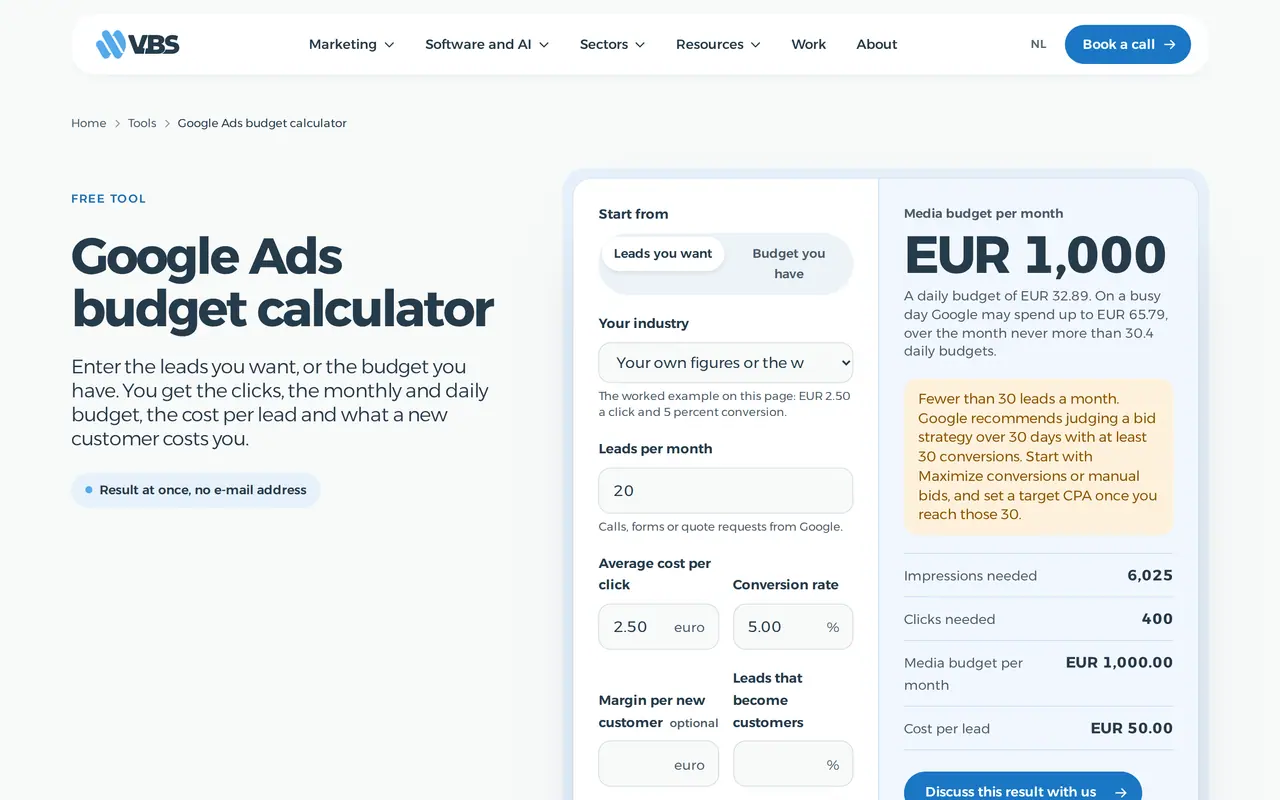
Run it backwards to find your ceiling: the most a lead may cost, times the share of visitors who become a lead. If a lead is worth €90 to you and 4 percent of visitors enquire, never pay more than €3.60 a click. The Google Ads budget calculator does this with your own figures, and the ROAS calculator checks whether revenue follows.
Every country, and every language, is its own auction
If you advertise in more than one market, do not copy a budget from one to the next. A query in Dutch in the Netherlands, the same query in Flemish Belgium and its French version in Wallonia have different competitors and different prices. English queries in a non-English market are often cheap simply because few locals type them, and they convert worse for the same reason. Keyword Planner shows a low and a high top-of-page bid per keyword for each location you choose: start there, then let a month of real data correct it. What a full campaign costs per month is broken down in our guide to Google Ads cost.
Three default settings that inflate your CPC
In accounts set up by the business owner, we keep finding the same three settings left as Google ships them. Broad match on every keyword, so you pay for loosely related searches. The search partner network switched on, which adds clicks from sites you never chose. And location targeting set to people "interested in" your area rather than people in it, so a plumber in Leeds pays for clicks from someone planning a holiday there. Fix these before you touch a single bid.
After that, the levers are the usual ones: one ad group per service and per language, each sending people to a page about exactly that service, negative keywords such as free, jobs and DIY, and a fast page; check yours with the website speed test. Wondering whether to pay per click at all or build organic traffic instead? Read SEO or Google Ads, and if you serve one town, how Google Ads works for local businesses.
What advertisers ask about click prices
What is the difference between CPC and PPC?
PPC, pay per click, is the model. CPC is the price of each click within it.
What is a maximum CPC?
The most you are willing to pay for one click. Your actual CPC is usually lower, because you only pay what keeps you ahead of the advertiser below you.
Why did my CPC jump this month?
Usually more competitors on the same queries, a drop in Quality Score, or an automated bid strategy chasing more conversions. Check Quality Score per keyword before raising budgets.