Industries: home care
Domiciliary care software for the hours between calls
Care plans, medication records and electronic call monitoring stay in the system your council and CQC already expect. We build what sits around it: a rota that counts the drive, a run your carers can follow on one phone, an update the family can open and a page that brings in your next care worker.
Forty calls before lunch, across six villages
Domiciliary care software has to work where the job happens: a kitchen in Bayston Hill, a bungalow in Minsterley with one bar of signal, a car on the A488 between two calls. A double-up starts at seven, a medication prompt at half past, a lunch call that cannot slip because the client is diabetic. In between, a daughter rings about tomorrow and the coordinator asks who can cover Pontesbury on Thursday.
Most agencies already run care plans, visit notes and call monitoring in a system on the government's Assured Solutions List, and that is the right place for them. What surrounds it often still lives in a WhatsApp group, a spreadsheet or the coordinator's memory. This page sets out what we build beside that system, the rules it has to respect and how much of it a sole provider or an agency with fifty carers actually needs.
The time that never shows on a timesheet
The care itself is rarely the problem. Hours disappear around it: rebuilding the rota when a carer goes off sick, ringing round for cover, answering families who want to know when someone is coming, and matching the council invoice against calls that ran short or late.
| Moment | How it often runs | With a tool built beside your care system |
|---|---|---|
| The rota | A coordinator, a big screen and a spreadsheet | A board that knows postcodes, travel time and which carer a client already knows |
| Sickness cover | An hour of phone calls before 7am | Calls offered to carers already working nearby, accepted on the phone |
| The run | A printed list or a screenshot in a group chat | The day's calls on the phone, with door codes and notes from the last visit |
| Families | Phone the office or the carer mid-visit | A link that shows when the next call is due and who is coming |
| Month end | Matching delivered minutes to the council's figures by hand | Commissioned against delivered hours per client, with late calls flagged |
| Recruitment | An advert on a job board that runs for weeks | A vacancy on your own site that a carer can answer from the sofa |
What we do not build is a second care record. Care plans, MAR charts and call monitoring belong in a recognised digital social care record, and there are several good ones. We build around it, and where it offers an API we read from it or write to it. How that works is set out under API integration services.
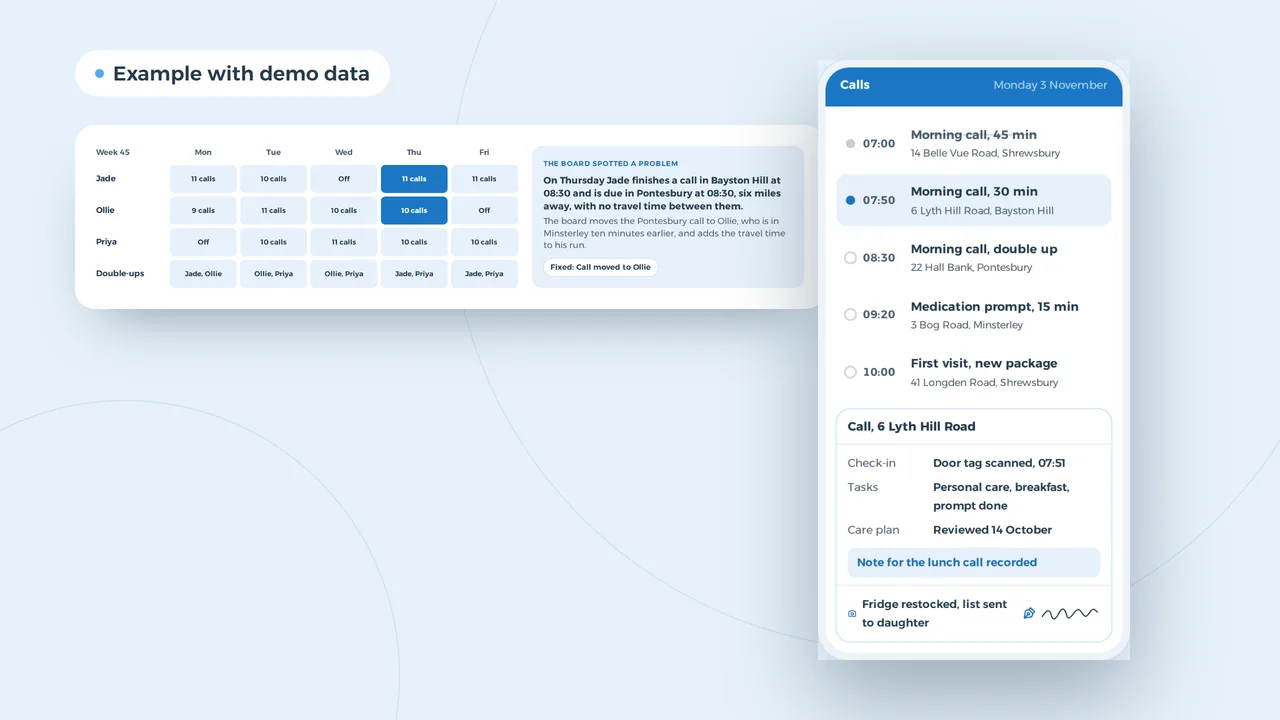
Two calls six miles apart with no travel time between them
The board spotted a problem
On Thursday Jade finishes a call in Bayston Hill at 08:30 and is due in Pontesbury at 08:30, six miles away, with no travel time between them.
The board moves the Pontesbury call to Ollie, who is in Minsterley ten minutes earlier, and adds the travel time to his run.
Fixed: Call moved to Ollie
An example of what we can build, with made-up names. You choose what the board checks.
A rota that counts the drive between calls
In most agencies the rota is one person's job and a large part of their week. A new package, a hospital admission, a carer who rings in sick: each change ripples through three runs. A board built for your agency knows your rules. How many calls a run can hold, which carers a client has met before, who drives and who does not, which calls are double-ups and which clients need the same carer at the same time each day.
Travel time is the rule that costs most when it is missing. Under the National Minimum Wage rules, time spent travelling between appointments counts as working time; the commute from home to the first call does not. A rota that leaves no gap between two calls six miles apart either makes the carer late or leaves them paid below the minimum for the hour. The board treats the drive as part of the shift. If you are weighing a spreadsheet against software for this, read Excel scheduling or planning software; how we build rotas in general is under staff scheduling software.
The morning run in Shrewsbury, on the carer's phone
- Check-in and check-out are the evidenceTime on site is logged at the door, so the council invoice matches what was delivered, not what was planned.
- The next carer knows what this one sawA spoken note sits with the client, not in a folder on the kitchen table.
- No signal, no problemIn a rural lane or a basement flat the app keeps the visit and sends it once there is signal again.
An example of what we can build, with made-up addresses. You choose which fields a call has.
One phone for the whole run
A care worker has a phone in one hand and a pair of gloves in the other. An app for the run should ask for very little: where next, what this call is for, who was here last and a button to say it is done. It keeps working with no signal and sends everything once the phone is back in range. It does not need to be in an app store; a web app saved to the home screen, a progressive web app, is usually enough.
Check-in and check-out are what the council reads, so they end up in your call monitoring system, sent from our app through an integration or logged in the system's own app and shown beside the run. Electronic call monitoring is not a single national rule; councils write it into their framework contracts, and many now ask for alerts on late or missed calls. With the check-in beside the run, a coordinator sees a late call before the family does.
A home care package, with no clinical content
The family see visit times and who is coming through a secure link. Care notes stay in the record.
An example of what we can build, with a made-up client and hours.
Commissioned hours that match delivered ones
Council-funded packages are paid on delivered time, and the gap between what was commissioned and what was delivered is where invoices get queried. A call that ran fifteen minutes short, a cancelled call that was never logged, a double-up where only one carer checked in. The care record holds each of those facts; what is often missing is the view across them before the invoice goes out.
We build that view per client, without clinical content. Families get a separate link that shows only when the next call is due and who is coming. Anything more personal, such as a review summary to sign, belongs in a client portal with two-factor authentication, not in an email thread.
Dictated notes become a draft visit summary
An example of what we can build, with a made-up client. The AI drafts from your own notes, you decide what goes in the record.
Visit notes you check rather than type
After a run of fifteen calls nobody wants to type fifteen notes. Speaking them in the car is quicker, but a voice memo is not a record. AI can turn a few spoken lines into a draft in the shape your care record expects: what was done, what was noticed, what the next carer needs to know. The carer reads it and approves it. The AI makes no care decisions, suggests no treatment and writes nothing to the record on its own.
With health data we build it on a model that runs in the UK or EU, under a data processing agreement, with no retention for training. Why a general chatbot is not enough for this is covered in is ChatGPT safe for business.
Finding a care worker for a fourth run
An example of what we can build, with made-up names. You choose what you ask.
A vacancy a carer can answer from the sofa
An agency grows as fast as it can recruit. The care worker thinking of moving from a care home looks at local jobs on their phone in the evening, and an application form that wants a CV upload loses most of them. We build the vacancy on your own site with three questions: name and number, whether they hold a full UK driving licence, and whether they prefer mornings, evenings or weekends. It states plainly that travel time between calls is paid. What you show the people who might work for you is employer branding.
The same site has a second reader: the son or daughter looking for care for a parent after a hospital discharge. They search by town, so a page per area you cover and a Google Business Profile with the right category do more than a slogan, as set out under local SEO. We build that website from 1,500 euros.
Sized for a sole provider or a fifty-carer agency
A registered manager running a small agency does not need an enterprise system or a planning board. An agency with fifty carers across three towns needs more than a shared calendar. Here is what we would build beside your care record at each size.
| Size | What you need | What you do not need (yet) |
|---|---|---|
| Sole provider | A site with a Google Business Profile, a family link, drafts for visit notes | A rota board, roles and permissions, your own app |
| Team of five | A rota with your rules and travel time, sickness cover, a vacancy page | An intranet, an integration with every system |
| Agency of 20 to 50 | Runs per area, roles for carers and coordinators, a link to your care record, hours per package | A large platform where you use half the modules |
| Larger or several branches | A platform across branches, a portal for families and commissioners, reports per area | A second care record beside the assured one |
What drives the cost of a project like this is set out in custom software development cost, and you can try your own figures in the software development cost calculator.
The rules a home care tool has to respect
Home care in England sits under several regulators and contracts at once. These are the rules that most often have to be built into the software, read at the source on 31 October 2026.
| Situation | What the rule asks | What the software does |
|---|---|---|
| Registration | Providing personal care in people's homes is a regulated activity, and the provider registers with the Care Quality Commission | Nothing: the tool keeps the records your registered manager already keeps, in one place |
| Care records | Government guidance, updated in September 2026, moves the sector to digital social care records; systems on the Assured Solutions List are assured by NHS England and can connect with GP records | Care plans and notes stay in the assured system; we read from it where it allows |
| Call monitoring | No national rule; councils write electronic call monitoring and late or missed call alerts into their framework contracts | The run shows the same check-in the council sees |
| Pay for travel | Under the National Minimum Wage rules, travel between appointments counts as working time | The rota treats the drive as part of the shift |
| Client data | Health data is special category data under UK GDPR; the ICO expects a lawful basis and an Article 9 condition | Forms ask nothing about care, data stays in the UK or EU, access by role |
The software decides nothing about care and certifies nothing. It makes sure the rule is in front of you at the moment it matters. Where UK GDPR and EU GDPR differ, see UK GDPR vs EU GDPR.
Ten carers and a week of phone calls
| Task per week | Spreadsheet and phone | With a rota board and a family link |
|---|---|---|
| Rota and changes | 360 minutes | 150 minutes |
| Sickness cover | 60 minutes | 20 minutes |
| Families asking when someone is coming | 90 minutes | 30 minutes |
| Matching hours for the council invoice | 30 minutes | 10 minutes |
| Total | 540 minutes | 210 minutes |
That is 330 minutes a week, five and a half hours of a coordinator's time. Home care does not stop for the holidays, so across 52 weeks it comes to 286 hours. Whether those hours go into supervision, an extra package or a coordinator who leaves on time is your call.
Starting from one week of your rota
- A conversation about your runsHow many carers, how many calls, which care record, who builds the rota and where the hours go. We look at an ordinary week, not a feature list.
- One price, agreed before we buildWe pick the part that costs you the most time and give a fixed price for it. A website starts from 1,500 euros; software is priced after the conversation.
- One run tries it firstA carer uses the first version on their own run for a few weeks. What does not fit gets fixed before the rest of the team joins. The code and the data belong to your agency.
We have no home care agency as a client yet, but for DA Logistics we built a weekly planning board that resolves its own conflicts and an app where drivers send leave requests and reports in three languages.
Other care and practice work has its own page: software for physiotherapists and software for veterinary practices, and for early years settings, software for nurseries.
Before an agency starts: the usual questions
- Does your domiciliary care software replace our care record system?
- No. Care plans, visit notes, MAR charts and call monitoring stay in the system you already use, ideally one on the Assured Solutions List. We build what sits beside it: the rota board, the carer's run, the family link, the vacancy page and drafts for visit notes.
- Can the rota include travel time between calls?
- Yes, and it should. Under the National Minimum Wage rules, travel between appointments counts as working time. The board gives each drive its own slot, so a run that looks full on paper but has no gap between distant calls shows up before the week starts.
- Will it work with our council's electronic call monitoring?
- Call monitoring stays in the system the council reads. Where that system offers an API or an export, our tools show the same check-ins and late call alerts beside the rota. Where it does not, we say so in the first conversation.
- Can families see visits without seeing care notes?
- Yes. The family link shows when the next call is due and who is coming, nothing about the care itself. Notes stay in the care record, and what the family needs to know comes from you.
- Is AI for visit notes safe with client data?
- Only if the model runs in the UK or EU, the provider signs a data processing agreement and keeps nothing for training. That is how we build it. The carer reads every draft before it reaches the record.
- What does home care software from VBS cost?
- You pay a fixed price per project, set after a first conversation about your runs. The one fixed figure is a website, from 1,500 euros. A rota board or an app for the run depends on the number of carers, your rules and whether your care record allows an integration.
Custom software
How VBS helps you with this
We build the platform your business runs on every day: your spreadsheets, emails and paperwork in one system that does what you do.
- Your workflow mapped first, then a fixed price
- Screens for the office, the client and the road
- Hosting, backups and security managed by us on AWS
How we approach it is on our page about Custom software.
A rota that leaves room for the drive?
Tell us how a week runs at your agency and which care record you use. You will see the first piece we would build.
Rather get in touch right away?